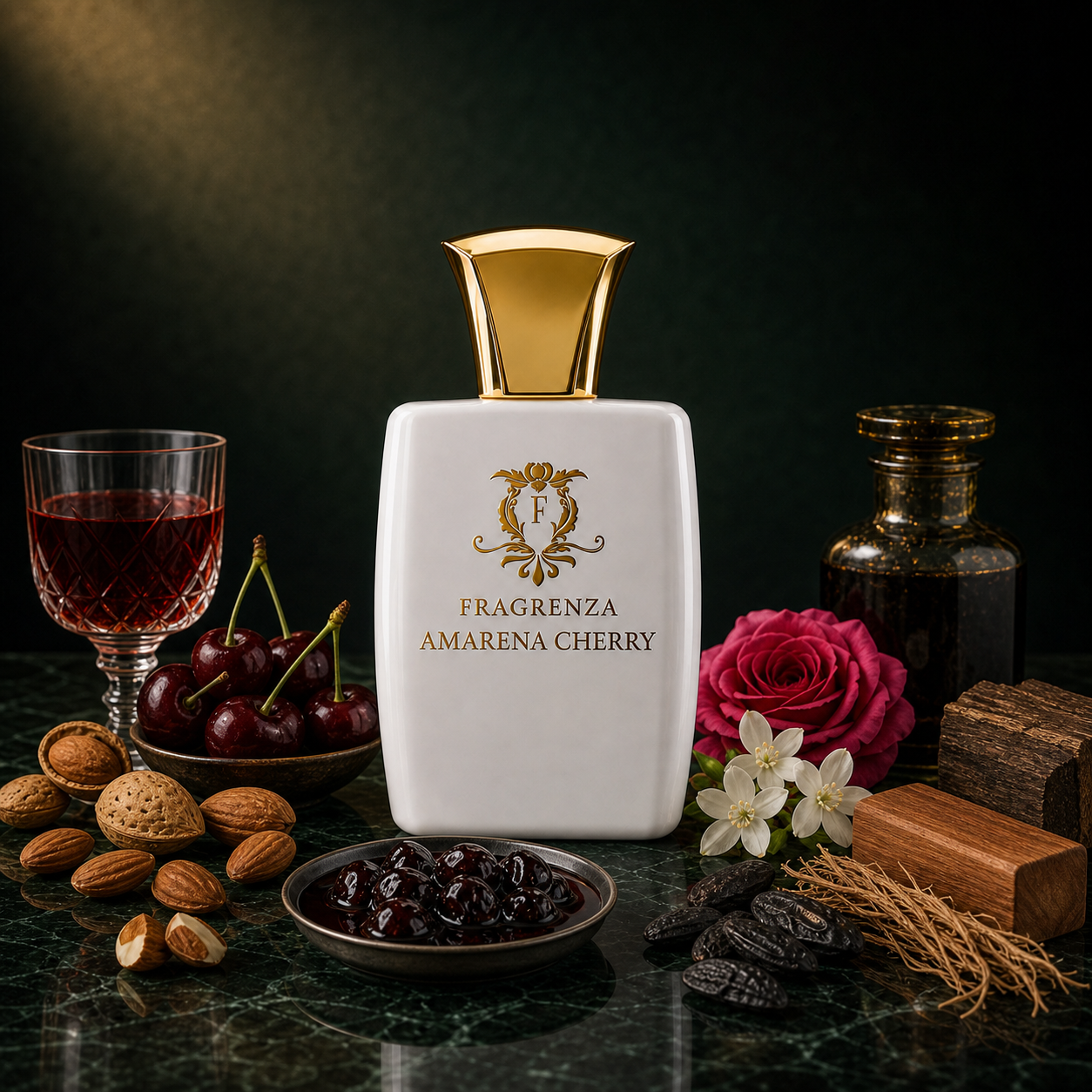

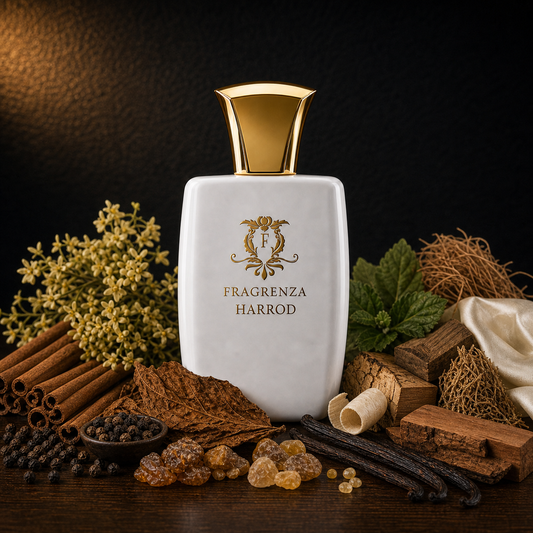


Savory Gourmand and Burnt Sweet: The 2026 Guide to Dark-Sweet Perfumery
The third wave past Mugler's 1992 Angel finds its centre at the singed moment of caramelisation, the shadowed instant where sugar meets fire before tipping into bitterness.
By The Fragrenza Team 19 min read
There is a moment in the caramelization of sugar - just past golden, just before bitter - where the smell becomes more interesting than sweetness alone. The aroma carries a shadow, a faint suggestion of fire, a tension between comfort and danger that no purely sweet fragrance can deliver. This is the territory of the savory gourmand: the third wave of perfumery's love affair with edible accords, and the most important development in gourmand fragrance since Thierry Mugler's Angel transformed the category in 1992.
Through 2025 and into 2026, the savory or burnt-sweet register has emerged as the defining direction in serious gourmand perfumery. The cultural critics call it Marshmallow Gothic, soft goth, dark cottagecore. The industry calls it burnt sweet or dark gourmand. What the names share is the recognition that the most compelling moment in gourmand perfumery is no longer the bright sugary opening - it is the shadowed, caramelized, slightly singed moment where sweetness meets smoke. This guide is the complete account of the register, the materials that define it, the seven archetypes that organize the contemporary landscape, and how to wear it well.
For adjacent reads, see the general gourmand fragrances introduction for the bright end of the spectrum, the honey perfumes spoke for the golden-gourmand direction, and the Skin Scents 2.0 pillar for the cleaner contemporary register that sits opposite to this one on the modern fragrance map.
The three waves of gourmand fragrance
Understanding what makes savory gourmand a distinct register requires a brief account of how the broader gourmand genre has evolved.
The first wave (1992 to early 2000s) began with Thierry Mugler's Angel. The first commercially successful gourmand worked by treating sweet, foodlike materials (chocolate, caramel, patchouli, honey) as legitimate perfumery raw materials. The register was abundant, theatrical, almost celebratory. Angel did not whisper; it announced itself across rooms. The wave codified a generation of dessert-adjacent feminines and proved that gourmand was a viable commercial direction.
The second wave (2000s through mid-2010s) refined Angel's vocabulary into something more wearable but also more generic. Soft vanilla, light praline, transparent musks, accessible sweetness. The result was the lingua franca of mass-market perfumery for a decade and a half: pleasant, comforting, universally approachable, and increasingly difficult to distinguish from one bottle to the next.
The third wave - savory gourmand - is a reckoning with the shadow side of all that sweetness. The wave began in the niche and artisanal community around 2018 to 2020, broke through to mainstream awareness in 2024 to 2025, and reached critical mass through 2025 and into 2026 with enough significant releases, enough critical attention, and enough creative coherence across houses to constitute a genuine movement. The defining characteristic: the sweetness is permanently shadowed, permanently at risk of tipping into something darker. The bright gourmand sang in major key. The savory gourmand sings in minor.
What savory gourmand actually means
The defining characteristic of the register is the coexistence of genuine sweetness and genuine darkness, with neither element dominating or domesticating the other. A savory gourmand is not simply a sweet fragrance with a smoke accord added on top - that would be the perfumery equivalent of decorating a cupcake with a skull, applied rather than transformative. What distinguishes the genuine work in this space is integration so thorough that the sweet and dark elements seem to emerge from a single creative vision: the smoke is inside the marshmallow, the darkness is inherent to the sweetness rather than layered above it.
In sensory terms, the wear character runs through a specific sequence. The opening often reads as bright, sometimes deceptively sweet, with citrus and aromatic top notes lifting the composition. Within twenty to forty minutes, the heart darkens. Tobacco, tonka, labdanum, smoke, oud, or birch tar begins to emerge from underneath, transforming the early sweetness into something denser, more textured, more enigmatic. The dry-down resolves on a base that smells less like dessert and more like the warm, slightly smoky aftermath of dessert: caramelized, lived-in, intimate.
The result is the most emotionally complex register in contemporary perfumery. Where the first-wave gourmand was confident and the second-wave was friendly, the third-wave is ambivalent in the way the best art is ambivalent: it holds two truths at once and refuses to resolve them.
The material palette
The materials that define savory gourmand are specific and worth knowing in some detail.
Tonka bean is the structural backbone of nearly every successful composition in the register. Rich in coumarin, tonka delivers an almond-vanilla-hay sweetness that is more complex and less cloying than vanilla alone. In savory gourmand, tonka is often the bridge between the bright top notes and the darker base: it carries sweetness into shadow without breaking continuity.
Smoked vanilla is the signature note of the register. Vanilla accord treated with birch tar, smoke, or campfire accords transforms the most familiar comfort material in perfumery into something edgier. The classical vanilla character is still there - sweet, creamy, warm - but it carries a slight char that completely reframes the wear.
Benzoin is a sweet resinous balsam derived from the Styrax tree. The material delivers caramel-like depth that reads as amber-adjacent but darker. Benzoin appears in nearly every well-built savory gourmand because it provides structural warmth that no synthetic substitute fully replicates.
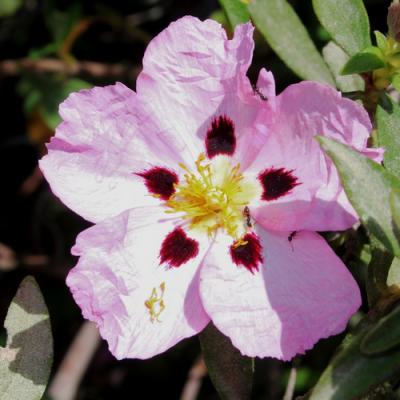
Labdanum is the great cistus-derived resin of classical perfumery. Sweet, amber-tinted, slightly animalic, with a leather-skin quality that roots gourmand sweetness in something carnal and earthy. Labdanum is the material that prevents savory gourmand from feeling like dessert - it brings the wear back to the body.
Tobacco absolute and tobacco blossom both contribute the dried-leaf, slightly honeyed, slightly smoky character that defines the most successful evening compositions in the register. Tobacco materials interact dynamically with vanilla and tonka, creating the unmistakable tobacco-vanille profile that has become a major commercial direction.
Coffee ranges from a roasted-bean clarity at low concentration to a dense burnt-espresso character at higher dosages. The material adds a savory sophistication that lifts gourmand sweetness off the dessert register and into something more grown-up.
Saffron contributes a leathery, slightly medicinal, golden-spiced character. The material is expensive and used sparingly, but it transforms compositions in ways nothing else can; saffron in a gourmand context reads as luxe-adjacent, ceremonial, slightly Eastern.
Birch tar and oud appear as the more confrontational elements of the palette. Birch tar with its intense smokiness and tarry depth, oud with its complex range from incense to leather to the edge of something burning. Neither is comfortable material, and their presence in a gourmand context creates the productive tension that defines the genre at its best.
Caramelized notes (ethyl maltol handled with restraint, burnt-sugar accords, treacle, molasses) supply the literal burnt-sweet effect. The trick is to use them sparingly enough that they suggest caramelization rather than declare it.
The seven archetypes of savory gourmand
The contemporary register organizes around seven distinct archetypes. Each can stand alone, and the most ambitious wearers will build a small wardrobe across multiple archetypes for occasion and mood variation.
1. Tobacco-vanille
The most commercially successful archetype, defined by a tobacco accord woven through vanilla, tonka, and warm woody base. The wear opens slightly bright, develops into the unmistakable tobacco-vanille interplay through the heart, and resolves on a warm woody dry-down that reads as dignified and slightly nostalgic. Excellent for evening contexts, cool-weather wear, and any occasion where a sophisticated warmth is the right register.
The Fragrenza pick:
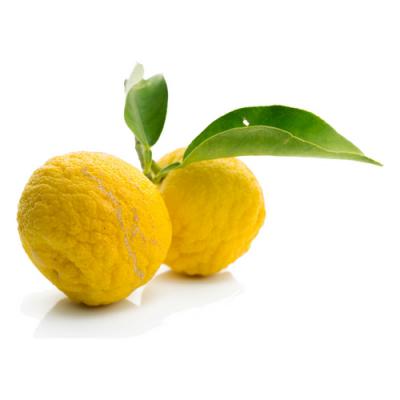
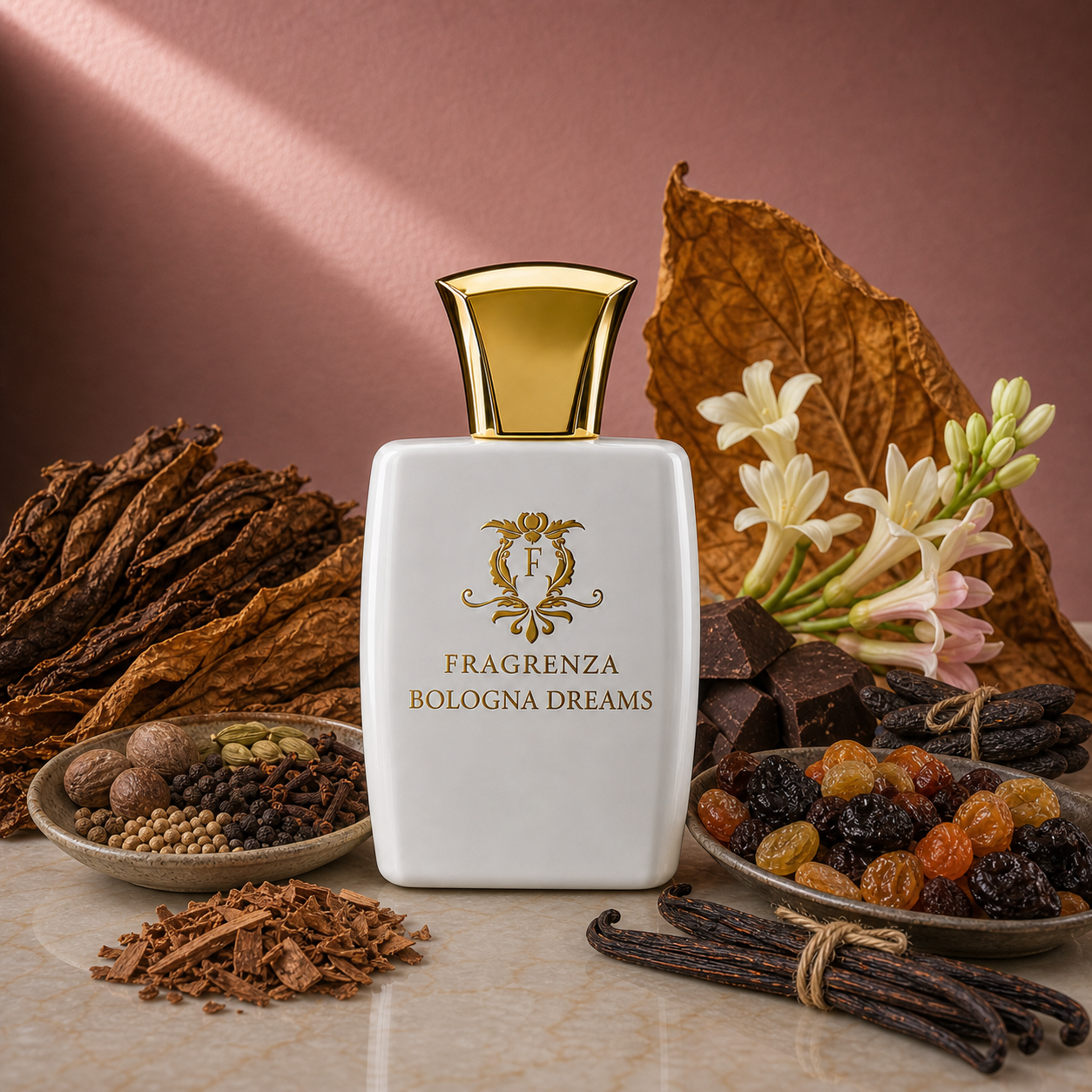
is the canonical clean-handle tobacco-vanille in the line. Lantana, coriander, mandarin, and yuzu open with green-citrus brightness; the heart unfolds rich tobacco leaf and tobacco blossom alongside tonka, saffron, water lily, and cinnamon; the base resolves on cocoa, vanilla, amber, nagarmotha, musk, sandalwood, and vetiver. The wear reads as a slow-burning, deeply textured tobacco-vanille that holds the register's emotional ambivalence beautifully.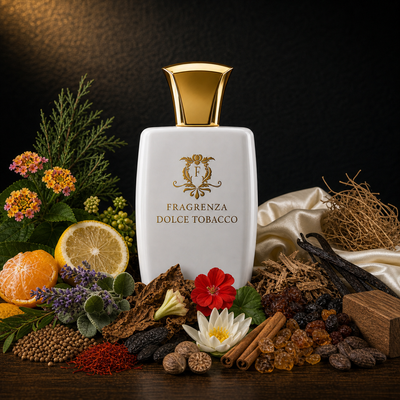
2. Saffron-spiced tobacco
A richer, more golden variation on the tobacco-vanille archetype. Saffron and cinnamon enter the composition prominently, often alongside oud, and the result is a register that leans Eastern-luxurious rather than European-romantic. The wear is more ambitious and more occasion-specific than tobacco-vanille; it rewards evening contexts and formal settings.
The Fragrenza pick:
opens with saffron, cinnamon, incense, nutmeg, pear, apple, and oud; the heart works patchouli and jasmine into the spiced foundation; the base resolves on tobacco leaf, amber, woody notes, vetiver, vanilla, and white musk. The composition demonstrates how saffron transforms tobacco from a casual evening register into something genuinely ceremonial.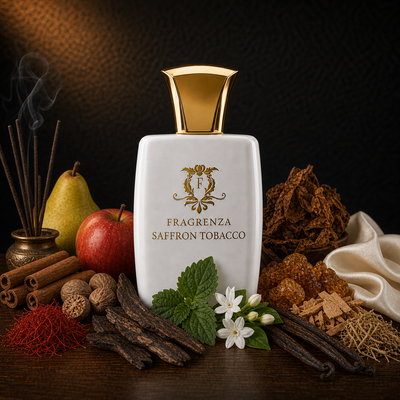
3. Caramel-oud
The archetype that most directly embodies the burnt-sweet idea. Caramel handled at the point where sweetness tips toward bitter, with oud providing the dark counter-weight that prevents the composition from reading as dessert. The wear is gourmand at the core but anchored in something carnal; the result is one of the most distinctive directions in the contemporary register.
The Fragrenza pick:
opens with bergamot and pink pepper, builds a heart of ylang-ylang, jasmine, tuberose, lily of the valley, honey, and paradisone, and resolves on a base of smoky oud, luscious caramel, creamy vanilla, and milky notes. The wear is unmistakably caramel-oud while remaining wearable in a way the more confrontational examples of the archetype do not always achieve.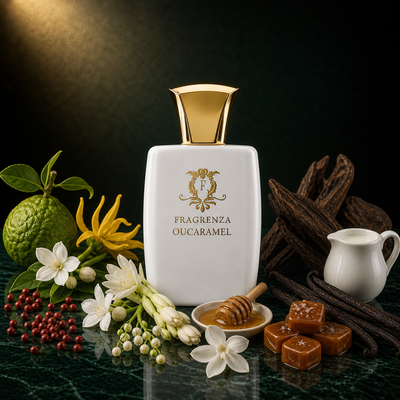
4. Smoky-sweet woods
An adjacent archetype where the burnt-sweet idea is anchored in smoky woods rather than in caramelization specifically. Incense, labdanum, oud, patchouli, and sandalwood combined with sweet anchors (honey, vanilla, crystallized sugar) produce a wear that reads as deeply tactile, slightly ceremonial, often unisex. The register is among the most age-appropriate and gender-flexible in the savory gourmand family.
The Fragrenza pick:
opens with bergamot, oregano, and pepper; the heart unfolds crystallized sugar dissolving into labdanum, opoponax, and incense; the base resolves on patchouli, sandalwood, vanilla, oud, and leather. The composition demonstrates how smoke and sweetness can coexist as a single integrated character rather than as competing registers.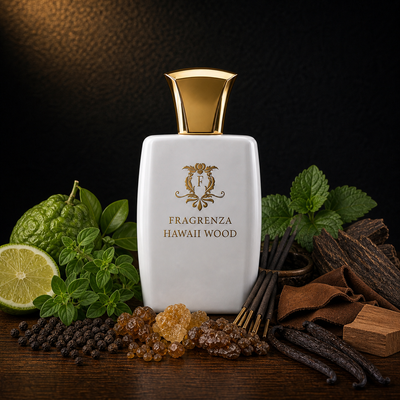
5. Coffee-tonka dark
The most contemporary of the seven archetypes, anchored in coffee absolute or coffee-bean accord paired with tonka and dark gourmand materials. The wear leans modern and slightly minimalist within the register; less Eastern-luxurious than saffron-tobacco, less carnal than caramel-oud. The archetype overlaps with the Skin Scents 2.0 register at its lightest end and with the burnt-sugar archetype at its denser end.
The Fragrenza pick:
sits between savory gourmand and Skin Scents 2.0. Black currant and pink pepper open the composition, iris and orange blossom build the heart alongside coffee and jasmine, and a base of patchouli, tonka, vanilla, cedar, and dark chocolate provides the savory gourmand anchor. The wear reads as the modern minimalist face of the third-wave register.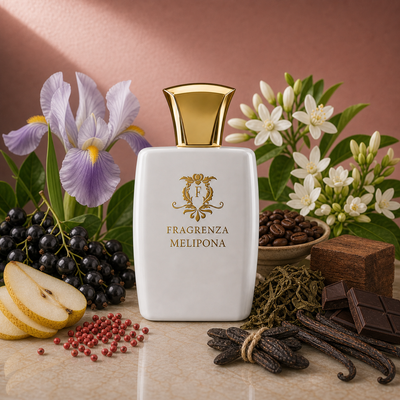
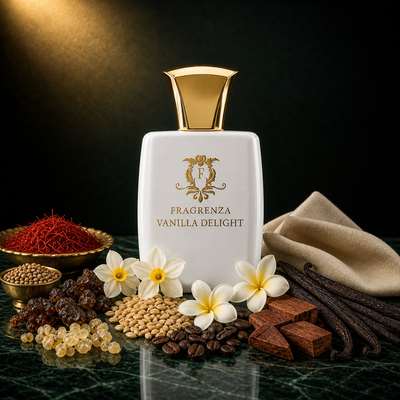
6. Burnt-vanilla suede
The archetype that most directly captures the caramelized moment. Vanilla treated dark, with saffron, myrrh, and coffee accents, anchored on a suede or mahogany base that reads as slightly smoky-leather. The wear is intimate, evening-focused, and reads as more polished than the more confrontational archetypes in the family.
The Fragrenza pick:
7. Burnt-saffron sugar
The most boldly statement-driven archetype in the family. Saffron used at higher concentrations alongside burnt-sugar accords and a dense base of musks and woods. The wear is unmistakable and projection-forward, the natural choice for wearers who want their savory gourmand to declare rather than whisper.
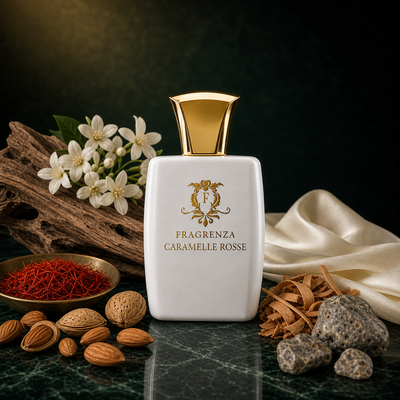
The Fragrenza pick:
How savory gourmand wears on skin
The wear pattern of the register is specific and worth understanding before committing to a bottle.
The first thirty minutes can be misleading. Most savory gourmands open brighter and sweeter than the dry-down. If you judge the composition on the opening, you will miss the wear that you will actually carry for most of the day. Give any savory gourmand at least two hours before deciding whether it works on you - ideally four. The dry-down is the wear.
Skin chemistry amplifies the savory side. The register interacts strongly with individual skin chemistry, and wearers with warmer or oilier skin tend to amplify the savory and smoky elements while wearers with cooler or drier skin amplify the sweet elements. The same composition can read substantially different across two wearers, and the difference is more pronounced than in most other fragrance families. See the deep-dive on skin chemistry and fragrance for the full account.
Projection and longevity are usually high. The dense base materials (labdanum, benzoin, oud, tobacco absolute) are tenacious. Most well-built savory gourmands wear eight to twelve hours on skin, and the projection is enough to register in a room without dominating it. Apply less than you would for a transparent fragrance; one to two sprays is typically enough.
When to wear savory gourmand
The register is emphatically an evening one - not because it cannot be worn in daylight, but because its emotional temperature is most at home after dark. The contrast between interior warmth and exterior cool is when the composition's alchemy reads most clearly, and the wear's slight ambivalence is most expressive in low-light settings where comfort and shadow can coexist naturally.
Cool weather is the natural seasonal home. The denser materials project less aggressively in cold air and develop more slowly, which lets the wear unfold without becoming heavy. Hot weather is the harder context for the register; the sweetness can read as cloying in heat, and the smoke can feel inappropriate. Most wearers reserve savory gourmand for fall, winter, and the cooler shoulder weeks of spring and autumn.
For occasion, the register is ideal for dinners, theater and music performance, evening events with intimate proportions, and quiet domestic settings (reading, working at home, slow Sunday mornings in cold weather). It is less suited to high-energy daytime contexts, formal professional settings, or summer occasions.
For wearers building a savory gourmand presence in a broader fragrance wardrobe, a single high-quality pick in the register is enough; the wear pattern is distinctive and recognizable enough that two wearings per week is plenty.
How to layer savory gourmand
The register layers well with a small number of partners and poorly with most others. Three patterns work consistently.
Savory gourmand over a clean musk skin scent. Apply a transparent clean musk broadly across the chest, neck, and inner arms, then add a single spray of the savory gourmand to one pulse point. The musk softens the projection of the gourmand into the body's immediate radius, and the gourmand adds the characterful focal voice that pure musk cannot supply. For the full technique, see how to layer skin scents with vanilla, oud, or florals.
Two savory gourmands of contrasting archetypes. A tobacco-vanille on the chest and a caramel-oud on a pulse point produces a layered effect that combines both registers without losing the savory character. The combination is among the most rewarding in the broader layering vocabulary.
Savory gourmand under a single bright top. Apply the gourmand broadly and add a single spray of a bright citrus or aromatic to one pulse point. The bright top reads in the opening and fades over the first hour; the gourmand carries the wear through the rest of the day. The technique is useful for daytime wear of evening-leaning compositions.
What does not work: layering two heavy projecting fragrances, layering savory gourmand with a strong floral, or applying multiple sprays of any gourmand in the family. The register is dense enough that less is consistently more.
The Marshmallow Gothic connection
The savory gourmand register did not emerge in a cultural vacuum. Its timing corresponds closely with the wider aesthetic movement that has been variously described as Marshmallow Gothic, dark cottagecore, and soft goth - an aesthetic that embraces the coexistence of the cosy and the slightly sinister, the candlelit and the shadowed. This is the visual and emotional vocabulary of the witch's kitchen, of the cottage in the woods where extraordinary comfort coexists with something faintly uncanny.
Marshmallow Gothic functions as the consumer-facing name for what perfumers and critics call burnt sweet. The terms point at the same thing: a sweetness that holds its shadow side as an integral component rather than as a contradiction. The tension is not rhetorical but genuine, and the best work in the category inhabits both registers simultaneously. The smoke is inside the marshmallow.
The trend's roots run through the broader creative restlessness in the niche community over the past several years. As the clean and airy gourmand end of the market became increasingly crowded, a significant number of perfumers began exploring what happened when sweetness was passed through smoke, incense, or a dark resinous base that transformed its character without erasing it. The results were initially confined to the rarefied corners of the niche world. By 2025 they had broken into prestige; by 2026 they have reached mainstream awareness. The fragrance audience that has grown bored with universally approachable comfort now has a register that meets them where their taste has moved.
Heritage houses have engaged with the territory with somewhat more commercial caution than the niche community, but the more adventurous releases from several major maisons in early 2026 show clear evidence of Marshmallow Gothic influence. The willingness to push sweetness into darker registers, to allow the dry-down to reveal something not immediately apparent in the opening - this is the direction prestige perfumery is moving in, and the savory gourmand wave is its leading edge.
Building a savory gourmand wardrobe
A minimum viable savory gourmand wardrobe needs three pieces from contrasting archetypes. One tobacco-vanille for the most universally appropriate occasion register. One smoky-sweet wood for unisex versatility and day-evening range. One caramel-oud or burnt-vanilla suede for nights where the wear should declare a clear point of view. Add a single bright skin-scent base for layering, and you have a savory gourmand presence that covers nearly every cool-weather evening context worth dressing for.
For wearers building deeper into the register, a fourth bottle from the saffron-spiced tobacco or burnt-saffron sugar archetypes extends the range into more ceremonial and statement-forward territory. Most serious wearers stop at five pieces from the family; the register is distinctive enough that diminishing returns set in past that point.
Related reads
- Gourmand Fragrances: The Bright End of the Spectrum
- Honey Perfumes: The Golden Gourmand Trend of 2026
- Skin Scents 2.0: The Opposite Register
- How to Layer Skin Scents With Vanilla, Oud, or Florals
- Why Fragrance Smells Different on Different People
- How to Build a Fragrance Wardrobe
- The Layering Guide
- Vanilla in Perfumery (Educational Pillar)
FAQ
What is the difference between savory gourmand and regular gourmand?
Regular gourmand fragrances foreground sweetness as the dominant register - vanilla, caramel, praline, chocolate handled to feel comforting and abundant. Savory gourmand uses the same edible vocabulary but introduces smoke, tobacco, oud, labdanum, or birch tar as integrated structural elements rather than as decorative additions. The result is a wear that retains the gourmand character but anchors it in something darker and more emotionally complex. The dry-down is where the difference is most apparent: regular gourmand finishes sweet; savory gourmand finishes shadowed.
Is Marshmallow Gothic the same as savory gourmand?
Yes, with slightly different emphasis. Savory gourmand or burnt sweet are the industry terms for the register; Marshmallow Gothic is the consumer-facing aesthetic name that captures the broader cultural moment the perfumery is part of. The terms refer to the same olfactory direction. Marshmallow Gothic foregrounds the aesthetic and cultural framing (dark cottagecore, soft goth, witch's kitchen); savory gourmand foregrounds the material-and-technique framing. Most wearers can use the terms interchangeably without losing meaning.
Can men wear savory gourmand fragrances?
Yes, and several archetypes within the register are explicitly masculine-coded or unisex. Tobacco-vanille, saffron-spiced tobacco, smoky-sweet woods, and the burnt-vanilla suede archetypes all work well on men. The dense, smoky, animalic facets of the register pair naturally with the kind of compositions traditionally read as masculine, and the third wave of gourmand has largely broken the gender associations that the first and second waves carried.
Is savory gourmand appropriate for the office?
Generally no. The register is dense, projecting, and emotionally evocative in ways that read as out of place in most professional settings. The smoke and tobacco elements particularly can feel intrusive in shared workspaces. For office wear, choose lighter registers (clean musks, soft florals, light woody compositions); save savory gourmand for evening or weekend contexts where the register's emotional ambition is appropriate.
Are savory gourmands too sweet for hot weather?
For most wearers, yes. The dense materials project more aggressively in heat, and the sweetness can read as cloying when warm air does not let the smoke and tobacco anchors develop properly. The register is at its best in fall, winter, and cooler shoulder weeks. Wearers in consistently warm climates can still wear savory gourmand in air-conditioned interior settings, but outdoor wear in summer is generally not the right context for the register.
How long should a good savory gourmand last on skin?
Eight to twelve hours is typical for well-built compositions in the register. The dense base materials (labdanum, benzoin, oud, tobacco absolute, certain musks) are tenacious, and the wear extends naturally as body heat develops over the course of the day. If a savory gourmand fades on you within four hours, the composition is either under-dosed or your skin chemistry is particularly fast - either way, it is worth trying a different pick from the family.
What is the easiest savory gourmand to start with?
For most wearers, a tobacco-vanille or burnt-vanilla suede pick is the most accessible entry point. Both archetypes hold the savory gourmand character while remaining wearable across a wide range of contexts, and the tobacco-vanille register particularly has cultural familiarity (through Tom Ford Tobacco Vanille and adjacent designer references) that makes the wear feel less unfamiliar than the more confrontational archetypes. Start with one of these, wear it through a season, and decide whether to explore deeper into caramel-oud, saffron-spiced tobacco, or the more statement-driven directions from there.
The bottom line
Savory gourmand is the most important development in gourmand fragrance since 1992, and the defining olfactory direction of 2026. The register's emotional ambivalence (comfort that carries shadow, sweetness that holds its dark side) meets a cultural moment that has grown tired of universally approachable comfort and has begun to look for fragrances that match more complex states of mind. The seven archetypes give the contemporary landscape its shape; the material palette gives the register its distinctive character; the wearing patterns reward the wearer who is willing to live with a fragrance through a full day before judging the dry-down.
The shadow side of sweetness has found its moment in 2026. The best savory gourmands no longer apologize for their darkness; they integrate it as a constitutive element of the wear. Step into the dark and smell what is waiting there - the most interesting things in contemporary perfumery are happening at the edges, and the savory gourmand register is where the edges are right now.