

Inspired-by alternative
Best Coco Mademoiselle Dupe
Looking for a Coco Mademoiselle dupe that actually holds up on skin? Pompeii Fantasy mirrors the original's oriental architecture — same notes, same wear, priced where the formulation cost lands rather than where the brand campaign budget does.
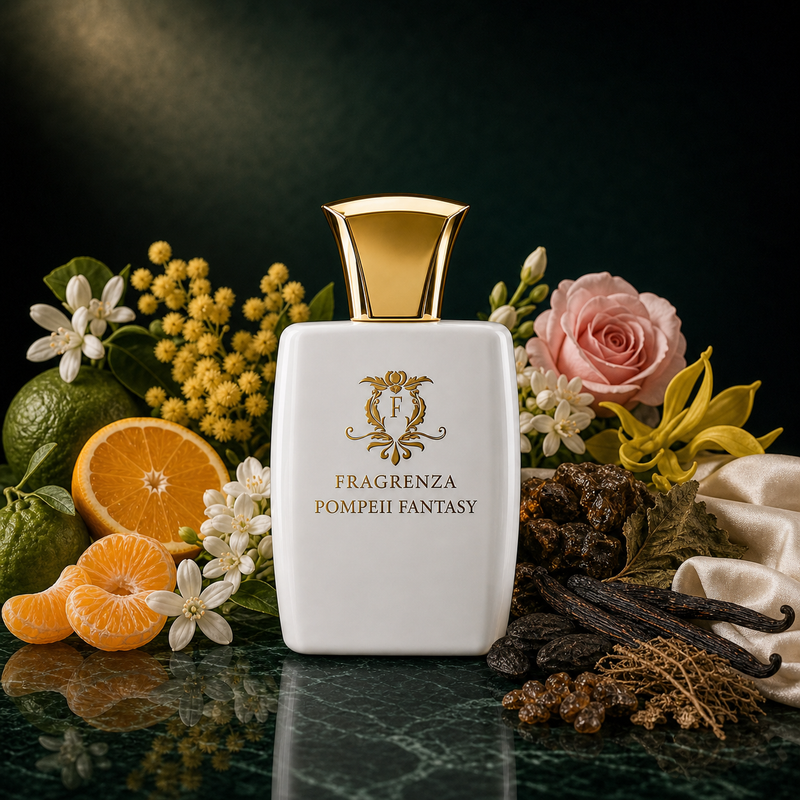
Pompeii Fantasy
A Fragrenza alternative to Chanel's Coco Mademoiselle
Why this dupe
- Faithful to the oriental signature of Coco Mademoiselle — note for note, Pompeii Fantasy is engineered to wear like the original.
- Formulated as Eau de Parfum at a concentration most designer houses reserve for their top tier — 8+ hours on skin, projection people compliment.
- Vegan and cruelty-free, paraben-free, hypoallergenic. The juice is the work; nothing's added that doesn't belong.
- 52% off Chanel's retail price. No celebrity endorsement deals, no department-store fees, no retail middlemen — just the formulation.
- Trusted by 558+ customers (4.6★) — full reviews on the product page.
About Coco Mademoiselle
Coco Mademoiselle is a richly layered perfume for women from Chanel that draws you in with the warm, spiced opening of bergamot and mandarin. The oriental heart unfolds around jasmine, adding depth and unmistakable sensuality. The dry-down rests on a base of opoponax — dense, enveloping, built to linger.
On skin, Coco Mademoiselle typically delivers excellent longevity (8+ hours) with strong sillage that projects across a room. The price point — $105 at retail — reflects Chanel's positioning, packaging, and distribution overhead more than the cost of the formulation itself.
How to wear it
Pompeii Fantasy is built for evenings, colder months, and occasions where you want to leave a lasting impression. The dry-down develops slowly on skin and rewards close wear.For best longevity, apply to pulse points (wrists, neck, behind the ears) on moisturised skin.
How we matched it
To build Pompeii Fantasy, we reverse-engineered Coco Mademoiselle: cataloguing the oriental architecture, isolating the bergamot top accord, the jasmine heart, the opoponax base. Then we composed our own version using the same ingredient grade most luxury houses work with — just without the layered markups that come after the bottle leaves the perfumer's bench.
Where it lands on skin: the same family character, comparable longevity (8+ hours), comparable sillage. Where it might diverge: a few accord choices in the top 30 minutes — fragrance is partly skin chemistry, and no two skins read a scent identically. That's true for Coco Mademoiselle too.
Standard across our line: Eau de Parfum concentration, vegan, cruelty-free, paraben-free. We're a perfumery, not a brand-marketing operation. The bottle costs what the juice costs.
Side by side
The original
Chanel
Coco Mademoiselle
$105
Designer/niche pricing reflects brand positioning, retail markups, and campaign spend — not always the juice itself.
The Fragrenza alternative
Pompeii Fantasy
$49.99
Same oriental character, formulated as Eau de Parfum, vegan and cruelty-free, built to last 8+ hours.
What it costs per spray
Chanel retail
Coco Mademoiselle
$0.18
per spray · ~600 sprays/bottle
Fragrenza
Pompeii Fantasy
$0.08
per spray · ~600 sprays/bottle
A 60ml bottle averages around 600 sprays at 0.1ml apiece. That puts Pompeii Fantasy at roughly $0.08 per spray and Coco Mademoiselle at retail around $0.18 per spray. The atomiser, the volume, the application — identical. The price-per-use is where the brand premium becomes visible.
Multiply that out across a year — three wears a week, two sprays each, around 312 actuations — and you're looking at roughly $25.99 of Pompeii Fantasy versus roughly $54.60 of Coco Mademoiselle at retail. About $28.61 a year saved without changing how often you wear it, how you apply it, or what it smells like on you.
Inside the scent
Inside each note
What you smell, and why. A short profile of every note that defines Coco Mademoiselle's composition — each linking to the wider Fragrenza collection of fragrances built around it.
Top — first impression
Bergamot (Citrus bergamia) is one of perfumery's most beloved and versatile citrus ingredients, grown almost exclusively along the sun-drenched Calabrian coastline of southern Italy. A hybrid believed to descend from the bitter...
The mandarin orange (Citrus reticulata) is the sweetest, most approachable member of the citrus family — a fruit with origins in ancient China, where it was historically reserved for the Imperial court,...
Sweet orange (Citrus sinensis) is one of the most universally beloved and widely used fragrance ingredients in the world. Its scent is the definition of cheerful brightness: sunny, juicy, and vibrantly sweet,...
Orange blossom is the flower of the bitter orange tree, Citrus aurantium, cultivated extensively across the Mediterranean basin — particularly in Morocco, Tunisia, Egypt, and southern Spain. The flowers are harvested by...
Heart — the character
Among all the ingredients in the perfumer's palette, jasmine stands apart as the undisputed queen of florals. Cultivated across India, Egypt, Morocco, and the Grasse region of southern France, jasmine flowers have...
Mimosa in perfumery refers primarily to Acacia dealbata, a silver wattle tree native to southeastern Australia that has become naturalised across the Mediterranean coast of France and Italy — particularly in the...
Rose is the undisputed queen of perfumery — a note so ancient, so complex, and so universally beloved that its history mirrors the history of fragrance itself. The two most important varieties...
Ylang-ylang is among the most intoxicating florals in the perfumer's palette — a tropical bloom of extraordinary richness and complexity that has been central to fine fragrance for well over a century....
Base — the dry-down
Opoponax — sometimes called sweet myrrh — is an ancient aromatic resin obtained from Commiphora guidottii, a tree native to the Horn of Africa and the Arabian Peninsula. One of the oldest...
Patchouli, Pogostemon cablin, is one of the most iconic and consequential ingredients in the history of perfumery. Native to tropical Asia — primarily the Philippines, Indonesia, and India — this aromatic herb...
Tonka bean is the seed of the Dipteryx odorata tree, a leguminous giant native to Venezuela, Brazil, and the wider tropical Americas. The seeds are harvested when ripe, then dried or macerated...
Vanilla (Vanilla planifolia) is native to Mexico, where the Totonac people first cultivated it long before Spanish explorers brought it to Europe in the sixteenth century. The vanilla orchid's seed pods —...
Vetiver is one of perfumery's great foundational ingredients — a note with deep roots, both literally and figuratively. Distilled from the sprawling root system of the Vetiveria zizanioides grass, primarily grown in...
White musk is one of perfumery's most essential and versatile ingredients — a family of synthetic aromatic compounds developed in the 20th century as an ethical and sustainable alternative to animal-derived musks....
Frequently asked questions
Is Pompeii Fantasy really a dupe of Coco Mademoiselle?
How long does Pompeii Fantasy last on skin?
Is it suitable for women?
What occasions is Coco Mademoiselle best for?
Why is Coco Mademoiselle so expensive?
Is Pompeii Fantasy vegan and cruelty-free?
What's your return policy?
Skip the gamble — try a sample
Fragrance is personal. Start with the 5ml ($9.99) and decide on your own skin before committing to the full bottle. Most customers do.
View Pompeii Fantasy