

Inspired-by alternative
Best Costa Azzurra Dupe
Costa Azzurra by Tom Ford costs $195 at retail. Azure Coast delivers the same aromatic structure top to base, formulated as Eau de Parfum and built to last 8+ hours.
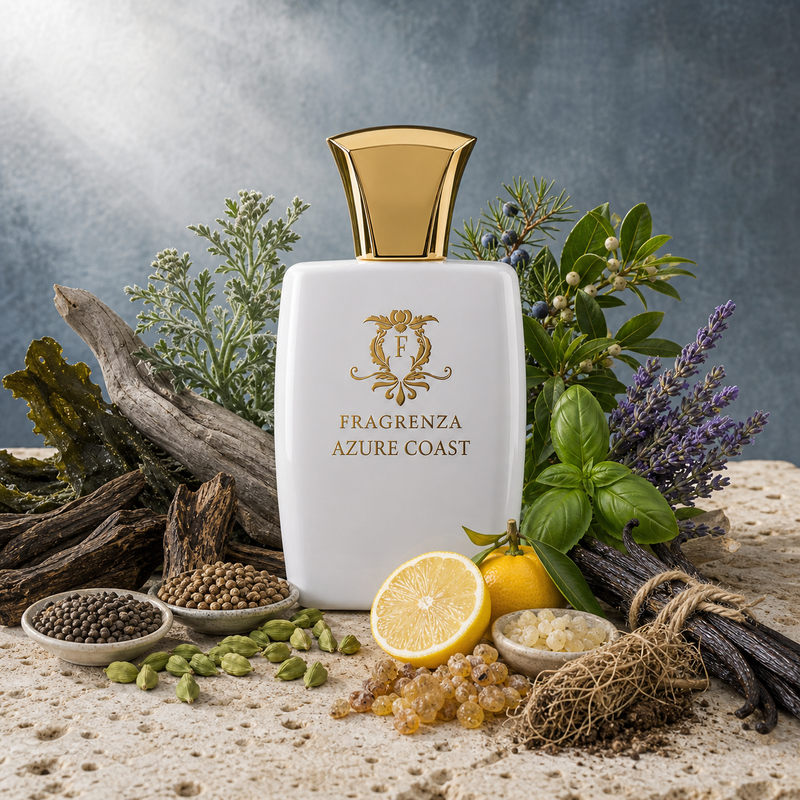
Azure Coast
A Fragrenza alternative to Tom Ford's Costa Azzurra
Why this dupe
- Built around Costa Azzurra's exact note progression — the kelp opening, mugwort heart, and mastic resin dry-down all map to the original.
- Higher fragrance-oil concentration than most designer EdPs — translates to projection that holds through a workday and a dry-down that's still wearing the next morning.
- 100% vegan, cruelty-free, paraben-free. We sourced clean ingredients because the modern fragrance shopper expects it.
- About 64% less than the Tom Ford list price — same scent, none of the prestige markup baked into the bottle.
- 5.0★ across 1 verified Fragrenza reviews — see what real customers say on the product page.
About Costa Azzurra
Costa Azzurra is a fresh, herb-forward fragrance from Tom Ford with an opening built around kelp and driftwood. The aromatic heart centers on mugwort, tying the composition together with clean, confident energy. The dry-down fades into a soft, lasting base of mastic resin.
On skin, Costa Azzurra typically delivers solid longevity (6–8 hours) with moderate sillage — noticeable in close quarters. The price point — $195 at retail — reflects Tom Ford's positioning, packaging, and distribution overhead more than the cost of the formulation itself.
How to wear it
Clean, fresh, and broadly appealing, Azure Coast works well across most settings — work, travel, casual social. Reads as fresh without being generic.For best longevity, apply to pulse points (wrists, neck, behind the ears) on moisturised skin.
How we matched it
Azure Coast starts from Costa Azzurra's actual composition: a kelp-led opening, a heart anchored by mugwort, and a mastic resin foundation. We rebuild that arc with high-quality aroma compounds chosen for fidelity, not flash — the goal is wearing the same scent, not approximating it.
The honest disclosure: this is an interpretation, not a chemical clone. The first 30 minutes — when top notes do their volatile work — can read slightly differently. Once the heart settles and the base develops, the two scents converge. Most customers can't reliably tell them apart on a side-by-side wear test after the first hour.
Formulated in-house as Eau de Parfum, vegan, cruelty-free, paraben-free. We don't pay for celebrity campaigns or retail-store distribution, so the price reflects the formulation cost — not someone else's marketing budget.
Side by side
The original
Tom Ford
Costa Azzurra
$195
Designer/niche pricing reflects brand positioning, retail markups, and campaign spend — not always the juice itself.
The Fragrenza alternative
Azure Coast
$69.99
Same aromatic character, formulated as Eau de Parfum, vegan and cruelty-free, built to last 8+ hours.
What it costs per spray
Tom Ford retail
Costa Azzurra
$0.33
per spray · ~600 sprays/bottle
Fragrenza
Azure Coast
$0.11
per spray · ~600 sprays/bottle
Per-spray pricing is the more honest comparison than sticker price alone. Most 60ml fragrances deliver ~600 sprays from a standard atomiser. Azure Coast prices out at roughly $0.11 a spray; Costa Azzurra at retail runs about $0.33 a spray. Same juice volume, same actuation — the gap is what designer positioning costs the buyer.
Stretch that across a year of regular wear (3× weekly, 2 sprays per wear, ≈312 sprays annually) and the math gets concrete: about $36.39 for Azure Coast versus roughly $101.40 for Costa Azzurra at retail. The ~$65.01 gap is what designer pricing recovers for marketing, retail margins, and brand operations — not for the juice.
Inside the scent
Inside each note
Every fragrance is the sum of its parts. Here's what each ingredient contributes to Costa Azzurra's aromatic character — with links to explore other Fragrenza scents that feature the same notes.
Top — first impression
Kelp is one of perfumery's most distinctive and unusual marine notes — an ingredient that captures the raw, briny atmosphere of the ocean's edge with remarkable authenticity. Derived from the vast underwater...
Driftwood carries the memory of a long journey — timber that has been bleached by salt water, dried by wind, and worn smooth by time before arriving on a shore far from...
Oud — also known as agarwood, aloeswood, or oudh — is one of the most extraordinary and expensive natural materials used in perfumery. It is formed in the heartwood of Aquilaria trees,...
Ambrettolide is a macrocyclic musk molecule that has earned a distinguished place in fine perfumery for its clean, sophisticated, and remarkably skin-flattering character. Belonging to the family of macrocyclic musks — molecules...
Celosia, commonly called cockscomb for the distinctive velvety, brain-like shape of its flower heads, is a vibrant annual plant cultivated across tropical Asia, Africa, and the Americas. Its blooms — which range...
Cardamom is one of the world's most ancient and prized spices, cultivated primarily in the lush hills of southern India, Guatemala, and Sri Lanka. Botanically known as Elettaria cardamomum, it is a...
Heart — the character
Mugwort (Artemisia vulgaris) is one of perfumery's most intriguing and underappreciated herbal ingredients — a wild plant of ancient lineage with an olfactory profile that is simultaneously familiar and deeply distinctive. Used...
Juniper berries are the female seed cones of Juniperus communis, a hardy evergreen shrub found across the Northern Hemisphere from North America and Europe to the Himalayas. These small, dark blue-black berries...
Myrtle — Myrtus communis — is one of the Mediterranean's most storied aromatic plants, cultivated for millennia across Greece, Italy, North Africa, and the Middle East. Sacred to Aphrodite in ancient Greek...
Basil (Ocimum basilicum) is one of the world's most universally loved culinary herbs, and in perfumery it translates into a note of vivid, aromatic freshness with a pleasingly complex character. Originally native...
Lavender (Lavandula angustifolia) is perhaps the single most iconic ingredient in the entire history of perfumery. Native to the sun-drenched hillsides of the Mediterranean basin and cultivated on an enormous scale in...
Lemon (Citrus limon) is one of the most universally recognised and widely used ingredients in the entire history of perfumery. Originally cultivated in South and Southeast Asia and introduced to the Mediterranean...
Hassaku (Citrus hassaku) is a Japanese citrus fruit whose name translates roughly as "the first of August" — traditionally the time of its harvest — though it is enjoyed throughout the winter...
Base — the dry-down
Mastic — known in Greek as mastiha and derived from the resin of the Pistacia lentiscus tree grown almost exclusively on the island of Chios, Greece — is one of the Mediterranean...
Olibanum, more commonly known as frankincense, is one of the world's oldest and most revered aromatic resins. Harvested from the Boswellia tree — native to the arid regions of Somalia, Oman, Ethiopia,...
Vetiver is one of perfumery's great foundational ingredients — a note with deep roots, both literally and figuratively. Distilled from the sprawling root system of the Vetiveria zizanioides grass, primarily grown in...
Vanilla (Vanilla planifolia) is native to Mexico, where the Totonac people first cultivated it long before Spanish explorers brought it to Europe in the sixteenth century. The vanilla orchid's seed pods —...
Frequently asked questions
Is Azure Coast really a dupe of Costa Azzurra?
How long does Azure Coast last on skin?
Is it suitable for unisex?
What occasions is Costa Azzurra best for?
Why is Costa Azzurra so expensive?
Is Azure Coast vegan and cruelty-free?
What's your return policy?
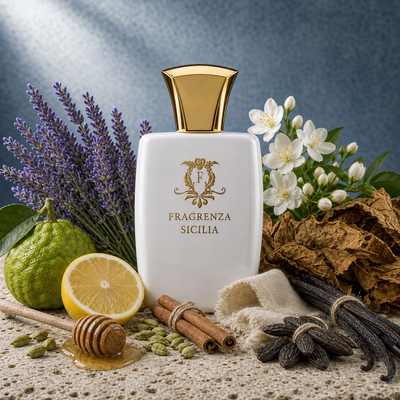
Sample first, full bottle later
The 5ml travel size is $9.99. Spray it for a week. If Azure Coast reads like Costa Azzurra on your skin, the full 60ml is waiting whenever you want it.
View Azure Coast