

Inspired-by alternative
Best Herod Dupe
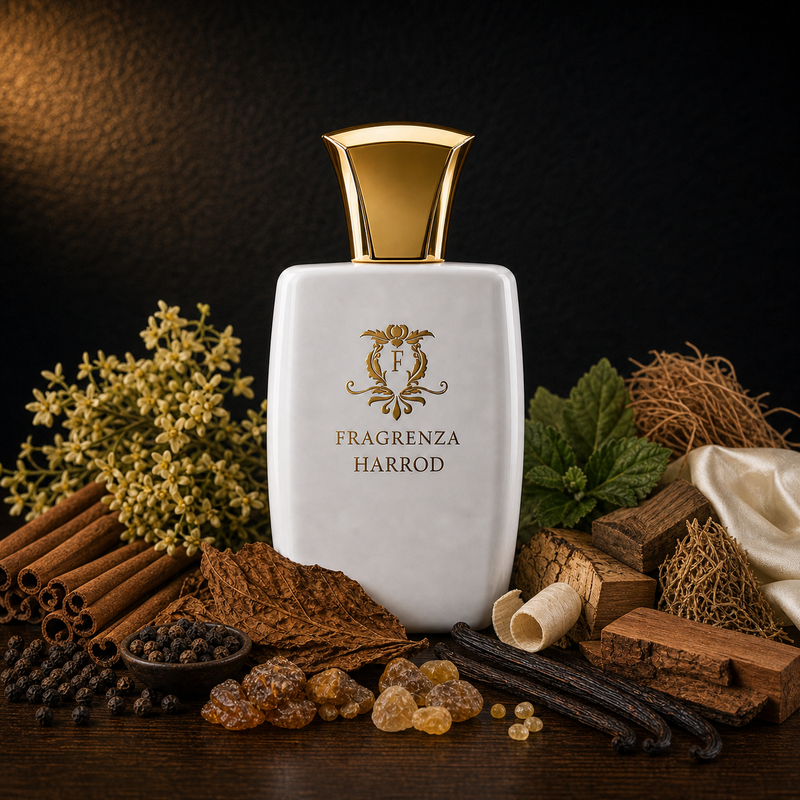
Looking for a Herod dupe that actually holds up on skin? Harrod mirrors the original's woody architecture — same notes, same wear, priced where the formulation cost lands rather than where the brand campaign budget does.
Why this dupe
- Faithful to the woody signature of Herod — note for note, Harrod is engineered to wear like the original.
- Formulated as Eau de Parfum at a concentration most designer houses reserve for their top tier — 8+ hours on skin, projection people compliment.
- Vegan and cruelty-free, paraben-free, hypoallergenic. The juice is the work; nothing's added that doesn't belong.
- 79% off Parfums de Marly's retail price. No celebrity endorsement deals, no department-store fees, no retail middlemen — just the formulation.
- 5.0★ across 1 verified Fragrenza reviews — see what real customers say on the product page.
About Herod
Herod is a grounded, cologne for men from Parfums de Marly that leads with the crisp, open-air freshness of cinnamon and pepper. The heart reveals the rich, resinous character of osmanthus, anchoring the woody signature of the composition. The dry-down settles into a smooth, enduring base of vanilla — built for substance that lasts.
On skin, Herod typically delivers excellent longevity (8+ hours) with strong sillage that projects across a room. The price point — $330 at retail — reflects Parfums de Marly's positioning, packaging, and distribution overhead more than the cost of the formulation itself.
How to wear it
Harrod fits cooler weather, casual-smart settings, and evening wear naturally. The woody base gives it staying power without being heavy.For best longevity, apply to pulse points (wrists, neck, behind the ears) on moisturised skin.
How we matched it
To build Harrod, we reverse-engineered Herod: cataloguing the woody architecture, isolating the cinnamon top accord, the osmanthus heart, the vanilla base. Then we composed our own version using the same ingredient grade most luxury houses work with — just without the layered markups that come after the bottle leaves the perfumer's bench.
Where it lands on skin: the same family character, comparable longevity (8+ hours), comparable sillage. Where it might diverge: a few accord choices in the top 30 minutes — fragrance is partly skin chemistry, and no two skins read a scent identically. That's true for Herod too.
Standard across our line: Eau de Parfum concentration, vegan, cruelty-free, paraben-free. We're a perfumery, not a brand-marketing operation. The bottle costs what the juice costs.
Side by side
The original
Parfums de Marly
Herod
$330
Designer/niche pricing reflects brand positioning, retail markups, and campaign spend — not always the juice itself.
The Fragrenza alternative
Harrod
$69.99
Same woody character, formulated as Eau de Parfum, vegan and cruelty-free, built to last 8+ hours.
What it costs per spray
Parfums de Marly retail
Herod
$0.55
per spray · ~600 sprays/bottle
Fragrenza
Harrod
$0.11
per spray · ~600 sprays/bottle
A 60ml bottle averages around 600 sprays at 0.1ml apiece. That puts Harrod at roughly $0.11 per spray and Herod at retail around $0.55 per spray. The atomiser, the volume, the application — identical. The price-per-use is where the brand premium becomes visible.
Multiply that out across a year — three wears a week, two sprays each, around 312 actuations — and you're looking at roughly $36.39 of Harrod versus roughly $171.60 of Herod at retail. About $135.21 a year saved without changing how often you wear it, how you apply it, or what it smells like on you.
Inside the scent
Inside each note
What you smell, and why. A short profile of every note that defines Herod's composition — each linking to the wider Fragrenza collection of fragrances built around it.
Top — first impression
Cinnamon is one of the most beloved spices in the world, harvested from the inner bark of Cinnamomum verum and related species cultivated across Sri Lanka, India, and Southeast Asia. Its warm,...
Black pepper (Piper nigrum) is one of humanity's oldest and most traded spices, native to the Malabar Coast of India and cultivated across tropical Asia for over four thousand years. The dried...
Heart — the character
Osmanthus (Osmanthus fragrans) is a flowering shrub native to Asia — particularly China, Japan, and the Himalayas — whose tiny, inconspicuous blossoms produce one of the most intoxicating and complex scents in...
Tobacco leaf is one of fragrance's most nuanced and multi-dimensional natural ingredients — a note that captures the full aromatic journey of the tobacco plant from field to curing barn. Unlike the...
Olibanum, more commonly known as frankincense, is one of the world's oldest and most revered aromatic resins. Harvested from the Boswellia tree — native to the arid regions of Somalia, Oman, Ethiopia,...
Labdanum is one of perfumery's oldest and most beloved raw materials, derived from the sticky resin of the Cistus ladanifer shrub native to the Mediterranean basin — particularly the sun-scorched hillsides of...
Base — the dry-down
Vanilla (Vanilla planifolia) is native to Mexico, where the Totonac people first cultivated it long before Spanish explorers brought it to Europe in the sixteenth century. The vanilla orchid's seed pods —...
The woody fragrance family is one of perfumery's most expansive and enduring categories, encompassing a rich spectrum of materials drawn from the world's most aromatic trees. At its heart, woody fragrances are...
Atlas cedar — Cedrus atlantica — grows in the rugged mountain ranges of Morocco and Algeria, where it has been harvested for centuries for its beautifully aromatic wood. The essential oil derived...
Vetiver is one of perfumery's great foundational ingredients — a note with deep roots, both literally and figuratively. Distilled from the sprawling root system of the Vetiveria zizanioides grass, primarily grown in...
Patchouli, Pogostemon cablin, is one of the most iconic and consequential ingredients in the history of perfumery. Native to tropical Asia — primarily the Philippines, Indonesia, and India — this aromatic herb...
Iso E Super is arguably the most influential synthetic aroma molecule of the modern perfumery era. Developed by IFF (International Flavors and Fragrances) and first introduced in the 1970s, this versatile woody-amber...
Nagarmotha — known botanically as Cyperus scariosus or cypriol — is a sedge grass native to India, where it has been used in Ayurvedic medicine, incense, and traditional perfumery for thousands of...
Musk is one of the oldest and most foundational materials in the history of perfumery. Originally derived from the glandular secretions of the male musk deer of the Himalayas, natural musk has...
Frequently asked questions
Is Harrod really a dupe of Herod?
How long does Harrod last on skin?
Is it suitable for men?
What occasions is Herod best for?
Why is Herod so expensive?
Is Harrod vegan and cruelty-free?
What's your return policy?
Skip the gamble — try a sample
Fragrance is personal. Start with the 5ml ($9.99) and decide on your own skin before committing to the full bottle. Most customers do.
View Harrod