

Inspired-by alternative
Best Fate Man Dupe
Looking for a Fate Man dupe that actually holds up on skin? Pinnacle of Power Man mirrors the original's oriental architecture — same notes, same wear, priced where the formulation cost lands rather than where the brand campaign budget does.
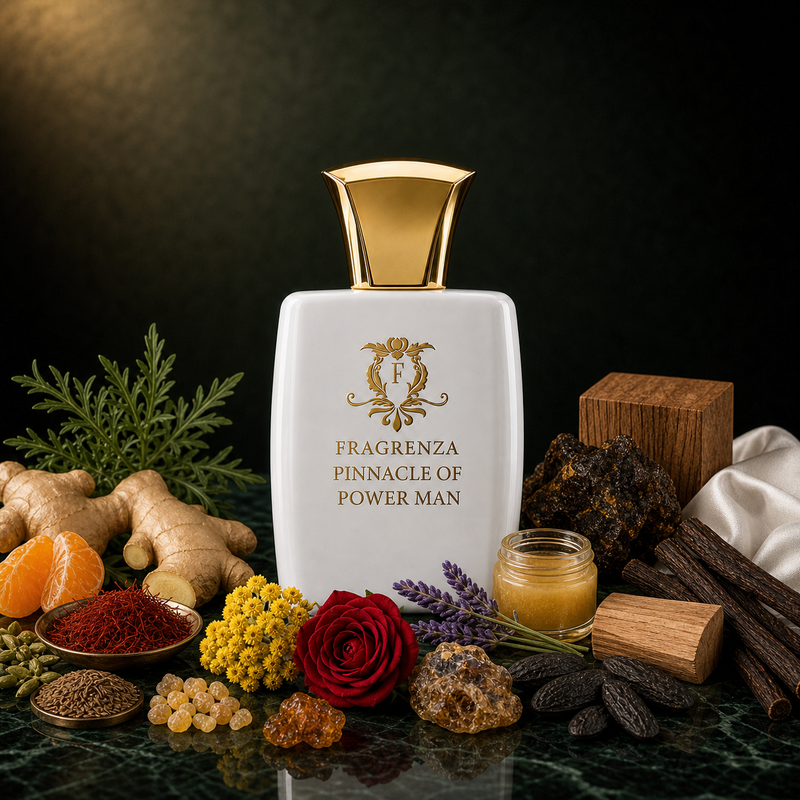
Pinnacle of Power Man
A Fragrenza alternative to Amouage's Fate Man
Why this dupe
- Faithful to the oriental signature of Fate Man — note for note, Pinnacle of Power Man is engineered to wear like the original.
- Formulated as Eau de Parfum at a concentration most designer houses reserve for their top tier — 8+ hours on skin, projection people compliment.
- Vegan and cruelty-free, paraben-free, hypoallergenic. The juice is the work; nothing's added that doesn't belong.
- 81% off Amouage's retail price. No celebrity endorsement deals, no department-store fees, no retail middlemen — just the formulation.
- Trusted by 558+ customers (4.6★) — full reviews on the product page.
About Fate Man
Fate Man is a richly layered cologne for men from Amouage that draws you in with the warm, spiced opening of mandarin and saffron. The oriental heart unfolds around immortelle, adding depth and unmistakable sensuality. The dry-down rests on a base of labdanum — dense, enveloping, built to linger.
On skin, Fate Man typically delivers excellent longevity (8+ hours) with strong sillage that projects across a room. The price point — $360 at retail — reflects Amouage's positioning, packaging, and distribution overhead more than the cost of the formulation itself.
How to wear it
Pinnacle of Power Man is built for evenings, colder months, and occasions where you want to leave a lasting impression. The dry-down develops slowly on skin and rewards close wear.For best longevity, apply to pulse points (wrists, neck, behind the ears) on moisturised skin.
How we matched it
To build Pinnacle of Power Man, we reverse-engineered Fate Man: cataloguing the oriental architecture, isolating the mandarin top accord, the immortelle heart, the labdanum base. Then we composed our own version using the same ingredient grade most luxury houses work with — just without the layered markups that come after the bottle leaves the perfumer's bench.
Where it lands on skin: the same family character, comparable longevity (8+ hours), comparable sillage. Where it might diverge: a few accord choices in the top 30 minutes — fragrance is partly skin chemistry, and no two skins read a scent identically. That's true for Fate Man too.
Standard across our line: Eau de Parfum concentration, vegan, cruelty-free, paraben-free. We're a perfumery, not a brand-marketing operation. The bottle costs what the juice costs.
Side by side
The original
Amouage
Fate Man
$360
Designer/niche pricing reflects brand positioning, retail markups, and campaign spend — not always the juice itself.
The Fragrenza alternative
Pinnacle of Power Man
$69.99
Same oriental character, formulated as Eau de Parfum, vegan and cruelty-free, built to last 8+ hours.
What it costs per spray
Amouage retail
Fate Man
$0.60
per spray · ~600 sprays/bottle
Fragrenza
Pinnacle of Power Man
$0.11
per spray · ~600 sprays/bottle
A 60ml bottle averages around 600 sprays at 0.1ml apiece. That puts Pinnacle of Power Man at roughly $0.11 per spray and Fate Man at retail around $0.60 per spray. The atomiser, the volume, the application — identical. The price-per-use is where the brand premium becomes visible.
Multiply that out across a year — three wears a week, two sprays each, around 312 actuations — and you're looking at roughly $36.39 of Pinnacle of Power Man versus roughly $187.20 of Fate Man at retail. About $150.81 a year saved without changing how often you wear it, how you apply it, or what it smells like on you.
Inside the scent
Inside each note
What you smell, and why. A short profile of every note that defines Fate Man's composition — each linking to the wider Fragrenza collection of fragrances built around it.
Top — first impression
The mandarin orange (Citrus reticulata) is the sweetest, most approachable member of the citrus family — a fruit with origins in ancient China, where it was historically reserved for the Imperial court,...
Saffron — The Most Precious Spice in PerfumerySaffron is the world's most expensive spice by weight, harvested by hand from the stigmas of the Crocus sativus flower in the fields of Iran,...
Absinthe — the infamous spirit distilled from wormwood (Artemisia absinthium), green anise, and fennel — carries one of perfumery's most dramatically distinctive aromatic profiles. The bitter, intensely herbal bite of wormwood is...
Ginger root has been one of humanity's most treasured spices for over five thousand years, originating in the tropical rainforests of Southeast Asia before spreading along ancient trade routes to India, the...
Cumin (Cuminum cyminum) is one of the oldest and most widely used spices in human history, with evidence of cultivation dating back over 4,000 years to ancient Egypt and the Middle East....
Heart — the character
Immortelle — derived from Helichrysum italicum, a sun-loving flowering herb native to the rocky, sun-baked landscapes of the Mediterranean coast, Corsica, Sardinia, and the Balkans — takes its name from the French...
Rose is the undisputed queen of perfumery — a note so ancient, so complex, and so universally beloved that its history mirrors the history of fragrance itself. The two most important varieties...
Olibanum, more commonly known as frankincense, is one of the world's oldest and most revered aromatic resins. Harvested from the Boswellia tree — native to the arid regions of Somalia, Oman, Ethiopia,...
Lavandin is a hybrid lavender — a natural cross between true English lavender (Lavandula angustifolia) and spike lavender (Lavandula latifolia) known botanically as Lavandula x intermedia. Unlike its more delicate parent, lavandin...
Cistus incanus, also known as pink rock rose, is a wild-growing shrub native to the rocky hillsides and garrigue landscapes of the Mediterranean. It is closely related to Cistus ladanifer, the source...
Copahu balm — also known as copaiba oil or balsam of copaiba — is derived from Copaifera officinalis and related species of Copaifera trees native to the tropical forests of South America,...
Base — the dry-down
Labdanum is one of perfumery's oldest and most beloved raw materials, derived from the sticky resin of the Cistus ladanifer shrub native to the Mediterranean basin — particularly the sun-scorched hillsides of...
Cedarwood is one of the most widely used and universally loved ingredients in all of perfumery — a versatile, reliable, and deeply appealing woody note that has anchored fragrances for centuries. The...
Licorice flavour and fragrance derive from the root of Glycyrrhiza glabra, a perennial herb native to the Mediterranean and southwestern Asia, whose name literally means "sweet root" in Greek. Licorice root has...
Tonka bean is the seed of the Dipteryx odorata tree, a leguminous giant native to Venezuela, Brazil, and the wider tropical Americas. The seeds are harvested when ripe, then dried or macerated...
Sandalwood is one of the most treasured aromatic materials in the history of human civilization. Derived primarily from the heartwood of Santalum album (Mysore sandalwood from India) and Santalum spicatum (Australian sandalwood),...
Musk is one of the oldest and most foundational materials in the history of perfumery. Originally derived from the glandular secretions of the male musk deer of the Himalayas, natural musk has...
Frequently asked questions
Is Pinnacle of Power Man really a dupe of Fate Man?
How long does Pinnacle of Power Man last on skin?
Is it suitable for men?
What occasions is Fate Man best for?
Why is Fate Man so expensive?
Is Pinnacle of Power Man vegan and cruelty-free?
What's your return policy?
Skip the gamble — try a sample
Fragrance is personal. Start with the 5ml ($9.99) and decide on your own skin before committing to the full bottle. Most customers do.
View Pinnacle of Power Man