

Inspired-by alternative
Best Italian Leather Dupe
Memo Italian Leather retails for $300. Pelle Italiana captures the same scent character at a fraction of the price — same DNA, same 8+ hour wear, same compliments.
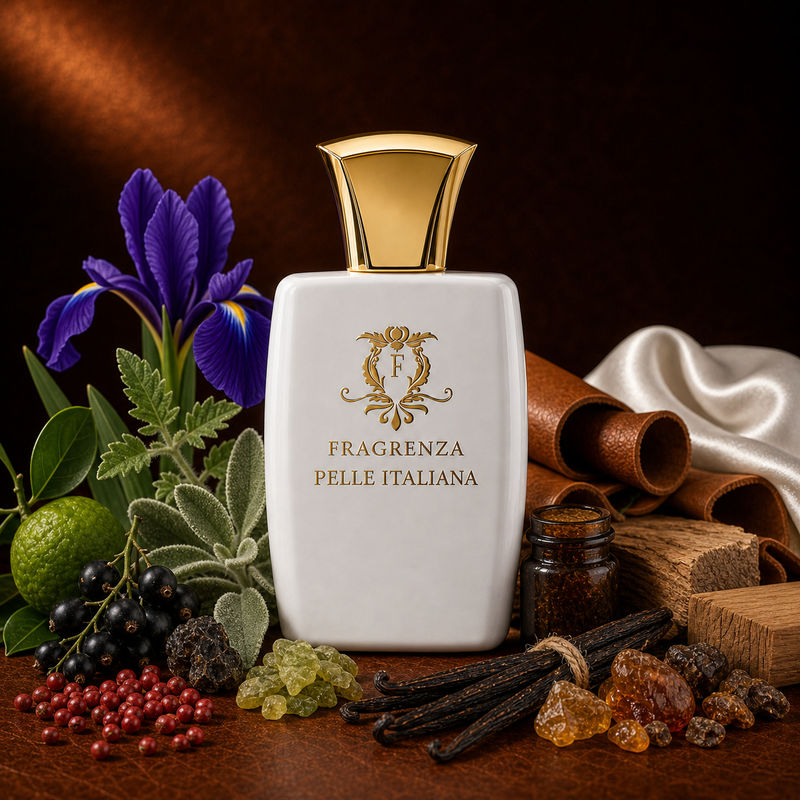
Pelle Italiana
A Fragrenza alternative to Memo's Italian Leather
Why this dupe
- Captures the same leather character that defines Italian Leather — top, heart, and base notes reflect the original's DNA.
- Eau de Parfum concentration with higher-than-industry-standard fragrance oil — projects and lasts 8+ hours on skin.
- Vegan, cruelty-free, paraben-free formulation. Same wearable scent without the luxury markup.
- Roughly 77% cheaper than Memo's retail — the difference goes back in your wallet, not into brand campaigns and retail markups.
- 4.6★ across 558+ reviews from real customers — see what they're saying on the product page.
About Italian Leather
Italian Leather is a bold, edgy fragrance from Memo that opens with the striking combination of pink pepper and petitgrain. At the core, galbanum gives the scent its defining leather personality — smoky, raw, unforgettable. A deep, tenacious base of vanilla ensures it lingers long after application.
On skin, Italian Leather typically delivers excellent longevity (8+ hours) with strong sillage that projects across a room. The price point — $300 at retail — reflects Memo's positioning, packaging, and distribution overhead more than the cost of the formulation itself.
How to wear it
Pelle Italiana is bold enough for evenings and cold-weather wear — occasions where strong sillage works in your favour. Not for the gym.For best longevity, apply to pulse points (wrists, neck, behind the ears) on moisturised skin.
How we matched it
Our perfumers studied Italian Leather's note structure — the pink pepper opening, the galbanum heart, the vanilla dry-down — and built Pelle Italiana around that same architecture. The aim isn't a molecule-for-molecule clone; it's a faithful interpretation of the scent character at a price the market doesn't normally allow for.
What's the same: the leather family signature, the note progression on skin, the longevity profile (8+ hours on most skin types). Where it can differ: small accord nuances in the first 30 minutes — the most volatile part of any fragrance — and slight projection variation depending on your skin chemistry. We're transparent about that. Your nose will tell you the truth before any review can.
Every Fragrenza fragrance is formulated as Eau de Parfum, vegan, cruelty-free, and paraben-free. The juice does the work; the price reflects the juice, not the brand campaign budget.
Side by side
The original
Memo
Italian Leather
$300
Designer/niche pricing reflects brand positioning, retail markups, and campaign spend — not always the juice itself.
The Fragrenza alternative
Pelle Italiana
$69.99
Same leather character, formulated as Eau de Parfum, vegan and cruelty-free, built to last 8+ hours.
What it costs per spray
Memo retail
Italian Leather
$0.50
per spray · ~600 sprays/bottle
Fragrenza
Pelle Italiana
$0.11
per spray · ~600 sprays/bottle
A standard atomiser pushes about 0.1ml per spray, so a 60ml bottle delivers around 600 sprays before it's empty. At $69.99, Pelle Italiana works out to roughly $0.11 per spray. The Memo original at $300 sits at about $0.50 per spray — same volume, same delivery, very different per-use cost.
Project that across a year of regular wear — three times a week, two sprays per wear, about 312 sprays a year — and Pelle Italiana runs roughly $36.39 for the year, against roughly $156.00 for Italian Leather. That's about $119.61 a year staying in your wallet — the difference covering the brand campaigns, retail concession fees, and prestige packaging that don't change what's inside the bottle.
Inside the scent
Inside each note
A closer look at the building blocks behind Italian Leather's scent. Each note plays a specific role across the wear arc — and links to the full Fragrenza collection of fragrances built around it.
Top — first impression
Pink pepper is derived from the dried berries of Schinus molle and Schinus terebinthifolia, trees native to South America — particularly Brazil, Peru, and Argentina. Despite being called pepper, these plants are...
The petunia (Petunia spp.) is one of the world's most beloved bedding plants, beloved for its prolific blooms in every shade from white through violet to near-black. Native to South America, petunias...
Black Currant — known botanically as Ribes nigrum — is a small, intensely dark berry native to northern Europe and Asia, prized in perfumery for a character that is simultaneously vibrant and...
Cistus incanus, also known as pink rock rose, is a wild-growing shrub native to the rocky hillsides and garrigue landscapes of the Mediterranean. It is closely related to Cistus ladanifer, the source...
Heart — the character
Gardenia — Gardenia jasminoides — is native to the tropical and subtropical regions of Asia, particularly southern China, Japan, and Vietnam, where it has been cultivated for over a thousand years for...
Clary sage (Salvia sclarea) is a perennial herb native to the Mediterranean basin and parts of Central Asia, prized for centuries in herbal medicine and culinary traditions. Its essential oil, steam-distilled from...
Iris — extracted primarily from the dried rhizomes (roots) of Iris pallida and Iris germanica grown in Tuscany, Morocco, and China — is one of the most precious, labour-intensive, and sought-after ingredients...
Base — the dry-down
Vanilla (Vanilla planifolia) is native to Mexico, where the Totonac people first cultivated it long before Spanish explorers brought it to Europe in the sixteenth century. The vanilla orchid's seed pods —...
Sandalwood is one of the most treasured aromatic materials in the history of human civilization. Derived primarily from the heartwood of Santalum album (Mysore sandalwood from India) and Santalum spicatum (Australian sandalwood),...
Tolu balsam is a natural resinous exudate obtained from the Myroxylon balsamum tree, native to Colombia, Venezuela, and surrounding regions of northern South America. It takes its name from the city of...
Opoponax — sometimes called sweet myrrh — is an ancient aromatic resin obtained from Commiphora guidottii, a tree native to the Horn of Africa and the Arabian Peninsula. One of the oldest...
Myrrh is a natural resin exuded from trees of the genus Commiphora, primarily C. myrrha and related species, which grow in the arid regions of Somalia, Ethiopia, Yemen, and Oman. One of...
Benzoin is a resinous balsam obtained from the bark of Styrax trees, principally Styrax benzoin from Sumatra and Styrax tonkinensis from Siam (modern-day Thailand and Laos). Harvested by scoring the tree's bark...
The leather note in perfumery is a crafted accord that evokes the scent of fine cured hide — an aroma with deep cultural associations with luxury, craftsmanship, and sophisticated masculinity. Historically, the...
Musk is one of the oldest and most foundational materials in the history of perfumery. Originally derived from the glandular secretions of the male musk deer of the Himalayas, natural musk has...
Frequently asked questions
Is Pelle Italiana really a dupe of Italian Leather?
How long does Pelle Italiana last on skin?
Is it suitable for unisex?
What occasions is Italian Leather best for?
Why is Italian Leather so expensive?
Is Pelle Italiana vegan and cruelty-free?
What's your return policy?
Try it for $9.99
Not sure? Start with the 5ml travel size. Wear it. If it's the Italian Leather dupe you've been looking for, upgrade to the full bottle whenever you're ready.
View Pelle Italiana