

Inspired-by alternative
Best Pegasus Dupe
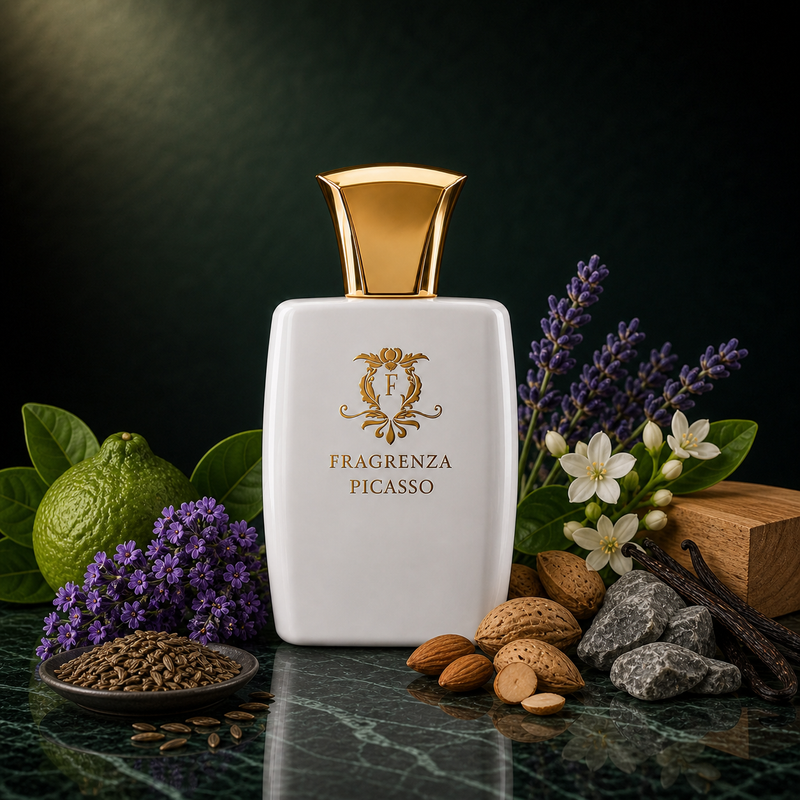
Pegasus by Parfums de Marly costs $250 at retail. Picasso delivers the same oriental structure top to base, formulated as Eau de Parfum and built to last 8+ hours.
Why this dupe
- Built around Pegasus's exact note progression — the bergamot opening, lavender heart, and ambergris dry-down all map to the original.
- Higher fragrance-oil concentration than most designer EdPs — translates to projection that holds through a workday and a dry-down that's still wearing the next morning.
- 100% vegan, cruelty-free, paraben-free. We sourced clean ingredients because the modern fragrance shopper expects it.
- About 72% less than the Parfums de Marly list price — same scent, none of the prestige markup baked into the bottle.
- 4.6/5 average from 558+ verified Fragrenza buyers — read the reviews on the product page.
About Pegasus
Pegasus is a richly layered cologne for men from Parfums de Marly that draws you in with the warm, spiced opening of bergamot and heliotrope. The oriental heart unfolds around lavender, adding depth and unmistakable sensuality. The dry-down rests on a base of ambergris — dense, enveloping, built to linger.
On skin, Pegasus typically delivers excellent longevity (8+ hours) with strong sillage that projects across a room. The price point — $250 at retail — reflects Parfums de Marly's positioning, packaging, and distribution overhead more than the cost of the formulation itself.
How to wear it
Picasso is built for evenings, colder months, and occasions where you want to leave a lasting impression. The dry-down develops slowly on skin and rewards close wear.For best longevity, apply to pulse points (wrists, neck, behind the ears) on moisturised skin.
How we matched it
Picasso starts from Pegasus's actual composition: a bergamot-led opening, a heart anchored by lavender, and a ambergris foundation. We rebuild that arc with high-quality aroma compounds chosen for fidelity, not flash — the goal is wearing the same scent, not approximating it.
The honest disclosure: this is an interpretation, not a chemical clone. The first 30 minutes — when top notes do their volatile work — can read slightly differently. Once the heart settles and the base develops, the two scents converge. Most customers can't reliably tell them apart on a side-by-side wear test after the first hour.
Formulated in-house as Eau de Parfum, vegan, cruelty-free, paraben-free. We don't pay for celebrity campaigns or retail-store distribution, so the price reflects the formulation cost — not someone else's marketing budget.
Side by side
The original
Parfums de Marly
Pegasus
$250
Designer/niche pricing reflects brand positioning, retail markups, and campaign spend — not always the juice itself.
The Fragrenza alternative
Picasso
$69.99
Same oriental character, formulated as Eau de Parfum, vegan and cruelty-free, built to last 8+ hours.
What it costs per spray
Parfums de Marly retail
Pegasus
$0.42
per spray · ~600 sprays/bottle
Fragrenza
Picasso
$0.11
per spray · ~600 sprays/bottle
Per-spray pricing is the more honest comparison than sticker price alone. Most 60ml fragrances deliver ~600 sprays from a standard atomiser. Picasso prices out at roughly $0.11 a spray; Pegasus at retail runs about $0.42 a spray. Same juice volume, same actuation — the gap is what designer positioning costs the buyer.
Stretch that across a year of regular wear (3× weekly, 2 sprays per wear, ≈312 sprays annually) and the math gets concrete: about $36.39 for Picasso versus roughly $130.00 for Pegasus at retail. The ~$93.61 gap is what designer pricing recovers for marketing, retail margins, and brand operations — not for the juice.
Inside the scent
Inside each note
Every fragrance is the sum of its parts. Here's what each ingredient contributes to Pegasus's oriental character — with links to explore other Fragrenza scents that feature the same notes.
Top — first impression
Bergamot (Citrus bergamia) is one of perfumery's most beloved and versatile citrus ingredients, grown almost exclusively along the sun-drenched Calabrian coastline of southern Italy. A hybrid believed to descend from the bitter...
Heliotrope is a genus of flowering plants whose blossoms have enchanted gardeners and perfumers alike for centuries. Native to Peru and widely cultivated across Europe since the eighteenth century, heliotrope earned its...
Caraway seed (Carum carvi) has been cultivated across Europe and Western Asia for thousands of years, appearing in ancient Egyptian tombs and medieval European kitchens alike. As a fragrance note, it carries...
Heart — the character
Lavender (Lavandula angustifolia) is perhaps the single most iconic ingredient in the entire history of perfumery. Native to the sun-drenched hillsides of the Mediterranean basin and cultivated on an enormous scale in...
Almond in perfumery is a note of remarkable warmth and intimacy, drawing on a family of chemical compounds — principally benzaldehyde, heliotropin (piperonal), and coumarin — to recreate the sweet, slightly bitter,...
Among all the ingredients in the perfumer's palette, jasmine stands apart as the undisputed queen of florals. Cultivated across India, Egypt, Morocco, and the Grasse region of southern France, jasmine flowers have...
Base — the dry-down
Ambertonic is a proprietary amber complex developed by IFF (International Flavors and Fragrances) that represents the cutting edge of amber accord technology. Unlike traditional amber bases, which often rely on a fixed...
Vanilla (Vanilla planifolia) is native to Mexico, where the Totonac people first cultivated it long before Spanish explorers brought it to Europe in the sixteenth century. The vanilla orchid's seed pods —...
Sandalwood is one of the most treasured aromatic materials in the history of human civilization. Derived primarily from the heartwood of Santalum album (Mysore sandalwood from India) and Santalum spicatum (Australian sandalwood),...
Frequently asked questions
Is Picasso really a dupe of Pegasus?
How long does Picasso last on skin?
Is it suitable for men?
What occasions is Pegasus best for?
Why is Pegasus so expensive?
Is Picasso vegan and cruelty-free?
What's your return policy?
Sample first, full bottle later
The 5ml travel size is $9.99. Spray it for a week. If Picasso reads like Pegasus on your skin, the full 60ml is waiting whenever you want it.
View Picasso