

Why a Great Fragrance Is Impossible to Forget in 2026
Why a Great Fragrance Is Impossible to Forget in 2026, an editorial deep-dive on notes, character, and how to wear it
By Julia MorettiFragrenza makes several of the alternatives featured in our guides — here’s how we test.
8 min read
Most fragrances are forgotten within hours of being smelled. A small minority become permanent fixtures of memory, retrievable decades later with a precision that feels almost magical. The difference between these two outcomes is not luck or random preference. It is the result of specific compositional choices that interact with how human memory actually works at a neurological level. Understanding what makes a fragrance unforgettable is partly an exercise in psychology, partly an exercise in chemistry, and partly an exercise in cultural reception. The combination is what produces the rare compositions that earn permanent places in the wearer's emotional architecture.
The phrase memorable fragrance gets used loosely, but it points at something specific. A memorable fragrance is not just one you like at the moment of smelling. It is one that encodes itself into autobiographical memory in a way that allows it to be retrieved later, often involuntarily, and to bring with it the emotional content of the original context. This phenomenon is well-known in neuroscience and has a robust experimental literature behind it. Perfumers who understand the underlying mechanisms can deliberately design compositions to enhance memorability, although the wearer's own context contributes at least as much as the composition itself.
The Neurological Foundation
The olfactory system is anatomically unique among the senses. Sight, sound, taste, and touch all route through the thalamus before reaching the cortex, but smell bypasses the thalamus and reaches the limbic system directly. The limbic system includes the hippocampus (responsible for memory consolidation) and the amygdala (responsible for emotional processing), which means scent information arrives at these regions before the conscious mind has even classified what is being smelled.
This anatomical fact has profound consequences for memory encoding. Olfactory memories are stored with stronger emotional content than memories from other senses, and they are stored in a way that resists the usual decay of autobiographical memory over time. A song you heard at twelve may be retrievable but with its emotional content diminished. A fragrance you wore at twelve, if you encounter it again at fifty, will often retrieve not just the memory but the original emotional state with surprising fidelity.
The Three Conditions of Memorable Fragrance
Three conditions need to align for a fragrance to become a permanent memory rather than a passing impression. First, the composition must have enough architectural distinctiveness that the nose registers it as a singular experience rather than a generic example of a category. Second, the wearing context must be emotionally significant enough to activate the limbic encoding pathway. Third, the wearer must repeat the experience enough times to consolidate the memory beyond a single isolated exposure.
The first condition is where perfumers can contribute most directly. Generic compositions are forgettable by design. Distinctive compositions are designed for memorability.
The Architectural Signature
Memorable compositions almost always feature what can be called an architectural signature: a specific combination of materials and proportions that the nose can identify as unique. The signature might be a single distinctive material treated unusually (the way certain irises are treated as cool and earthy rather than powdery and floral) or a combination of materials that produces an unexpected harmony.
Bontà
illustrates how an architectural signature creates memorability. The composition uses pistachio, creamy lactonic notes, and an amber base in a combination that is rare enough to be unmistakable but harmonious enough to be wearable. A wearer encountering Bontà for the first time registers it as a specific olfactory event rather than a generic gourmand, and that specificity is what gets encoded into memory.
This is the architectural strategy that distinguishes compositions designed for memorability from compositions designed for broad appeal. Broad-appeal compositions tend to use familiar combinations in familiar proportions, which produces fragrances that are pleasant in the moment but indistinguishable from competitors in retrospect. Memorable compositions accept the risk of being less universally liked in exchange for being more deeply remembered.
The Emotional Anchor
The second condition involves the wearer's context rather than the perfumer's craft. A fragrance worn during emotionally significant moments encodes alongside those moments, and the resulting memory becomes one of the strongest anchors of autobiographical memory. The composition itself does not need to be extraordinary; many wearers have unforgettable memories attached to perfectly ordinary fragrances that happened to be worn during weddings, childbirths, deaths, or transformative travel.
This is why memory-encoding works equally well with comfort-register fragrances. Vanilla Delight
The implication for wearers is practical: the fragrances you choose to wear during the most emotionally significant moments of your life will become the fragrances you remember most precisely later. This is one reason serious fragrance enthusiasts often rotate compositions deliberately around major life events, choosing compositions they know they will want to associate with those events rather than reaching for whatever happens to be on the shelf.
The Consolidation Through Repetition
The third condition involves repeated exposure. A single wearing of a distinctive composition during an emotionally significant moment produces a memorable experience, but the memory is fragile until it has been reinforced through additional wearings. Multiple wearings in similar emotional registers consolidate the memory into something that becomes essentially permanent.
Sensual Flame
is the kind of composition that benefits significantly from this consolidation effect. The composition uses a creamy floral heart against a spiced amber base, and the architectural complexity rewards repeated wearing. Each wearing reveals additional facets and deepens the wearer's relationship with the composition, and the cumulative effect is a memory that grows richer rather than fading over time.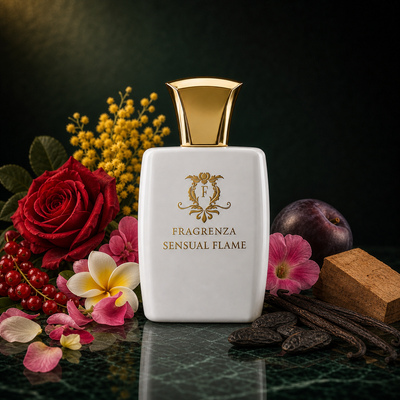
This consolidation principle has an important implication for how to build a fragrance wardrobe with memory in mind. Owning many fragrances and wearing each one only occasionally produces an olfactory life with breadth but no depth. Owning fewer fragrances and wearing each one frequently in specific contexts produces an olfactory life with deep memory encoding that pays dividends across decades. Most serious enthusiasts eventually adopt the second approach, although the first approach is more common during the initial exploration phase.
What Mainstream Fragrance Often Gets Wrong
Mainstream commercial fragrance optimises for the wrong outcome from the perspective of memorability. The goal of mainstream fragrance is to please the widest possible audience at the moment of sampling, which produces compositions that are pleasant but generic. The architectural homogeneity that broad appeal demands is precisely the quality that prevents deep memory encoding.
This is one reason wearers who exclusively wear mainstream fragrances often have weaker fragrance memories than wearers who explore niche or vintage compositions. The mainstream wearer may have used dozens of fragrances over the decades without any of them encoding deeply, while the niche wearer who has used a smaller number of architecturally distinctive compositions may have precise memories tied to each one. The difference is not snobbery but neurology.
How to Build Memorability Into Your Fragrance Practice
Three practical changes amplify the memorability of your fragrance life. First, choose compositions with architectural distinctiveness rather than broad commercial appeal. Distinctive compositions encode more deeply, and the trade-off in universal acceptance is usually worth the deeper memory return. Second, wear compositions intentionally around emotionally significant moments rather than reaching for whatever is convenient. The pairing of distinctive composition with significant moment produces the strongest encoding. Third, repeat wearings in similar emotional contexts rather than constantly rotating. Repetition consolidates memory in a way that variety cannot.
Related Reads
- Psychology of perfume: deeper exploration of fragrance and mood
- How to choose your signature scent: framework for memorable wardrobes
- What is niche perfumery: the field that prioritises memorability
- Vanilla in Perfumery: the most memory-active material
- Amber in Perfumery: a foundational material for memorable compositions
- Exploring niche fragrances: building an architecturally distinctive wardrobe
Frequently Asked Questions
Why do some fragrance memories stay vivid for decades?
Olfactory memories are encoded directly into the limbic system through a unique neuroanatomical pathway that bypasses the usual filtering of other senses. This direct route preserves the emotional content of the original experience alongside the sensory information, which is why scent memories often retrieve not just the smell but the original feeling. The encoding is unusually durable and resists the gradual decay that affects memories from other senses.
Can I deliberately create fragrance memories?
Yes, and the practice produces remarkable results over time. Choose a composition with architectural distinctiveness, wear it during emotionally significant moments, and repeat the wearing in similar contexts. The combination of distinctive composition, emotional significance, and repetition produces memory encoding that remains accessible across decades. Serious enthusiasts often plan fragrance choices around upcoming significant events for precisely this reason.
Does the quality of the fragrance matter for memorability?
Architectural distinctiveness matters more than absolute quality. A modest but distinctive composition can encode more deeply than an expensive but generic one. That said, quality and distinctiveness tend to correlate in practice, as the compositions designed with architectural ambition are usually the ones built from quality materials. Use distinctiveness rather than price as the primary criterion.
What happens when I encounter a fragrance memory unexpectedly?
The retrieval is often involuntary and surprisingly complete. Many people describe encountering a fragrance they have not smelled in decades and being transported, in a matter of seconds, to a precise moment in the past with full emotional content intact. This phenomenon is the Proustian effect, and it is one of the most reliably documented experiences in olfactory neuroscience.
Why are mainstream fragrances often forgettable?
Mainstream fragrance is engineered to please the widest possible audience, which requires architectural homogeneity. The compositions are designed to be pleasant rather than distinctive, and the lack of distinctiveness prevents the deep encoding that memorable fragrances achieve. This is not a flaw in the products; it is the consequence of their design priorities, but it has the side effect of producing forgettable olfactory experiences.
How many memorable fragrances should I have?
Quality matters more than quantity. A wearer with three architecturally distinctive compositions worn intentionally across emotionally significant contexts will accumulate more durable fragrance memories than a wearer with thirty rotating compositions worn casually. The depth of relationship with each composition determines memorability, and depth requires both selectivity and repetition.
The Bottom Line
A great fragrance becomes unforgettable through the combination of architectural distinctiveness, emotional context, and repeated wearing. The neurology of olfactory memory makes scent uniquely effective as a memory medium, and wearers who understand and apply this principle deliberately can build olfactory archives that pay dividends across decades. Choose distinctively, wear meaningfully, and repeat consistently.