

Musk in Perfumery: The Invisible Note That Holds Everything Together
Musk is a deeply animalic note that gives fragrance its skin-feel, a note every fragrance lover should learn to recognise on skin.
By Julia Moretti 14 min read
Of all the notes in perfumery, musk is the most fundamental and the most misunderstood. It is the note that most people cannot quite identify in isolation but whose absence they would immediately notice — the invisible structural element that holds a fragrance together, extends its life on skin, and creates the sensation of warmth and depth that distinguishes a great perfume from a merely pleasant one. Musk is to fragrance what a foundation is to architecture: you do not see it, but without it everything collapses.
This is the explainer. What musk actually is, the troubling animal history that gave it its name, the synthetic revolution that replaced it, what the various musks of contemporary perfumery actually smell like, the famous fragrances built around the note, how musk works structurally in a composition, and how to wear musk-led fragrances well. By the end you will understand why nearly every fine fragrance ever made depends on this single category, and why “musk” in 2026 is a family of materials with extraordinarily different characters that share a single olfactory function.
What musk actually is
The word musk encompasses an extraordinarily diverse family of aromatic materials united not by a common molecular structure but by a shared olfactory character. At its most fundamental, musk smells clean, warm, intimate, and skin-like — an amplification of the body’s own scent rather than something clearly separate from it. This quality of intimacy is musk’s most important contribution to perfumery: it makes a fragrance feel as though it belongs to the wearer rather than sitting on top of them.
Different musks within this broad family vary considerably. Some are intensely animalic and almost disturbing, recalling the raw secretion of the musk deer. Others are fresh and powdery. Still others are woody and dry. The cleanest contemporary white musks smell of nothing so much as freshly laundered fabric. This range within a single aromatic family is part of why musk is so essential to understand: a fragrance described as “musky” could be soft and laundered, dark and animalic, woody and dry, or warm and powdery, depending on which member of the family is doing the work.
Origins: a deeply troubling history
The original musk — and the source of the name — was the secretion of the male musk deer (Moschus moschiferus and related species), a small, antler-less deer native to the mountainous regions of Central and South Asia. The musk pod, a small sac located beneath the deer’s abdominal skin, produced a waxy secretion that the animal used for territory marking and mate attraction. Dried and aged for several years to develop its full aromatic complexity, this secretion was historically one of the most precious substances in the world. A kilogram of musk absolute was worth more than its weight in gold.
Genuine deer musk in concentration is almost overpowering — intensely animalic, fecal even, with a density that approaches headache-inducing. But diluted to perfumery concentrations — as low as one part in ten thousand — it transforms into something extraordinary: warm, skin-like, deeply sensual, with a faint sweetness beneath the animalic quality and a persistence that no synthetic material has fully replicated. A handkerchief soaked in natural musk tincture, perfumers note, can retain its scent for forty years.
The use of musk in perfumery stretches back at least to the sixth century BCE, when Greek explorers encountered it in India and sent it along the trade routes to Persia and Rome. Through the Silk Road and into the Belle Epoque, musk was central to the great classical perfume traditions of Europe and the Middle East. The environmental cost was catastrophic. It took the glands of approximately 140 musk deer to produce a single kilogram of musk absolute, and the deer must be killed to obtain the pod. By the late twentieth century the Siberian musk deer was critically endangered. In 1979 CITES (the Convention on International Trade in Endangered Species) extended legal protection to the species, effectively ending the trade in natural animal musk in legitimate commercial fragrance.
The synthetic revolution
The chemistry had begun before the conservation crisis forced it. In 1888, the German chemist Albert Baur, working with derivatives of TNT, accidentally noticed that one of his compounds had a strong, pleasant musky odor. The resulting material — later known as Musk Baur — was the beginning of an entirely new chapter in perfumery. The discovery was serendipitous; the implications were enormous.
The early synthetic musks — nitromusks, named for their chemical structure — were widely used through the early twentieth century in everything from fine perfumes to fabric softeners. Cheap, powerful, and stable, they powered the rise of mass-market fragrance. Their eventual withdrawal, after research showed they were phototoxic and potentially neurotoxic, drove the next wave of musk chemistry.
The replacements arrived in two families. Polycyclic musks — including Galaxolide and Tonalide — became the workhorses of the fragrance industry from the 1970s onward. Affordable, versatile, and clean-smelling, they are the musks responsible for the laundry-and-fabric-softener aesthetic that has dominated mainstream fragrance for decades. Macrocyclic musks — large-ring molecules that include muscone (the key odorant in natural deer musk, now produced synthetically), exaltolide, and habanolide — represent the most sophisticated and closest-to-natural materials available to contemporary perfumers. They are more expensive, but they deliver a richer and more complex character that fine perfumery prefers.
Two adjacent molecules deserve mention because both are technically musk-family materials with their own dedicated articles: Iso E Super, a woody-cedar-musk hybrid, and Ambroxan, a warm woody-amber musk derived from ambergris. Both work with classical musks rather than against them, and both have become structurally inseparable from modern perfumery in their own right. Our Iso E Super pillar and Ambroxan explainer cover them in detail.
What musk actually smells like
The challenge in describing musk is that it behaves differently on different people and across different molecules in the family. The German perfumer Philip Kraft, one of the leading researchers in musk chemistry, has described natural musk tincture as a dynamic interplay of contradictions: “repulsive-attractive, chemical-warm, sweaty-balmy, acrid-waxy, earthy-powdery, fatty-chocolate-like, pungent-leathery, fig-like, dry, nutty, and woody.” That single sentence tells you everything about why musk is so compelling and so hard to define.
The synthetic white musks — the family most commonly found in modern fragrances — occupy the softer, cleaner end of this spectrum. They are powdery, slightly sweet, faintly floral, and have an almost tactile quality: the sense that you are not just smelling something but touching it. They smell like freshly laundered sheets, like warm skin, like the faint trail someone leaves in a corridor.
The animalic musks — the heavier, darker end of the spectrum, including civet (now only used synthetically) and castoreum — are more overtly sensual, with a faintly feral edge that stops just short of unpleasant. These were the foundation of the great oriental fragrances of the early twentieth century. Their rich, complex, deeply human quality is something the clean white musks cannot fully replicate. Contemporary perfumery uses both registers, often layered into a single composition for textural depth.
Tonkin musk and white musk each have their own dedicated entries on this blog covering the specialized character of those sub-categories. The full picture below treats musk as a single composite category.
Musk in famous fragrances
Virtually every great fragrance relies on musk in some form, which makes singling out specific examples difficult. Some compositions, however, treat musk as the headline material rather than the structural backbone, and those are the ones worth studying.
The defining contemporary musk fragrance is Narciso Rodriguez For Her (2003) — built almost entirely on a dry, skin-like musk accord with subtle floral and woody support. The composition demonstrated that musk, stripped of competing elements, could be extraordinarily beautiful and sophisticated, and the fragrance became one of the best-selling perfumes of its era. The Body Shop’s White Musk (1981) democratized the idea of musk as a personal signature scent and was for decades among the best-selling fragrances in the world — the lower-cost equivalent of the same skin-musk philosophy.
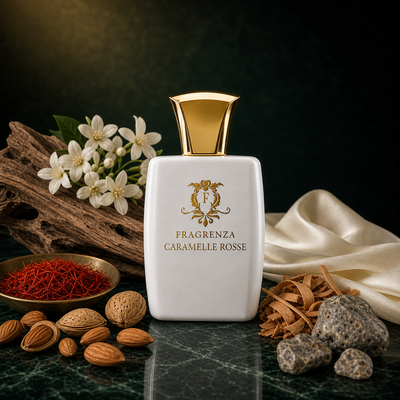
At the luxury end, the saffron-amber niche tradition uses ambroxan-derived musk as a central structural element. Baccarat Rouge 540 by Maison Francis Kurkdjian is the most-cited example: its characteristic almost-molecular, warm, slightly metallic musk character is what gave the saffron-amber accord its breakthrough moment. The Fragrenza interpretation,
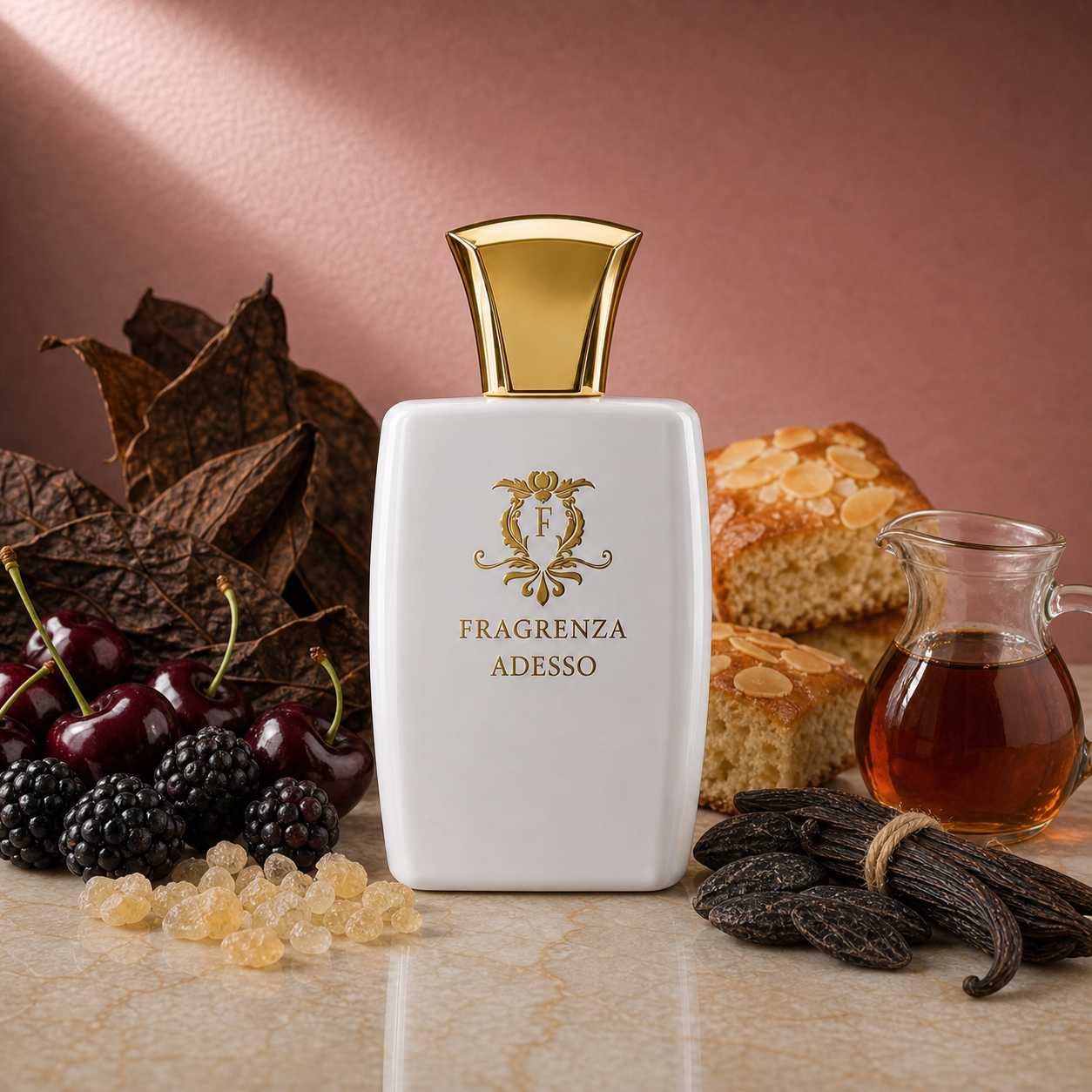
The mainstream gourmand-oriental tradition uses musks differently — as the warm, intimate base that gives sweet compositions their skin-close quality. Black Opium by YSL is a clear example: the coffee-vanilla heart sits on a musk base that gives the wear its characteristic addictive warmth. The Fragrenza version,
, holds the same coffee-musk register.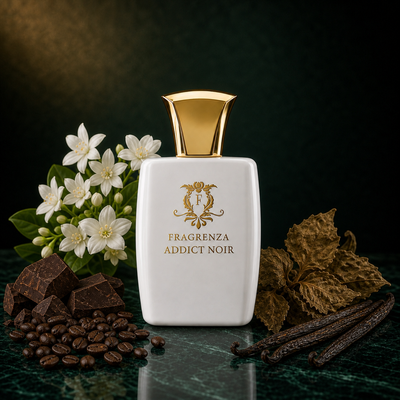
Musk at the heart of the Fragrenza line
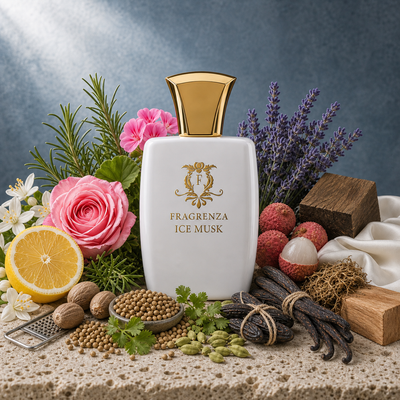
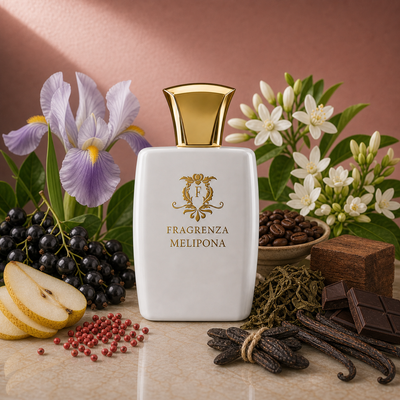
Beyond the dupes that interpret musk’s mainstream lineage, three clean-handle Fragrenza compositions place musk at the structural center.
is the line’s most direct musk pick — clean, soft, second-skin, the kind of wear that registers as the wearer’s own skin rather than as a fragrance applied. It sits in the “clean girl” / Skin Scents 2.0 register and represents the polycyclic-musk family at its most contemporary. uses musks more dimensionally, with iris and pear and a soft floral structure on top of a skin-close musk base. The wear reads as elegant rather than minimal — musk providing the close-skin foundation while the other notes give the composition its character.

For the broader cluster context, our Skin Scents 2.0 pillar places these compositions in the wider 2026 musk-forward trend.
How musk works in a composition
Musk’s primary function in perfumery is amplification and fixation. It extends the life of more volatile materials on skin, amplifies the projection of the overall composition, and creates a warm, skin-like base that makes the whole fragrance feel more intimate. These functions are why musk appears in essentially every fragrance family.
What perfumers call the “skin effect” is musk’s most distinctive contribution. A well-chosen musk creates the sense that the fragrance is emanating from the wearer rather than sitting on top of them. The composition reads as personal, intimate, and skin-adjacent — a quality that older animalic-and-floral perfumes did not achieve as cleanly as modern musk-led work does. The skin effect is also why musk-forward fragrances generate such strong “you, but better” reactions from wearers and the people around them.
Beyond longevity and the skin effect, musk acts as a blender. It softens harsh edges between disparate materials and creates transitions that feel smooth rather than abrupt. A perfumer working without musk has to do a great deal of structural work to achieve coherence; with musk, much of that work happens automatically.
How musk interacts with other notes
With florals, musk creates the soft, powdery quality that transforms a floral arrangement into something skin-adjacent rather than simply a bunch of flowers. With woods, musk adds warmth and roundness that prevents woody compositions from feeling cold or austere. With oriental bases — vanilla, amber, resins — musk amplifies the warmth and contributes its own intimate quality. With citrus and fresh top notes, clean musks create a base that extends the brightness while giving it surprising longevity.
Two pairings deserve specific mention. Musk and sandalwood share a warm, skin-like, slightly creamy quality that creates extraordinary harmony when combined — a structural pairing that anchors many of the great oriental compositions and modern unisex skin scents. Musk and amber build the warm-resinous-skin foundation of the great oriental tradition, with musk providing the human-skin-warmth that amber alone cannot achieve. Both pairings are worth understanding because they show up across half the modern canon.
Building a musk wardrobe
Understanding the different types of musk allows for more intelligent fragrance choices and layering. Fresh, clean white musks — the laundry-fabric-softener family — are excellent everyday companions for those who want presence without heaviness. They layer beautifully beneath virtually any other fragrance, extending the wear while adding the clean skin-like quality that many people find irresistible.
Deeper, warmer, more animalic musks are statement materials best used in evening or cool-weather contexts where their intensity has room to develop. The two registers are not rivals; they handle different jobs in a wardrobe and the well-built musk-aware collection includes both.
For the broader picture of how musk-forward fragrances fit into a wardrobe, our complete guide to building a fragrance wardrobe in 2026 places musk alongside the other major base-note categories. For the mood register that musk-forward compositions occupy — polished, fresh, intimate — our guide to choosing perfume by mood covers the territory in detail.
Frequently asked questions
What does musk smell like?
Clean, warm, intimate, and skin-like — an amplification of the body’s own scent rather than something clearly separate from it. The character varies by which musk: synthetic white musks are powdery and laundered; macrocyclic musks like muscone are richer and warmer; animalic musks (civet, castoreum) are darker and more sensual. The unifying quality across the family is the skin-close warmth that makes a fragrance feel personal rather than projected.
Is real animal musk still used in perfume?
No, not in legitimate commercial fragrance. The Siberian musk deer was protected by CITES in 1979 after centuries of harvest had pushed it to critical endangerment. Genuine deer musk no longer appears in serious commercial perfumery. Synthetic musks — polycyclic, macrocyclic, and the muscone molecule itself produced synthetically — are what every modern fragrance uses. The shift has been positive ethically and, increasingly, aesthetically: macrocyclic musks now rival natural musk in complexity and depth.
Are synthetic musks safe?
The current generations are. Early nitromusks (used through the mid-twentieth century) were withdrawn after research showed phototoxic and potentially neurotoxic effects. The polycyclic and macrocyclic musks that replaced them have been thoroughly tested and are considered safe at the concentrations used in fine fragrance. Regulatory bodies in the EU and US monitor the category continuously, and any material with safety concerns is restricted or removed.
Why does musk last so long on skin?
Musk molecules tend to be heavy and slow to evaporate, which gives musk-forward fragrances exceptional substantivity on skin. A handkerchief soaked in natural musk tincture has been reported to retain detectable scent for forty years. Modern synthetic musks do not match that extreme, but their persistence is still remarkable — often outlasting the rest of the composition by hours. This is why musk is treated as a base note: it anchors the entire fragrance and keeps the wear coherent over time.
Is musk unisex?
Yes — musk is one of the most genuinely unisex categories in modern perfumery. Some musks have been culturally coded as feminine (the soft white musks of mass-market 1990s fragrance) and others as masculine (the darker animalic musks of certain niche compositions), but those associations are conventions, not chemistry. The molecule itself is genderless; what surrounds it does the gender coding, and contemporary fragrance is increasingly comfortable letting musk play across the spectrum.
Why do some people not smell musk on themselves?
Specific anosmia to certain musk molecules is reasonably common, particularly to synthetic white musks. A meaningful portion of the population cannot smell certain polycyclic musks at all, or smells them only briefly before losing perception due to receptor saturation. This is why wearers of clean musk fragrances frequently report receiving compliments on a scent they themselves cannot detect. The molecule continues to project to people nearby long after the wearer’s nose has tuned it out.
What perfumes layer well with musk?
Almost everything, which is why musk is so essential. Sandalwood is the closest match — both share the creamy-skin-like character and the pairing produces a seamless oriental base. Vanilla and benzoin add edible warmth that musk amplifies. Florals get softer and more skin-adjacent layered over musk. Citrus and white florals get longer wear. Wood compositions get rounder. The category that musk does not pair well with is sharp aquatic-marine notes, where the contrast tends to feel jarring rather than complementary.
The future of musk
The search for better, safer, more sustainable musks continues to be one of the most active areas of fragrance chemistry. Biotechnology companies are working on biosynthetic approaches — using yeast and other microorganisms to produce macrocyclic musk molecules — that could eventually offer a truly natural, sustainable musk without any impact on wildlife. The result would close a circle: musk derived not from endangered deer but from fermentation vessels, not from suffering but from science.
Whatever form it takes, musk will remain at the heart of perfumery. It is too fundamental — too deeply connected to what makes fragrance feel human and intimate — to be dispensed with. In the end, musk smells like us. And nothing in perfumery is more powerful than that.