

Hyssop in Perfumery: The Herbal Note That Bridges Garden and Cathedral
Hyssopus officinalis carries a camphoraceous floor under a restrained mint and small-flower lavender bloom, and its monastery-garden depth lets perfumers thread herbal compositions toward the sacred.
By Julia Moretti 6 min read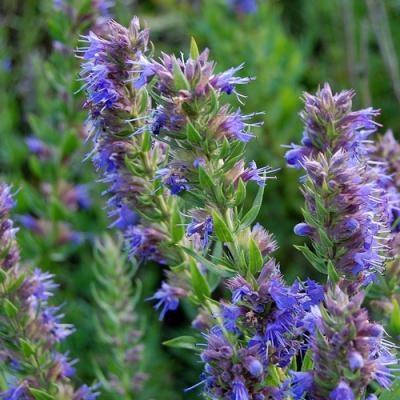
Hyssop is not a note for the casually curious. This ancient aromatic herb — known since biblical times, harvested from Mediterranean hillsides and monastery gardens — carries a scent that is simultaneously medicinal, herbal, floral, and faintly minty, with a depth that takes time and attention to fully appreciate. In perfumery, hyssop functions at the margins of more familiar aromatic families, lending compositions a character that is difficult to name but immediately compelling.
The herb itself, Hyssopus officinalis, is a small woody perennial with narrow leaves and dense spikes of small blue, pink, or white flowers. Its essential oil has been used in herbal medicine, liqueur production, and culinary contexts for centuries. In perfumery, it belongs to the broader family of aromatic herbs — alongside lavender, rosemary, thyme, and sage — but occupies a more unusual position within that family due to its particular combination of characteristics.
The Smell Profile of Hyssop
Hyssop essential oil is a complex material. At its core lies a camphoraceous quality — a clean, medicinal, slightly cool character similar to eucalyptus or rosemary — layered over which are distinctly herbal and floral registers. There is a slight mintiness, though hyssop is not minty in the direct, aggressive way of peppermint; the mint quality is more restrained and integrated. Underlying all of this is a warm, slightly sweet, balsamic depth that gives hyssop unusual staying power for an herbal material.
The flower aspect is particularly interesting. Hyssop's small flowers contribute a delicate, almost lavender-adjacent floral note that softens the herb's medicinal edge and gives it a quality of gentle beauty. This is why hyssop has sometimes been described as a bridge between the aromatic herb family and the lavender family — it partakes of both without fully belonging to either.
The overall effect of hyssop in a fragrance is one of cool, clear aromatics layered over a warm, complex base. It reads as simultaneously ancient and fresh, institutional and natural — the scent of an old monastery garden on a warm summer morning, where stone walls radiate heat and herbs grow in dense, ordered rows.
Ancient Roots and Ceremonial Uses
Hyssop's use as an aromatic material predates modern perfumery by millennia. It is mentioned multiple times in the Old Testament — in Leviticus and Numbers as an instrument of ritual purification, in Psalms in the famous line "purge me with hyssop, and I shall be clean." This biblical resonance gave hyssop a powerful symbolic charge in early Christian and Jewish contexts, and the herb was used in religious ceremonies, church purifications, and apotropaic rituals throughout the medieval period.
In classical Greek and Roman medicine, hyssop was classified as a warming, drying herb appropriate for respiratory ailments, and it appeared in the extensive aromatic pharmacopoeias of Galen and Dioscorides. The medieval medical tradition, which drew heavily on these ancient sources, continued to deploy hyssop extensively, and it was among the most common herbs found in monastic physic gardens across Europe.
Its presence in chartreuse — the extraordinary liqueur produced by Carthusian monks since the eighteenth century — speaks to hyssop's deep roots in monastic aromatic culture. The herb is one of the 130 plants that contribute to chartreuse's famously complex flavor, and its presence in that context captures something essential about its character: ancient, slightly mysterious, possessed of a herbal authority that commands respect.
Extraction and Key Molecules
Hyssop essential oil is produced primarily through steam distillation of the flowering tops and leaves of Hyssopus officinalis. The oil is relatively small in volume — the plant's yield is modest — which contributes to its relative rarity and cost compared to more mainstream herbal materials.
The primary aromatic components of hyssop oil include pinocamphone and isopinocamphone, two ketones that are responsible for the camphoraceous, slightly medicinal character. These are the same ketone family found in sage and thuja, and their presence explains both hyssop's medicinal reputation and some of the safety considerations around concentrated hyssop oil use. Beta-pinene contributes a fresh, woody-resinous character, while linalool adds a gentle floral-herbal warmth similar to what is found in lavender.
Hyssop decumbens, a subspecies of the plant, produces an oil lower in pinocamphone and higher in linalool — a gentler, more floral profile that some perfumers prefer for its greater blending flexibility. This variety is sometimes called sweet hyssop, and its oil is increasingly used in modern natural perfumery where the full-strength pinocamphone character of regular hyssop would be too assertive.
Hyssop in Perfume Compositions
In contemporary perfumery, hyssop is primarily a niche material — it appears far more frequently in artisanal and natural compositions than in mainstream designer fragrance. Its complex, somewhat challenging character requires a skilled hand to deploy effectively, and mass-market formulas tend to favor more immediately accessible aromatic herbs.
Within the niche fragrance world, hyssop appears most naturally in aromatic fougères, herbal orientals, and compositions inspired by the Mediterranean landscape. It pairs particularly well with lavender, sharing lavender's dual herbal-floral character while adding a distinctly medicinal depth that lavender lacks. The combination of the two creates an accord that is simultaneously accessible and complex, capable of carrying significant compositional weight.
Hyssop also appears in incense-based compositions, where its camphoraceous quality reinforces the cold, mineral character of frankincense and the dry, woody depth of myrrh. The combination evokes the interior of an ancient church — cold stone, incense smoke, dried herbs — with an authenticity that purely synthetic incense accords cannot replicate. For incense-focused fragrances seeking genuine historical resonance, hyssop is an invaluable tool.
Note Interactions and Compositional Context
Hyssop's most natural companions in perfumery are others from its aromatic and herbal family. With lavender, as noted above, it creates a deeply Mediterranean accord that forms the heart of many traditional fougères. With rosemary and sage, it builds toward a herbal complexity — the kind of dense, layered herbal character associated with the garrigue, the sun-baked scrubland of southern France and the Ligurian coast.
With citrus notes, hyssop performs well in the top-to-heart transition. Its herbal freshness extends the brightness of bergamot or lemon while adding a complexity that citrus alone cannot sustain. This pairing is common in fresh aromatic men's fragrances, where hyssop appears often without being explicitly named — one of those invisible contributors that shapes a fragrance's character from within.
With oakmoss and other mossy base materials, hyssop reaches toward the classic chypre territory — the family of fragrances built on a citrus-floral-mossy structure that was one of the dominant paradigms of twentieth-century perfumery. In this context, hyssop functions as a bridge between the fresh, herbal top notes and the dense, animalic base, and its presence gives chypre compositions a particularly rich middle register.
Hyssop's Place in the Modern Fragrance Wardrobe
Hyssop fragrances are most at home in contexts that reward subtlety and depth over immediate impact. They are excellent choices for those who want their fragrance to develop interestingly over time — to reward the person who gets close enough to experience the full complexity of the drydown rather than simply projecting a single loud statement from across a room.
Because of its herbal and slightly medicinal character, hyssop reads as distinctly unisex. It does not carry the overt sweetness associated with many feminine fragrances, nor the aggressive woodiness of many masculine constructions. Instead, it occupies a middle ground of elegant complexity — a quality that the growing unisex sector of the fragrance market has increasingly come to prize.
For those who love the aromatic herbal tradition — who respond to lavender, rosemary, and the broader vocabulary of Mediterranean herbs — hyssop represents a deepening of that tradition into more ancient, more layered territory. It is a note for the curious and the patient, and for those who want their fragrance to tell a story that goes back further than last season's launches.






