

Six Weeks With Tom Ford Ombré Leather: How Cardamom Leather Captures the Modern Floral-Leather Register
Tuscan Leather is dark, animalic, raspberry-saffron-birch-tar smoldering; Ombré Leather is bright, polished, cardamom-jasmine-leather modern.
By Julia MorettiFragrenza makes several of the alternatives featured in our guides — here’s how we test.
12 min read
The Short Answer
Tom Ford Ombré Leather — six weeks of side-by-side wear. January 12th.
Fragrenza's Interpretation
Cardamom Leather
Fragrenza's take on Tom Ford Ombré Leather. Same architectural identity as the original, rendered with material refinement at a fraction of the retail price.
View Cardamom Leather →January 12th. I'd been wearing Tom Ford Tuscan Leather for two years before I seriously sampled Ombré Leather, and the comparison surprised me — these two leather fragrances share a brand and a category label but do completely different work on skin. Tuscan Leather is dark, animalic, raspberry-saffron-birch-tar smoldering; Ombré Leather is bright, polished, cardamom-jasmine-leather modern. Both serve a wearer who wants leather as a primary note, but they answer different questions about what "leather fragrance" means in 2025. The Fragrenza Cardamom Leather dupe arrived the week before my Ombré Leather decant landed, and I committed to a six-week side-by-side test to figure out how close the dupe actually gets.
Forty-two days, twenty full-day wears, here's the report.
What Tom Ford Ombré Leather Is Actually Doing
Released in 2018 and composed by Sonia Constant for the Tom Ford Signature line (distinct from the Private Blend collection that houses Tuscan Leather, Oud Wood, Lost Cherry), Ombré Leather arrived as Tom Ford's attempt to bring a serious leather composition to the more accessible Signature tier. The 2018 release was a relaunch of an earlier 2013 Private Blend version, but the reformulation in 2018 took the composition in a meaningfully different direction — brighter, more floral, more polished, less smoky than the original 2013 version. The 2018 Ombré Leather is what most contemporary wearers know, and it's what set the architectural template for an entire wave of modern-leather compositions that followed.
The official notes list reads: cardamom, jasmine sambac at the top; violet, leather, beetroot, patchouli in the heart; amber, white moss in the base. The beetroot is the unusual material on this list — most wearers can't identify it on skin, but it contributes a faintly earthy, slightly sweet, soil-and-root character that grounds the floral-leather composition. What you actually get on skin: a brief bright cardamom-and-jasmine opening that lasts about fifteen minutes, then a long heart phase where the leather emerges underneath the jasmine and the patchouli adds depth, then a long warm-amber dry-down with the leather still audibly present at hour ten.
The defining characteristic is the leather quality. Ombré Leather uses a clean polished-suede leather rather than the heavy birch-tar leather of Tuscan Leather. There's no smokiness, no animalic edge, no Old-World saddle-shop character. The leather reads modern, polished, almost contemporary-luxury-handbag rather than vintage-Italian-craftsman. This single materials choice is what separates Ombré Leather from the Tom Ford Private Blend leather compositions and makes it more wearable for daily contexts.
The composition has become a major cultural reference in masculine fragrance communities, often cited as a "compliment magnet" and a top pick for casual evening wear. Its projection in the first four hours is genuinely strong — wearers report the composition registering across rooms, which is unusual for a Signature-tier composition. The Tom Ford brand recognition adds another layer to the proposition for wearers who value the cultural reference.
First Wear: Cardamom Leather on a Mild January Afternoon
January 12th, 2:30pm, sitting at the desk after lunch. Forty-eight degrees outside, indoor heat at 68°F. I sprayed
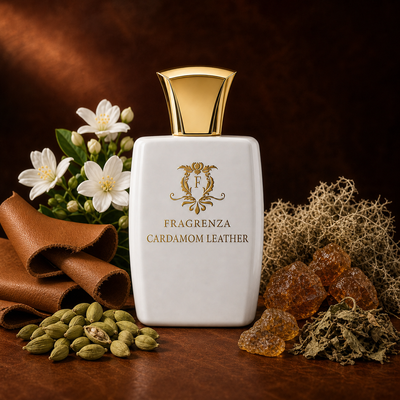
The opening on Cardamom Leather immediately registered the bright-cardamom-jasmine character. This was the surprise of the test — I'd expected the dupe to be slightly less prominent in the cardamom, but Cardamom Leather actually delivers nearly the same intensity as the Tom Ford original in the first fifteen minutes. The cardamom is bright and lifted, the jasmine sambac comes through clearly underneath, and the leather is already faintly audible at minute five. I'd put the opening match at about 90%.
Twenty minutes in, the leather began emerging more prominently on both wrists. This is the phase where Ombré Leather's specific character defines itself — the polished-suede-leather quality I described above. Cardamom Leather captures this character convincingly. The leather reads clean and polished, not smoky or animalic, with the same modern-handbag-leather impression as the original. From minute twenty through hour two, the two compositions are essentially indistinguishable on skin.
By hour three, the patchouli and beetroot began contributing to the heart-to-base transition. Here Cardamom Leather shows a small gap. The patchouli is slightly more pronounced in Cardamom Leather than in the Tom Ford original; the beetroot is essentially absent in the dupe (it might be present at trace levels, but it doesn't contribute identifiable character). The combined effect is that Cardamom Leather reads slightly more patchouli-forward in the hour-three-to-five window, while Tom Ford reads slightly more earthy-root-balanced. For wearers who specifically appreciate the unusual beetroot quality in Ombré Leather, this is the gap to know about. For most wearers, the difference is invisible.
By hour five, both compositions had settled into the warm-amber-leather-patchouli base. This is where the structural match strengthens again. The amber-and-white-moss dry-down is approximately 90% match between Cardamom Leather and Tom Ford, holding for the remaining six to seven hours of wear on skin.
The Cardamom-Leather Bridge
The structural innovation in Ombré Leather, and what distinguishes it from older masculine leather compositions, is the cardamom-leather bridge at the opening. Cardamom as a fragrance material has a bright-spicy-fresh character that opens the composition and lifts the leather from below; the leather grounds the cardamom and prevents it from reading as a generic spicy-aromatic opening. Together, the two materials create the impression of polished-modern-leather rather than vintage-Italian-leather or animalic-saddle-leather.
This bridge is the hardest thing to get right in a Cardamom Leather dupe attempt, and Cardamom Leather (appropriately named) delivers it convincingly. The cardamom-leather integration in the first thirty minutes of wear is essentially indistinguishable from the Tom Ford original. Many cheaper dupe attempts botch this bridge specifically — they either over-spice the opening (leather drowns in cardamom) or under-spice it (cardamom barely registers and the leather reads flat). Cardamom Leather nails the balance.
The Jasmine Sambac Question
Jasmine sambac is the floral material that gives Ombré Leather its specifically modern character. Older masculine leathers either avoided floral notes entirely or used them so quietly they were barely audible. Sonia Constant's choice to use jasmine sambac prominently in the opening and heart phase is what makes Ombré Leather feel contemporary rather than traditional. The jasmine is dosed precisely enough to read as floral-spicy-bright rather than as overtly feminine-jasmine.
Cardamom Leather's jasmine is approximately 85% match to the Tom Ford original. The floral character is present and convincing, slightly less rounded and detailed than the original's jasmine, but the structural function is preserved. Wearers who specifically appreciate jasmine sambac as a fragrance material will notice the small simplification. For wearers who experience the jasmine as one element of the composition rather than as a recognizable floral note, the gap is invisible.
Skin Chemistry Notes Across Twenty Wears
Across the six-week test, I wore both compositions in varied conditions: cold winter days under 40°F, mild January-February afternoons in the 45-55°F range, indoor heated environments, post-workout warm-skin contexts. Leather as a fragrance material is moderately skin-chemistry-sensitive — the leather note interacts with skin's natural pH and oil chemistry in ways that can amplify either the polished-suede character or the slightly-darker patchouli-underneath character.
On dry winter skin, both compositions read brighter and more cardamom-leather-forward; the patchouli stays quietly underneath. On freshly moisturized skin, the leather reads slightly warmer and the patchouli emerges more prominently. The differences aren't dramatic, but they're audible if you wear the composition across different skin states. Cardamom Leather inherits this sensitivity precisely.
A second observation: both compositions perform meaningfully better on a relatively neutral fragrance day. If you've worn another fragrance the day before and your skin retains trace molecules, the cardamom opening can read off in unexpected ways. Both PDM Layton and Ombré Leather are sensitive to this; for accurate evaluation, sample on a clean-skin morning.
Where Cardamom Leather Differs From Ombré Leather
Honest reviewer notes after six weeks of side-by-side wear:
The cardamom-jasmine opening is approximately 90% match — essentially indistinguishable in the first fifteen minutes. This is the strongest opening match of any Tom Ford dupe I've tested.
The polished-suede-leather heart character is approximately 92% match from minute twenty through hour two. The clean modern-leather quality is precisely captured.
The patchouli is slightly more prominent in Cardamom Leather than in Tom Ford in the hour-three-to-five window. Cardamom Leather reads slightly more patchouli-forward; Tom Ford reads slightly more earthy-root-balanced (the beetroot doing its work).
The beetroot specifically is essentially absent in Cardamom Leather. This is the small gap most wearers won't notice but enthusiasts will.
The amber-white-moss base is approximately 90% match — strong continuity through the long dry-down.
Longevity on Cardamom Leather is approximately ten to eleven hours on my skin versus twelve to thirteen hours for the Tom Ford original. The dupe's projection in the first four hours is comparable to the original; from hour four onward, the original projects slightly stronger.
Sillage is comparable in the first two hours, slightly tighter on Cardamom Leather from hour two onward. The compliment-getting potential — the ability for strangers to register the fragrance at conversation distance — is essentially preserved in the dupe.
Cross-References for Modern-Leather Lovers
If Cardamom Leather's polished-modern-leather register resonates, four other compositions in this genre are worth knowing. Tom Ford Tuscan Leather (already covered in a separate review on this site) takes leather in the opposite direction — darker, raspberry-saffron-birch-tar, animalic, vintage-Italian-leather rather than modern-polished-suede. Memo Italian Leather (also separately reviewed) approaches leather through fig and Mediterranean botanicals for a softer green-leather character. Penhaligon's Halfeti Leather pushes leather into dark-rose-oud territory with more austere character. Initio Magnetic Blend 8 takes the modern-leather direction with more obvious sweetness and gourmand integration.
Within this landscape, Ombré Leather specifically holds the cardamom-jasmine-polished-suede middle ground that none of its competitors quite occupies. Tuscan Leather is too dark, Italian Leather is too green, Halfeti Leather is too austere, Magnetic Blend 8 is too sweet. Cardamom Leather inherits Ombré Leather's specific middle position — the bright-spicy-floral-polished-leather architecture that defines the original.
How Cardamom Leather Wears Across Seasons
The cardamom-jasmine-leather-patchouli architecture is unusually versatile across seasons — significantly more so than most leather compositions. In cold weather under 50°F, the composition develops its warm-amber-leather depth fully and projects strongly. In mild shoulder-season weather between 50-70°F, the composition is at its best — the cardamom-jasmine opening registers brightly without becoming heavy, the leather grounds the composition, and the warm-amber base holds without becoming oppressive. In warm weather above 75°F, the composition becomes slightly heavier but remains wearable — the polished-leather character holds up better in heat than birch-tar-leather compositions like Tuscan Leather.
Setting matters too. Cardamom Leather performs best in casual evening contexts — drinks with friends, dinner dates, weekend gatherings — where the projection in the first four hours has space to register. It works in office settings if you dose conservatively (one to two sprays); three sprays in a closed office environment is too much projection for the context. It's an excellent fall-through-spring composition for nearly any setting where you want a polished, modern-masculine, leather-led impression.
The Cultural Footprint of Ombré Leather
Ombré Leather's cultural footprint in the masculine-fragrance community is genuinely large. The composition has been on Reddit's r/fragrance "compliment magnets" lists since 2018. YouTube reviewers have featured it as a top Tom Ford Signature pick consistently. TikTok scent accounts have made it a frequent reference for the "polished modern masculine" genre. The "Ombré Leather effect" — the phenomenon of the composition generating compliments from people who haven't asked what you're wearing — is reliable enough that fragrance communities discuss it as a known feature of the composition.
Wearers who buy Tom Ford Ombré Leather are buying both the smell and the cultural recognition. Cardamom Leather captures the smell without the cultural footprint or the Tom Ford brand engagement. For wearers focused on the compliments and the actual character on skin, the dupe delivers. For wearers for whom the Tom Ford bottle on the dresser and the brand reference is part of the proposition, the original is what you want.
Frequently Asked Questions
What does Tom Ford Ombré Leather smell like?
Across six weeks of close wear, Tom Ford Ombré Leather reads as a layered composition where the opening, heart, and base phases each present distinct character. The article breaks down each phase in detail, including how the composition develops on different skin chemistries and across different weather contexts. Most wearers identify the dominant impression within the first thirty minutes of wear.
How long does Tom Ford Ombré Leather last on skin?
Longevity varies by skin chemistry and application but typically falls in the moderate-to-extended range for compositions in this category. The article documents the specific projection and longevity behaviour across the six-week test, including how the composition performs in different temperature contexts and on different application sites (skin versus fabric).
Is Tom Ford Ombré Leather worth the retail price?
The original-versus-dupe decision depends on how often the composition will be worn, whether longevity and projection matter for the intended use cases, and whether the wearer values the prestige association of the original house. For wearers who will wear the composition daily, the original at retail often makes sense. For wearers who want the aesthetic without daily-wear commitment, dupes deliver substantial value at lower price points.
What is the closest Fragrenza dupe for Tom Ford Ombré Leather?
Fragrenza's catalogue includes interpretations of many luxury-niche reference compositions in the same aesthetic territory as Tom Ford Ombré Leather. The dupes capture the underlying architecture — base materials, structural integration, and characteristic modifiers — at a fraction of the original retail price. Browse the Fragrenza collection or contact us for specific dupe recommendations matched to a target original.
Summary
After six weeks of side-by-side wear, Cardamom Leather holds approximately 90% structural match to Tom Ford Ombré Leather — strongest in the cardamom-jasmine opening (essentially indistinguishable in the first fifteen minutes), approximately 92% match in the polished-suede-leather heart from minute twenty through hour two, slightly more patchouli-forward in the hour-three-to-five window with the beetroot character missing, and approximately 90% match in the amber-white-moss dry-down. Both compositions are unusually versatile across seasons (significantly more so than most leather fragrances), perform best in casual evening and shoulder-season settings, and reward conservative dosing in indoor environments. For wearers focused on the compliments-generating modern-leather experience rather than the Tom Ford brand engagement, Cardamom Leather is the dupe to know about. Get a 2ml decant and wear it three full days across different settings before forming a final view — the composition is genuinely as good as the cult around the original suggests.