

The Best Niche Fragrances Under £100: Luxury Scent Without the Luxury Price Tag
Niche is a philosophy, not a price tier: polarising notes, unusual combinations and skin development that rewards close attention rather than demanding it.
By Julia MorettiFragrenza makes several of the alternatives featured in our guides — here’s how we test.
5 min read
Niche Perfumery Without the Eye-Watering Price Tag
There is a persistent myth in the fragrance world that niche perfumery is exclusively the domain of those with deep pockets — that to smell truly extraordinary, you must surrender £200, £300, even £500 to a small-batch Parisian house whose bottles arrive swathed in tissue paper and self-congratulation. It is a compelling narrative, and the industry has worked hard to maintain it. But it is also, fundamentally, untrue.
The truth is that what makes a fragrance "niche" is not its price point. It is the philosophy behind it: the willingness to prioritise creative vision over mass-market appeal, to use interesting ingredients in interesting combinations, to make a scent that provokes a reaction rather than simply blending into the background. By that definition, genuinely niche-quality fragrance is available at a fraction of what the heritage houses charge — and the niche fragrance collection at Fragrenza is proof of that.
This guide is for fragrance lovers who refuse to compromise on quality but also refuse to pay luxury-goods markups for marketing budgets and retail overheads. Here are the finest niche-quality fragrances available under £100.
What Actually Makes a Fragrance Niche?
Before we curate, it is worth being precise about terminology. "Niche" has been so thoroughly co-opted by marketing departments that it has started to lose meaning. A fragrance launched by a luxury conglomerate in a limited-edition bottle is not niche, regardless of what the press release says. Niche means independent. It means the perfumer had genuine creative latitude. It means the formula was not focus-grouped into inoffensiveness.
In practical terms, niche fragrances tend to share certain characteristics: they lean into unusual or polarising notes rather than away from them; they have more interesting development on skin as the hours pass; they reward close attention rather than demanding it from across a room. These are the qualities worth seeking out — and they have nothing to do with how much the bottle costs.
The Case for Fragrance Dupes Done Properly
There is a hierarchy of quality in the fragrance dupe world that most buyers do not appreciate until they have been burned by a cheap alternative. At the bottom are synthetic imitations that approximate a famous scent for the first twenty minutes before collapsing into something flat and vaguely chemical. At the top — and this is where Fragrenza operates — are fragrances built on the same quality raw materials as the originals, structured by perfumers who understand not just what a scent smells like, but why it smells that way.
The difference is evident in the dry-down. A properly made alternative to a niche fragrance will move through the same arc of development — the bright top notes giving way to a more complex heart, settling eventually into a deep, skin-close base — because it is made with the same class of ingredients. It is the difference between a cover version performed by a musician who understands the original and one who has simply memorised the notes.
Caramelle Rosse: The Sweet Niche Statement
If you have spent any time in the world of niche fragrance, you will recognise the archetype that
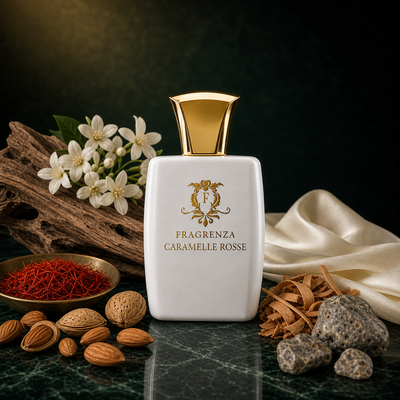
This is the kind of fragrance that niche houses charge £200 for precisely because it is unapologetically unusual — sweet enough to be memorable, complex enough to be interesting, and built to last on skin rather than evaporate within the hour. Under £100, it represents exceptional value for anyone who has wanted to explore the gourmand category without the usual financial commitment.
Santal Lush: The Quiet Luxury Benchmark
Sandalwood has been central to perfumery for centuries, but the way contemporary niche houses use it — creamy, almost milky, with a depth that seems to come from somewhere ancient — is a relatively recent development. Santal Lush belongs squarely to this tradition: a sandalwood-forward fragrance that achieves the quiet, skin-close intimacy that has made this note one of the most sought-after in modern perfumery.
What distinguishes genuinely good sandalwood fragrances from mediocre ones is the quality of the sandalwood material itself. Cheap synthetic sandalwood reads as flat and slightly waxy. The good stuff — the material used in properly made fragrances at every price point — has a warmth and dimensionality that feels almost alive on skin. Santal Lush delivers this quality consistently, making it one of the finest sandalwood fragrances available at any price under £100.
Exploring the Range: Where to Start
For those new to niche perfumery — or new to Fragrenza specifically — the smartest approach is almost always to sample before committing to a full bottle. The fragrance sample pack allows you to explore multiple scents across the range before deciding which ones deserve a permanent place on your shelf. This is how the fragrance-literate have always approached building a collection: methodically, with proper research rather than impulse purchases driven by clever bottle design.
The discount fragrances collection is also worth a look for those who want to maximise value further — particularly when building an initial collection and wanting to cover multiple occasions and moods without a significant outlay.
Building a Niche Collection Under £100
The conventional wisdom in fragrance is that you need one great scent. The more sophisticated view is that you need several — at minimum a warm-weather fragrance, a cold-weather fragrance, and something for evenings or special occasions. Under £100, it is entirely possible to build a small but genuinely impressive niche collection that covers all these bases.
Consider Santal Lush as your year-round signature: versatile enough for daily wear, distinctive enough to be memorable. Caramelle Rosse as your evening or autumn statement: richer, more declarative, the kind of fragrance that invites curiosity. And a sample pack to identify which direction your collection should develop next. That is not a compromise. That is a collection.
The Bottom Line on Niche Fragrance Value
The fragrance industry has a sophisticated apparatus for convincing you that price and quality are the same thing. The packaging, the heritage narrative, the carefully curated retail environments — all of it is designed to make you feel that the number on the price tag reflects something real about what is in the bottle. Sometimes it does. Often it does not.
What matters in a fragrance is the quality of the raw materials, the skill of the perfumer, and the originality of the creative vision. None of these things require a three-figure price tag. The finest niche fragrances under £100 are not compromises or consolation prizes. They are what good perfumery looks like when the overhead of luxury branding is removed from the equation.