Oud Explained: The World's Most Expensive Fragrance Ingredient and Why It's Worth It
Phialophora parasitica infects a tiny fraction of trees and the resin takes decades to form, which is the entire reason oud commands its price.
By Julia MorettiFragrenza makes several of the alternatives featured in our guides — here’s how we test.
6 min read
What Is Oud and Where Does It Come From?
Oud — also known as agarwood, aloeswood, or by its Arabic name oudh — is one of the oldest and most revered fragrance materials in human history. It originates in the heartwood of Aquilaria trees, a genus native to Southeast Asia and parts of South Asia, when those trees become infected with a particular mould called Phialophora parasitica. In response to this infection, the tree produces a dense, dark, aromatic resin that saturates the heartwood over a period of many years.
The result of this process — which can take decades, and which only occurs in a small percentage of Aquilaria trees — is a material of extraordinary complexity. When burned as incense, which is its oldest and most traditional application, oud produces a smoke of such richness and depth that it has been used in religious rituals, royal courts, and ceremonial contexts across the Middle East, Southeast Asia, and East Asia for millennia. When distilled into an essential oil, or used as an ingredient in perfumery, it brings those same qualities to fragrance: a dark, woody, slightly sweet, slightly smoky, occasionally animalic depth that no other material can fully replicate.
For a deeper understanding of how oud functions in contemporary perfumery and what to look for when evaluating oud fragrances, the guide to oud in perfumery provides essential background. The short answer is that oud is genuinely unlike anything else — complex, living, and deeply distinctive in a way that synthetic alternatives have not yet managed to replicate convincingly.
Why Is Oud So Expensive?
The price of genuine oud oil is, by weight, comparable to gold. This is not hyperbole and it is not marketing — it is simply the economic consequence of extreme rarity combined with intense demand. The infection that creates agarwood occurs naturally in only a small fraction of Aquilaria trees, and those trees are now heavily protected in most of their native range as a result of decades of over-harvesting. Wild agarwood of high quality is extraordinarily rare.
Plantation-grown agarwood exists and has improved significantly in quality over recent decades, but it remains expensive to produce, time-consuming to harvest, and yields oil that most connoisseurs regard as somewhat less complex than wild material. The distillation process itself is painstaking: it takes a large quantity of wood chips to produce a small quantity of oil, and the process requires careful temperature control and considerable expertise.
The result is that even a small quantity of genuine oud oil is an extremely valuable commodity. This is why oud fragrances from major houses command premium pricing, and why the agarwood fragrances in Fragrenza's agarwood collection represent genuine value in delivering authentic oud character at accessible prices.
How Oud Smells: A Guide for the Uninitiated
Oud is one of those fragrance materials that is genuinely difficult to describe to someone who has never encountered it, because it combines qualities that do not normally appear together. It is simultaneously woody and sweet, dark and bright, ancient and immediate. There is often a slightly animalic quality — something that evokes the body in a warm, sensuous rather than unpleasant way. There can be smokiness, a hint of leather, a dry woody background, and over all of it a sweetness that gives the whole composition an almost foodlike richness.
The specific character of oud varies considerably depending on its geographical origin. Indian oud, which is often considered among the finest, tends to be the most complex and animalic. Cambodian oud is typically smoother and sweeter, more accessible to Western palates new to the ingredient. Indonesian oud can be lighter and more fruity. These differences reflect variations in the Aquilaria species involved, the local soil and climate, and the specific character of the mould infection.
In contemporary Western niche perfumery, oud is most often presented in one of two ways: as the dominant character of a composition, or as a background note that adds depth and richness to a wood, rose, or amber-centred fragrance. Both approaches can produce extraordinary results.
Joyful Oud: Oud at Its Most Accessible
For those coming to oud for the first time, or those who want the richness of the ingredient without the most challenging animalic aspects,

The opening is bright and slightly fruity, with the oud appearing as a warm, resinous presence that becomes more prominent as the fragrance develops on skin. The drydown is smooth and long-lasting, with the oud blending into a base of warm woods and a subtle sweetness that makes the whole composition feel comforting and wearable across a wide range of occasions. This is oud for daily use — which is the point.
Oud Raso and Oud Velluto: The Full Oud Experience
For those ready to explore oud in its more complete, complex form, the range extends into territory that will satisfy the most dedicated agarwood enthusiast.
— the name refers to satin, the smoothest of silks — brings an oud character that is simultaneously rich and refined. There is nothing raw or challenging here, but there is genuine depth: the oud note is prominent and distinctive, wrapped in rose and musk in the manner of the great Middle Eastern rose-oud traditions.
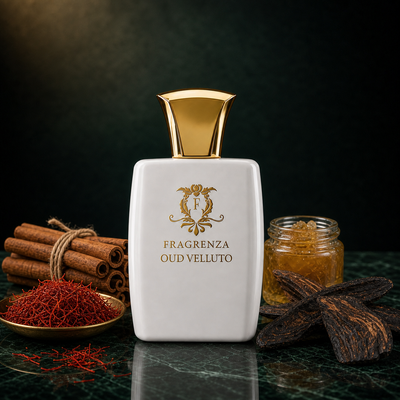
, meanwhile — velluto meaning velvet in Italian — takes the ingredient in an even more opulent direction. The name promises luxury and the fragrance delivers it: a deep, velvety oud accord that develops over hours on skin, revealing new facets as the top notes fade and the base settles into a rich, warm, enduring presence. This is oud for long evenings, for occasions that demand something extraordinary, for the days when ordinary fragrance simply will not do.
Oud in Context: A Global Tradition
To understand oud fully is to understand something of the cultural contexts that have treasured it for thousands of years. In the Gulf states of the Middle East, burning oud wood chips is both a daily ritual and a mark of hospitality — guests are welcomed with oud smoke as an expression of generosity and care. The fragrance of oud smoke clings to fabrics and hair for hours, and in many cultures this is the desired effect: to carry the scent as a mark of the occasion.
In Japan, where the material is known as jinko, the ceremonial appreciation of agarwood has its own elaborate tradition, kodo, the way of fragrance, which is considered one of the classical Japanese arts alongside the tea ceremony and flower arrangement. In these contexts, oud is appreciated with a mindfulness and attention that reminds us that fragrance, at its finest, is an art form deserving serious engagement.
The Western fragrance industry came to oud relatively recently — the first major mainstream Western oud fragrances appeared in the early 2000s — but it arrived with genuine enthusiasm. Today, oud is one of the defining ingredients of luxury perfumery globally, and the best oud fragrances available draw on all of these traditions to create something genuinely cross-cultural: an ingredient that speaks a language every nose can appreciate.