

Inspired-by alternative
Best Opus I Dupe
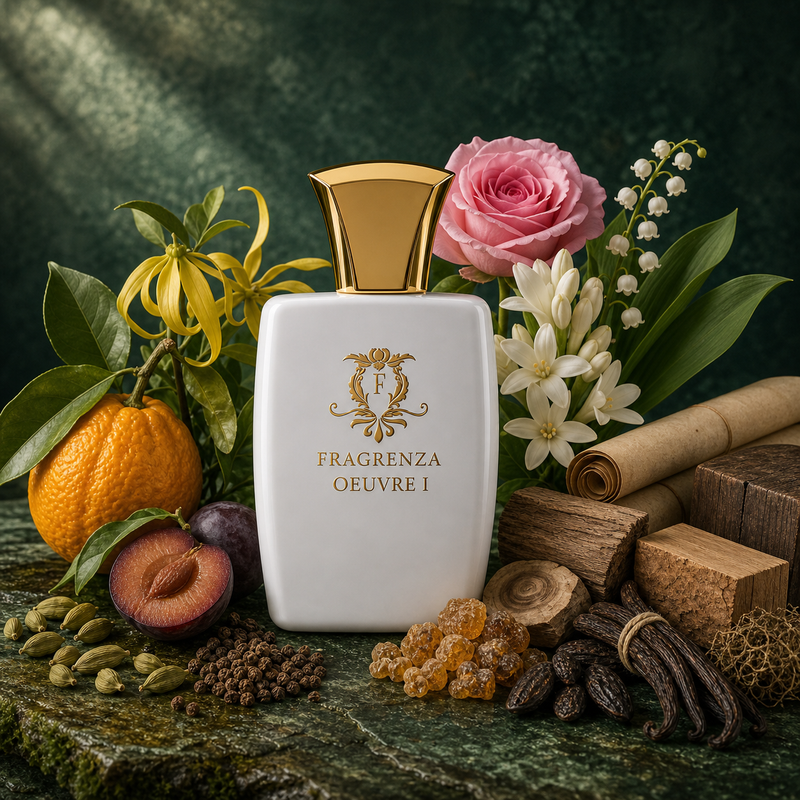
Amouage Opus I retails for $360. Oeuvre I captures the same scent character at a fraction of the price — same DNA, same 8+ hour wear, same compliments.
Why this dupe
- Captures the same chypre character that defines Opus I — top, heart, and base notes reflect the original's DNA.
- Eau de Parfum concentration with higher-than-industry-standard fragrance oil — projects and lasts 8+ hours on skin.
- Vegan, cruelty-free, paraben-free formulation. Same wearable scent without the luxury markup.
- Roughly 81% cheaper than Amouage's retail — the difference goes back in your wallet, not into brand campaigns and retail markups.
- 4.6★ across 558+ reviews from real customers — see what they're saying on the product page.
About Opus I
Opus I is a sophisticated, character-driven perfume for women from Amouage that opens with the bold, distinctive pairing of bigarade and plum. Its chypre identity is shaped by the earthy, mossy depth of ylang-ylang at the heart. The base of papyrus brings a quietly powerful finish that rewards close wear.
On skin, Opus I typically delivers excellent longevity (8+ hours) with moderate sillage — noticeable in close quarters. The price point — $360 at retail — reflects Amouage's positioning, packaging, and distribution overhead more than the cost of the formulation itself.
How to wear it
The sophistication of Oeuvre I suits formal occasions, professional settings, and evenings when you want your scent to be quietly memorable.For best longevity, apply to pulse points (wrists, neck, behind the ears) on moisturised skin.
How we matched it
Our perfumers studied Opus I's note structure — the bigarade opening, the ylang-ylang heart, the papyrus dry-down — and built Oeuvre I around that same architecture. The aim isn't a molecule-for-molecule clone; it's a faithful interpretation of the scent character at a price the market doesn't normally allow for.
What's the same: the chypre family signature, the note progression on skin, the longevity profile (8+ hours on most skin types). Where it can differ: small accord nuances in the first 30 minutes — the most volatile part of any fragrance — and slight projection variation depending on your skin chemistry. We're transparent about that. Your nose will tell you the truth before any review can.
Every Fragrenza fragrance is formulated as Eau de Parfum, vegan, cruelty-free, and paraben-free. The juice does the work; the price reflects the juice, not the brand campaign budget.
Side by side
The original
Amouage
Opus I
$360
Designer/niche pricing reflects brand positioning, retail markups, and campaign spend — not always the juice itself.
The Fragrenza alternative
Oeuvre I
$69.99
Same chypre character, formulated as Eau de Parfum, vegan and cruelty-free, built to last 8+ hours.
What it costs per spray
Amouage retail
Opus I
$0.60
per spray · ~600 sprays/bottle
Fragrenza
Oeuvre I
$0.11
per spray · ~600 sprays/bottle
A standard atomiser pushes about 0.1ml per spray, so a 60ml bottle delivers around 600 sprays before it's empty. At $69.99, Oeuvre I works out to roughly $0.11 per spray. The Amouage original at $360 sits at about $0.60 per spray — same volume, same delivery, very different per-use cost.
Project that across a year of regular wear — three times a week, two sprays per wear, about 312 sprays a year — and Oeuvre I runs roughly $36.39 for the year, against roughly $187.20 for Opus I. That's about $150.81 a year staying in your wallet — the difference covering the brand campaigns, retail concession fees, and prestige packaging that don't change what's inside the bottle.
Inside the scent
Inside each note
A closer look at the building blocks behind Opus I's scent. Each note plays a specific role across the wear arc — and links to the full Fragrenza collection of fragrances built around it.
Top — first impression
Bigarade, derived from the bitter orange tree (Citrus aurantium), is one of the most storied raw materials in the history of perfumery. Native to Southeast Asia and later cultivated throughout the Mediterranean...
The Richness of Plum in PerfumeryPlum is one of the most beloved stone fruits in the fragrance world — a note of deep, dark, sweet-tart juiciness that brings an immediate sense of...
Cardamom is one of the world's most ancient and prized spices, cultivated primarily in the lush hills of southern India, Guatemala, and Sri Lanka. Botanically known as Elettaria cardamomum, it is a...
Heart — the character
Ylang-ylang is among the most intoxicating florals in the perfumer's palette — a tropical bloom of extraordinary richness and complexity that has been central to fine fragrance for well over a century....
Rose is the undisputed queen of perfumery — a note so ancient, so complex, and so universally beloved that its history mirrors the history of fragrance itself. The two most important varieties...
Among all the ingredients in the perfumer's palette, jasmine stands apart as the undisputed queen of florals. Cultivated across India, Egypt, Morocco, and the Grasse region of southern France, jasmine flowers have...
Tuberose (Polianthes tuberosa) is native to Mexico but has been cultivated across tropical and subtropical regions for centuries, arriving in Europe in the sixteenth century where it quickly became one of the...
Lily of the valley — known in French perfumery as muguet — is one of the most storied and beloved floral notes in the history of fine fragrance. The diminutive white bell-shaped...
Base — the dry-down
Papyrus, the reed plant Cyperus papyrus, is one of the most historically resonant botanical materials in human civilization. Native to the wetlands of the Nile Delta and sub-Saharan Africa, it served as...
Cedarwood is one of the most widely used and universally loved ingredients in all of perfumery — a versatile, reliable, and deeply appealing woody note that has anchored fragrances for centuries. The...
Guaiac wood — derived from the heartwood of Bulnesia sarmientoi, a tree native to the Gran Chaco region of South America spanning Paraguay, Bolivia, and northern Argentina — is one of perfumery's...
Olibanum, more commonly known as frankincense, is one of the world's oldest and most revered aromatic resins. Harvested from the Boswellia tree — native to the arid regions of Somalia, Oman, Ethiopia,...
Tonka bean is the seed of the Dipteryx odorata tree, a leguminous giant native to Venezuela, Brazil, and the wider tropical Americas. The seeds are harvested when ripe, then dried or macerated...
Sandalwood is one of the most treasured aromatic materials in the history of human civilization. Derived primarily from the heartwood of Santalum album (Mysore sandalwood from India) and Santalum spicatum (Australian sandalwood),...
Vetiver is one of perfumery's great foundational ingredients — a note with deep roots, both literally and figuratively. Distilled from the sprawling root system of the Vetiveria zizanioides grass, primarily grown in...
Frequently asked questions
Is Oeuvre I really a dupe of Opus I?
How long does Oeuvre I last on skin?
Is it suitable for women?
What occasions is Opus I best for?
Why is Opus I so expensive?
Is Oeuvre I vegan and cruelty-free?
What's your return policy?
Try it for $9.99
Not sure? Start with the 5ml travel size. Wear it. If it's the Opus I dupe you've been looking for, upgrade to the full bottle whenever you're ready.
View Oeuvre I