

Chanel No. 5 and Cinema: How a Fragrance Campaign Became a Short Film Tradition
No fragrance has been filmed more times, photographed more often, or repositioned through cinema and advertising more strategically than Chanel No 5
By Julia MorettiFragrenza makes several of the alternatives featured in our guides — here’s how we test.
8 min read
No fragrance has been filmed more times, photographed more often, or repositioned through cinema and advertising more strategically than Chanel No 5. The bottle is older than colour television, older than commercial radio in most of the world, older than the entire concept of the celebrity endorsement as it exists today. And yet the fragrance has remained a touchstone of luxury for more than a century, in part because the brand has been extraordinarily skilful at recruiting cinema and moving images to refresh the meaning of the bottle for each new generation.
The story of No 5 on screen is also the story of how perfume marketing learned to use narrative. Earlier perfume advertising relied on still imagery, evocative copy, and celebrity portraits. Chanel under the direction of successive creative leadership figured out that perfume could be sold as a feeling generated by a film rather than as a product described in a brochure, and that insight reshaped how the entire industry communicated. To understand the cultural weight of No 5 today is to understand the cinematic campaigns that built and rebuilt its meaning.
The Original Cultural Context
When Ernest Beaux composed No 5 for Coco Chanel in 1921, the dominant feminine fragrance category was the single-flower soliflore: rose, violet, jasmine, lily of the valley. These compositions presented woman as a flower, the perfume as an extension of natural feminine delicacy. Chanel and Beaux deliberately broke from this convention by building a composition that smelled deliberately artificial, structured around a generous overdose of synthetic aldehydes that no flower produced naturally.
The aldehydic top, the abstract floral heart built from jasmine and rose absolutes layered with ylang-ylang, and the sandalwood-vetiver-vanilla base together produced a fragrance that was unmistakably modernist in its ambition. The bottle echoed the modernism: a sharp rectangular flacon with a minimalist label, the antithesis of the curved, decorated bottles favoured by the great couturiers of the previous generation. From the start, No 5 was positioned as a fragrance that did not pretend to be nature. It was art.
The Marilyn Moment
The first cinematic chapter in the story of No 5 was not a film but a magazine interview. In 1952 Marilyn Monroe was asked by Life magazine what she wore to bed, and she answered with the now-famous line about wearing only a few drops of Chanel No 5. The remark was unscripted, and Chanel did not pay for it. The cultural impact was immediate and lasting. The pairing of the most photographed woman of the mid-century with a specific fragrance bottle reshaped how perfume was understood culturally. The bottle became a character.
Sixty years later, in 2013, Chanel finally produced a campaign around archived audio of Monroe's interview, marrying her voice with film footage and the silent fragrance bottle. The campaign was a study in cultural restoration. By reaching back to a remark made decades earlier and presenting it as a contemporary statement, the brand demonstrated how a fragrance can accumulate meaning over time and how that meaning can be reactivated through new media without inventing anything.
The Cinema Director Era
Beginning in the late twentieth century, Chanel started commissioning major film directors to produce short films featuring No 5. Ridley Scott directed Pool, a 1990 commercial that operated like a compressed feature film. Luc Besson directed a 1990 piece featuring Carole Bouquet. Jean-Paul Goude produced campaigns that treated perfume advertising as music video.
The most consequential of these collaborations was the 2004 Baz Luhrmann production starring Nicole Kidman, billed as the most expensive perfume advertisement ever made and structured as a three-minute narrative film about a movie star and a writer in a city. The Luhrmann piece is critical to understanding modern perfume cinema because it abandoned product centrality almost entirely. The bottle appears briefly. The fragrance is barely mentioned. The film is about longing, glamour, the conflict between public image and private feeling. The perfume becomes a feeling distilled from the narrative, which is a complete inversion of older advertising logic where the product was the protagonist.
The Modern Successor Campaigns
Subsequent campaigns have featured Audrey Tautou directed by Jean-Pierre Jeunet, Brad Pitt as the first male spokesperson for the fragrance (a deliberate provocation given the historically gendered marketing of No 5), Gisele Bundchen directed by Baz Luhrmann a second time, and Marion Cotillard in a 2020 short film directed by Johan Renck. Each iteration has tested how far the meaning of No 5 can be stretched while remaining recognisable as a continuous brand statement.
The Brad Pitt campaign in particular generated significant cultural friction, with many viewers reading it as a misstep that undermined the gendered identity of the fragrance. In retrospect the campaign reads as a deliberate experiment in seeing what the bottle could mean if removed from its conventional context. The mixed reception itself became part of the cultural conversation, demonstrating that No 5 is one of the few fragrance properties strong enough to survive an unpopular campaign without lasting damage to its identity.
The Olfactory Conversation
While the cinematic history is the most public face of No 5, the fragrance itself has remained recognisable across the decades. The aldehydic floral architecture that Beaux composed in 1921 is still the structural identity of the modern formulation, with adjustments for regulatory changes in raw materials and shifts in consumer skin chemistry expectations. The brightness up top, the abstract floral heart, the powdered base: these elements have been preserved with care.
For wearers who appreciate the aldehydic floral architecture but want to explore how modern niche perfumery interprets that family, Sensual Flame
offers a contemporary reading. Where No 5 leans on the cool, sharp side of the aldehydic floral, Sensual Flame uses a warmer creamy floral heart with spiced amber depth, demonstrating how the same architectural family can be reframed for different aesthetic temperaments. The two compositions speak to each other across the decades, both treating florals as abstract material rather than literal flower reproduction.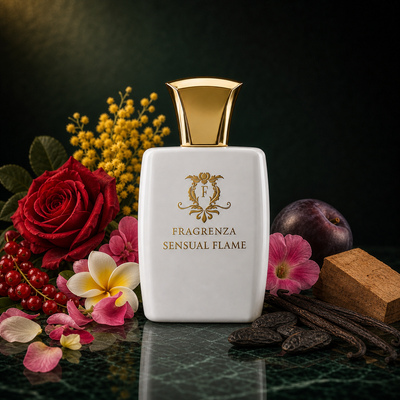
What the Cinema Campaigns Got Right
The most important lesson from the No 5 cinema history is that perfume marketing works best when it treats the fragrance as a feeling rather than a list of notes. The campaigns that endured culturally are the ones that built a mood, told a story, and let the bottle appear briefly as the object that crystallised the feeling. The campaigns that fared less well tended to feature the product more prominently, which is counterintuitive but consistent with how scent operates psychologically.
Scent works through association. The Luhrmann campaign with Kidman did not describe how No 5 smells. It described a feeling of romantic possibility and creative ambition in a city, and viewers who connected with that feeling went on to associate the feeling with the bottle. That is the mechanism by which a fragrance becomes culturally embedded, and No 5 has been more successful at this than any competitor.
Why This History Still Matters
The cinematic history of No 5 is a case study in how a luxury object can remain relevant across cultural transformations far broader than fashion or fragrance. The bottle has survived the shift from mass advertising to social media, from cinema to streaming, from the era of singular celebrities to the era of distributed influence. Each chapter required reinvention without losing recognisability, and the brand has demonstrated that the underlying olfactory identity is durable enough to support an enormous range of cultural framings.
For students of perfumery, the lesson is that a fragrance is not just a formula. It is a formula plus a story plus a set of associations, and the most enduring compositions are the ones that maintain the formula while letting the stories and associations evolve. No 5 is the clearest example we have of this dynamic at work over a century.
Related Reads
- Chanel No 5 bottle design: the modernist flacon that defined a category
- Chanel Coco Mademoiselle: the cinema sister to No 5
- Aldehydes in Perfumery: the sparkling materials that defined No 5
- Jasmine in Perfumery: the floral heart of No 5
- How to choose your signature scent: lessons from the No 5 legacy
- What is niche perfumery: the conversation No 5 anticipated
Frequently Asked Questions
Why is Chanel No 5 considered so important culturally?
No 5 introduced the modernist principle to perfumery in 1921, breaking from soliflore conventions by using overdosed synthetic aldehydes and abstract floral architecture. Its century-long marketing strategy, anchored by cinematic campaigns with major directors and stars from Monroe to Cotillard, has kept it culturally relevant across vastly different media eras. It is the clearest example of a luxury object surviving by reinvention while preserving olfactory identity.
Did Marilyn Monroe really wear Chanel No 5?
The famous 1952 Life magazine remark about wearing only a few drops of No 5 to bed was unscripted and unpaid. Whether Monroe wore the fragrance habitually outside that moment is less clear, but the cultural impact of the statement was enormous and the brand reactivated the connection in a major 2013 campaign using archived audio of her voice.
Who has directed Chanel No 5 campaigns?
Major directors include Ridley Scott (Pool, 1990), Luc Besson, Jean-Paul Goude, Baz Luhrmann (Kidman 2004, Bundchen 2014), Jean-Pierre Jeunet (Tautou), and Johan Renck (Cotillard 2020). The pattern of commissioning feature-film directors rather than commercial specialists has been central to the brand's strategy for decades.
Why did the Brad Pitt campaign generate controversy?
No 5 had been marketed almost exclusively to women since 1921, and the 2012 campaign featuring Brad Pitt as the first male spokesperson struck many viewers as an awkward break with that tradition. The mixed reception itself became part of the cultural conversation about whether luxury fragrances can be ungendered, and the campaign is now studied as a deliberate experiment in stretching brand meaning.
Has the formula of Chanel No 5 changed since 1921?
The architectural identity has been preserved, but specific raw materials have been adjusted in response to regulatory restrictions on certain natural ingredients and the availability of synthetic substitutes. The aldehydic top, abstract floral heart, and powdered base all remain recognisable to wearers familiar with vintage versions, though specialists can detect subtle differences across decades.
How does No 5 compare to modern niche aldehydic florals?
Modern niche compositions in the aldehydic floral family often reframe the architecture with warmer base materials, spicier hearts, or unconventional textural elements that the original 1921 formula avoided. The result is a family with significant internal variety, where No 5 remains the canonical reference point and modern variations offer alternative emotional registers within the same structural tradition.
The Bottom Line
Chanel No 5 is more than a perfume; it is a century-long experiment in how olfactory identity can be paired with cinematic narrative to produce enduring cultural meaning. Understanding its film history is one of the best ways to understand how the modern fragrance industry communicates, and why the bottle continues to occupy the symbolic centre of the category more than a hundred years after its first release.