
Myrtle in Perfumery: The Mediterranean Herb You Didn't Know You Loved
Myrtle is a fresh, herbaceous note prized by perfumers. Learn how perfumers use it, what it smells like on skin, and the fragrances that wear it best.
By Julia Moretti 7 min read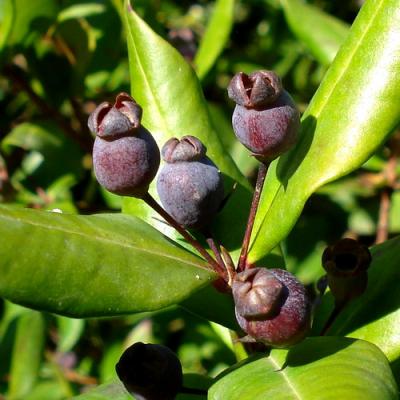
The Herb of Venus, the Note of Elegance
Myrtle is one of those ingredients that works most powerfully when it goes unnoticed. Unlike the grand, attention-commanding notes of rose or oud, myrtle operates in a more understated register — adding a brightness, a green herbal freshness, and a faintly floral lift that elevates the materials around it without demanding recognition of its own. It is the ingredient of the skilled supporting player: technically accomplished, essential to the whole, yet rarely the name on the marquee. For fragrance lovers who have ever encountered a Mediterranean-style aromatic and found themselves transported to the sun-warmed hillsides of Corsica or Sardinia, myrtle is very likely part of the reason why.
Myrtus communis, the common myrtle, is a small evergreen shrub native to the Mediterranean basin and southwestern Europe, where it grows wild along coastal clifftops and inland hillsides, filling the air with its distinctive clean-green, slightly camphoraceous aroma. It has been cultivated and revered since antiquity: sacred to Aphrodite in Greek mythology, prized by Roman brides who wore myrtle wreaths, used medicinally and aromatically across centuries of Mediterranean culture. Today it grows widely across Sardinia, Corsica, Morocco, and parts of the Middle East, and the essential oil obtained from its leaves and twigs remains a genuinely useful and characterful material in fine fragrance and aromatherapy.
What Does Myrtle Smell Like?
Myrtle essential oil has a bright, clean, herbaceous aroma with several distinct facets. The dominant impression is green and slightly camphoraceous — a crisp, almost eucalyptus-adjacent freshness that is more refined and less medicinal than eucalyptus itself. Beneath this lies a delicate floral quality: myrtle's small white flowers contribute a subtle sweetness that softens the herb's sharper aromatic edges, giving the overall impression a gentle, almost powdery elegance.
There is also a distinctly citrus-adjacent quality to good myrtle oil — a lemon-like brightness that makes it feel luminous and lifting rather than heavy or dense. This citrus facet is particularly evident in the so-called green myrtle oil distilled from younger plant material, while oil from more mature leaves and stems tends to be warmer, woodier, and slightly more camphoraceous. The result is a material that sits at a fascinating intersection of green, floral, citrus, and herbal — a Mediterranean aromatic in the truest sense.
Compared to its fellow Mediterranean aromatics — lavender, rosemary, and sage — myrtle is finer and more delicate. Lavender is more robust and more overtly floral; rosemary is sharper and more resinous; sage is earthier and more medicinal. Myrtle occupies the most elegant and restrained position in this family, making it easier to incorporate into fine fragrance without overwhelming other materials.
Extraction and Chemistry
Myrtle essential oil is produced primarily by steam distillation of the leaves and small branches of the plant. Two main types of myrtle oil are commercially available: green myrtle (from Corsica and Morocco, distilled from fresh plant material and characterised by a high content of the compound alpha-pinene and 1,8-cineole) and red myrtle (named for the reddish colour of the oil produced from more mature material, which has higher levels of myryrtenyl acetate and linalool, giving a softer, more balsamic, floral character).
The principal aromatic compounds in myrtle oil include alpha-pinene, which contributes the clean, pine-adjacent freshness; 1,8-cineole (also found in eucalyptus), responsible for the camphoraceous brightness; myryrtenyl acetate, which provides a fruity, ester-like sweetness; and linalool, shared with lavender and many floral materials, which adds a gentle floral lift. This chemical complexity is what gives myrtle its multi-faceted character — the reason it reads simultaneously as green, floral, citrus-like, and gently camphoraceous rather than as a single-note aromatic.
Myrtle in Historical and Cultural Context
Myrtle's history in human culture stretches back to at least ancient Greece, where it was sacred to Aphrodite, goddess of love and beauty. Myrtle wreaths adorned victors, brides, and the divine, and the plant was grown in temple gardens throughout the ancient Mediterranean world. The Roman naturalist Pliny the Elder wrote about myrtle's aromatic and medicinal properties, and Corsican myrtle liqueur — made by macerating the berries and leaves of the wild plant in grape spirit — has been produced on the island for centuries and remains a point of local pride.
In Corsican and Sardinian traditional medicine and perfumery, wild myrtle has always been a foundational material. The plant grows so abundantly in the macchia — the dense, aromatic scrubland that covers much of both islands — that its scent is inescapable in the summer landscape. This association with the wild Mediterranean, with sun-baked landscapes and clean sea air, is something that skilled perfumers capture and exploit when they use myrtle in composition. It is one of the most evocative of all regional botanical materials in European fine fragrance.
Note Interactions: Where Myrtle Excels
Myrtle's clean, herbal-floral character makes it an exceptionally versatile ingredient for the top and heart phases of a fragrance. Its most natural companions are citrus materials — bergamot, lemon, and orange — with which it shares the bright, luminous quality that characterises Mediterranean aromatic compositions. Where a purely citrus opening might feel thin or too brief, myrtle extends and enriches it, adding herbal complexity and a slightly longer-lasting green dimension.
Myrtle also works beautifully alongside rose and other florals, where its green quality adds naturalism and freshness. In floral compositions, myrtle functions somewhat like a stem note — the green, slightly watery, photosynthetic quality of a flower's living support system, providing context and making the floral note feel like a real bloom rather than an abstract construction. This is a sophisticated use that appears in many quality floral compositions without ever being explicitly announced.
With woody and aromatic base notes, myrtle provides a Mediterranean herbal bridge. Paired with cedar or sandalwood, it creates a scent landscape that evokes the Mediterranean macchia — aromatic shrubs growing alongside old conifers in dry, sun-filled air. With geranium, another green-floral aromatic, myrtle creates a particularly interesting accord, sharing and amplifying the green and slightly rosy facets of both materials.
Myrtle in Contemporary Fragrance
While myrtle does not appear on the fragrance front page in the way that rose or oud do, it has a consistent and valued presence in contemporary perfumery, particularly in two distinct categories. The first is Mediterranean and herbal-aromatic fragrances — the freshly-cut-herbs, sun-warmed-scrubland category that encompasses everything from classic eau de colognes to modern aquatic chypres. In this territory, myrtle is a key ingredient, one of the materials that gives these scents their specific sense of place and botanical authenticity.
The second category where myrtle appears is in certain sophisticated floral compositions, where it serves as a green modifier for white and rose florals, lending naturalism and freshness. In this role, it is rarely listed as a prominent note — it operates in the background, doing its quiet, elegant work without drawing attention. Fragrance lovers who enjoy discovering the less-discussed ingredients in their favourite scents will find myrtle a consistently rewarding note to trace.
For those exploring men's fragrances in the fresh-aromatic category, or floral fragrances with a green, naturalistic quality, myrtle is likely already part of what you love — you simply may not have had a name for it yet. Learning to recognise its clean, Mediterranean brightness is like learning to identify a particularly skilled musician in an ensemble: once you know what to listen for, the whole performance becomes richer and more rewarding.
Wearing Myrtle: A Note for All Seasons
Myrtle's clean, herbal brightness makes it particularly appealing in spring and summer, when its Mediterranean lightness feels entirely at home in warm weather. But its more resinous, camphoraceous facets also give it a certain cool-weather character — it works well in autumn aromatic compositions where its woody-herb quality adds depth without heaviness. Unlike some purely fresh or citrus ingredients that can feel out of place in the cold, myrtle's complexity gives it genuine year-round applicability.
As a note, myrtle rewards those who prize elegance over spectacle — those who find more pleasure in a fragrance that reveals itself slowly and rewardingly than in one that announces itself with maximum impact. It is the herb of Venus, after all, associated in ancient tradition with beauty, grace, and the pleasures of love rather than with force or conquest. In a fragrance wardrobe, a myrtle-containing composition occupies the role of the quietly confident choice: not the loudest thing in the room, but consistently the most interesting.