Water Fruits in Perfumery: Summer Freshness Distilled into Fragrance
Water Fruits is a salt-cool, mineral-bright aquatic: ozone-lifted, wave-cool, clean and weightless through the dry-down on skin.
By Julia Moretti 6 min read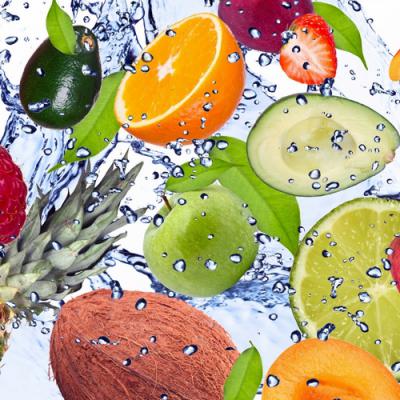
Freshness in a Bottle: The Water Fruit Revolution
The history of fragrance trends can often be told through a single dominant quality that characterises an era. The 1970s belonged to the heavy oriental — dense, voluptuous, unapologetically opulent. The 1980s were defined by the powerful, linear aldehydic floral — big, assertive, impossible to ignore. And the 1990s? The 1990s were the decade when perfumery fell in love with transparency, with lightness, with the olfactory equivalent of clear water in bright sunlight. It was the decade of aquatics, of ozonic freshness, of the fragrance that seemed to weigh nothing at all.
Within this broader revolution toward lightness and freshness, one category of ingredient played a particularly significant role: the water fruits. Melon, watermelon, kiwi, lychee, white grape, cucumber — fruits defined by their high water content, their translucent sweetness, their delicate and instantly perishable aroma. These were notes that captured something that traditional perfumery had rarely attempted: the smell of summer itself — not the heavy, sensual summer of tuberose and jasmine, but the bright, clean, energetic summer of fresh fruit eaten in the open air, now central to modern floral fragrances.
What Are Water Fruits?
The category of "water fruits" in perfumery is something of a convenient construct — a grouping of fruits that share certain olfactory characteristics rather than a strict botanical family. They include:
- Watermelon — approximately 92% water by weight, with a scent that is almost purely a clean, slightly green sweetness with no acidity to speak of
- Melon — typically Charentais or cantaloupe varieties in perfumery, with a warmer, slightly musky-sweet quality
- Kiwi — green, slightly tart, with a freshness that bridges the gap between fruit and vegetable
- Lychee — technically not a "water" fruit by water content, but its light, delicate, rose-like sweetness places it aesthetically in this family
- White grape — translucent, barely sweet, with a clean musty quality that is genuinely unusual
- Cucumber — straddling the fruit-vegetable boundary, with a clean, green, watery freshness that is one of the most cooling scents in nature
What unites these notes is their olfactory character: light, delicate, transparent, cooling. They smell of water and sunlight rather than rich, concentrated sweetness. They are the fragrance equivalent of a glass of cold water on a hot day — immediately refreshing, satisfying in a way that does not overwhelm.
The Health and Cosmetic Appeal of Water Fruits
The appeal of water fruits extends well beyond their fragrance. Nutritionally, they are exceptional: high in vitamins, minerals, and antioxidants, low in calories, and profoundly hydrating. Watermelon contains lycopene, the same powerful antioxidant found in tomatoes, along with vitamin C and B vitamins. Kiwi fruit is famously rich in vitamin C — containing as much per gram as several varieties of citrus. Lychee provides significant quantities of vitamin C and copper.
In cosmetics, the active compounds from water fruits have found extensive application: watermelon seed oil in moisturisers, kiwi extract in brightening serums, lychee antioxidants in anti-ageing formulations. The industry's recognition that what smells fresh often also provides genuine skin benefits has helped to position water fruit ingredients as dual-purpose — simultaneously sensory pleasures and functional skincare actives.
It is no coincidence that the rise of water fruit fragrances in the 1990s and 2000s coincided with a broader cultural shift toward health consciousness and the valorisation of the "natural." These fragrances felt healthy, they felt clean, they felt like the olfactory expression of a lifestyle choice rather than merely a personal adornment.
How Water Fruit Notes Are Created
None of the classic water fruits yield conventional essential oils through distillation. The aromatic compounds responsible for their characteristic scents are highly volatile and water-soluble — they dissipate rapidly at the temperatures required for steam distillation, and solvent extraction typically captures only a pale ghost of the living fruit's aroma.
Water fruit notes in perfumery are therefore primarily synthetic constructions. The key molecules include:
- Cis-3-hexenol and related green aldehydes — contribute the fresh, green quality that sits underneath watermelon and kiwi notes
- Ketal and acetal materials — provide the characteristic sweet-watery quality of melon and watermelon
- Aldehyde C14 (peach aldehyde) — in small quantities, contributes a fruity warmth that gives melon notes their characteristic body
- Hedione — a jasmine-related material with a clean, diffusive, almost watery quality that works beautifully in water fruit contexts
- Calone and related marine materials — the connection between aquatic notes and water fruit notes is deep; many of the same molecules appear in both families
The headspace technique has been particularly valuable in identifying the precise molecular composition of water fruit aromas, enabling perfumers to construct increasingly accurate and sophisticated reconstructions.
Water Fruits in Iconic Fragrances
The water fruit note achieved its first major commercial success in the context of the aquatic fragrance boom of the early 1990s, a revolution well represented in men's fragrances. Fragrances like Davidoff's Cool Water (1988) and Issey Miyake's L'Eau d'Issey (1992) had already established the market for transparent, water-inspired freshness. Water fruit notes arrived as the natural next step — adding sweetness and summer warmth to the clean, ozonic freshness of aquatics.
Calvin Klein's CK One Summer series became the flagship for water fruit experimentation, returning season after season with new takes on the melon-watermelon-citrus fresh accord. The 2012 and 2013 editions, pairing water fruit notes with mint and lotus, were particularly successful. Escada's Ocean Blue used water fruit alongside marine and hawthorn notes for a particularly evocative, clean summery accord.
For masculine fragrances, water fruits found a natural home in woody-aquatic compositions. Bazar Pour Homme by Christian Lacroix combined water fruit with yuzu, grapefruit, and lavender to create an airy, tonic opening. Ralph Lauren's Polo Black deployed water fruits within a woody-aromatic structure, using the note's freshness to cut through the depth of the base without losing the masculinity of the composition overall.
Pairing Notes for Water Fruits
- Marine and ozonic materials — the natural partnership; water fruits and aquatic notes share olfactory DNA and blend seamlessly
- White florals — freesia, lily of the valley, and orange blossom all benefit from water fruit's transparent sweetness, as seen in many of our women's fragrances
- Bergamot and citrus — brightness amplifies water fruit's fresh quality into something genuinely luminous
- Lavender and herbs — in masculine contexts, the clean herbal quality of lavender complements water fruit's softness beautifully
- Cedarwood and light woods — provides structure and grounding without overwhelming water fruit's delicacy
- Sheer musks — particularly polycyclic and macrocyclic musks, which add longevity without weight
Water Fruits and Contemporary Perfumery
After their dominance in the 1990s and 2000s, water fruit notes went through a relative quiet period as the fragrance market swung toward darker, richer, more complex compositions — the gourmand orientals, the heavy florals, the intensely resinous niche releases that defined the 2010s. But like all genuine trends, their appeal never fully disappeared. The desire for freshness, for lightness, for that specific quality of transparent summer sweetness is perennial.
Contemporary niche perfumery is increasingly revisiting the water fruit category with more sophisticated tools and a more nuanced approach — using these notes not as the dominant statement but as a counterpoint to heavier materials, a way of adding unexpected airiness to compositions that might otherwise feel relentlessly dark. The result is a new generation of water fruit-inflected fragrances that feel simultaneously nostalgic and completely modern.
The water fruit note is, ultimately, one of perfumery's greatest democratic gestures — a note that is immediately pleasing to almost everyone, that demands nothing of the wearer, and that delivers the straightforward pleasure of summer captured in a bottle. Explore our best-selling fragrances for the finest water-fruit-forward options. In a medium that can sometimes take itself very seriously, there is something genuinely lovely about that.