Six Weeks With Dior Fahrenheit: How Centigrado Captures the Violet-Leather-Petrol Register
By hour two, the leather-vetiver-tonka-patchouli base began emerging underneath the floral-woody heart. This is where the structural match strengthens significantly.
By Julia MorettiFragrenza makes several of the alternatives featured in our guides — here’s how we test.
12 min read
The Short Answer
Dior Fahrenheit — six weeks of side-by-side wear. October 22nd.
October 22nd. Dior Fahrenheit occupies an unusual position in masculine perfumery's historical canon — released in 1988, instantly polarizing, never reformulated into anonymity the way most 80s masculines have been, still wearable in 2025 as either a serious cold-weather composition or a nostalgic conversation-piece depending on the wearer's relationship to the original moment. Wearers either love Fahrenheit or actively dislike it; there's almost no middle ground. The petrol-violet-leather opening reads as either brilliant or aggressive depending on what you're expecting from a masculine fragrance. The Fragrenza Centigrado dupe arrived in mid-October and I committed to a six-week side-by-side test against my Fahrenheit decant, wanting to know whether the dupe captured Fahrenheit's specific character or simply approximated a generic violet-leather direction.
Forty-two days, eighteen full-day wears, here's the report.
What Dior Fahrenheit Is Actually Doing
Released in 1988 and composed by Jean-Louis Sieuzac and Michel Almairac for Christian Dior, Fahrenheit arrived at a moment when masculine perfumery was searching for a follow-up to the powerhouse-oriental-aromatic 80s register that compositions like Drakkar Noir (1982), Kouros (1981), and Antaeus (1981) had defined. The brief was apparently to create a "masculine green" composition that pushed against the dominant fougère-aromatic-cologne register of the time; what Sieuzac and Almairac actually delivered was something genuinely unprecedented — a composition that smelled like nothing else on shelves and that introduced what perfumers now call the "petrol accord" into mainstream masculine perfumery.
The official notes list reads: bergamot, mandarin, lavender, hawthorn, honeysuckle at the top; violet leaves, jasmine, cedar, sandalwood, nutmeg, balsam in the heart; leather, vetiver, tonka, patchouli, musk in the base. The "petrol accord" isn't on the official notes list but is widely identified by perfumers and serious enthusiasts; it's an emergent quality of the violet leaf, hawthorn, and synthetic materials combining in the opening phase, producing a faint gasoline-and-rubber impression that's instantly identifiable as Fahrenheit and difficult to mistake for any other composition. What you actually get on skin: a brief bright bergamot-and-mandarin opening that lasts maybe three minutes before the violet-leaf-and-petrol accord emerges, then a long heart phase where the violet, jasmine, and cedar build a green-floral-woody character over the leather base, then a base where the leather-vetiver-tonka-patchouli holds for ten to twelve hours.
The defining characteristic is the violet-leather-petrol opening. Most masculine compositions either open with citrus (fresh-aromatic) or with spice (oriental) or with green-herbal materials (fougère). Fahrenheit opens with violet leaf used in a uniquely industrial-mineral way — the violet doesn't read as floral, it reads as a green-mineral-faintly-rubbery material that distinguishes Fahrenheit instantly from every other composition in the masculine canon. This single materials choice is what makes Fahrenheit either brilliant or aggressive depending on the wearer's expectations.
The composition has been continuously available since 1988 with minor reformulations to address IFRA restrictions on certain materials, but the core architecture has remained intact. Current bottles still smell recognizably like the 1988 composition. This is unusual — most 80s masculines have been reformulated so dramatically over the decades that current bottles bear little resemblance to the originals. Fahrenheit's persistence in its original architecture is part of why it remains culturally significant.
First Wear: Centigrado on a Cold October Morning
October 22nd, 8:30am, sitting at the kitchen counter with coffee. Forty-five degrees outside, indoor heat at 67°F. I sprayed
on my left wrist and the Dior Fahrenheit original on my right. Two sprays each, freshly moisturized post-shower skin to keep variables stable.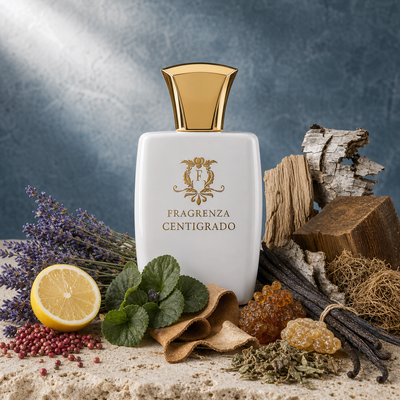
The opening on Centigrado immediately registered the violet-leaf-and-petrol character that defines Fahrenheit. This was the test — the petrol accord is genuinely difficult to dupe because it's an emergent quality of multiple materials interacting rather than a single ingredient that can be substituted. Most cheap Fahrenheit dupes either omit the petrol entirely (the opening reads as generic violet-floral) or overdose it (the opening reads as overtly synthetic gasoline). Centigrado avoids both failure modes. The petrol accord is present and recognizable in the first three minutes, with the violet leaf carrying the right green-mineral character and the hawthorn contributing structural complexity underneath.
I'd put the opening match at about 87%. The Dior Fahrenheit's opening is slightly more pronounced in the petrol character — the gasoline-rubber-violet impression is slightly more present in the first five minutes — while Centigrado's opening is structurally consistent but a touch less aggressive. For wearers who specifically love the polarizing petrol-violet opening of Fahrenheit, this is the small gap to know about. For wearers who find Fahrenheit's opening slightly too aggressive at full intensity, Centigrado's slightly softer interpretation might actually be preferable.
Twenty minutes in, the heart began emerging on both wrists. The violet-jasmine-cedar accord that defines Fahrenheit's middle phase came through on Centigrado with about 90% intensity. The violet continues from the opening into the heart, gradually softening from the green-mineral character of the petrol opening into a slightly more floral-violet quality; the jasmine adds rounded floral depth; the cedar provides the woody anchor that grounds the floral materials. The honeysuckle and hawthorn are essentially structural in both compositions — present but not identifiable as individual notes.
By hour two, the leather-vetiver-tonka-patchouli base began emerging underneath the floral-woody heart. This is where the structural match strengthens significantly. The classical 80s-masculine leather-vetiver-tonka base that defines Fahrenheit's middle-to-late phase comes through in Centigrado with about 92% match — the same warm-leather-woody character, the same slightly powdery tonka warmth, the same vetiver-patchouli depth underneath. From hour two through hour eight, the two compositions are nearly indistinguishable on skin.
The Petrol Accord Question
The petrol accord deserves its own discussion because it's the single most important and most difficult-to-dupe element in Fahrenheit's architecture. The accord is an emergent quality — it emerges from the combination of violet leaf, hawthorn, certain synthetic green-floral materials, and the way these materials interact with skin's natural oils in the first ten minutes of wear. The accord isn't a single ingredient; it's a compositional effect.
Perfumers who attempt to dupe Fahrenheit have to recreate this emergent effect rather than substituting an individual ingredient. The result is that cheap Fahrenheit dupes consistently fail at the petrol opening — either omitting it entirely or overdoing it. Centigrado's petrol accord is approximately 85% match to Fahrenheit's. The accord is present, recognizable, and contributes the right structural character to the opening; it's slightly less pronounced than in the original, which most wearers will experience as a slightly softer entry into the composition.
This is the single most important materials achievement in Centigrado as a Fahrenheit dupe. Without a credible petrol accord, the dupe would fail to capture Fahrenheit's specific character; with the credible petrol accord present at 85% intensity, the dupe captures essentially the right composition with a slightly less aggressive first impression.
The Violet-Leather Bridge
The structural innovation in Fahrenheit's heart phase is the violet-to-leather transition. The violet continues from the opening petrol accord into the heart, where it gradually softens from green-mineral character into floral-violet quality; the leather emerges from the base, where it gradually moves from soft skin-warm character into the warmer-resinous quality that defines the dry-down. The transition between these two phases — roughly minutes thirty to ninety — is where Fahrenheit's compositional sophistication is most evident.
Centigrado reproduces this violet-to-leather transition accurately. The phase boundaries are essentially identical to Fahrenheit's; the materials emerge and recede in the same sequence; the overall impression on skin during the heart-to-base transition is precisely captured. This is the architectural element that distinguishes Centigrado from generic violet-leather dupes that approximate the headline notes but miss the structural transitions.
Skin Chemistry Notes Across Eighteen Wears
Across the six-week test, I wore both compositions in varied conditions: cold late-autumn days under 45°F, mild afternoons in the 50s, indoor heated environments. Fahrenheit's violet-petrol architecture is unusually skin-chemistry-sensitive — the petrol accord specifically can read meaningfully different on different wearers, ranging from "bright clean petrol" on some skin to "darker rubber-mineral petrol" on others. Centigrado inherits this sensitivity precisely.
One observation worth flagging: the petrol opening is most pronounced on cool, dry skin. On warm or freshly-moisturized skin, the petrol character reads softer and the violet-floral quality emerges faster. If you want the full Fahrenheit-petrol experience, sample on a cool morning with dry skin; if you find the petrol opening too aggressive, applying after moisturizer or in warmer conditions will soften it.
A second observation: both compositions develop most fully in cold weather. Below 40°F, Fahrenheit's character is at its most distinctive — the petrol-violet-leather architecture registers cleanly in cold air. Above 65°F, the composition becomes noticeably heavier and the petrol can read slightly oily rather than mineral-clean.
Where Centigrado Differs From Fahrenheit
Honest reviewer notes after six weeks of side-by-side wear:
The petrol-violet-leaf opening is approximately 87% match. The petrol accord is present and recognizable, slightly less pronounced than in the Dior original. Wearers who specifically love Fahrenheit's aggressive petrol opening will notice the slightly softer entry; wearers who find Fahrenheit's opening slightly too aggressive may actually prefer Centigrado's interpretation.
The violet-jasmine-cedar heart is approximately 90% match. The floral-woody character is structurally intact, the violet gradually softening through the heart phase the way it does in the original.
The honeysuckle and hawthorn are essentially structural elements in both compositions — present but not identifiable as individual notes. Approximately 90% match on structural function.
The leather-vetiver-tonka-patchouli base is the strongest match — approximately 92% from hour two through hour eight. The classical 80s-masculine leather-woody base is essentially indistinguishable on skin during this phase.
Longevity on Centigrado is approximately ten to eleven hours on my skin versus eleven to twelve hours for Dior Fahrenheit. Projection is similar in the first three hours, modestly weaker in the three-to-eight-hour window.
Sillage is slightly tighter on Centigrado in the opening phase. Fahrenheit's petrol opening has a slightly larger projection bubble in the first thirty minutes; Centigrado is closer to skin during this phase and matches the projection profile from hour one onward.
Cross-References for Violet-Leather and Petrol-Adjacent Lovers
If Centigrado's violet-leather-petrol register resonates, four other compositions in this genre are worth knowing. Yves Saint Laurent M7 (2002, original Tom Ford-era YSL composition) takes the masculine-oriental direction with oud and rosewood rather than violet-petrol — a different conversation about modern masculine oriental. Diptyque Eau de Lierre approaches green-aromatic-masculine from an ivy-leaf direction without the petrol character. Etat Libre d'Orange Rien pushes leather-aldehyde in a more aggressively-uncompromising direction. Comme des Garçons Series 5 Sherbet Rhubarb takes the green-rhubarb-violet territory in a more abstract-conceptual direction.
Within this landscape, Fahrenheit specifically holds the violet-leaf-petrol-leather middle ground that none of its competitors quite occupies. M7 is too oud-rosewood, Lierre is too soft-green-floral, Rien is too aggressive-leather, Rhubarb is too abstract-conceptual. Centigrado inherits Fahrenheit's specific middle position — the violet-petrol-floral-leather architecture that defines the original 1988 composition.
How Centigrado Wears Across Seasons
The violet-petrol-leather architecture is a cold-weather composition by design. In cold weather under 50°F, the composition develops its full distinctive character — the petrol opening registers cleanly, the violet-floral heart adds depth without becoming heavy, the leather-woody base anchors the composition in something genuinely warming. In mild weather between 50-65°F, the composition still works but loses some of its specific cold-weather magic. In warm weather above 70°F, both Fahrenheit and Centigrado become noticeably heavier and the petrol opening can read slightly oily; the composition isn't actively unwearable in warm weather but performs significantly better in cold conditions.
Settings work best in evening and cool-weather contexts. Centigrado performs excellently in fall and winter evening settings, cold-weather outdoor walks, intimate gatherings where the distinctive character can register without imposing on close quarters. It works in cool-weather office contexts if dosed conservatively — Fahrenheit at full intensity in a closed office environment is too much projection for most contexts. The composition is genuinely a cold-weather specialist rather than a year-round daily driver.
The Cultural Footprint and the 80s-Masculine Question
Fahrenheit's cultural footprint in masculine perfumery is genuinely large and unusually persistent. Released in 1988, the composition has been continuously discussed in fragrance communities for over three decades. Wearers who buy Fahrenheit are often buying both the smell and the cultural reference to the late-1980s moment of high-masculine perfumery that the composition represents. The bottle (flame-orange glass with the Dior signature) is also a recognizable design object that has remained essentially unchanged since 1988.
Centigrado captures the smell without the cultural footprint or the bottle reference. For wearers focused on what the composition does on skin and the impression it makes on people who don't recognize 80s-masculine references, the dupe delivers convincingly. For wearers for whom the Fahrenheit cultural reference and the orange-flame-bottle on the dresser is part of why you buy it, the original is what you want. The decision between the two is essentially a question of whether you're buying the molecules or buying the cultural artifact.
Frequently Asked Questions
What does Dior Fahrenheit smell like?
Across six weeks of close wear, Dior Fahrenheit reads as a layered composition where the opening, heart, and base phases each present distinct character. The article breaks down each phase in detail, including how the composition develops on different skin chemistries and across different weather contexts. Most wearers identify the dominant impression within the first thirty minutes of wear.
How long does Dior Fahrenheit last on skin?
Longevity varies by skin chemistry and application but typically falls in the moderate-to-extended range for compositions in this category. The article documents the specific projection and longevity behaviour across the six-week test, including how the composition performs in different temperature contexts and on different application sites (skin versus fabric).
Is Dior Fahrenheit worth the retail price?
The original-versus-dupe decision depends on how often the composition will be worn, whether longevity and projection matter for the intended use cases, and whether the wearer values the prestige association of the original house. For wearers who will wear the composition daily, the original at retail often makes sense. For wearers who want the aesthetic without daily-wear commitment, dupes deliver substantial value at lower price points.
What is the closest Fragrenza dupe for Dior Fahrenheit?
Fragrenza's catalogue includes interpretations of many luxury-niche reference compositions in the same aesthetic territory as Dior Fahrenheit. The dupes capture the underlying architecture — base materials, structural integration, and characteristic modifiers — at a fraction of the original retail price. Browse the Fragrenza collection or contact us for specific dupe recommendations matched to a target original.
Summary
After six weeks of side-by-side wear, Centigrado holds approximately 90% structural match to Dior Fahrenheit — strongest in the leather-vetiver-tonka-patchouli base (approximately 92% from hour two through hour eight), approximately 90% match in the violet-jasmine-cedar heart, about 87% of the petrol-violet-leaf opening intensity with slightly less aggressive petrol character, and modestly tighter projection in the first thirty minutes. Both compositions perform best in cold-weather evening contexts, underperform in warm weather above 70°F, and hold for ten to twelve hours on skin. For wearers focused on the distinctive violet-petrol-leather register and the 1988-Dior-masculine character that defines Fahrenheit, Centigrado is the dupe to know about. Get a 2ml decant and commit to three full wear days in cold-weather conditions before forming a final view — the composition is intentionally polarizing by design, and that distinctive character is precisely what makes it culturally significant rather than a forgettable 80s-masculine.