

Cherry Perfumes in 2026: The New Releases and Lasting Classics Worth Knowing
Tom Ford's 2018 Lost Cherry colonised the cherry note for almost a decade, but bright Bing, tart Morello and cherry blossom are finally being explored as separate registers in their own right.
By Julia MorettiFragrenza makes several of the alternatives featured in our guides — here’s how we test.
4 min read
There is a particular cruelty to the way cherry became synonymous, for several years, with a single fragrance. Tom Ford's Lost Cherry arrived in 2018 and, through sheer force of character and cultural timing, colonised the entire note. Cherry meant Lost Cherry. Cherry meant that specific vision of boozy, almond-laced, dark fruit decadence. Everything else in the cherry spectrum — the brightness of fresh Bing, the delicate whisper of cherry blossom, the tart edge of Morello — existed in its shadow.
That period is over. What is happening with cherry in 2026 is something categorically different, broader, and considerably more interesting. This is not a single-fragrance moment. This is an entire note family finally being explored with the seriousness it deserves.
Understanding the Cherry Spectrum
Before navigating the current landscape, it helps to understand what perfumers mean when they reach for cherry — because cherry in fragrance is not a monolithic thing. At one end sits the bright, almost effervescent quality of fresh cherry: clean, slightly sweet, with a watery juiciness that reads as contemporary and wearable in almost any context. This is the cherry of spring, of transparency, of fragrances that feel like good weather.
Move along the spectrum and you encounter cherry's richer personalities. Morello cherry brings tartness and depth, a slight funkiness that prevents sweetness from becoming saccharine. Black cherry pushes further into dark fruit territory, often pairing with labdanum, patchouli, or vetiver to create something genuinely brooding. And then there is cherry blossom, which is perhaps less cherry than it is floral-sakura-adjacent — a translucent, slightly powdery interpretation that has its own devoted following and sits apart from the flesh-fruit expressions entirely.
Why 2026 Is Cherry's Defining Year
Several converging forces have made this cherry's moment. The ongoing rehabilitation of fruity fragrance — once dismissed as unsophisticated by the fine fragrance establishment — has created space for fruit notes to be treated with genuine creative ambition. Perfumers who previously might have avoided cherry for fear of association with cheap confectionery are now leaning into its complexities. The results have been extraordinary.
There is also a generational dimension to this. Younger fragrance consumers, who grew up with the democratisation of fragrance knowledge and arrived without the categorical prejudices of an earlier era, have no particular reason to avoid cherry. They evaluate each fragrance on its merits rather than its note family's reputation. Their enthusiasm has given houses permission to invest seriously in cherry-forward compositions.
The Established Classics and the New Contenders
Tom Ford's Lost Cherry remains the reference point for dark, boozy cherry — and it remains exceptional at what it does. The combination of Turkish rose, black cherry, and bitter almond liqueur is precise, intentional, and wears with authority. It has earned its place as a modern classic. But the mistake would be to assume that is the ceiling of what cherry fragrance can be.
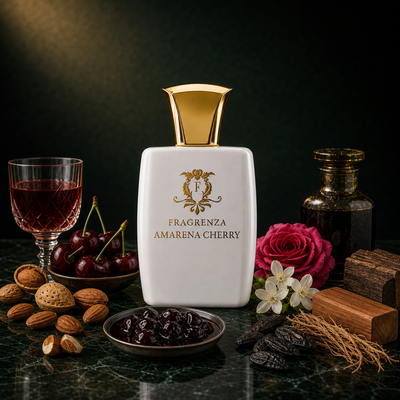
Fragrenza's Amarena Cherry takes a different position on the spectrum entirely, working with the tart brightness of Amarena cherries — the Italian variety used in classic desserts and cocktails — to create something simultaneously nostalgic and sharply contemporary. Where Lost Cherry moves toward darkness, Amarena Cherry maintains a bittersweet clarity that feels more wearable across a broader range of contexts and seasons.
Among the new arrivals of 2026, the most compelling releases have tended to explore the intersection of cherry with unexpected partners: marine notes for freshness, iris for powdery elegance, smoked wood for complexity. The cherry-meets-tobacco releases have been particularly interesting, developing a dry, almost leathery cherry quality that sits far outside the conventional fruity register.
Choosing Your Cherry
The question to ask yourself is not whether you like cherry but what you want cherry to do for you. If you are looking for a statement scent with genuine projection and presence, the dark, boozy expressions will serve you well in cooler months when their richness can fully express itself. If you want something that wears closer to the skin and transitions gracefully from day to evening, the tart or fresh cherry interpretations offer considerably more versatility.
Cherry blossom fragrances operate differently again — lighter, more evanescent, ideal for those who want a suggestion of the note rather than a declaration of it.
What Cherry's Moment Tells Us
The elevation of cherry is part of a broader story about fruity fragrance finally receiving its critical due. A category that the fine fragrance establishment long treated with condescension has produced, in 2026, some of the most technically accomplished and emotionally resonant work of the decade. Cherry led the charge. The rest of fruit fragrance is following closely behind.
Discover at Fragrenza
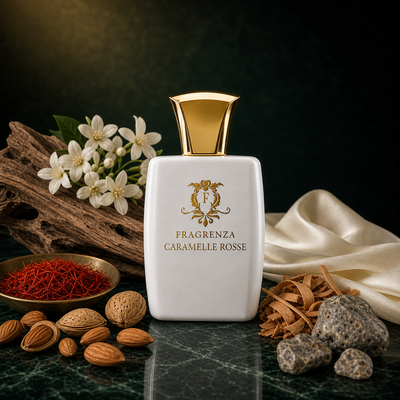
Cherry fragrance in 2026 rewards those willing to explore beyond the obvious reference points — and Fragrenza offers two distinct takes on this versatile note.
delivers the tart, bittersweet brightness of Italian Amarena cherries in a composition that is as wearable as it is distinctive, while