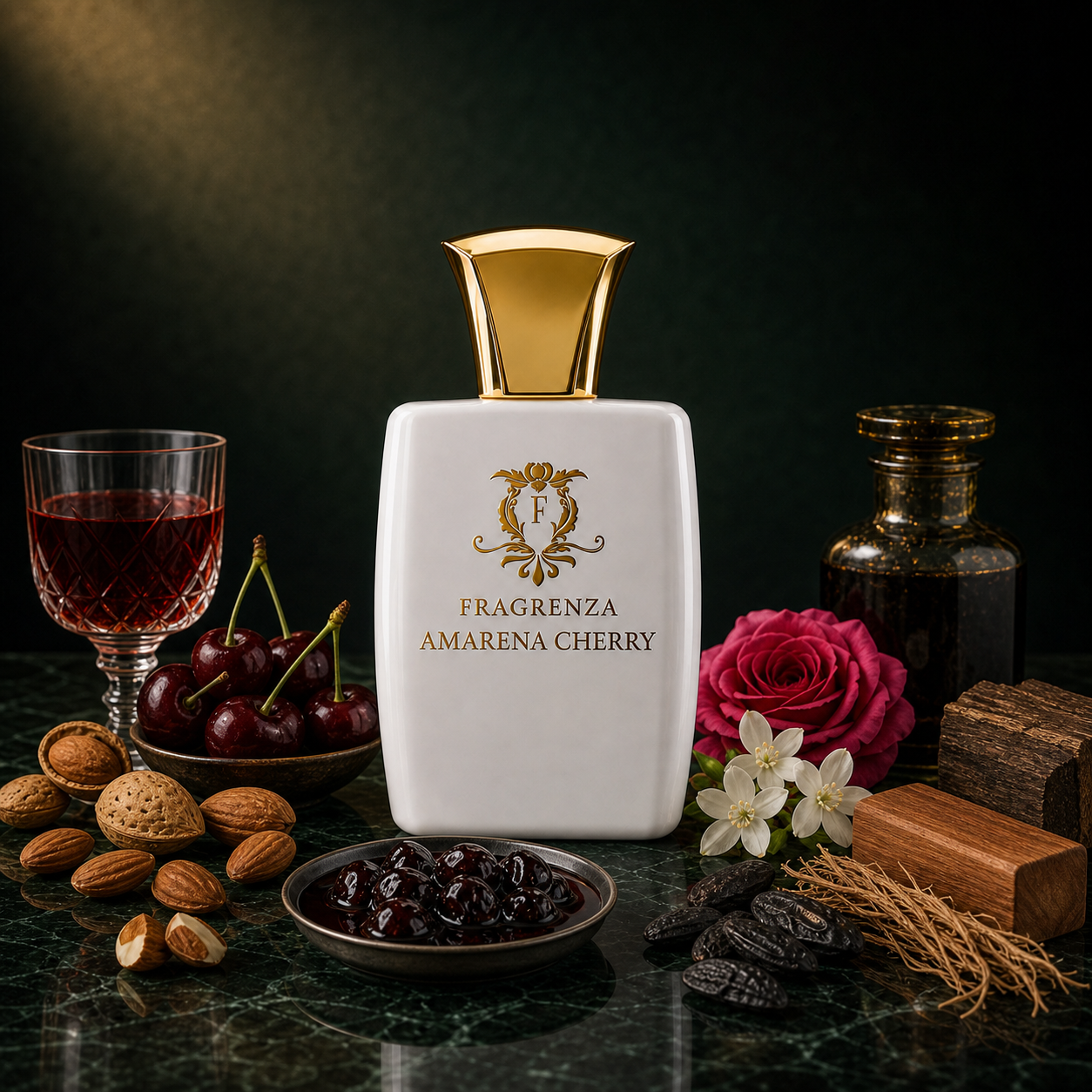


Coffee Perfumes 2026: The Roasted Anchor of the Modern Savory Gourmand
Coffea arabica bean absolute carries the daily-ritual familiarity that lifts compositions out of the dessert register, which is why coffee now anchors so much modern savoury gourmand work.
By Julia MorettiFragrenza makes several of the alternatives featured in our guides — here’s how we test.
14 min read
Coffee is the most quietly revolutionary note in contemporary fine fragrance. It smells warm without being sweet, gourmand without being dessert, sophisticated without being inaccessible. The material occupies a unique position in modern perfumery: it carries the comforting familiarity of a daily ritual while delivering an aromatic complexity that few other gourmand materials approach. Where vanilla can read as cloying and caramel as juvenile, coffee retains a grown-up gravity that lifts compositions out of the dessert register and into something altogether more interesting.
Through 2025 and into 2026, coffee has emerged as one of the most important anchors of the contemporary savory gourmand register. The material's roasted depth and slightly bitter complexity make it the natural counter-weight to the honeyed, sometimes-saccharine sweetness of conventional gourmand materials. This is the complete guide to the best coffee fragrances in the Fragrenza line, organized by the four coffee archetypes that define the contemporary commercial landscape.
For the broader savory gourmand register that coffee now anchors, the savory gourmand 2026 guide is the cluster's anchor pillar.
What coffee actually is in fine perfumery
Coffee in fine fragrance is derived primarily from roasted coffee bean absolute (Coffea arabica), produced through solvent extraction of the green bean and then progressively darker roasts to capture different facets of the material's aromatic profile. The fragrance industry also uses synthetic coffee accords (typically blends of pyrazines, furanones, and ketones) that approximate the natural's character while bypassing the cost and supply volatility of high-quality coffee absolute.
The chemistry of coffee aroma is famously complex; roasted coffee contains over 800 identified volatile compounds, more than wine or whiskey. The materials that matter most for perfumery use are 2-methylpyrazine and related pyrazines (which contribute the roasted-nutty character that gives coffee its unmistakable signature), furfurylthiol (responsible for much of the wet-coffee aromatic intensity), furanones (caramelized-sweet facets), and methylpyrazinyl methyl ketone (the warm-burnt aroma that connects coffee to other roasted gourmand materials).
What coffee actually smells like in concentrated perfumery use depends heavily on the roast level the perfumer is working with. Light-roast coffee accord reads bright, slightly fruity, almost herbal. Medium-roast reads as the canonical coffee-bean character: warm, nutty, slightly chocolatey, balanced. Dark-roast reads burnt-bitter, intensely roasted, with the slight char that pushes the material into the broader burnt-sweet register. Most contemporary fragrances use medium or dark roasts; light-roast coffee accords are rarer and tend to appear in niche aromatic or fresh-gourmand compositions.
Coffee pairs uniquely well with three material families in perfumery: vanilla and tonka (which share warm coumarinic chemistry and create the classical coffee-gourmand pairing), rose and saffron (which produce the modern coffee-rose register pioneered by Middle Eastern-influenced niche), and cacao and chocolate accords (which extend coffee's dessert-adjacent character into properly gourmand territory while preserving its roasted-bitter complexity).
Coffee in modern perfumery
Coffee was a quiet undercurrent in commercial perfumery through most of the 20th century, appearing as a supporting note in a handful of orientals but rarely as a foregrounded character. The category's modern breakthrough came in two stages.
Thierry Mugler Angel (1992) contained coffee-adjacent praline accords that hinted at the gourmand-coffee direction without fully committing to it. The fragrance's commercial success established gourmand as a viable mainstream register and created the conditions for explicit coffee compositions to follow. YSL Black Opium (2014) was the genuine breakthrough: a coffee-vanilla-incense composition that put coffee front and center as the dominant character and proved the material could anchor a mass-market prestige feminine. Black Opium became one of the best-selling perfumes of the 2010s and inspired a wave of coffee-forward releases across niche, designer, and accessible-prestige tiers.
The contemporary moment (2024 through 2026) has seen coffee move from supporting note to one of the central characters of the savory gourmand wave. The material's roasted-bitter complexity makes it the natural anchor for compositions that want to read as gourmand-adjacent without committing to full dessert sweetness. It is the single most useful material for taking a gourmand composition out of the dessert register and into the burnt-sweet adult territory that defines the contemporary direction.
The four coffee archetypes
Contemporary coffee perfumery organizes around four distinct archetypes, each delivering a different wearing experience. The Fragrenza line covers all four with three clean-handle picks and one §6.2-flagged cultural-benchmark pick.
1. Coffee-vanilla-incense (the classical gourmand register)
The archetype that Black Opium codified at the prestige tier and that remains the most commercially universal coffee direction. Coffee-vanilla-incense pairs roasted coffee with vanilla, jasmine sambac, orange blossom, and an incense or patchouli anchor. The wear opens with the unmistakable coffee-and-cacao moment, develops through a luminous floral heart that prevents the composition from becoming monotonously sweet, and resolves on a vanilla-patchouli base that reads as comforting and slightly nocturnal. The cultural reference point for what coffee can do at the modern luxe-gourmand tier.
The Fragrenza pick:
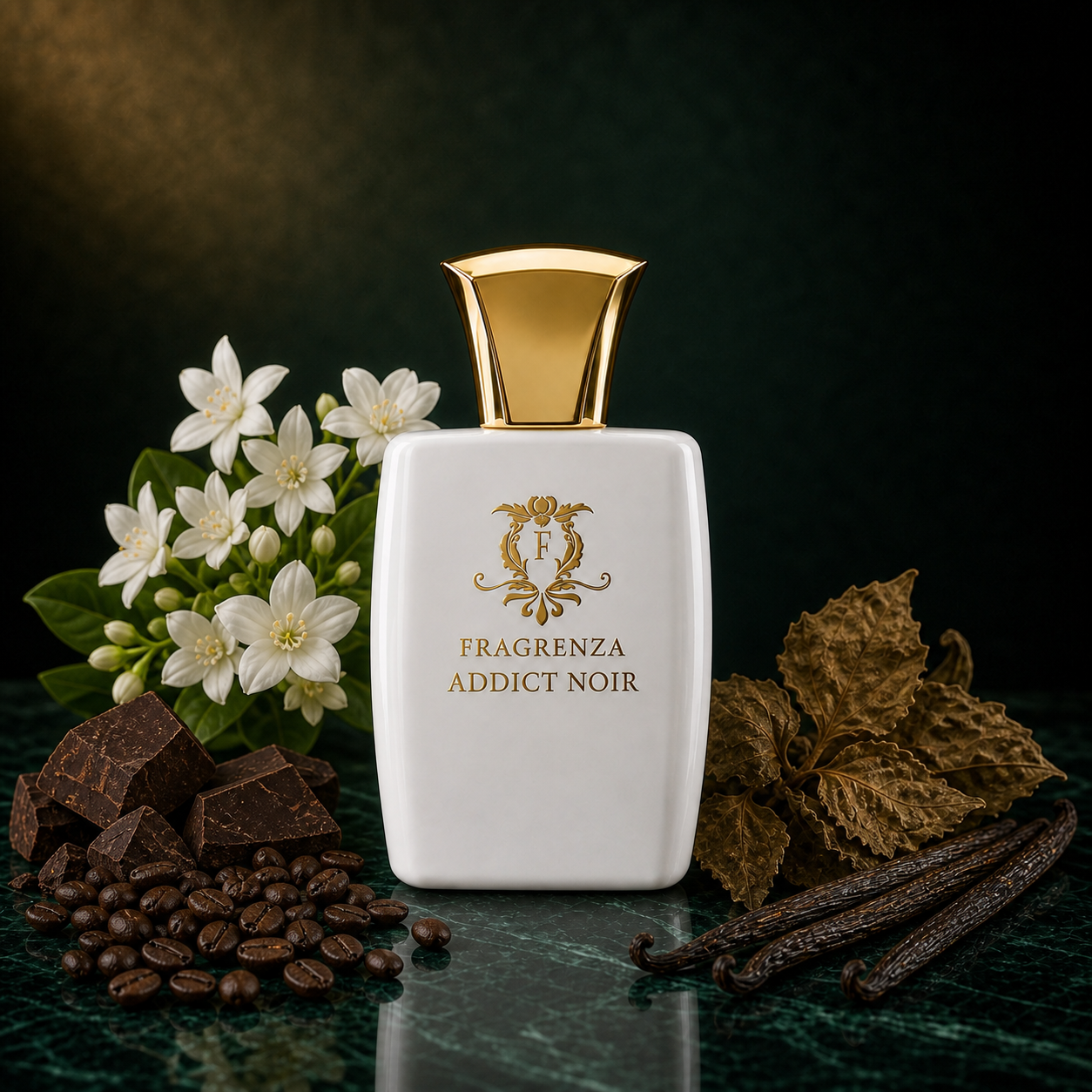
opens with a dark intoxicating rush of roasted coffee and rich cacao; the heart unfolds jasmine sambac alongside the honeyed softness of orange blossom; the base resolves on Bourbon vanilla and the warm velvety earthiness of patchouli. The wear is unmistakable from the first spray and demonstrates the archetype handled with prestige-tier polish. Among the most culturally recognized coffee compositions in modern perfumery.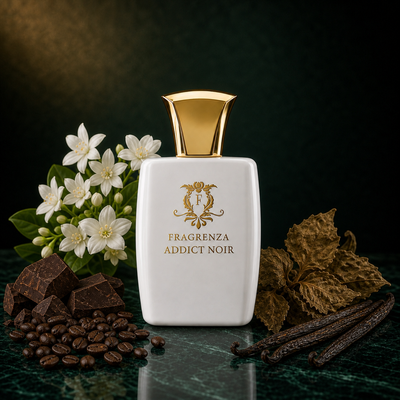
2. Coffee-rose (the modern Middle-Eastern-influenced register)
An archetype with cultural roots in classical Persian and Mughal perfumery, where coffee and rose appeared together in ceremonial compositions for centuries. The contemporary version pairs roasted coffee with rose absolute (often supported by saffron, patchouli, and incense) in a composition that reads as both ancient and unmistakably modern. The wear is more characterful and more occasion-specific than coffee-vanilla-incense; it rewards evening contexts and wearers who want their fragrance to register as a clear statement.
The Fragrenza pick:
opens with the molten golden warmth of saffron and the sharp aromatic bite of black pepper; the heart unfolds Rose de Mai, Turkish rose, and Bulgarian rose in a deep sensual chorus; the base resolves on the roasted depth of coffee, smoky incense, warm amber, creamy sandalwood, and earthy patchouli. The coffee character is most prominent in the base, where it bridges the floral heart and the dry-down resin anchors. Among the most distinctive coffee compositions in the Fragrenza range.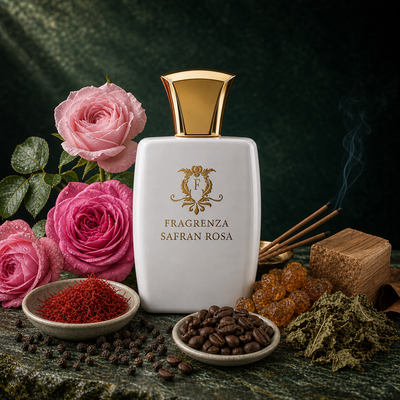
3. Coffee-chocolate (the Skin Scents 2.0 crossover)
The most contemporary of the four archetypes. Coffee paired with dark chocolate or cacao, anchored on a base of patchouli, tonka, and modern musks. The wear leans closer to the contemporary Skin Scents 2.0 register than to the traditional projecting gourmand: the coffee character is present and recognizable but integrated into a wearing-pattern that stays close to the body. The archetype is the natural choice for wearers who want a coffee-forward register that does not declare itself across rooms.
The Fragrenza pick:
opens with black currant and pink pepper, builds through iris, orange blossom, jasmine, and the roasted depth of coffee at the heart, and resolves on a base of patchouli, tonka, vanilla, cedar, and dark chocolate. The composition demonstrates how coffee can be handled in a 2.0-musk register where the wear stays intimate while the material list carries genuine textural depth.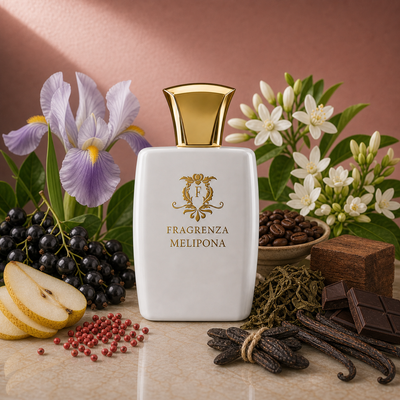
4. Coffee-suede-saffron (the savory gourmand crossover)
The archetype that most directly bridges coffee into the broader savory gourmand register. Coffee paired with saffron, myrrh, frankincense, and a vanilla-suede base, producing a wear that reads as polished, slightly Eastern, and unmistakably evening-coded. The savory gourmand character emerges from the interplay between coffee's roasted-bitter complexity and saffron's metallic-honey warmth; vanilla and suede carry the wear through the dry-down. Ideal for formal evening contexts where the register should declare itself with restraint.
The Fragrenza pick:
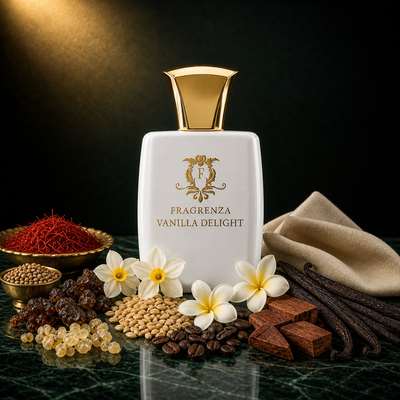
How coffee fragrances wear on skin
The wear pattern of the coffee family is specific and worth understanding before committing to a bottle.
Coffee declares itself early. Unlike many gourmand materials that emerge in the heart or base, coffee tends to be most chemically present in the opening and the early heart of the wear. The roasted character peaks in the first hour and progressively integrates into the base materials thereafter. If you are buying a fragrance specifically for the coffee note, the opening is where you will hear it most clearly; if you are buying for the wear that lasts the rest of the day, understand that coffee will become a textural anchor rather than a foregrounded character.
Coffee interacts strongly with skin warmth. The volatility curve of the major coffee aroma molecules (pyrazines, furanones, furfurylthiol) is mid-range, which means body heat plays a significant role in how the material releases over the wear. Warmer or oilier skin amplifies the roasted-sweet facets and pulls the coffee character toward a chocolate-and-caramel register. Cooler or drier skin amplifies the roasted-bitter facets and keeps the coffee closer to its espresso-and-burnt-sugar register. The same coffee composition can read substantially different across two wearers. See the skin chemistry deep-dive for the full account.
Coffee compositions project moderately and last well. Eight to ten hours is typical on most skin, with projection registering at a moderate level for the first two to three hours and then settling into a close-skin wear pattern for the remainder of the day. The dry-down is where coffee compositions show their character: the roasted-bitter notes integrate with vanilla, patchouli, or musk anchors to produce a warm, slightly nocturnal character that is among the most rewarding finish moments in contemporary perfumery.
When to wear coffee fragrances
The register is occasion-coded and the specific occasion depends on the archetype.
Coffee-vanilla-incense and coffee-suede-saffron are evening fragrances, ideal for dinners, theater performances, and any context where the wear should declare a clear point of view. Cool weather is the natural seasonal home; the roasted materials project less aggressively in cold air and develop more slowly, which lets the composition unfold without becoming heavy.
Coffee-rose is a day-to-evening transitional fragrance, appropriate for daytime social events as well as evening occasions. The floral materials soften the coffee's roasted edge and make the wear universally appropriate across daytime contexts.
Coffee-chocolate is the most versatile of the four, suitable for evening wear, cooler-weather daytime contexts, and quieter formal occasions. The Skin Scents 2.0-adjacent wearing pattern means the composition stays close to the body and never imposes on those nearby.
Hot weather is the harder context for coffee fragrances generally. The roasted materials project more aggressively in heat, and the coffee character can read as cloying or oddly food-coded when warm air does not let the resin and wood anchors develop properly. Most wearers reserve coffee compositions for fall, winter, and the cooler shoulder weeks of spring.
How to layer coffee fragrances
Coffee layers well with a small number of partners and poorly with most others. Three patterns work consistently.
Coffee over a clean musk skin scent. Apply a transparent clean musk broadly; add a single spray of the coffee fragrance to one pulse point. The musk softens the projection of the coffee into the body's immediate radius while preserving the roasted focal voice. Particularly useful for wearers who love coffee compositions but find their daytime appropriateness limited by the projection profile. For the full technique, see how to layer skin scents with vanilla, oud, or florals.
Coffee paired with vanilla on contrasting pulse points. Apply a coffee-forward composition to the chest and a vanilla-forward composition to a single pulse point (inner wrist or behind the ear). The two registers reinforce rather than compete with each other (they share the warm coumarinic chemistry that makes coffee-vanilla a natural pairing) and the layered effect amplifies the gourmand character without tipping the wear into dessert territory.
Coffee under a single bright citrus top. Apply the coffee fragrance broadly and add a single spray of bergamot or orange-blossom cologne to one pulse point. The bright top reads in the opening and fades over the first hour; the coffee carries the wear through the rest of the day. The technique extends evening-coded coffee compositions into daytime appropriateness, particularly useful for office or daytime social contexts.
Coffee in a fragrance wardrobe
A minimum viable coffee presence in a broader fragrance wardrobe is one well-chosen pick from the archetypes most aligned with your wearing patterns. For wearers building toward the savory gourmand register, the coffee-vanilla-incense or coffee-suede-saffron archetypes are the natural anchors. For wearers who want coffee in their rotation but at a lower projection profile, coffee-chocolate or coffee-rose are more versatile picks.
Two well-chosen coffee picks (one declarative, one close-skin) cover essentially every cool-weather context where the register is appropriate. Most serious coffee-wearers stop at two pieces from the family; coffee is distinctive enough that the wearer's signature becomes recognizable past that point in ways that make additional picks less useful than picks from related but contrasting archetypes (saffron, tobacco, vanilla, oud).
Related reads
- Savory Gourmand and Burnt Sweet: The 2026 Pillar
- Best Tobacco Fragrances 2026: The Six Archetypes
- Best Saffron Fragrances 2026: The Four Archetypes
- Skin Scents 2.0: The Modern Close-Skin Register
- How to Layer Skin Scents With Vanilla, Oud, or Florals
- Why Skin Scents Smell Different on Everyone
- How to Build a Fragrance Wardrobe
- How to Make Your Perfume Last All Day
FAQ
What does coffee actually smell like in perfumery?
Coffee in fine fragrance smells warm, roasted, slightly nutty, slightly bitter, with chocolate-and-caramel facets depending on the roast level the perfumer is working with. The character is unmistakably coffee but more layered than a fresh-brewed cup; the perfumery version emphasizes the roasted-aromatic dimensions over the immediate bitterness, and pairs naturally with vanilla, rose, saffron, cacao, and patchouli. Light-roast accords read brighter and more herbal; medium-roast reads canonical-coffee; dark-roast reads burnt-bitter and pushes the material into the broader savory gourmand register.
Is coffee a feminine or masculine note?
Neither inherently. Coffee is one of the most gender-flexible gourmand materials in contemporary perfumery, and the four archetypes above span the full range. Coffee-vanilla-incense has been marketed feminine (via Black Opium and similar) but works on any wearer; coffee-suede-saffron leans slightly masculine in cultural associations but is widely worn by women; coffee-rose and coffee-chocolate are essentially unisex. Treat gender marketing on coffee compositions as a starting point rather than a constraint.
Why does coffee in perfume not smell exactly like fresh coffee?
Two reasons. First, perfumery coffee accords are calibrated for skin wear, not for immediate olfactory impact; the materials are selected to develop slowly over hours rather than to deliver the bright peak that defines a fresh cup. Second, coffee in perfumery is almost always paired with materials (vanilla, patchouli, jasmine, rose) that reshape the wear into something more complex than coffee alone. The result is recognizable as coffee but more textured, more atmospheric, more long-wearing than the source material.
How long do coffee fragrances last on skin?
Eight to ten hours is typical for well-built coffee compositions on most skin. The coffee character is most chemically present in the first one to two hours; thereafter it integrates into the base materials and continues to contribute a roasted textural anchor through the dry-down. The dense base materials in most coffee compositions (patchouli, vanilla, certain musks, oud or amber depending on the archetype) are tenacious, and the wear extends naturally as body heat develops over the course of the day.
Can coffee fragrances be worn in summer?
Generally not, or at least not comfortably. The roasted materials project more aggressively in heat, and the coffee character can read as cloying or oddly food-coded when warm air does not let the resin and wood anchors develop properly. Coffee-chocolate is the most warm-weather-tolerant of the four archetypes (its Skin Scents 2.0-adjacent close-skin pattern keeps the projection contained); even there, the composition is happier in cooler weather. Save coffee fragrances for fall, winter, and the cooler shoulder weeks of spring.
Is coffee fragrance appropriate for the office?
Depends on the archetype. Coffee-vanilla-incense and coffee-suede-saffron are evening-coded and generally read as out of place in most shared workspaces; the projection profile reads as evening rather than daytime. Coffee-chocolate, with its close-skin wearing pattern, can work in office contexts because the wear stays within the wearer's immediate radius. Coffee-rose is borderline; it works in less formal office environments but can feel statement-driven in conservative ones. When in doubt, apply less than you would for evening and choose a close-skin archetype.
What is the easiest coffee fragrance to start with?
For most wearers, the coffee-chocolate or coffee-suede-saffron archetype is the most accessible entry point. Both deliver the coffee character clearly without the projection commitment of the coffee-vanilla-incense register, and both work across cool-weather contexts from daytime to evening. Wear one through a season, learn how your skin amplifies the coffee material, and decide whether to explore deeper into the more declarative coffee-vanilla-incense register or the more characterful coffee-rose direction from there.
The bottom line
Coffee is the most quietly revolutionary note in contemporary fine fragrance and one of the defining anchors of the modern savory gourmand register. The four archetypes give you the full commercial landscape; the Fragrenza picks within each give you concrete starting points; the wearing patterns and layering techniques give you the technical vocabulary to wear the register well.
Whether you want the classical luxe-gourmand statement (Addict Noir), a coffee-rose Eastern-luxury wear (Safran Rosa), a Skin Scents 2.0-adjacent close-skin coffee (Melipona), or a polished coffee-suede-saffron evening pick (Vanilla Delight), the contemporary coffee family has the depth to reward years of exploration. Coffee in perfumery is the daily ritual rendered as fine art; the four-hour wear test on your own skin is the diagnostic that tells you which archetype your chemistry amplifies and which to make a long-term part of your rotation.