Best Chocolate Fragrances 2026: The Three Archetypes from Floral to Savory
Cocoa absolute carries the bittersweet dark register, while pyrazines and methylpyrazine handle the roasted character that no fresh extraction of chocolate ever delivers cleanly on its own.
By Julia MorettiFragrenza makes several of the alternatives featured in our guides — here’s how we test.
11 min read
Chocolate in fine fragrance is the most viscerally legible of the gourmand notes. Where vanilla reads as warm-comforting, tonka as nutty-foundational, and caramel as bright-indulgent, chocolate reads as immediately dessert-coded: the smell of a luxury patisserie, of dark velvet cocoa powder, of the bittersweet richness that no other material in perfumery fully replicates. The note is also one of the most polarizing - wear it well and you smell genuinely sophisticated; wear it badly and you smell like the bakery you walked past.
This is the complete commercial guide to the best chocolate fragrances in the Fragrenza line, organized by the three chocolate archetypes that define the contemporary commercial landscape. For the broader Dubai chocolate trend that has elevated cocoa-and-pistachio compositions to mainstream visibility, see the Dubai Chocolate trend hub. For the broader bright gourmand register that chocolate anchors, see the bright gourmand 2026 pillar.
What chocolate actually is in fine perfumery
Chocolate in fragrance is almost always a constructed accord rather than a natural extraction. The fragrance industry uses cocoa absolute (a natural extraction from roasted cocoa beans that captures the deeper bittersweet character of dark chocolate), synthetic chocolate accords (blends of pyrazines, methylpyrazine, and other roasted-character molecules that approximate cocoa for cost-effective formulation), and milk-chocolate-leaning lactone accords (which add the creamy-sweet character of milk chocolate to compositions that need warmth without the bitter intensity of pure cocoa).
The chemistry of chocolate aroma is famously complex. Roasted cocoa contains over 600 identified volatile compounds, more than wine. The materials that matter most for perfumery use are 2-methylpyrazine and related pyrazines (the same roasted-nutty character that anchors coffee), isovaleraldehyde (the malty-chocolate facet), 2-phenylethanol (the floral-rose facet of high-cocoa chocolate that explains why chocolate pairs naturally with rose in perfumery), and theobromine derivatives (the slightly bitter, slightly stimulating quality at the heart of dark cocoa).
Chocolate's two most natural partners in fragrance are vanilla and tonka (which together produce the chocolate-vanilla register that defined first-wave gourmand) and patchouli (whose earthy-camphorous character pairs with cocoa in ways that no other woody material does, anchoring the most successful chocolate compositions in the canon).
Chocolate in modern perfumery
Chocolate's modern fragrance breakthrough came with Thierry Mugler Angel (1992), which paired chocolate and caramel with patchouli and vanilla in a composition that established gourmand as a viable commercial direction and put cocoa front and center as a serious perfumery material. Angel's chocolate-patchouli combination remains the most influential chocolate accord in commercial fragrance and the cultural reference point for every subsequent chocolate-forward release.
The 2010s saw chocolate split into two directions. The floral-chocolate prestige register (Tom Ford Black Orchid 2006 being the canonical reference) paired dark chocolate with exotic florals and a deep patchouli-vetiver base, producing wears that read as sophisticated and emotionally complex. The mass-market chocolate-praline register (Lancome La Vie Est Belle 2012 and many successors) softened chocolate into praline-and-vanilla territory for universal commercial appeal.
The contemporary moment (2024 through 2026) has seen chocolate move further toward the niche end of the spectrum, partly driven by the cultural Dubai Chocolate phenomenon and partly by the broader savory gourmand wave's reckoning with sweetness. Chocolate today is less a mass-market commercial direction than a serious niche register that rewards careful composition. The Fragrenza line covers three contemporary chocolate archetypes that span this landscape.
The three chocolate archetypes
1. Chocolate-floral prestige (the Angel/Black Orchid register)
The archetype that established chocolate at the prestige tier. Dark chocolate paired with narcotic florals (orchid, jasmine, gardenia, black currant) and a deep patchouli-vetiver-amber base. The wear reads as opulent, sensual, slightly transgressive; the natural choice for wearers who want chocolate that declares a clear point of view rather than apologizes for its sweetness.
The Fragrenza pick:
opens with a luminous constellation of jasmine, gardenia, black currant, lemon, bergamot, and mandarin; the heart unfolds rare orchid surrounded by spiced and fruity accents with a delicate touch of lotus; the base resolves on earthy vetiver, enigmatic patchouli, warm sandalwood, rich chocolate, incense, amber, and a whisper of vanilla. The chocolate character emerges most prominently in the dry-down, where it integrates with patchouli and amber to produce the canonical floral-chocolate wear. Among the most culturally recognized chocolate compositions in contemporary perfumery.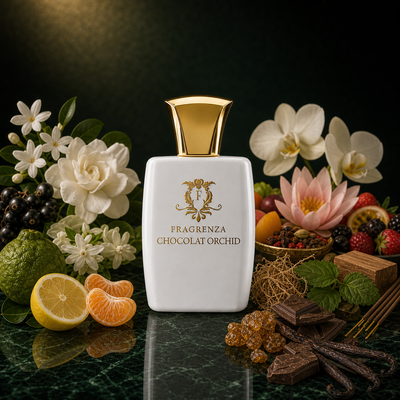
2. Coffee-chocolate Skin Scents 2.0 (the modern minimalist register)
The most contemporary of the three archetypes. Chocolate paired with coffee, iris, and a vanilla-tonka-patchouli base that keeps the wear close to the body rather than projecting outward. The composition sits between bright gourmand and the Skin Scents 2.0 register; the chocolate character is present and recognizable but integrated into a wearing-pattern that stays intimate. The natural choice for wearers who want a chocolate fragrance that does not declare itself across rooms.
The Fragrenza pick:
opens with black currant and pink pepper, builds through iris, orange blossom, jasmine, and the roasted depth of coffee at the heart, and resolves on a base of patchouli, tonka, vanilla, cedar, and dark chocolate. The composition demonstrates how chocolate can be handled in a 2.0-musk register where the wear stays intimate while the material list carries genuine textural depth. Among the most distinctive contemporary chocolate compositions because the chocolate emerges as a textural anchor rather than as a foregrounded sweet character.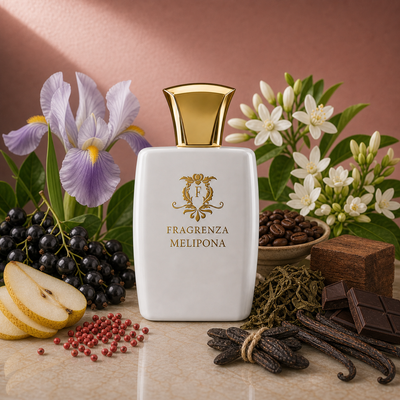
3. Tobacco-cocoa savory (the indulgent savory register)
An archetype that bridges chocolate into the savory gourmand register. Cocoa paired with tobacco, dark spice, woody anchors, and vanilla to produce a wear that reads as savory at the surface and indulgent at the base. The composition style sits between bright gourmand and the broader savory gourmand pillar; the chocolate contributes warmth and depth without becoming the dominant character.
The Fragrenza pick:
opens with lantana, coriander, mandarin, and yuzu; the heart unfolds rich tobacco leaf and tobacco blossom alongside tonka, saffron, water lily, and cinnamon; the base resolves on cocoa, vanilla, amber, nagarmotha, musk, sandalwood, and vetiver. The cocoa character integrates with the tobacco-and-vanilla base to produce the canonical tobacco-cocoa savory wear; the chocolate is present and structurally significant but never declares itself the way it does in the floral-chocolate register.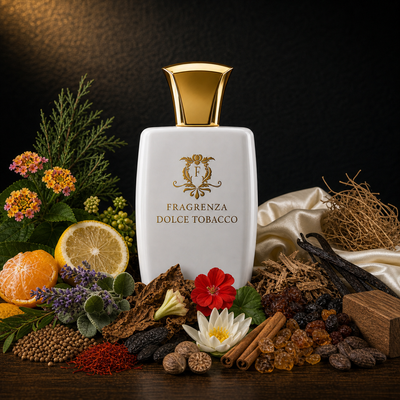
Chocolate-adjacent picks (for wearers who want the mood without the explicit cocoa)
Several Fragrenza compositions evoke the chocolate-fragrance mood through praline-vanilla-patchouli architecture without containing literal cocoa absolute. For wearers who want the emotional warmth and indulgent character of chocolate perfumery in a composition that does not actually contain chocolate, the praline-floral and vanilla-tonka archetypes from the vanilla best-of and the cherry-almond direction from the cherry best-of deliver chocolate-adjacent emotional territory through different chemistry. Belle di Verona (praline-and-vanilla over patchouli) sits closest to the Angel-era chocolate-patchouli mood without containing cocoa; Amarena Cherry (bitter almond and cherry-balsam over tonka) bridges the dark-cherry-chocolate register through almond chemistry.
How chocolate fragrances wear on skin
Chocolate compositions wear specifically.
Chocolate emerges in the heart-to-base transition. Unlike vanilla (which builds slowly across the wear) or coffee (which declares itself early), chocolate typically peaks around the one-hour mark and remains as a textural anchor through the rest of the wear. The opening reads as floral, citrus, or spice; the chocolate emerges as the warmer materials integrate. Give chocolate compositions at least two hours before judging.
Skin chemistry shapes the wear significantly. Warmer or oilier skin amplifies the sweet-milk-chocolate facets; cooler or drier skin amplifies the bitter-cocoa facets. The same chocolate composition can read as warm-milk-chocolate on one wearer and dark-bittersweet-cocoa on another. The variation is more pronounced than for most gourmand materials. See the skin chemistry deep-dive.
Projection and longevity are typically high. The dense base materials (patchouli, vetiver, vanilla, soft musks) are tenacious; eight to twelve hours is typical. The chocolate character itself peaks in the heart-to-base transition and remains as a textural anchor through the dry-down. Apply with restraint; one to two sprays is enough for any composition in the family.
When to wear chocolate fragrances
The chocolate register is occasion-coded. The floral-chocolate prestige archetype is emphatically evening-coded; the cocoa-coffee Skin Scents 2.0 archetype is daytime-flexible (the close-skin wearing pattern keeps it appropriate for office and casual contexts in cool weather); the tobacco-cocoa savory archetype is evening-only.
The natural seasonal home for chocolate fragrances is fall and winter. The dense materials project less aggressively in cold air and develop more slowly; the chocolate character reads more authentically in cool weather than in heat. Hot weather is the harder context for chocolate generally; the sweetness can read as cloying when warm air does not let the base anchors develop.
How to layer chocolate fragrances
Chocolate layers well with a small number of partners. Chocolate over a clean musk skin scent softens the projection while preserving the cocoa focal voice - particularly useful for daytime wear of evening-coded chocolate compositions. Chocolate paired with vanilla on a contrasting pulse point reinforces the natural vanilla-cocoa chemistry and produces a warm-gourmand layered effect. Chocolate layered with rose draws on the natural phenylethanol chemistry that connects cocoa and rose at the molecular level, producing one of the most distinctive layered wears in contemporary perfumery. For the broader layering theory, see the layering pillar.
Chocolate in a fragrance wardrobe
A minimum viable chocolate presence in a broader fragrance wardrobe is one well-chosen pick from the archetype most aligned with your wearing patterns. Most wearers stop at one chocolate piece; the register is distinctive enough that the wearer's signature becomes recognizable past that point. Pair a chocolate fragrance with a clean musk skin scent for daytime layering flexibility, and the combined wardrobe slot covers nearly every cool-weather context where chocolate is welcome.
Related reads
- The Dubai Chocolate Perfume Trend
- Bright Gourmand: The 2026 Pillar
- Best Pistachio Perfumes 2026
- Best Nutty Fragrances 2026
- Best Cherry Fragrances 2026
- Best Vanilla Fragrances 2026
- Savory Gourmand and Burnt Sweet 2026
- How to Build a Fragrance Wardrobe
FAQ
Does chocolate fragrance actually smell like chocolate?
Yes, recognizably, though the perfumery version emphasizes specific facets of the source material. Dark cocoa absolute reads as bittersweet and slightly roasted; milk-chocolate-leaning accords read as creamy and sweet; chocolate-praline registers lean toward hazelnut-caramelized warmth. The best chocolate fragrances do not smell like a candy bar; they smell like the idea of chocolate rendered as fine fragrance, with depth and complexity that the food itself does not deliver.
Why does chocolate pair so well with rose and patchouli?
Chemistry. Roasted cocoa contains 2-phenylethanol (the same molecule responsible for the natural floral-rose character in chocolate) which produces a natural affinity between chocolate and rose materials. Patchouli's earthy-camphorous character provides a structural counter-weight to chocolate's sweetness; the two materials anchor each other in ways that no other woody pairs match. Angel's chocolate-patchouli backbone is the canonical demonstration of this chemistry.
Are chocolate fragrances unisex?
Most contemporary chocolate compositions function as unisex even when marketed by gender. The floral-chocolate prestige archetype has feminine marketing histories but the wear is genre-fluid; the coffee-chocolate Skin Scents 2.0 archetype is essentially unisex; the tobacco-cocoa savory archetype leans slightly masculine in cultural associations but works on any wearer. Treat gender marketing on chocolate compositions as a starting point rather than a constraint.
How long do chocolate fragrances last on skin?
Eight to twelve hours is typical for well-built chocolate compositions on most skin. The dense base materials (patchouli, vetiver, vanilla, certain musks, woody anchors) are tenacious; the wear extends naturally as body heat develops. The chocolate character peaks in the heart-to-base transition and remains as a textural anchor through the dry-down.
Can chocolate fragrances be worn in summer?
The coffee-chocolate Skin Scents 2.0 archetype is the most warm-weather-tolerant of the three (its close-skin wearing pattern keeps projection contained); even there, the composition is happier in cooler weather. The floral-chocolate prestige and tobacco-cocoa savory archetypes are emphatically cool-weather compositions; the dense materials project too aggressively in heat. Save chocolate fragrances for fall, winter, and cool spring weeks.
What is the difference between the Dubai chocolate trend and traditional chocolate perfumery?
The Dubai Chocolate trend pairs cocoa specifically with pistachio cream, kataifi pastry warmth, and sometimes caramel to evoke the viral Sicilian-influenced chocolate bar that gave the trend its name. Traditional chocolate perfumery uses cocoa across a broader range of pairings (florals, tobacco, patchouli, vanilla, coffee). The Dubai trend is a specific commercial direction within the broader chocolate register; the chocolate archetypes covered above include the Dubai-trend register and several others. For the trend-specific guide, see the Dubai Chocolate trend hub.
What is the easiest chocolate fragrance to start with?
For most wearers, the coffee-chocolate Skin Scents 2.0 archetype (Melipona register) is the most accessible entry point. The chocolate character is present and recognizable but never declarative; the wear stays close to the body and is universally appropriate across cool-weather contexts. Wear it through a season, learn how your skin amplifies the cocoa materials, and decide whether to explore deeper into floral-chocolate prestige or tobacco-cocoa savory territory from there.
The bottom line
Chocolate is one of the most viscerally legible directions in contemporary fine fragrance and one of the most rewarding archetypes within the broader gourmand register. The three archetypes give you the full commercial landscape; the Fragrenza picks within each give you concrete starting points; the wearing patterns and layering techniques give you the technical vocabulary to wear the register well.
Whether you want the floral-chocolate prestige register of Chocolat Orchid, the coffee-chocolate Skin Scents 2.0 character of Melipona, or the tobacco-cocoa savory direction of Dolce Tobacco, the contemporary chocolate family has the depth to reward years of exploration. Chocolate done well is the most immediately legible of the gourmand registers; the four-hour wear test on your own skin tells you which archetype your chemistry amplifies and which to make a long-term part of your rotation.