

The History of Cherry in Perfumery: From Ancient Origins to Modern Icons
The History of Cherry in Perfumery: From Ancient Origins to Modern Icons, an editorial deep-dive on notes, character, and how to wear it
By Julia MorettiFragrenza makes several of the alternatives featured in our guides — here’s how we test.
13 min read
Cherry in Perfumery: A Story as Old as Civilisation
The cherry has always been more than a fruit. In ancient cultures across the Mediterranean and the East, it carried associations of fertility, abundance, and feminine beauty — qualities that made it a natural candidate for inclusion in the aromatic preparations that these cultures used for ritual, personal adornment, and medicine. The history of cherry in perfumery is, in one sense, the history of human culture's relationship with sweetness itself: the desire to capture and carry something irresistible, to make a transient pleasure permanent.
That history runs from the cosmetic preparations of ancient Egyptian queens through the Silk Road spice trade, the perfumed courts of Renaissance Europe, the synthetic chemistry laboratories of the 20th century, and ultimately to the creation of what is now widely considered the finest cherry fragrance ever made. It is a story that illuminates how perfumery evolves, how ideas travel across time and geography, and why certain ingredients retain their power across thousands of years of olfactory history.
Ancient Egypt: Cherry as Sacred Sweetness
The earliest documented uses of cherry in aromatic preparations come from ancient Egypt, where the fruit and its associated scent compounds appeared in cosmetic formulations reserved for the highest levels of society. Egyptian perfumery was not primarily concerned with personal fragrance in the modern sense — it was deeply embedded in religious ritual, with specific aromatic preparations assigned specific sacred meanings and uses. Sweetness, in this context, carried associations with divine favour, fertility, and beauty.
The Egyptian mastery of aromatic preparation was extraordinary for its time. Perfumers working in temple workshops developed techniques for extracting and preserving aromatic compounds from flowers, resins, and fruits that anticipated modern extraction chemistry by millennia. While cherry as a specific note was not isolated in the way modern perfumers work with individual materials, the sweet, fruity aromatic compounds associated with stone fruits appeared in preparations that demonstrate a sophisticated understanding of what sweetness could do in a fragrance context.
The lasting contribution of Egyptian perfumery to the cherry tradition is less about specific formulas and more about establishing the cultural framework in which sweet, fruit-associated aromatics were understood as precious and worthy of serious investment — a framework that would persist through every subsequent culture that inherited the Egyptian aromatic tradition.
The Silk Road and the Spread of Aromatic Culture
The Silk Road — the vast network of trade routes connecting China and Central Asia with the Middle East and Mediterranean Europe — played a decisive role in disseminating aromatic culture, including the materials and practices associated with sweet, fruit-based fragrance. As merchants moved spices, textiles, and luxury goods across thousands of miles of desert and mountain terrain, they also moved aromatic knowledge: recipes, techniques, and materials that enriched the perfumery traditions of every culture the trade touched.
Cherry trees, native to various parts of Asia and the Middle East, found their way along Silk Road routes to new geographies where their aromatic associations took root in local perfumery cultures. More importantly, the trade routes created the conditions for the kind of cross-cultural exchange that accelerates the development of any art form. Perfumers in 10th-century Baghdad were incorporating materials and techniques from China, India, Persia, and Arabia simultaneously, creating a richness of aromatic vocabulary that had never previously existed in any single tradition.
The Arabic and Persian perfumery traditions that flourished in this context were technically sophisticated and deeply influential on European perfumery — it was largely through Arabic intermediaries that the techniques of distillation and solvent extraction reached Europe during the medieval and Renaissance periods, laying the technical foundation for everything that followed.
The Renaissance: Cherry Notes Enter the Perfumer's Palette
The Renaissance period brought a dramatic acceleration in the sophistication of European perfumery, fuelled by increased trade, growing prosperity among the merchant classes, and the development of new extraction techniques that allowed perfumers to work with a much wider range of aromatic materials than had previously been possible. Cherry notes, in this context, began to emerge as distinct elements in complex fragrance compositions rather than merely incidental components of broader sweet-fruity accords.
Renaissance perfumers were, by the standards of their predecessors, technically accomplished artisans who understood the chemistry of their materials in increasingly precise ways. The cultivation of the German cherry variety — Prunus avium — across northern Europe, combined with the distillation techniques imported from the Arabic tradition, enabled the extraction of cherry aromatic compounds with a degree of precision that supported their deliberate use as fragrance ingredients. Perfumers of the period celebrated the natural world as a source of olfactory inspiration, and the complex, bittersweet aroma of dark cherries — at once fruity, slightly alcoholic, and deeply satisfying — was precisely the kind of note that appealed to the Renaissance sensibility.
The scented gloves and pomanders of the Renaissance courts frequently incorporated fruit-associated sweet notes, and cherry's specific character — darker and more complex than rose or orange blossom, with a natural association with the slightly fermented quality of ripe fruit — gave it a distinctive place in the aromatic vocabulary of the period.
The 20th Century: Synthetic Chemistry Transforms Cherry
The development of organic chemistry in the 19th and early 20th centuries transformed perfumery more fundamentally than any previous development in its history, and the cherry note benefited enormously from this transformation. The ability to synthesise specific aromatic compounds — rather than relying on extraction from natural materials — gave perfumers access to cherry-associated molecules in quantities and at purities that were impossible with natural methods alone.
Benzaldehyde, the almond-cherry compound, became one of the most important materials in modern perfumery precisely because it could be produced synthetically at scale. Heliotropin provided the sweet, powdery dimension that gives cherry compositions their softness. Various fruity esters allowed perfumers to modulate the fresh-versus-dark character of cherry accords with extraordinary precision, dialling a composition toward the juicy brightness of fresh fruit or the complex depth of macerated cherries depending on the creative intention.
This technical freedom enabled a golden age of cherry fragrance experimentation across the mid-20th century, with houses from Guerlain to Dior incorporating cherry-adjacent accords into compositions of genuine artistry. The note gradually moved from occasional supporting role to central character in certain compositions, laying the groundwork for the cherry fragrance renaissance that would arrive decades later.
Modern Icons: When Cherry Became a Luxury Statement
The contemporary chapter of cherry fragrance history belongs, above all others, to Tom Ford's Lost Cherry — a 2018 Private Blend release that demonstrated definitively what the note could achieve when treated as a luxury ingredient deserving of the finest surrounding materials. By pairing black cherry and cherry liqueur with Turkish rose, jasmine sambac, and a warm resinous base, Tom Ford created a composition that was simultaneously gourmand and sophisticated — sweet without being juvenile, dark without being inaccessible.
Lost Cherry's success reinvigorated the entire cherry fragrance category. What had been a note associated primarily with lighter, more casual compositions was suddenly the centrepiece of one of the most prestigious fragrance ranges in the world. The industry took notice, and the subsequent years saw a significant expansion in ambitious cherry-based compositions from niche houses, designer brands, and quality alternative producers alike.
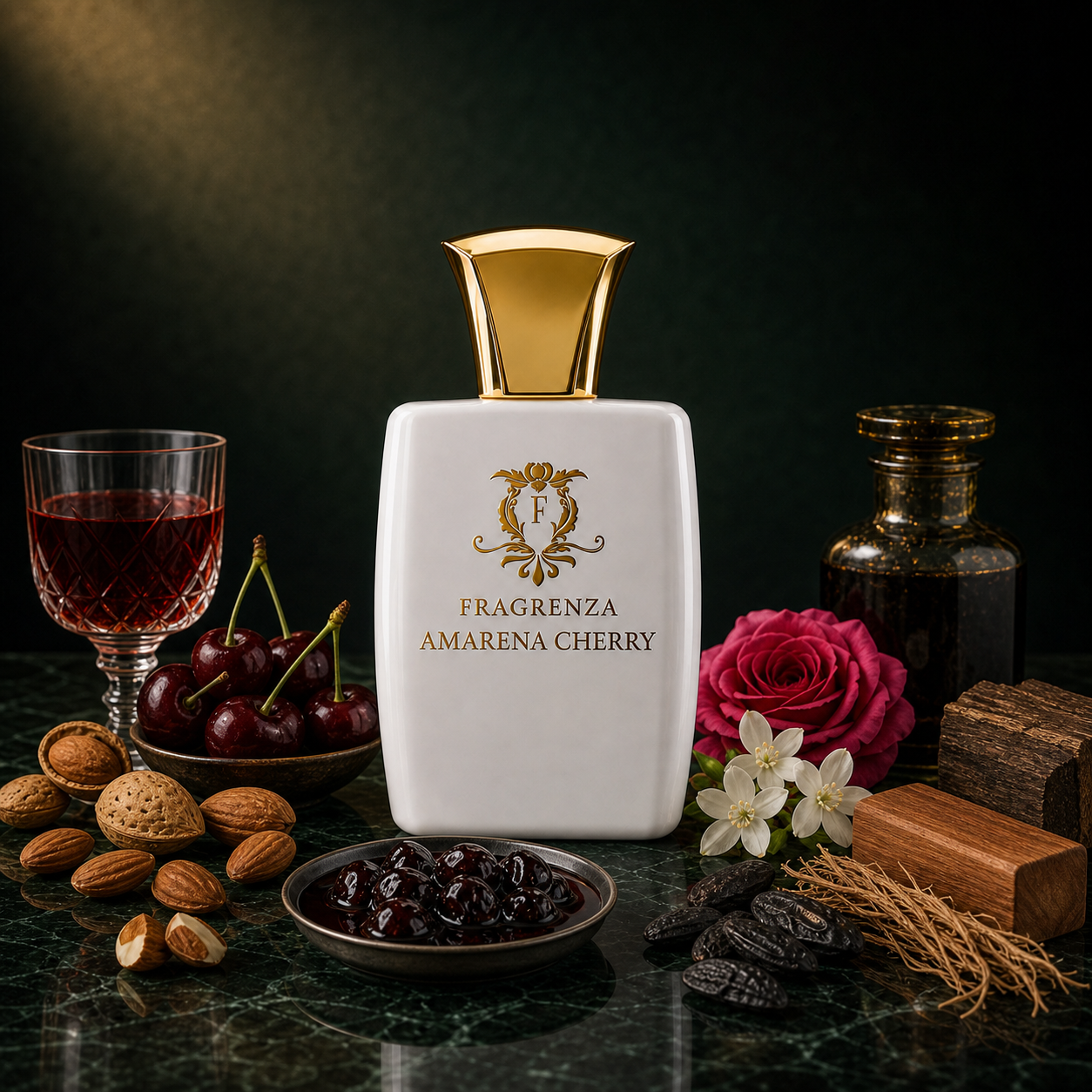
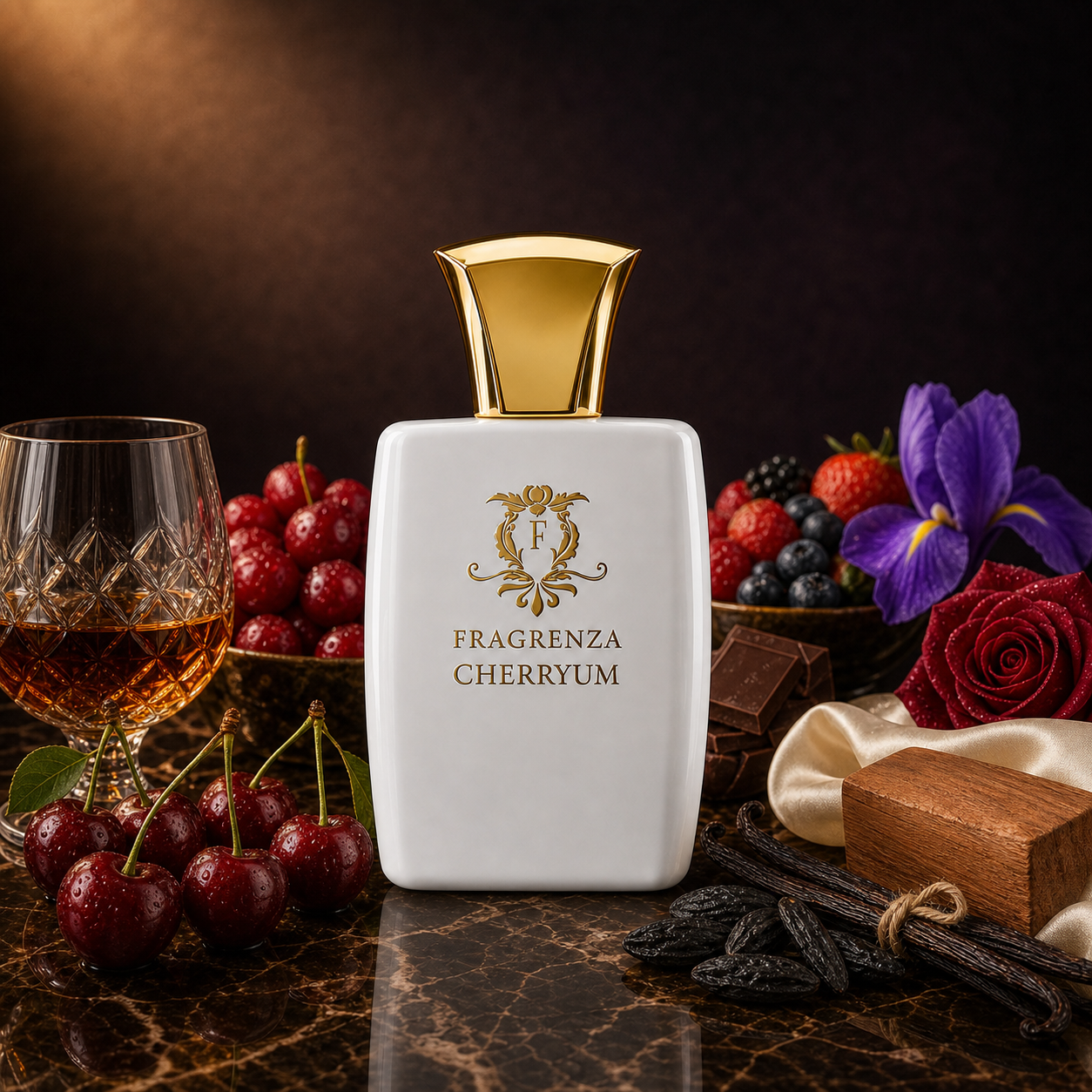
Today, Fragrenza's Amarena Cherry stands among the most accomplished alternatives in this tradition — capturing the essential DNA of the Lost Cherry approach at a price that makes the luxury of daily cherry wear genuinely accessible. Alongside original creations like Cherryum and the sparkling and dark cherry expressions in the broader Fragrenza range, it represents a moment when the cherry fragrance category has never been more exciting or more fully explored.
The Future of Cherry in Perfumery
Cherry's story in perfumery is far from complete. As biotechnology continues to advance, new methods of extracting and synthesising cherry-associated aromatic compounds will create possibilities that current chemistry cannot yet achieve. As fragrance culture continues its global expansion — particularly in markets like China, South Korea, and Southeast Asia, where cherry blossom already carries deep cultural resonance — the cherry note will find new contexts, new associations, and new creative interpretations.
What will not change is the fundamental appeal of the note itself: its ability to evoke sweetness without sacrificing complexity, to carry associations of luxury and indulgence while remaining deeply rooted in the natural world. Cherry in perfumery has survived thousands of years because it delivers something irreplaceable — a sense of richness, warmth, and pleasure that speaks to something essential in human experience. That, ultimately, is why it matters, and why it will continue to matter for as long as people wear fragrance at all.
The Specific Cherry Aromatic Materials That Define Contemporary Cherry Compositions
The broader cherry-anchored compositional approach that contemporary perfumery practice employs draws on multiple specific aromatic materials that collectively produce the broader cherry aromatic character. Natural cherry materials face substantial limitations because fresh cherry flesh does not yield essential oils through conventional extraction methods that produce stable aromatic outputs. Contemporary cherry-anchored compositions consequently rely substantially on synthetic cherry-accord materials that combine multiple specific aromatic compounds to approximate the broader fresh-cherry-fruity aromatic character that natural cherry produces.
The broader synthetic cherry-accord materials include various specific aromatic compounds including benzaldehyde (which provides the broader almond-cherry character that natural cherry pits contain), various ester compounds that provide the broader fresh-fruity character, and various supporting aromatic materials that collectively produce the broader cherry-accord aromatic outputs. The broader contemporary cherry-accord materials have substantially developed across multiple decades, with newer-generation cherry-accord materials producing substantially more naturalistic cherry-aromatic outputs than previous-generation cherry-accord materials typically achieved.
The Specific Cherry Variants That Contemporary Compositions Engage With
The broader contemporary cherry-anchored perfumery practice engages with multiple specific cherry variants that produce substantially different aromatic outputs across different compositional applications. Sweet cherry variants (the broader Bing cherry, Rainier cherry, and adjacent sweet cherry types) provide the broader sweet-fruity-fresh character that most contemporary commercial cherry-anchored compositions emphasise. Sour cherry variants (the broader Morello cherry, Montmorency cherry, and adjacent sour cherry types) provide the broader tart-fruity character that adjacent contemporary cherry-anchored compositions explore.
Maraschino cherry (the broader processed cherry preparation that combines fresh sour cherry with sweet sugar syrup and various flavouring compounds) provides another specific cherry aromatic profile that adjacent contemporary cherry-anchored compositions reference. The broader cherry-blossom aromatic profile (which differs substantially from cherry-fruit aromatic profiles, with cherry-blossom providing delicate-floral character rather than fruit-character) represents an adjacent category that has been discussed in adjacent articles in this series. The substantial diversity across cherry variants provides substantial compositional range for contemporary cherry-anchored perfumery.
The Specific Contemporary Cherry-Anchored Compositions That Define the Modern Category
The broader contemporary cherry-anchored perfumery market includes substantial diversity across multiple specific compositions that have collectively defined the broader contemporary cherry-anchored aesthetic territory. Tom Ford Lost Cherry (the broader luxury-niche cherry-vanilla-almond composition that established substantial contemporary cherry-anchored commercial recognition since its 2018 launch) anchors the broader luxury-niche cherry-anchored category. Kilian Sweet Redemption (the broader luxury-niche almond-cherry composition) provides adjacent luxury-niche cherry-adjacent coverage.
The broader Maison Francis Kurkdjian Baccarat Rouge 540-adjacent cherry-anchored compositions provide additional cherry-adjacent coverage within the broader luxury-niche category. The broader Fragrenza catalogue and adjacent inspired-by alternatives at accessible price points provide substantial cherry-anchored coverage at price points that the broader luxury-niche cherry-anchored compositions do not match, with the broader inspired-by market providing useful accessible-price interpretation of the broader luxury-niche cherry-anchored aesthetic territory.
The Specific Cultural Associations That Cherry Brings to Modern Compositions
The broader cultural associations that cherry brings to contemporary compositions extend across multiple cultural traditions and historical periods that contemporary perfumery practice continues to engage with. Japanese cultural tradition particularly emphasises the broader cherry-blossom aesthetic that connects to the broader hanami (cherry-blossom viewing) tradition and the broader mono no aware (the broader aesthetic appreciation of transience) philosophical framework. Western European cultural tradition emphasises the broader cherry-fruit aesthetic that connects to the broader fruit-orchard aesthetic and the broader cherry-pie comfort-food cultural associations.
American cultural tradition combines elements of both Western European cherry-fruit aesthetic and the broader maraschino cherry confectionery aesthetic that contemporary American food culture has developed substantially. The broader cross-cultural cherry aesthetic landscape provides substantial cultural-aesthetic depth for contemporary cherry-anchored perfumery, with individual compositions drawing on different specific cultural traditions to produce different specific emotional registers that wearers can engage with selectively.
The Specific Wear Contexts That Cherry-Anchored Compositions Best Match
The broader cherry-anchored compositions across multiple price tiers typically perform best in social contexts where the substantial fruity-sweet emotional register matches the social setting. Spring and summer daytime occasions, casual social settings, romantic contexts where the substantial fruity-sweet character can be appreciated, and adjacent contexts where confident-feminine-leaning projection is welcomed are the natural wear contexts for most contemporary cherry-anchored compositions. The broader fruity-sweet character typically reads as recognisably feminine-leaning even when contemporary cherry-anchored compositions are positioned as unisex.
The contexts where cherry-anchored compositions are less optimal include conservative formal-business environments that may find the substantial fruity-sweet projection unexpected enough to read as overly personal for purely professional settings, and adjacent contexts where contemporary commercial-designer cherry-anchored compositions may read as overly young for certain mature professional contexts. Building wardrobes that include cherry-anchored compositions typically means treating them as casual-romantic primaries rather than as universal daily-wear primaries.
The Specific Pricing Tiers Within the Modern Cherry-Anchored Market
The broader contemporary cherry-anchored market operates across multiple specific pricing tiers that wearers should understand for intentional wardrobe-building decisions. The luxury-niche tier (Tom Ford Lost Cherry, Kilian Sweet Redemption, and adjacent luxury-niche cherry-anchored compositions typically pricing between three hundred and four hundred dollars per bottle) operates at the highest material concentrations and substantial brand-positioning premium. The mainstream-luxury tier (various commercial-luxury cherry-anchored compositions typically pricing between one hundred and two hundred dollars per bottle) provides intermediate pricing coverage.
The accessible-price inspired-by tier (Fragrenza and adjacent accessible-price inspired-by brands typically pricing between thirty and seventy dollars per bottle) provides substantial cherry-anchored coverage at price points that make daily wear economically practical. The accessible-niche Gulf tier (various Lattafa, Maison Alhambra, and adjacent Gulf-niche cherry-anchored interpretations typically pricing between twenty and fifty dollars per bottle) provides additional accessible-price cherry-anchored coverage. Each tier provides specific value propositions, with selective acquisition across multiple tiers producing more comprehensive cherry-anchored wardrobe coverage.
The Specific Sampling Strategy for Cherry-Anchored Compositions
Cherry-anchored compositions across multiple price tiers require careful sampling because the broader cherry-aromatic character that defines the broader category can read substantially different across various sampling environments. The reliable sampling protocol is to acquire a proper decant or sample, apply two sprays to clean skin in a low-fragrance environment in the early evening, and evaluate at the thirty-minute, two-hour, four-hour, and six-hour marks. The two-to-four-hour evaluation window is particularly important because the cherry-supporting elements integration reaches its most distinctive expression in that window.
Side-by-side comparison across multiple price tiers (luxury-niche, mainstream-luxury, accessible-price inspired-by, accessible-niche Gulf) provides useful comparative information about which broader tier and which specific composition best matches your aesthetic preferences. Most wearers who do this cross-tier comparison find that the various cherry-anchored compositions occupy slightly different specific positions rather than directly substituting for each other, which informs more sophisticated cross-tier wardrobe-building decisions.
Final Notes on Cherry Perfumery History and Contemporary Wardrobe Building
The broader cherry-anchored perfumery tradition continues to develop substantially across multiple dimensions that affect the broader contemporary fragrance market. The broader synthetic cherry-accord materials continue to develop, with newer-generation cherry-accord materials producing increasingly naturalistic cherry-aromatic outputs. The broader cross-cultural cherry aesthetic landscape continues to expand, with contemporary compositions engaging with multiple specific cherry cultural traditions across multiple international markets. The broader cherry-anchored commercial market continues to develop across multiple price tiers.
For wearers building long-term wardrobes with cherry-anchored awareness, the broader practical approach involves selective cherry-anchored acquisition across multiple price tiers (selective luxury-niche investment for compositions that specifically warrant the substantial pricing, accessible-price inspired-by coverage for broader category access) combined with broader wardrobe coverage in adjacent aesthetic territories. The broader contemporary cherry-anchored perfumery tradition continues to develop, and the contemporary market provides substantial options for wearers willing to engage carefully with both the cultural-historical depth and the substantial contemporary commercial diversity that characterise the broader cherry-anchored perfumery landscape.