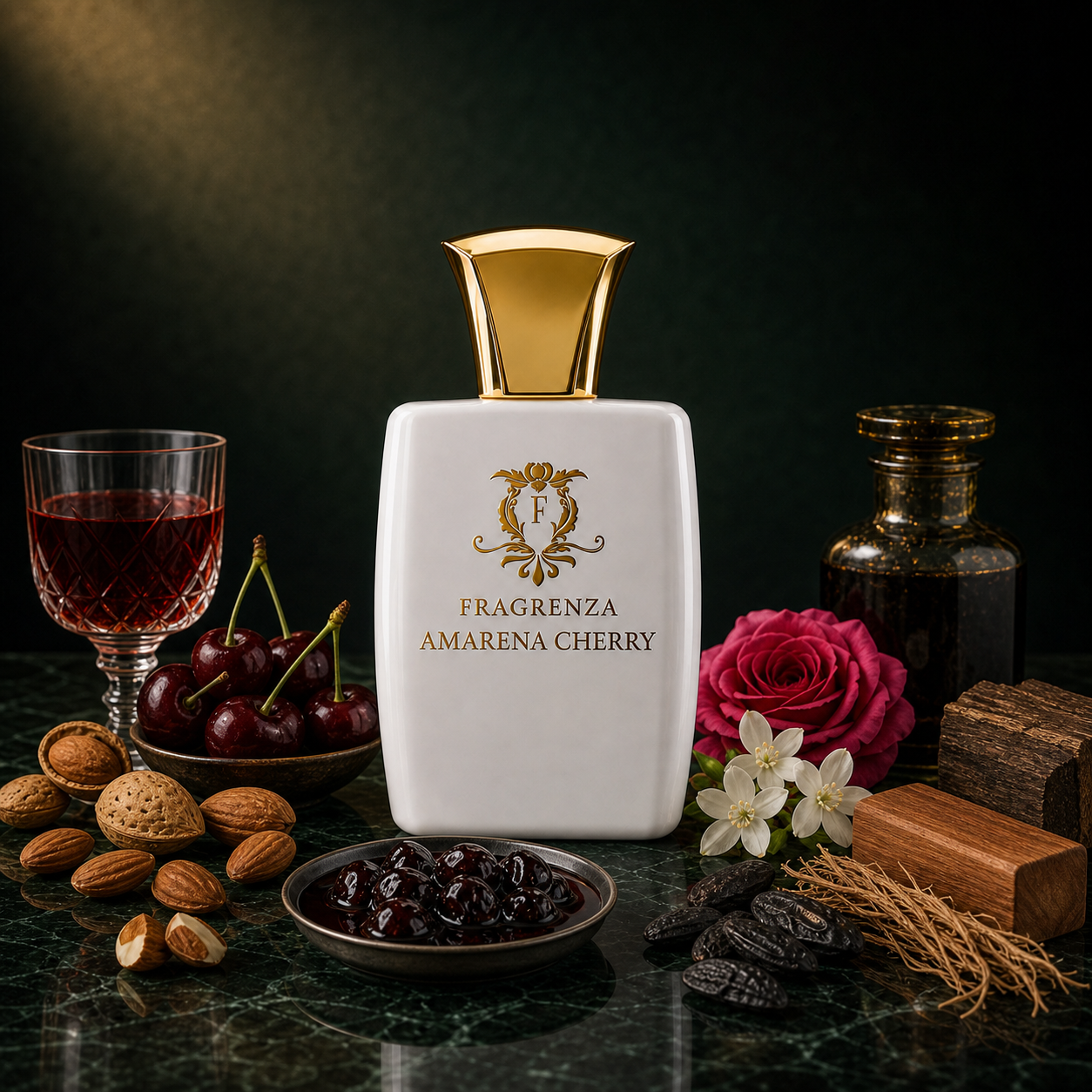


Amarena Cherry vs. Tom Ford Lost Cherry: Which One Actually Wins?
Amarena Cherry vs. Tom Ford Lost Cherry: Which One Actually Wins?, an editorial deep-dive on notes, character, and how to wear it
By Julia MorettiFragrenza makes several of the alternatives featured in our guides — here’s how we test.
15 min read
The Case for Cherry in Fine Fragrance
Cherry is a dangerous note in perfumery. Handle it carelessly and you end up with something that smells like cough syrup or lip gloss — sweet to the point of caricature, with none of the nuance that makes a fragrance worth wearing past the first five minutes. Handle it with the skill it demands, and cherry can anchor some of the most seductive, memorable, and genuinely luxurious fragrances in the modern canon. Tom Ford's Lost Cherry is the proof of concept. Fragrenza's Amarena Cherry is the argument that the experience does not require the price tag.
This comparison exists because fragrance lovers deserve honest answers. Not brand advocacy, not vague reassurances that "the dupe is great for the price," but a precise, unsentimental assessment of where each fragrance succeeds, where it falls short, and which one is actually right for you.
Tom Ford Lost Cherry: The Benchmark
Lost Cherry arrived in 2018 as part of Tom Ford's Private Blend collection, priced at $390 for 50ml, and immediately established itself as one of the finest cherry fragrances ever created. The reasons are clear from the first spray.
The opening is built on black cherry, cherry liqueur, and bitter almond — a trinity of cherry-related materials that creates extraordinary depth and complexity rather than simple fruitiness. The cherry liqueur accord, in particular, does something remarkable: it gives the composition an adult, boozy quality that immediately distinguishes it from every other cherry fragrance on the market. This is not a fresh cherry. It is a macerated, indulgent, slightly decadent cherry — and that distinction is everything.
The heart develops through Turkish rose, jasmine sambac, and a rich griotte syrup that deepens the cherry accord while adding genuine floral sophistication. The base — Peru balsam, roasted tonka bean, sandalwood, vetiver, and cedar — is warm, resinous, and extraordinarily long-lasting, evolving through hours of wear in ways that remain interesting all the way to the final dry down.
Lost Cherry performs excellently for its category: 7 to 9 hours on skin, with strong initial projection that settles into a close, intimate trail. It works best in cool weather and evening settings, where its richness reads as seductive rather than heavy. In any fair assessment, it is a genuinely exceptional fragrance — worth every dollar for those who can spend them.
Fragrenza Amarena Cherry: The Alternative Examined
Amarena Cherry was built from the same blueprint as Lost Cherry, with the intention of delivering the essential experience of the original at a price point that allows generous, fearless daily use. How well does it succeed?
The opening is immediately recognisable to anyone who knows Lost Cherry: black cherry and cherry liqueur dominate, with bitter almond in support. The boozy quality is present and accurate — this is not a simplified or sweetened version of the opening but a genuine attempt to capture the same note complex in the same proportions. On first spray, the resemblance is striking, and the quality of the cherry materials used is sufficient to sustain the comparison through the opening phase without the significant divergence that cheaper alternatives suffer at this stage.
The heart brings griotte syrup, Turkish rose, and jasmine sambac — the same structural trio as the original. The floral dimension is slightly lighter than Lost Cherry, with the jasmine sitting closer to the skin rather than projecting at full volume. This is the most noticeable difference in the mid-section: Amarena Cherry's heart is softer and more intimate, while Lost Cherry's is richer and more projecting. Depending on the context of wear — office versus evening, summer versus winter — this difference can work in Amarena Cherry's favour, making it more approachable for daytime use.
The base performs very well: Peru balsam, roasted tonka bean, sandalwood, vetiver, and cedar arrive in the dry down with solid accuracy. The warm, resinous character of the original's final hours is well represented, and longevity is impressive — 8 to 10 hours on skin with proper application, which puts it at or above the original in many testing scenarios.
Side-by-Side Comparison
Scent Profile
Lost Cherry: Richer, more projecting throughout, with particular depth in the jasmine-rose heart. The boozy cherry accord is more pronounced and sustained. Amarena Cherry: Very close in structure, with a slightly softer heart and a more intimate projection character that works well for daily wear. The dry down resemblance to Lost Cherry is especially accurate.
Longevity and Projection
Both fragrances perform well in this category. Lost Cherry projects confidently at close to medium range for 3 to 4 hours before retreating to a skin-close trail. Amarena Cherry projects at a similar range, perhaps slightly more restrained, then maintains excellent longevity through the base — matching or exceeding the original in many side-by-side tests.
Versatility
Lost Cherry's richness makes it more demanding of occasion: primarily an evening fragrance, particularly suited to cooler weather and special events. Amarena Cherry's slightly softer heart gives it more flexibility — it carries into daytime and workplace settings without demanding the same level of occasion to justify wearing it.
Price and Value
This is where the comparison becomes decisive for most fragrance buyers. Lost Cherry at $390 for 50ml is a luxury investment that demands conservative use — each spray represents real money. Amarena Cherry at a fraction of the price fundamentally changes the relationship with the fragrance: you wear it freely, layer it, experiment with it, take it on weekends and work trips without anxiety. That freedom is not a small thing. It changes how you experience the fragrance, which changes how much you actually enjoy it.
Which One Should You Choose?
The honest answer is that the right choice depends on what you are actually buying. If you are investing in a collection centrepiece — a flagship fragrance that represents a significant purchase decision and will be worn on special occasions — Lost Cherry justifies the investment with its richness, depth, and the full prestige of the Tom Ford bottle and brand experience.
If you want to wear a spectacular cherry fragrance freely, daily, and without restraint — to travel with, to layer, to discover how it wears across every season and occasion — Amarena Cherry delivers the essential experience with a performance profile that competes directly with the original, at a price that removes every reason for hesitation.
For most fragrance lovers, the choice is not actually difficult. The best fragrance is the one you wear, and the one you wear most freely is the one you love most completely. Explore more of Fragrenza's approach to designer fragrance dupes built on the same uncompromising quality principle — from Adeline, our interpretation of Parfums de Marly Delina, to the full warmth of the oriental collection.
The Cherry-Gourmand Category and How It Defined a Fragrance Era
Cherry as a featured fragrance material has a brief but consequential history in modern luxury perfumery. Before 2018, cherry was largely confined to either niche-experimental compositions (Serge Lutens Rahat Loukoum used cherry-almond accords in 1997, and various indie compositions explored cherry in non-commercial contexts) or to mass-market gourmand entries that treated cherry as a candy-sweet supporting note rather than as a structural anchor. Tom Ford Lost Cherry's 2018 launch as part of the Private Blend collection effectively created the contemporary luxury cherry-gourmand category, demonstrating that cherry could carry a serious composition at luxury-tier pricing and that the material had aesthetic depth that earlier compositions had not fully explored.
The commercial success of Lost Cherry triggered an explosion of cherry-anchored compositions across both designer and niche perfumery. Maison Francis Kurkdjian released various cherry-influenced flankers and limited editions. Initio released compositions exploring related territory. Multiple niche houses launched cherry-gourmand entries targeting the same demographic. By 2022, cherry had become one of the most-launched featured notes in luxury feminine perfumery, with dozens of compositions competing for the attention of consumers who had been introduced to the category through Lost Cherry. Understanding this rapid category expansion matters for how to evaluate any specific cherry-gourmand composition today — the originals that defined the category (Lost Cherry, the early competitive responses) have established aesthetic conventions that subsequent entries either reinforce or react against, and knowing the conventions helps clarify what each new entry is actually attempting.
The Specific Material Logic of the Cherry-Almond-Liqueur Accord
The cherry accord that defines Lost Cherry and Amarena Cherry is more complex than simple cherry imitation. Cherry as a pure perfumery material is difficult to render naturally — true cherry essential oil exists but is expensive and lacks the projection profile that fragrance compositions require, and most perfumery cherry effects are constructed through combinations of synthetic ionones, benzaldehyde, various lactones, and supporting fruit accords. The specific Lost Cherry construction adds bitter almond (which carries the same benzaldehyde-related aromatic compounds that natural cherry contains) and cherry liqueur (a boozy-macerated accord that reads as adult-indulgent rather than candy-sweet) to produce the multi-dimensional cherry character that distinguishes the composition from simpler cherry entries.
The almond contribution is structurally important and often underappreciated. Bitter almond delivers a specific marzipan-amaretto character that gives the cherry accord aromatic depth and adult-sophistication that pure cherry materials cannot produce. The almond is the element that connects Lost Cherry and Amarena Cherry to the broader almond-gourmand tradition that includes compositions like Tom Ford Cafe Rose, Guerlain L'Homme Ideal, and various niche almond-anchored entries. For wearers building a wardrobe around the cherry-almond aesthetic, knowing that the almond is doing as much aromatic work as the cherry helps clarify what specific facet of the composition appeals to you and which adjacent compositions might extend the wardrobe in productive directions.
The cherry liqueur accord is the element that gives the composition its specific adult-indulgent emotional register. Cherry liqueur in real-world experience (kirsch, cherry brandy, maraschino) carries a specific boozy-fermented character that is distinctly different from fresh cherry, and the perfumery reconstruction of this character through combinations of fruit accords and slight ethanol-resin elements is what produces the composition's signature opening character. This is the element that most often distinguishes well-constructed cherry-gourmand compositions from less successful entries — a composition that delivers cherry without the liqueur facet reads as juvenile-fruity, while a composition that handles the liqueur character competently reads as adult-sophisticated even within the gourmand category.
The Tom Ford Private Blend Collection and Its Competitive Position
Lost Cherry sits within the Tom Ford Private Blend collection, which is the house's luxury-niche line that competes directly with the upper-tier offerings from MFK, Roja Parfums, Amouage Library Collection, and other ultra-luxury fragrance brands. The Private Blend collection has built a reputation across its catalogue for compositions that combine commercial accessibility with luxury-niche material quality, which is why several Private Blend entries (Tobacco Vanille, Oud Wood, Lost Cherry, Black Orchid) have become genuine commercial successes within the luxury-niche category rather than remaining as boutique-only offerings.
The pricing of the Private Blend collection has increased substantially since the collection's launch, with current Lost Cherry pricing of roughly $390 for 50ml positioning the composition firmly in the ultra-luxury tier. The 100ml format at proportionally higher pricing pushes the per-bottle commitment into territory that requires serious financial commitment from buyers. This pricing structure is part of why the Fragrenza alternative discussed in the article above carries the value proposition it does — the gap between luxury-niche pricing and inspired-by pricing has widened as luxury houses have pushed their pricing upward, which means the relative economic case for inspired-by alternatives has strengthened over time.
How Cherry-Gourmand Compositions Behave Across Different Skin Types
One specific consideration that matters for cherry-gourmand compositions is the variable performance across different skin types. Cherry accords tend to amplify or mute differently depending on skin pH, skin oiliness, and the bacterial composition that lives on the skin surface. On oilier skin types, cherry-gourmand compositions tend to project more strongly and last longer, with the boozy-liqueur facets reading more prominently and the floral heart elements emerging more distinctly through the wear arc. On drier skin types, the same compositions tend to project less and fade faster, with the lighter floral elements becoming less perceptible and the wear arc compressing into a shorter window.
This variability is important for sampling protocol. A wearer who samples Lost Cherry briefly at a counter on a single skin type cannot reliably extrapolate to how the composition will wear across a full day on their own skin. The reliable protocol is to acquire a proper decant or sample, apply to clean skin in a low-fragrance environment, and evaluate at the thirty-minute, two-hour, four-hour, six-hour, and ten-hour marks. The eight-to-ten-hour mark is particularly important for cherry-gourmand compositions because the base resinous elements (Peru balsam, tonka, sandalwood, cedar) develop slowly and the eventual base character defines the long-tail wear experience. If the base does not work for you, the opening alone rarely justifies the composition regardless of how compelling the cherry top reads.
The Amarena Cherry Reference and What Amarena Cherries Actually Are
Amarena cherries, the specific cherry variety that gives the Fragrenza alternative its name, are a particular Italian wild sour cherry traditionally cultivated in Modena and Bologna regions. The cherries are typically preserved in syrup and used in Italian desserts, particularly gelato and tiramisu, and the specific flavour profile is sweeter and more complex than standard maraschino cherries. The choice of Amarena as the reference for the Fragrenza composition is aesthetically meaningful because it positions the alternative against the specific Italian-cherry tradition rather than against the broader generic cherry category. For wearers familiar with Italian dessert culture, the Amarena reference carries specific aesthetic associations that resonate with the boozy-indulgent character that the composition delivers.
This kind of specific cultural-aesthetic positioning matters more in the cherry-gourmand category than in some other fragrance categories because cherry itself carries strong cultural associations that the composition can either lean into or push against. American consumers tend to associate cherry with maraschino-candy-sweet treatments (cherry cola, cherry pie, cherry lip balm), European consumers (particularly Italian and German) tend to associate cherry with more sophisticated boozy-dessert treatments (kirsch, schwarzwälder kirschtorte, Amarena gelato), and Asian consumers often associate cherry primarily with cherry blossom rather than with cherry fruit. The Amarena Cherry composition leans into the European boozy-dessert reading, which is part of why the composition reads as adult-sophisticated rather than as juvenile-fruity even within the gourmand category.
Wear Context for Cherry-Gourmand Compositions
Cherry-gourmand compositions sit in a specific wear-context niche that is worth understanding clearly. The category performs at its best in cooler weather (roughly five to eighteen degrees Celsius), in evening or low-light settings, and in social contexts where the adult-indulgent emotional register matches the occasion. Date nights, evening dinners, late-autumn and winter social occasions, intimate gatherings with appreciative company — these are the natural wear contexts for compositions in this category. The compositions work less well in hot weather (where the resinous base elements can amplify uncomfortably), in bright daylight settings (where the dark-romantic emotional register reads as overdressed), and in casual professional contexts (where the indulgent character can read as too personal for the setting).
The Fragrenza alternative's slightly softer projection profile expands the appropriate wear contexts somewhat compared to the more assertive Lost Cherry original. Amarena Cherry works in daytime office wear that Lost Cherry would feel overdressed for, in mid-temperature conditions where Lost Cherry would amplify uncomfortably, and in casual social contexts that Lost Cherry's luxury-niche projection would feel out of place in. This is part of the practical case for the alternative — not only is daily wear more economically sustainable, but the actual wear-context range is broader because the projection profile suits a wider variety of settings. For wearers who want both the trophy-fragrance Lost Cherry experience for special occasions and the daily-wearable Amarena Cherry experience for broader use, owning both compositions is a defensible strategy that delivers value across different priorities.
The Cherry-Gourmand Wardrobe and Building Around These Compositions
A wardrobe built around the cherry-gourmand aesthetic typically benefits from one or two adjacent compositions rather than from multiple bottles in the same exact register. Adding a warmer-resinous oriental composition (Tom Ford Tobacco Vanille, MFK Grand Soir, or one of the Fragrenza alternatives in those territories) covers cold-weather evening contexts where the cherry-gourmand profile would be slightly mismatched. Adding a lighter floral-gourmand composition (the various Cheirosa entries, Kayali Vanilla 28, or any of the lighter sweet-floral alternatives) covers daytime contexts where the cherry-gourmand register would be too rich. Adding a fresher citrus or aquatic composition covers warm-weather and casual contexts that cherry-gourmand compositions handle poorly.
The wardrobe-building mistake to avoid is acquiring multiple cherry-gourmand compositions in the same general aesthetic register at different brand price points. Lost Cherry, Amarena Cherry, Initio Mystic Experience, and several other competing cherry-gourmand compositions all sit in adjacent territory, and owning multiple bottles in the same slot produces wardrobe redundancy rather than coverage. The more efficient approach is to choose one cherry-gourmand composition (the alternative if budget is a constraint, the original if it is not, both if you specifically value the projection differences for different wear contexts) and to expand the wardrobe in adjacent rather than overlapping directions.
Final Notes on the Cherry-Gourmand Choice
The honest framing of the Lost Cherry versus Amarena Cherry comparison is that both compositions deliver the same broad aesthetic register with subtle differences in projection profile, material concentration, and emotional intensity. The Lost Cherry original justifies its luxury pricing for buyers who specifically value the trophy-fragrance ownership experience, the slightly fuller projection that the higher material concentration enables, and the prestige association that the Tom Ford Private Blend collection carries. The Amarena Cherry alternative justifies its more accessible pricing for buyers who want the same broad aesthetic delivered in a daily-wearable format at price points that permit fearless application across the full year.
Neither choice is wrong; they serve different priorities. The wearer who carefully samples both, evaluates against actual wear contexts rather than against marketing positioning, and chooses based on the specific emotional register and wear-context profile that matches their actual life will get more enjoyment from their fragrance wardrobe than the wearer who chases either prestige or savings as goals in themselves. The cherry-gourmand category has matured into a serious aesthetic territory that rewards careful exploration, and both Lost Cherry and Amarena Cherry are competent entries that deserve consideration on their actual merits rather than on the cultural baggage that either luxury or inspired-by pricing sometimes carries.