

Mimosa in Perfumery: The Powdery Yellow Flower
Mimosa is one of perfumery's most beloved floral notes. Learn how perfumers use it, what it smells like on skin, and the fragrances that wear it best.
By Julia Moretti 6 min read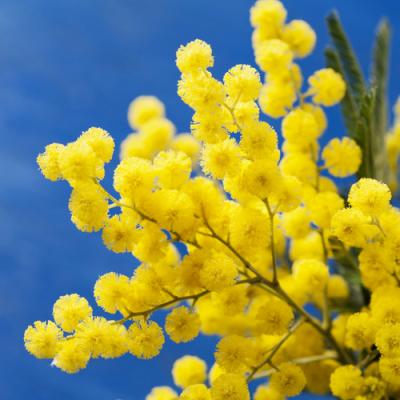
What Does Mimosa Smell Like?
The scent of mimosa in bloom is one of the most immediately recognizable and emotionally evocative smells in the natural world. Anyone who has walked through the hilly terrain above the French Riviera in February, when the mimosa trees erupt in cascades of tiny yellow flowers, will understand why this note has been so beloved by perfumers. The smell is simultaneously warm and fresh, powdery and honeyed, green and floral — a combination of qualities that feels paradoxical but that in practice creates something genuinely unique and beautiful.
At its most immediate, mimosa smells of warmth and sweetness — a honeyed, slightly animalic richness that suggests beeswax and warm yellow flowers. But this sweetness is not heavy: it is lifted by a green, slightly powdery quality that prevents mimosa from ever feeling cloying. There is a freshness to mimosa that is quite different from the simple aqueous freshness of lily of the valley or the citric brightness of citrus flowers — it is a warm freshness, paradoxical but perfectly calibrated. A very faint earthiness in mimosa's base note connects it to the soil and roots from which it grows, grounding its floral lightness with a suggestion of organic life. The overall impression is of tender, slightly animalic, deeply natural sweetness — a smell that induces in most people an almost involuntary response of pleasure and warmth.
Botanical Background and History in Perfumery
The mimosa used in perfumery is primarily Acacia dealbata, the silver wattle, a fast-growing tree native to southeastern Australia that was introduced to the French and Italian Rivieras in the nineteenth century and has since naturalized so completely that it is now synonymous with the Mediterranean spring landscape. Grasse, the traditional center of the French perfumery industry, sits in the hills above Cannes where mimosa cultivation is a significant commercial enterprise. The annual Mimosa Festival in Bormes-les-Mimosas and other Riviera towns celebrates the flower's cultural centrality to the region's identity.
In formal perfumery, mimosa has been used since at least the early twentieth century, when the development of solvent extraction techniques allowed perfumers to capture the absolute from the delicate flowers. The 1920s and 1930s saw numerous mimosa-based or mimosa-accented compositions emerge from the great French houses, taking advantage of the note's unique capacity to feel simultaneously classic and modern. Jean Patou's Moment Supreme (1929) featured mimosa prominently, and several Guerlain compositions of the interwar period incorporated mimosa absolute in their complex floral hearts.
The postwar era of French perfumery used mimosa extensively as a component of the powdery floral family that dominated feminine fragrance from the 1940s through the 1960s. Mimosa's natural powdery character aligned perfectly with the aesthetic of that period, which valued a certain refined, soft femininity in fragrance. The note's revival in the contemporary era owes much to the niche fragrance movement's interest in ingredients with strong regional identity and natural character. Grasse-sourced mimosa absolute is now considered a premium natural ingredient, and its use in a fragrance is often a marker of quality and authenticity. For further exploration of related white and powdery floral notes, our dedicated mimosa article sits alongside our guide to narcissus as essential reading on this family of complex naturals.
Extraction and Key Molecules
Mimosa absolute is produced by solvent extraction of the fresh flowers of Acacia dealbata. The process involves washing the flowers with a hydrocarbon solvent such as hexane to produce a concrete — a waxy solid containing both the aromatic compounds and the plant waxes — which is then extracted with ethanol to yield the final absolute. The resulting material is a dark orange-brown, semi-solid substance with an intensely concentrated aromatic character that faithfully reproduces the sweet, powdery, green-floral smell of the fresh flower.
The primary aromatic compounds in mimosa absolute include anisaldehyde, which contributes a sweet, hay-like, slightly anise-adjacent warmth; heptanal, which provides a slightly fatty, waxy freshness; linalool and its derivatives, which add smooth floral-lavender softness; benzaldehyde, contributing almond-like sweetness; and various fatty aldehydes that account for mimosa's characteristic warm, slightly animalic undertone. Notably, mimosa absolute is rich in the compound ionone — particularly alpha-isomethyl ionone, which is the same powdery-violet molecule central to iris and violet — and this shared chemistry explains the close olfactory relationship between mimosa and these other powdery notes. The mimosa note also contains compounds that align it with the osmanthus family, particularly in the dried flower form where apricot-peach facets can become more pronounced.
Famous Fragrances Featuring Mimosa
Mimosa has graced some of perfumery's most celebrated compositions across more than a century. Caron's Farnesiana (1947), a composition built almost entirely around mimosa absolute combined with heliotrope and vanillin, remains one of the definitive mimosa fragrances and demonstrates the note's capacity for genuine majesty when treated with care and simplicity. The fragrance is named for Acacia farnesiana (cassie flower), a related species whose absolute shares many of mimosa's qualities.
L'Artisan Parfumeur's Mimosa pour Moi is another celebrated composition dedicated to the note, using mimosa absolute alongside clean woody notes and musks to create a fresh-yet-warm interpretation that captures something of the Riviera hillside experience in wearable form. Estee Lauder's Beautiful incorporates mimosa as a significant element in its complex floral bouquet. Annick Goutal's Mimosa has been admired for its realistic, almost documentary capture of the living flower. Among contemporary feminine fragrances, Parfums de Marly Delina uses powdery floral elements closely related to mimosa in its celebrated rose-rhubarb-vanilla accord.
In the broader context of powdery and floral perfumery, mimosa shares significant aromatic territory with iris — both notes are characterized by their powdery, warm, slightly woody character — and the two notes combine beautifully in compositions that seek the highest expression of refined, powdery elegance. Our broader floral exploration provides context for understanding how mimosa sits within the powdery floral tradition.
Note Interactions: Mimosa's Aromatic Partnerships
Mimosa's most successful aromatic partnerships tend to be with notes that complement rather than compete with its distinctive powdery sweetness. Rose is perhaps mimosa's most natural floral partner: both are warm, slightly complex flowers whose combination creates an accord of substantial depth and beauty. The mimosa-rose pairing has been used in numerous distinguished compositions, and the two notes' shared animalic-floral quality creates a synergy that neither achieves alone.
Heliotrope and vanilla are complementary sweet notes that extend mimosa's own sweetness while adding their respective almond and caramel dimensions. The combination of mimosa with tonka bean creates a particularly warm, coumarin-rich accord of almost edible quality. With iris, as noted, mimosa creates a summit of powdery elegance. With sandalwood, mimosa's warmth is amplified and extended, the creamy wood providing a perfect base for the flower's sweetness.
More unexpected pairings can be equally successful. Mimosa with citrus — particularly bergamot — creates a fresh-yet-warm accord where the citrus's bitter clarity cuts through mimosa's potential heaviness. With green notes, particularly violet leaf and galbanum, mimosa's floral character is sharpened and made more naturalistic. With vetiver, mimosa's sweetness contrasts beautifully with the grass's dry earthiness, creating an accord that is simultaneously comfortable and surprisingly complex.
Wardrobe Context: Wearing Mimosa
Mimosa fragrances are among the most universally flattering in perfumery. The note's combination of warmth and freshness, sweetness and powder, makes it appealing across a very wide range of wearers and occasions. Spring is mimosa's natural season — the note aligns with the promise of warmth and blooming that characterizes early spring in Mediterranean latitudes — but its warmth also carries it comfortably through autumn. Summer can sometimes prove challenging for the heaviest, richest mimosa compositions, though lighter interpretations wear well in warm weather.
For those building a floral fragrance wardrobe, a mimosa-based composition represents an excellent investment: it fills the role of the warm floral with great distinction, offering something considerably more interesting and individual than generic rose or jasmine alternatives. These are fragrances that tend to generate genuine compliments from those with aromatic knowledge while remaining perfectly wearable in any social context. The note's long history in fine perfumery means there are dozens of excellent mimosa compositions at every price point and style, from classic powdery soliflores to contemporary interpretations that pair the flower with unexpected modern elements.