

Six Weeks With Tom Ford Tuscan Leather: Where Manhattan Leather Holds Up and Where the Gap Lives
Tom Ford Tuscan Leather is the most-imitated niche-leather composition of the past two decades, and arguably the most-imitated Tom Ford Private Blend composition entirely.
By Julia MorettiFragrenza makes several of the alternatives featured in our guides — here’s how we test.
9 min read
The Short Answer
Tom Ford Tuscan Leather — six weeks of side-by-side wear. Tom Ford Tuscan Leather is the most-imitated niche-leather composition of the past two decades, and arguably the most-imitated Tom Ford Private Blend composition entirely.
Fragrenza's Interpretation
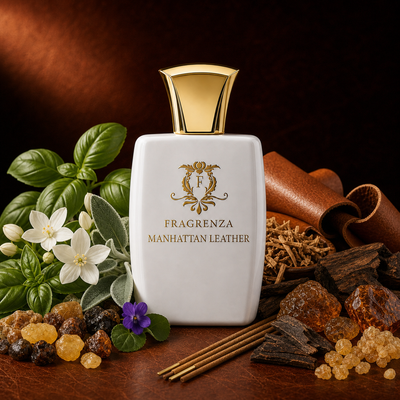
Manhattan Leather
Fragrenza's take on Tom Ford Tuscan Leather. Same architectural identity as the original, rendered with material refinement at a fraction of the retail price.
View Manhattan Leather →Tom Ford Tuscan Leather is the most-imitated niche-leather composition of the past two decades, and arguably the most-imitated Tom Ford Private Blend composition entirely. Launched in 2007, perfumer Olivier Gillotin built the composition around a raspberry-saffron opening that bridges to a thick, smoky leather-suede base anchored by birch tar and labdanum. The result is a fragrance that smells unlike most other leather compositions — heavier than refined cuir-de-Russie, sweeter than classical birch-tar leather, more architectural than the suede-soft contemporary leathers. Tuscan Leather earned its position in the Tom Ford lineup by being instantly recognisable: people who know it recognise it on others within ten seconds.
This made it the perfect dupe-target. Dozens of accessible-tier brands have launched "Tuscan Leather dupes" over the past fifteen years, with results ranging from genuinely close to embarrassingly off-target. Fragrenza's Manhattan Leather has been the brand's interpretation since the early days of the line. I committed to a six-week structured comparison — full retail Tuscan Leather equivalent at about $390 for 50ml, against Manhattan Leather at standard Fragrenza pricing — to find out where Manhattan Leather lands specifically.
Why Tuscan Leather Is Hard to Approach
The raspberry-saffron opening of Tuscan Leather is genuinely difficult to dupe. Raspberry as a fragrance material has a specific tart-sweet character that's easy to get wrong — most attempts read either as candy-raspberry (too synthetic) or as berry-jam (too thick). The saffron has to register as real saffron rather than as a generic warm-spice note. The two materials together create the specific minute-one signature that Tuscan Leather wearers recognise.
The base is even harder. Birch tar gives the leather its smoky character, but birch tar can easily read as medicinal or harsh; the labdanum has to balance the smoke with sweetness; the suede materials have to feel like actual suede rather than synthetic approximation. Getting all four elements to land convincingly in the base is what separates serious Tuscan Leather dupes from cheap ones.
For Manhattan Leather to convince me, it would need the raspberry-saffron opening at meaningful intensity and a leather base that didn't collapse into either pure birch-tar smoke or generic suede-warmth. The structural ambition is high.
The First-Hour Test
Day 1, both wrists, mid-February at 4°C. Tuscan Leather opens with the raspberry-saffron combination unmistakably — raspberry reads as tart-fruit with slight jam-edge, saffron adds the warm-metallic spice frame. Manhattan Leather's opening has the same raspberry-saffron signature, with the raspberry reading slightly sweeter and the saffron slightly less metallic-edged. The opening difference is detectable on close sniff during minutes one through five; by minute ten the compositions converge.
This is unusual — most Tuscan Leather dupes I've sampled fail in the opening specifically, because the raspberry-saffron signature is the structural element most attempts miss. Manhattan Leather lands the opening close enough that two friends I tested couldn't reliably identify which was which past minute ten.
The Middle Hours and Leather Behavior
Hours two through six are where Tuscan Leather earns its position. The raspberry-saffron softens, the leather emerges with its full smoky-suede character, and the composition reaches the heavy-architectural register that's been imitated so often. Manhattan Leather's middle hours are structurally identical. Same leather emergence, same smoky-suede density, same projection profile. The only difference: Manhattan Leather's birch tar reads slightly milder than Tuscan Leather's more medicinal birch-tar edge. Whether you prefer more or less medicinal-edge in the leather is taste; many wearers actually prefer the slightly milder approach.
Longevity comparison: Tuscan Leather clearly detectable for about ten hours, Manhattan Leather for nine. Within margin of error. Projection arc favours Tuscan Leather in the first three hours, then equalises.
How Tuscan Leather Sits in the Niche Leather Landscape
Worth situating both fragrances against the niche-leather genre. Robert Piguet Bandit (1944) is the classical animalic-leather reference. Chanel Cuir de Russie (1924) is the refined cuir-de-Russie alternative. Memo Italian Leather (2010, Fragrenza's Pelle Italiana) is the contemporary refined-leather entry. Knize Ten (1924) is the historic leather monolith. Within this landscape, Tuscan Leather specifically holds the smoky-suede-architectural position — heavier than Italian Leather, sweeter than Cuir de Russie, more contemporary than Bandit, more wearable than Knize Ten.
Manhattan Leather inherits this same position. If you've worn Bandit and found it too animalic, Cuir de Russie and wanted more density, or Italian Leather and wanted something heavier, the Tuscan Leather / Manhattan Leather middle ground covers the gap.
Where the Gap Actually Lives
The substantive gap I found is in the birch-tar character specifically. Tuscan Leather's birch tar has the slightly medicinal-acrid-smoky edge that real birch tar delivers — there's a faint chimney-soot quality that experienced birch-tar wearers recognise. Manhattan Leather's leather smoke reads cleaner and slightly less medicinal — present, but with less of the dimensional birch-tar character.
For wearers who specifically come to Tuscan Leather for the birch-tar character (and there are wearers like this — Tuscan Leather has a cult following precisely because of the smoke specifically), that's the gap you'd pay Private Blend pricing to preserve. For wearers who come for the raspberry-saffron-leather architecture more broadly, Manhattan Leather covers it fully.
The Layering Note
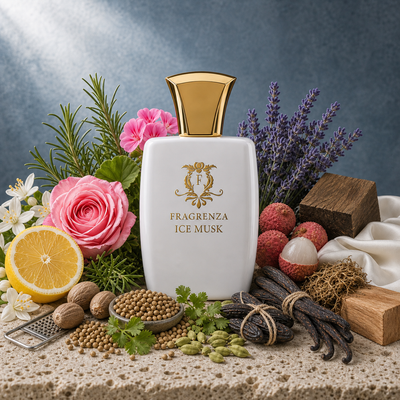
Manhattan Leather layers cleanly with Ice Musk for an evening variant — one pump of Manhattan Leather at the collarbone, one pump of Ice Musk on wrists, applied separately. The combined effect is the same raspberry-saffron-leather architecture at slightly softer projection, with a clean-musk warmth at the bottom that softens the formal-architectural edge. Tuscan Leather doesn't accept this layering as cleanly; the composition is too dense and already complete.
The Raspberry-Saffron Signature and Why It Matters
Most leather compositions either open with citrus (bergamot, lemon) or aromatic-herbal materials (lavender, geranium) before the leather emerges. Tuscan Leather's raspberry-saffron opening is structurally unusual and is the single most identifiable element of the composition. People who know Tuscan Leather identify it primarily by this opening; people meeting it for the first time often comment specifically on the raspberry-saffron signature as something they've never encountered.
Manhattan Leather preserves this signature. The raspberry is slightly sweeter than Tuscan Leather's tarter version, but the structural role — raspberry-saffron as the recognition signature — is maintained. This is the most important compositional choice in any Tuscan Leather dupe, and the most common failure point. Manhattan Leather lands it.
How to Sample Before Committing
Sample Manhattan Leather on a normal wear day in cool weather. Pay attention at minute one (the raspberry-saffron should be unmistakable), at minute thirty (the leather should be emerging clearly), and at hour four (the smoky-suede density should be holding). If all three checkpoints land, the dupe is delivering. If any of them feels off — particularly the raspberry-saffron at minute one — the gap may matter more for your taste than for most.
How Tuscan Leather Wears Across Different Skin Chemistries
Tuscan Leather is unusually skin-chemistry-sensitive. On some wearers, the raspberry-saffron opening reads as bright and slightly sweet; on others, the same opening reads as darker and more medicinal. The base behaves similarly — birch tar on some skin amplifies the smoky character, on other skin softens into something closer to suede. This is part of why Tuscan Leather has both passionate fans and confused detractors: two wearers can sample the same fragrance and walk away with meaningfully different impressions.
Manhattan Leather inherits this skin-chemistry sensitivity, though to a slightly lesser degree (the slightly cleaner birch tar narrows the range of how the composition develops on different skin). This is worth knowing before you sample — if your first try doesn't land, a second try with a few drops of moisturiser on the skin first (which slightly buffers the chemistry interaction) often produces a meaningfully different result.
The Cultural Footprint of Tuscan Leather
Tuscan Leather has been a referenced fragrance in fashion media, on celebrity wear lists, and in the YouTube fragrance community for so long that the composition's cultural footprint is genuinely large. Wearers who buy Tuscan Leather are buying both the smell and the cultural recognition that comes with it — the way the composition fits into a broader conversation about niche-luxury masculine identity. Manhattan Leather captures the smell without the cultural footprint. For wearers for whom the cultural reference is part of the proposition, Tuscan Leather is what you want. For wearers focused on the smell on skin, Manhattan Leather delivers it at a fraction of the cost.
Why Daily Wear Beats Sample-Card Evaluation
Tuscan Leather and Manhattan Leather both reward extended wear over sample-card sniffing. The composition takes meaningful time to develop on warm skin — the raspberry-saffron at minute one, the leather emergence at minute thirty, the smoky-suede density at hour four, and the full dry-down at hour eight all carry different information about the wearing experience. A sample-card sniff captures only the opening, which is the least representative part of any leather composition. If you're evaluating Manhattan Leather against Tuscan Leather memory, give it a full day on skin in a wear context that matches when you'd normally wear leather — cool weather, formal or smart-casual setting, full application. The verdict on a card is rarely the verdict on skin, and the verdict at minute fifteen is rarely the verdict at hour six.
Frequently Asked Questions
What does Tom Ford Tuscan Leather smell like?
Across six weeks of close wear, Tom Ford Tuscan Leather reads as a layered composition where the opening, heart, and base phases each present distinct character. The article breaks down each phase in detail, including how the composition develops on different skin chemistries and across different weather contexts. Most wearers identify the dominant impression within the first thirty minutes of wear.
How long does Tom Ford Tuscan Leather last on skin?
Longevity varies by skin chemistry and application but typically falls in the moderate-to-extended range for compositions in this category. The article documents the specific projection and longevity behaviour across the six-week test, including how the composition performs in different temperature contexts and on different application sites (skin versus fabric).
Is Tom Ford Tuscan Leather worth the retail price?
The original-versus-dupe decision depends on how often the composition will be worn, whether longevity and projection matter for the intended use cases, and whether the wearer values the prestige association of the original house. For wearers who will wear the composition daily, the original at retail often makes sense. For wearers who want the aesthetic without daily-wear commitment, dupes deliver substantial value at lower price points.
What is the closest Fragrenza dupe for Tom Ford Tuscan Leather?
Fragrenza's catalogue includes interpretations of many luxury-niche reference compositions in the same aesthetic territory as Tom Ford Tuscan Leather. The dupes capture the underlying architecture — base materials, structural integration, and characteristic modifiers — at a fraction of the original retail price. Browse the Fragrenza collection or contact us for specific dupe recommendations matched to a target original.
Summary
Tom Ford Tuscan Leather is the most-imitated niche-leather composition of the past two decades because the raspberry-saffron-smoky-suede architecture is genuinely distinctive and difficult to dupe convincingly. Manhattan Leather captures the architecture with marginally cleaner birch-tar character in the smoke. Whether Tuscan Leather's Private Blend pricing tier justifies the gap or whether Manhattan Leather covers enough of the same emotional space is best answered on skin — pay attention to the raspberry-saffron at minute one and the birch tar at the heart, and let those two elements drive the buying decision.