The Psychology of Perfume: How Scents Shape Moods and Memories in 2026
Fragrance is perhaps the most psychologically loaded sensory experience available to humans
By Julia MorettiFragrenza makes several of the alternatives featured in our guides — here’s how we test.
8 min read
Fragrance is perhaps the most psychologically loaded sensory experience available to humans. Of the five senses, smell has the most direct neurological route to the limbic system, the part of the brain responsible for memory and emotion. This anatomical fact has profound consequences for how perfumery operates. A fragrance does not just smell pleasant or unpleasant; it modulates mood, retrieves memories, and shapes how the wearer feels about themselves and how others perceive them. Understanding the psychology of perfume is the prerequisite to choosing fragrance with any genuine intentionality.
The mainstream conversation about fragrance tends to treat psychology as marketing copy: descriptions of fragrances as confident, sensual, joyful, or comforting. The real psychology is more rigorous than this. There are specific compositional choices that produce specific emotional responses, and those responses are reasonably consistent across wearers even though individual variation always exists. Knowing the emotional register each composition is engineered to produce lets you choose fragrance with the same clarity you would bring to choosing music for a particular mood.
The Four Core Emotional Registers
Most fragrance compositions can be sorted into four broad emotional registers, each defined by the combination of materials and architectural choices that produce a particular mood response. Wearers usually have one or two registers they reach for most often, but a complete fragrance wardrobe contains compositions across all four because the contexts of daily life demand different emotional inputs.
Register One: The Comfort Register
The comfort register is the emotional space of warmth, familiarity, and safety. Comfort fragrances tend to feature gourmand materials, soft musks, vanilla, and creamy lactonic notes that recall infancy, childhood food memories, and the olfactory signatures of close family. The neurological basis of these responses is well documented: vanilla in particular activates reward pathways in the brain associated with caregiving and food security.
Vanilla Delight
Register Two: The Warmth Register
The warmth register sits adjacent to the comfort register but operates differently. Where comfort fragrances evoke safety and familiarity, warmth fragrances evoke social connection, generosity, and the experience of being welcomed. The architectural materials are different: spiced amber, soft woods, honey, and warmer floral notes rather than the gourmand foundation of the comfort register.
Bontà
illustrates the warmth register. The composition uses pistachio, creamy lactonic notes, and an amber base in a way that recalls the welcome of an Italian dessert offered after a meal: not the comfort of being safe, but the warmth of being included. Wearers reaching for warmth-register fragrances are typically heading into social contexts where they want to be experienced as approachable and generous, and the compositional choices in this register support that intent.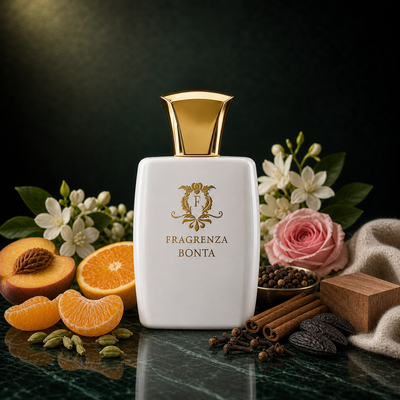
Register Three: The Sensuality Register
The sensuality register is the emotional space of physical presence, intimacy, and embodied confidence. Sensuality fragrances tend to use creamy florals, musks at higher concentrations than the comfort register would tolerate, animalic accents, and resinous bases that read as skin-adjacent rather than environmentally distant. The neurological response involves the activation of pathways associated with romantic and physical attraction.
Sensual Flame
is engineered for this register. The composition uses a creamy floral heart against a spiced amber base, with the kind of structural warmth that produces the embodied confidence sensuality fragrances are meant to deliver. Wearers reach for this register when the context calls for physical presence: romantic occasions, evening events, contexts where being noticed is part of the intent. The composition does not sell sex in the crude sense; it provides the wearer with a sensation of physical groundedness that translates into confident presence.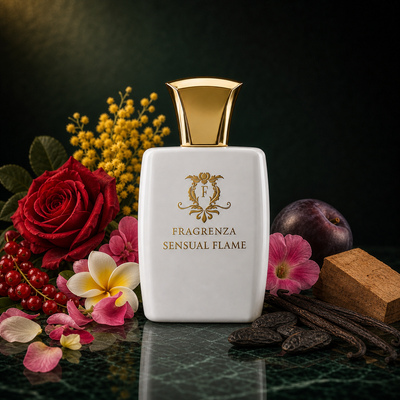
Register Four: The Confidence Register
The confidence register is distinct from the sensuality register, although the two are sometimes confused. Where sensuality fragrances produce embodied presence, confidence fragrances produce a sense of capability, focus, and professional readiness. The architectural materials are cleaner, sharper, more aromatic: citrus, herbs, transparent woods, controlled musks. The emotional response involves the activation of pathways associated with task readiness and social competence rather than physical attraction.
Genuine Touch
is built for the confidence register. The composition is clean, aromatic, with enough complexity to support a full professional day but enough restraint to remain appropriate in any setting. Wearers reach for this register before consequential meetings, important conversations, contexts where they need to feel capable and present. The composition does not announce the wearer's presence so much as it supports the wearer's own sense of preparedness.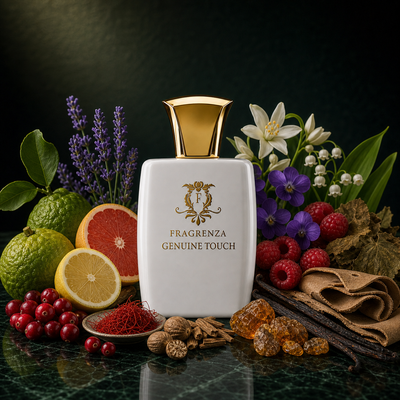
How These Registers Map to Daily Life
A typical week involves multiple shifts across these emotional registers, and a well-built fragrance wardrobe lets the wearer match composition to context. Mornings before high-stakes work usually call for the confidence register. Cold evenings at home generally call for the comfort register. Social gatherings where the wearer wants to feel generous and connected call for the warmth register. Romantic or intimate occasions call for the sensuality register.
Most wearers default to a single register because it matches their dominant context, but rotating through registers in response to actual mood needs produces a much richer relationship with fragrance over time. The wearer who only owns confidence-register compositions has nothing to reach for in moments that call for comfort, and vice versa.
The Psychology of Choosing
One of the most overlooked dimensions of fragrance psychology is the psychology of choosing. The act of selecting which composition to wear in the morning is itself a psychological intervention: it requires the wearer to consider what they will be doing, who they will be with, and what emotional state they want to bring to the day. This act of intentional selection has measurable effects on mood and self-perception that go beyond what the fragrance itself produces.
Wearers who use fragrance intentionally report higher satisfaction with their olfactory choices than wearers who default to a single signature regardless of context. The intentionality is the active ingredient, and any fragrance wardrobe of three or more thoughtfully chosen compositions can deliver this benefit.
The Memory Activation Effect
Beyond mood modulation, fragrance has a documented capacity to retrieve autobiographical memories. The Proustian phenomenon (named after the famous madeleine episode in Proust's novel) is well-supported by neuroscience: olfactory memories are stored differently from other sensory memories, with more direct connections to the emotional content of the original experience.
This memory-activation property has both creative and cautionary implications for fragrance choice. A composition you wore during a difficult period of life can retrieve the emotional content of that period years later, sometimes uncomfortably. Conversely, a composition worn during a happy period becomes a tool for retrieving that happiness on demand. Choosing fragrance with awareness of this memory-encoding property is part of mature fragrance practice.
Practical Applications
Begin by identifying which emotional register dominates your daily life. The composition you reach for most often probably belongs to that register, and recognising this gives you a starting point for diagnosing what your wardrobe is missing. Add compositions deliberately to fill the registers your current collection neglects. Over time, this approach produces a wardrobe that genuinely supports your psychological life rather than reflecting random accumulations driven by marketing exposure.
Related Reads
- Why a great fragrance is impossible to forget: deeper exploration of memory
- How to choose your signature scent: framework for wardrobe building
- What is niche perfumery: the field that takes psychology seriously
- Vanilla in Perfumery: the comfort-register foundation
- Amber in Perfumery: the warmth-register foundation
- Musk in Perfumery: the sensuality-register foundation
Frequently Asked Questions
Does fragrance really change my mood?
Yes, and the effect is supported by considerable neuroscientific research. The olfactory system has the most direct neurological route of any sense to the limbic system, the brain region responsible for emotion. Specific materials activate specific pathways: vanilla activates reward and caregiving responses, lavender activates parasympathetic relaxation, citrus activates alertness pathways. The effects are real, although individual variation means the same material does not produce identical responses in all wearers.
How do I figure out which register I respond to most?
Examine which fragrances you have repurchased over time. Repurchase decisions are unusually reliable indicators because they reflect satisfaction across many wearings rather than initial reaction to a sample. The register that dominates your repurchase history is the register your psychology most strongly responds to. From there, you can build out the other registers deliberately.
Can I wear the wrong register and feel worse?
In practice, yes. A wearer reaching for a confidence fragrance when their actual emotional need is comfort will often feel undermined rather than supported by the composition. The mismatch between intent and material produces an olfactory experience that feels off, even if the fragrance itself is well-made. Matching register to actual emotional need rather than to abstract preference improves the experience considerably.
What about gendered emotional registers in fragrance?
The four registers described here are gender-neutral. Comfort, warmth, sensuality, and confidence are human emotional needs rather than gendered ones, and compositions in each register can be worn by anyone. The gendered marketing of fragrance historically distorted this reality by associating certain registers with certain wearers, but contemporary niche perfumery has largely dispensed with these associations.
How long does the psychological effect of a fragrance last?
The acute mood-modulating effect typically peaks in the first hour of wear and gradually fades as the wearer adapts to the fragrance. The memory-encoding effect, however, persists indefinitely. A composition worn consistently across a particular life period becomes a permanent retrieval cue for the emotional content of that period, which can be activated decades later by the slightest re-exposure.
Can fragrance replace other forms of emotional support?
No, and treating it as a replacement leads to disappointment. Fragrance is a useful adjunct to a healthy emotional life rather than a substitute for it. Wearers who use composition thoughtfully report fragrance as a meaningful contribution to mood regulation alongside sleep, exercise, social connection, and other foundations. The role is real but bounded.
The Bottom Line
Fragrance operates as a genuine psychological tool when chosen with awareness of how compositions interact with mood and memory. Understand the four emotional registers, audit your wardrobe for gaps, and choose with intention rather than impulse. The wearer who applies fragrance psychology rigorously ends up with a much richer olfactory life and a much more reliable relationship with their own emotional needs.