

Best Honey Perfumes 2026: The Five Archetypes of the Golden Gourmand Trend
Guerlain's 1912 L'Heure Bleue anchors the cultural arc, while the contemporary niche revival treats honey as textured wax and powder rather than the syrup that earlier gourmand work defaulted to.
By Julia MorettiFragrenza makes several of the alternatives featured in our guides — here’s how we test.
16 min read
Honey is the golden gourmand of 2026. After a decade of vanilla dominance and a year of pistachio frenzy, the gourmand category has quietly tilted toward something warmer, more sensual, and harder to wear badly — a humming, slightly waxy sweetness that sits between vanilla and amber. Honey perfumes are the year's most underrated trend, and the launches landing right now are some of the best honey work the industry has done in fifteen years.
If you've been waiting for a gourmand that doesn't read as candy and doesn't lean as predictable as vanilla, honey is what you've been waiting for. This is the full 2026 v1.3 guide — what's behind the comeback, what the note actually smells like in modern compositions, the cultural arc from L'Heure Bleue (1912) to the contemporary niche revival, the five archetypes defining the category, and how to wear it without going syrupy. All Fragrenza picks below are §16.2-verified honey-tagged.
The trend in two sentences
Modern honey perfumery treats the note as a textured, slightly waxy, slightly powdery sweetness rather than a sugar bomb. The 2026 wave pairs honey with iris, mimosa, soft woods, refined amber, and trace animalic materials to build compositions that read as warm, golden, and quietly luxurious — closer to a beeswax candle than a honey jar.
What honey smells like in modern compositions
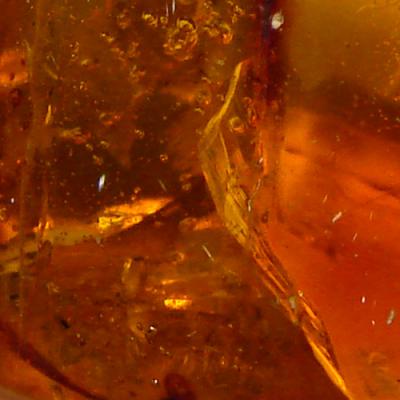
Honey is one of the most complex single notes in perfumery. Done well, it carries three sensations at once. There's the obvious sweetness — golden, edible, gourmand. There's a slightly animalic edge — warm, faintly skin-like, leaning sensual. And there's a waxy, almost floral facet that comes from beeswax, mimosa, and orange flower used in support.
The 2026 expression leans into all three. The sweetness is restrained — honey is the headline, but the formula does not stack other sugary notes on top of it. The animalic edge is preserved rather than scrubbed out, which is what gives modern honey perfumes their grown-up texture. And the waxy floral lift keeps the composition from going heavy.
The result wears warm but not sticky, sweet but not childish, sensual but not loud. It's gourmand framing for an audience that has aged out of full-sugar vanillas.
Honey in modern perfumery: the cultural arc
Honey is one of the oldest materials in perfumery. The ancient Egyptians used honey as a fixative in kyphi compositions. The Romans flavoured ointments with honey extracts. The Renaissance perfume tradition treated honey as both a fragrance material and a luxury foodstuff. But the note had a complicated relationship with fine perfumery throughout most of the twentieth century — partly because it is technically difficult to render honey convincingly with traditional materials, and partly because the animalic edge that gives honey its character was being scrubbed out of mass-market gourmands in favour of clean sugary sweetness.
The modern revival has roots in a handful of landmark launches. Guerlain L'Heure Bleue (1912) used a quiet honey accord at the heart of one of the great Edwardian-era perfumes. Jean Desprez Bal à Versailles (1962) leaned harder on the animalic-honey direction, building one of the most distinctive honey compositions of the twentieth century. Serge Lutens Miel de Bois (2005) was an uncompromising honey statement that polarised audiences — too animalic for many, but a critical milestone in proving that pure honey could carry a fine fragrance composition. Hermès Hermessence Cuir d'Ange (2014) brought honey-and-leather into the contemporary niche conversation. Paco Rabanne Lady Million (2010) brought the honey-jasmine-floral direction to mass-market scale and remains one of the best-selling honey-anchored compositions of the modern era.
The 2020s wave is different from any of these predecessors. The technical materials available to perfumers have improved meaningfully. The newer phenylacetic compounds and warm-sweet aromatics let perfumers write honey that smells convincingly like honey rather than like generic gourmand sweetness. The result is a category that has finally caught up to what the audience wanted from it twenty years ago — a sophisticated, grown-up version of the warmest gourmand note in the palette.
Famous honey fragrances in the cultural canon
Five compositions explain why honey has become a serious fine-fragrance register in 2026. Guerlain L'Heure Bleue (1912) is the foundational honey-as-heart-accent composition; the powdery-Edwardian honey reference point. Jean Desprez Bal à Versailles (1962) is the canonical animalic-honey statement and the cultural template for every modern animalic-honey-oriental composition. Serge Lutens Miel de Bois (2005) proved that uncompromising honey at concentration could anchor a serious niche release; it remains the most polarising honey perfume ever produced. Paco Rabanne Lady Million (2010) brought honey-jasmine-floral to mass-market scale and shaped how an entire generation perceives honey in fragrance. Amouage Jubilation XXV (2007) and the Amouage Journey line that followed brought honey-orchid-resin and honey-tobacco-saffron into the prestige niche conversation and codified the contemporary honey-as-luxury direction.
The material palette
The vocabulary of a modern honey perfume sits at the intersection of three material families.
The honey itself is built from a combination of natural absolutes (when budget allows) and synthetic aromatics — phenylacetic acid esters, methyl phenylacetate, p-cresyl phenylacetate, and warm sweet aldehydes. Done right, this reads as warm, golden, faintly animalic. Done wrong, it goes either generic-sweet or weirdly medicinal. The choice of honey-accord materials sets the entire personality of the composition.
The texture-and-lift palette includes beeswax (the textural ingredient that separates a luxurious honey perfume from a sugary one — adds a slightly waxy, faintly powdery dimension), mimosa (powdery, slightly green-yellow brightness), orange flower (sun-warmed radiance), and immortelle (golden-curry-honeyed and very perfumery-coded). Together they keep honey readable and stretch the wear past a single note.
The base architecture typically involves real benzoin, labdanum (which has its own honeyed-amber character that doubles down on the headline), sandalwood, vanilla absolute used sparingly, and soft musks. The dry-down of a great honey perfume usually reads more amber than honey — the headline fades into the base over the course of the day. That fade is the category's signature.
Bridge materials — iris, cinnamon, saffron, leather, tobacco — extend honey into adjacent registers. Each one shifts the composition's mood without abandoning the honey headline. Honey-leather reads masculine. Honey-iris reads luxurious-quiet. Honey-tobacco reads dark and evening-coded. Honey-cinnamon reads warm and Mediterranean.
The five honey perfume archetypes of 2026
The category divides into five distinct registers in 2026. Each represents a different decision about which bridge material partners with honey, and each has at least one Fragrenza interpretation with the headline note verified in the official tag list.
1. Honey-jasmine-floral (the luminous daytime archetype)
The luminous, daytime-feminine end of the category. Honey at the base, jasmine sambac and orange blossom at the heart, often with raspberry or neroli in the opening for brightness. Reads as confident, golden, broadly accessible. Best for daytime wear, warmer weather, and as the entry point for anyone new to the category. The archetype was codified at the mass-market tier by Paco Rabanne Lady Million (2010), which remains the most commercially successful honey-jasmine-floral ever released.
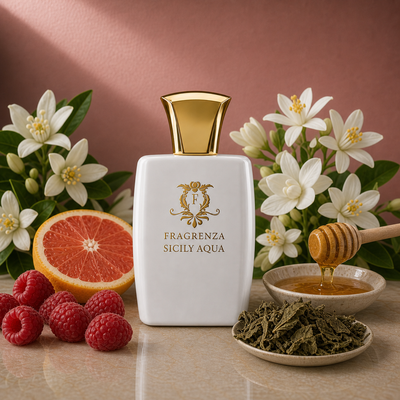
(rendered as Sicily Aqua) is the cleanest Fragrenza interpretation of this register. The opening is raspberry, neroli, and bitter orange — a sun-warmed citrus-fruit lift. The heart adds orange blossom and jasmine sambac for floral expansion. The base is honey explicitly named, anchored on patchouli for warm depth. Sicily Aqua is one of the few products in the line where honey is the literal star of the base rather than a textural reference — the architecture matches what the trend is built on. Wears beautifully across spring, summer, and warm-weather evenings.
2. Honey-cinnamon-Mediterranean (the warm-edible archetype)
The warmest, most edible end of the category. Honey paired with cinnamon and cashmeran, often with lavender or bergamot in the opening to keep the composition from going too sweet. Reads as warm, slightly nostalgic, and unmistakably Mediterranean. Best for cooler-weather daytime wear and gentle evening occasions. The architecture sits at the intersection of the Bright Gourmand and Savory Gourmand pillars and reads as the most universally appropriate honey direction across audiences.
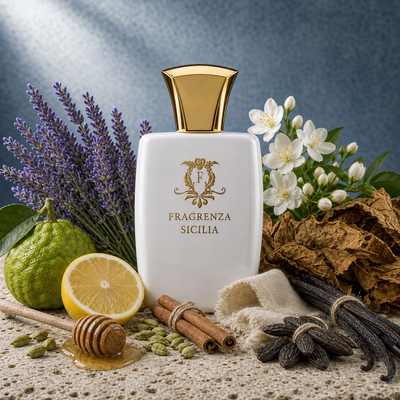
is the Fragrenza interpretation. The opening pairs wild lavender, bergamot, and lemon — bright, aromatic, Mediterranean. The heart brings golden honey explicitly together with cinnamon and cashmeran, with jasmine sambac running through for floral lift. The base is tobacco leaf, tonka, and vanilla — the kind of dry-down that holds for hours and gets progressively warmer. The honey-and-cinnamon pairing is the architectural anchor; the composition reads as honey that has been worn-in and grown-up rather than honey-as-novelty. Year-round wear, daytime-leaning, with enough warmth in the base for evening when the weather cools.
3. Honey-orchid-floral-regal (the opulent evening archetype)
The most ornate archetype in the category. Honey paired with orchid, rose, and clove, anchored on oud and smoky woods. Reads as opulent, evening-coded, and unmistakably luxury-tier. The honey works as a structural sweetener that gives the floral-oud composition somewhere to breathe. The architecture was prestige-tier codified by Amouage Jubilation XXV (2007) and the surrounding Amouage line that brought honey-orchid-resin into serious niche perfumery.
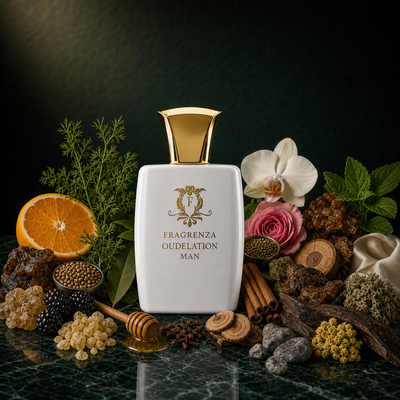
(rendered as Oudelation Man) is the Fragrenza interpretation. The opening brings labdanum and frankincense alongside coriander and orange — warm, resinous, ceremonial. The heart adds honey explicitly together with cinnamon, orchid, rose, and gaiac wood — a regal floral-honey accord. The base is patchouli, myrrh, smoky oud, atlas cedar, oakmoss, ambergris, with immortelle's honeyed glow weaving through. Despite the "Man" framing, the composition is genuinely unisex and lands beautifully as evening wear in cooler weather. The most cinema-coded honey perfume in the line.
4. Animalic-honey-oriental (the Bal à Versailles archetype)
The classical archetype, descended directly from Jean Desprez Bal à Versailles (1962) and the lineage of honey-leather-labdanum compositions that defined the animalic side of the category through the late twentieth century. Honey paired with labdanum, ambergris, and benzoin, with smoky resins and patchouli anchoring the base. The animalic edge is preserved rather than scrubbed — this is the most adult honey direction, and the one that most rewards a four-hour wear test before commitment.
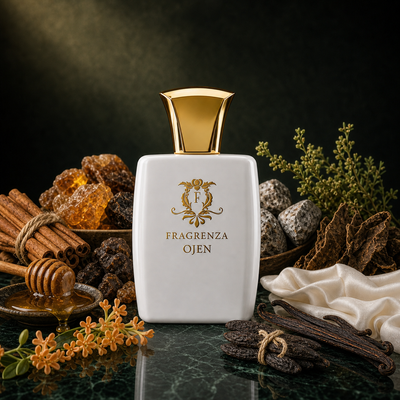
is the Fragrenza pick. The opening combines davana, cinnamon, and a faint citrus brightness. The heart unfolds the honeyed-labdanum core alongside osmanthus and patchouli — the literal Bal à Versailles architecture translated into modern materials. The base resolves on ambergris, benzoin, tonka, vanilla, and musk for an extended honeyed-amber dry-down. The composition holds the animalic-honey character through hours of wear and is the most architecturally classical honey pick in the Fragrenza catalog.
5. Smoky-honey-incense (the sacred-tobacco archetype)
The sacred-coded register. Honey paired with tobacco, saffron, and incense, often with cardamom and tea threading through for grit. The composition reads as ceremonial, slightly austere, and deeply unisex. The honey functions as the warm-sweet counterweight that keeps the smoke and tobacco from going one-dimensional. The architecture has been prestige-tier dominant since the late 2000s, particularly through the Amouage Journey line and the wave of honey-tobacco niche releases that followed.
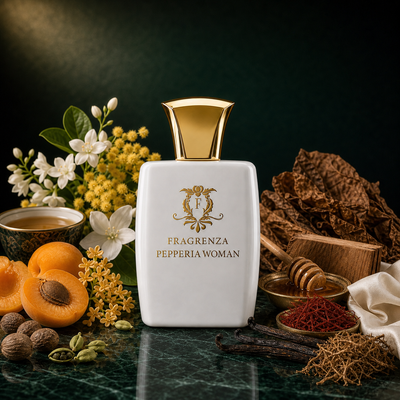
(rendered as Pepperia Woman, the Amouage Journey Woman analog) is the Fragrenza interpretation. The opening brings jasmine sambac, jasmine tea, mimosa, and apricot — a luminous bright-warm lift. The heart adds honey explicitly alongside pipe tobacco, saffron, osmanthus, cardamom, and nutmeg — the smoky-honey-tobacco-tea register at full luxury concentration. The base resolves on cypriol, nagarmotha, cedarwood, vanilla, and musk for a tenacious dry-down that reads ceremonial through the entire wear curve. The most evening-coded and the most prestige-tier honey pick in the line.
How honey perfumes wear on skin
The category has its own behavioural signature. The first hour is usually dominated by the honey itself — phenylacetic compounds are relatively volatile, so the headline reads loudest in the opening. By hour two, the bridge materials (cinnamon, iris, leather, jasmine) come forward and the honey settles into a textural undertone. By hour four, the base architecture — amber, sandalwood, labdanum, vanilla — does most of the work, and the honey is present mostly as warm-golden colour rather than as discrete note.
This wearing pattern matters for application. A honey perfume applied 30-60 minutes before social contact will read at its most balanced when the wearer arrives. Spraying immediately before leaving puts the wearer in the honey-dominant opening, which can read as overly sweet in close company. The post-shower window technique (covered in our longevity guide) is especially useful for this category.
Skin chemistry interacts with honey more visibly than with most gourmand notes. Warmer skin amplifies the animalic edge; cooler or drier skin keeps the honey more powdery. People who find honey perfumes go "wrong" on their skin are usually experiencing this amplification effect — the category rewards a sample wear test before committing more than almost any other.
Who and when to wear honey
Honey is one of the more flexible gourmand directions in the year. The lighter, jasmine-and-orange-flower-forward archetypes (Sicily Aqua) wear beautifully in spring and warm-weather evenings. The denser, cinnamon-and-tobacco archetypes (Sicilia) belong to year-round wear with a fall-and-winter lean. The animalic and smoky-incense archetypes (Ojen, Pepperia Woman) are evening and cool-weather only.
It is a thoroughly unisex direction in 2026. The animalic, warm edge of honey, paired with woody and amber bases, lands the note comfortably across genders. Where it leans more feminine is in the honey-jasmine and honey-rose interpretations; where it leans more masculine is in the honey-leather-tobacco direction. The smoky-honey-incense register is the most genuinely gender-neutral.
Application restraint matters more here than in most categories. Two sprays on chest and inner elbow is enough for most honey perfumes; three is reasonable for the heavier animalic and smoky archetypes in cool weather; more than three almost always reads as overdone. The animalic edge of honey amplifies on warm skin in ways that can read as overwhelming if applied generously.
How to layer honey perfumes
Three useful patterns. Warmer: layer with a vanilla or caramel-based gourmand on the chest only. The vanilla deepens the honey-amber dry-down and pushes the composition toward winter-evening territory. Drier: layer with a smoky woods or oud composition. The wood note pulls the honey toward leather-and-incense, working especially well with the Honey-cinnamon-Mediterranean archetype. Brighter: layer with a fig, neroli, or soft citrus scent for warm-weather wear. The citrus stretches the honey opening without disrupting the golden-amber heart.
What rarely works: layering two honey perfumes. The phenylacetic compounds stack badly — the combination reads as candy-sweet rather than complex, and the animalic edge collapses. Pick one honey perfume as the headline and layer something simpler underneath or on top, not another full composition. Our broader layering guide covers the underlying principles.
Building a honey mini wardrobe
A three-bottle honey wardrobe covers most occasions. One daytime option — Sicily Aqua or Sicilia — for office, casual, and warmer-weather wear. One evening option — Oudelation Man or Pepperia Woman — for cool-weather and occasion-coded wear. One classical anchor — Ojen — for the days when the Bal à Versailles-coded animalic-honey is the right mood, or for layering as a base under brighter compositions.
Honey works especially well as the bridge in a fuller gourmand wardrobe. Pair the honey direction with the broader Bright Gourmand pillar picks for the warm-comfort register, or with the Savory Gourmand pillar picks for the darker, more savory side. Honey sits in the connective tissue between the two pillars and translates well to either side.
Who each pick is for
Sicily Aqua is for the wearer who wants honey in its most luminous, accessible form: raspberry-neroli opening, jasmine-orange-blossom heart, honey-patchouli base. The natural choice for warm-weather wear and for new entrants to the category who want their first honey perfume to read as broadly appealing rather than statement-driven.
Sicilia is for the wearer who wants the warm-edible Mediterranean honey: lavender-bergamot-lemon opening, honey-cinnamon-cashmeran heart, tobacco-tonka-vanilla base. The natural choice for year-round daily wear and for the wearer who wants honey to feel familiar and grown-up rather than novel.
Oudelation Man is for the wearer who wants honey in its most ornate, opulent register: labdanum-frankincense opening, honey-orchid-rose-gaiac heart, oud-cedar-oakmoss-ambergris base. The natural choice for serious cool-weather evening wear and for the wearer who wants their honey to read as cinema-coded prestige.
Ojen is for the wearer who wants the classical animalic-honey architecture: the literal Bal à Versailles template translated into modern materials, with honey-labdanum-ambergris carrying the wear through hours of close-skin projection. The natural choice for the wearer who wants honey at its most architecturally classical and most adult.
Pepperia Woman is for the wearer who wants the prestige-tier smoky-honey-tobacco register: jasmine-tea-mimosa-apricot opening, honey-tobacco-saffron-osmanthus heart, cypriol-nagarmotha-cedar base. The natural choice for occasion-coded evening wear and for the wearer who wants the most luxury-tier honey composition in the catalog.
Frequently asked questions
What does honey smell like in perfume?
Honey in modern perfumery reads as warm, golden, slightly waxy, and faintly animalic — closer to a beeswax candle than to a sugary honey jar. The sweetness is restrained, with mimosa and orange flower lifting the top and beeswax-and-amber grounding the base. A good honey perfume should feel sensual rather than candy-sweet, and it should evolve toward a warm amber dry-down over the course of a few hours.
Are honey perfumes too sweet?
The 2026 wave of honey perfumes is deliberately less sweet than older gourmand work. Modern honey compositions lean on beeswax, iris, labdanum, and amber to build a textured, slightly powdery warmth rather than a sugar bomb. If you find vanilla or caramel perfumes too rich, a honey-leaning composition is usually a step in a more wearable direction — sweet, but framed.
Are honey perfumes good for men?
Yes — and increasingly worn that way in 2026. Honey sits comfortably in unisex territory, especially in compositions paired with leather, tobacco, smoky woods, or oud bases. The animalic, slightly waxy facet of honey gives it real depth, and a darker base keeps the sweetness in masculine territory. The Animalic-honey-oriental and Smoky-honey-incense archetypes (Ojen, Pepperia Woman) are some of the most-worn men's gourmand directions in the niche space.
What pairs well with honey in perfume?
Iris, mimosa, beeswax, orange flower, soft amber, sandalwood, soft musks, leather, tobacco, smoky woods, and oud are the most reliable honey pairings. The note also pairs well with vanilla and caramel for a deeper gourmand reading, with rose for a more classical floral-honey direction, and with cinnamon for the Mediterranean-warm register. Avoid stacking honey with very loud sugary notes — the composition will collapse into single-dimensional sweetness.
Do honey perfumes last long?
Generally yes, especially when built on a warm amber, sandalwood, labdanum, or beeswax base. Honey is technically a heart note, but the structural ingredients around it — amber, soft musks, vanilla absolute, labdanum — are long-wearing base materials that hold the composition in place for six to eight hours and beyond. Application on moisturised skin and on heat-emitting points is the easiest way to extend wear.
What's the best honey perfume for a first date?
The Honey-jasmine-floral and Honey-cinnamon-Mediterranean archetypes are the most reliable choices — Sicily Aqua and Sicilia both read as warmly inviting without being heavy or polarising. Skip the Animalic-honey-oriental register for first dates; the animalic edge can read as too bold before the relationship has context. Two sprays on chest and inner elbow, 30-60 minutes before arrival, is the working formula. (Our date-night fragrance guide covers the broader principles.)
Can honey perfumes work in summer?
The lighter archetypes (Honey-jasmine-floral, lighter readings of Honey-cinnamon-Mediterranean) work well in spring and early summer. The denser animalic and smoky-incense archetypes are too heavy for hot weather. The deciding factor is the base architecture — compositions with strong labdanum, oud, or leather bases need cool air to wear well, while compositions with cleaner musk and lighter floral bases handle warm weather without complaint. Apply restraint accordingly.
The takeaway
Honey is the gourmand note for people who want comfort without childishness — warm, sensual, lightly animalic, and grown-up in the right composition. The 2026 wave is the strongest case for the note in years, and the launches landing now are far better than the honey perfumery of the last decade. If gourmand is your direction but pistachio and vanilla aren't quite the texture you want, honey is the next move.
Related reads: Bright Gourmand: The 2026 Guide, Savory Gourmand pillar, Gourmand Floral pillar, The pistachio perfume boom, Dubai chocolate perfume trend, The most popular perfume notes of 2026, What makes a perfume smell expensive, Wardrobe pillar.