

Best Plum Fragrances 2026: The Five Archetypes from Dark Oud to Modern Unisex
Bandit in 1944, Poison in 1985 and Plum Japonais in 2008 wrote the canon, with gamma-undecalactone now giving the modern wave its rounded juicy character against suede and dark amber bases.
By Julia MorettiFragrenza makes several of the alternatives featured in our guides — here’s how we test.
15 min read
Plum is one of the most underrated notes in fine perfumery. Where peach reads as soft and summer-coded, plum reads as dark, jewel-toned, and emphatically evening — the fruit pushed all the way into a velvet-and-amber register that no other fruity material occupies. The note carried 1944 Bandit, 1985 Poison, and 2008 Plum Japonais into the canon and is having a quiet contemporary revival inside the broader savory gourmand wave of 2024-2026. This is the commercial buyer's edit organized around the five archetypal directions plum perfumery has settled into.
For the conceptual background on plum as a perfumery material, our Plum in Perfumery educational pillar covers the chemistry and history in depth. For the broader fruity-trend cluster context, the iter-23 Best Peach Fragrances 2026 pillar is the companion piece — plum and peach share lactone chemistry but diverge sharply in cultural and wearing patterns. This article is the dedicated plum buyer's edit.
What plum actually is in fine perfumery
Plum in perfumery is a constructed accord — the fresh fruit yields too little aromatic material for direct distillation, so the note is built from synthetic and natural materials that capture different facets of the plum character. Three structural elements anchor the category.
Gamma-undecalactone (aldehyde C-14) — the same peach lactone that defines stone-fruit perfumery — provides the rounded, juicy character that ties plum to its fruit-family neighbors. But where peach uses gamma-undecalactone at the surface, plum compositions push it deeper into the heart, letting the dry-down materials shape the wear more aggressively.
Damascones and ionones are what separate plum from peach chemically. Damascones (rose ketones) give plum its distinctive dark-floral facet — the rose-fruit chemistry that explains why plum pairs naturally with rose, oud, and patchouli in the most successful compositions. Beta-damascone in particular contributes the cooked-fruit, jam-adjacent character that defines the canonical plum oriental.
Cassis and prune accords supplement the core architecture in different commercial directions. Cassis (blackcurrant) chemistry extends plum into the dark-berry register; prune (dried plum) accords push it into the boozy-oriental territory that Plum Japonais defines. Many contemporary compositions blur cassis, plum, and blackberry — the materials share enough overlapping chemistry that the distinction is sharper in theory than on skin.
Plum is fundamentally a base-leaning note: the wear lives in the heart-to-base transition rather than the opening. This is the most important wearing distinction between plum and peach. A peach composition declares itself in the first 30 minutes; a plum composition reveals itself in the second and third hours, when the damascone-rose chemistry integrates with the resinous base materials.
The cultural arc — from chypre-leather to dark oriental
Plum has one of the longest continuous histories of any fruity note in fine perfumery. Five moments matter most for the contemporary commercial space.
1944: Robert Piguet Bandit. Germaine Cellier's groundbreaking chypre-leather composition used plum as a counterweight to the radical leather-galbanum architecture. Bandit established that plum could anchor a serious adult composition — not as a sweet fruit, but as a dark-velvet emotional register. The chemistry connection to leather (both materials share certain quinoline-related facets) made Bandit's plum-leather pairing unexpectedly natural.
1985: Dior Poison. Edouard Fléchier's masterpiece is the genre-defining plum oriental. Plum paired with wild berries, aniseed, coriander, orange honey, tuberose, rose, jasmine, frankincense, opoponax, amber, vanilla, and sandalwood produced one of the most architecturally dense feminine compositions of the 1980s. Poison rewrote what plum could do at the headline; every subsequent plum oriental traces its lineage back to this composition.
1992: Serge Lutens Féminité du Bois. Christopher Sheldrake's cedar-plum-rose composition demonstrated plum in a niche-luxury register that Poison's mass-market success had obscured. Féminité du Bois established that plum could carry quieter, more architectural compositions, paving the way for the contemporary niche plum revival.
2008: Tom Ford Plum Japonais. The Private Blend launch pushed plum into Japanese-influenced dark-oriental territory with saffron, cinnamon, immortelle, cypress, liquor, camellia, oud, benzoin, fir balsam, and vanilla. Plum Japonais is the contemporary cultural reference for dark plum-oud perfumery and the composition that defined the 2010s-2020s plum-as-luxury-note moment.
2020-2026: the savory gourmand wave. Plum re-emerged as one of the canonical materials of the broader savory gourmand register — its dark-floral chemistry pairs naturally with tobacco, oud, leather, and the smoky-sweet directions that dominate the current commercial moment. For the full context on this broader shift, our Savory Gourmand pillar covers the territory.
Famous plum fragrances worth knowing
Several compositions deserve study because they show what plum can do at the headline of a fine fragrance. Robert Piguet Bandit (1944) remains the genre benchmark for chypre-leather plum and is still the reference point for the most architecturally serious plum compositions. Dior Poison (1985) is the canonical plum oriental — the most influential mass-market plum composition ever produced and the reference point for every dark-floral plum that followed. Serge Lutens Féminité du Bois (1992) demonstrated plum as a niche-luxury structural material rather than a foregrounded fruit. Tom Ford Plum Japonais (2008) is the contemporary cultural reference for dark plum-oud. Frédéric Malle Une Rose (2003) folded plum into a high-prestige rose composition, showing how the damascone chemistry that connects rose and plum can produce compositions of considerable elegance. Mugler Womanity (2010) demonstrated plum-and-caviar — an experimental commercial direction that pushed the note into newly unexpected territory.
The Fragrenza catalog interpretations of the plum mood — covered in the archetype sections below — span five contemporary plum directions through two clean handles and three §6.2 flagged compositions where the cultural reference points (Poison, Plum Japonais, Dia Man) are themselves the canonical commercial pieces.
Five archetypal plum directions in 2026
Each direction has its own typical use case, its own seasonal register, and its own Fragrenza pick distributed inline.
1. Dark plum-oud (the Plum Japonais register)
The most architecturally dense of the five archetypes. Sun-ripened plum paired with saffron, cinnamon, immortelle, oud, amber, benzoin, and vanilla — the composition that defines contemporary dark plum-oud perfumery. Reads as opulent, evening-only, slightly austere. Best for evening wear, cool weather, and anyone drawn to the niche-luxury dark plum direction. The closest Fragrenza match:
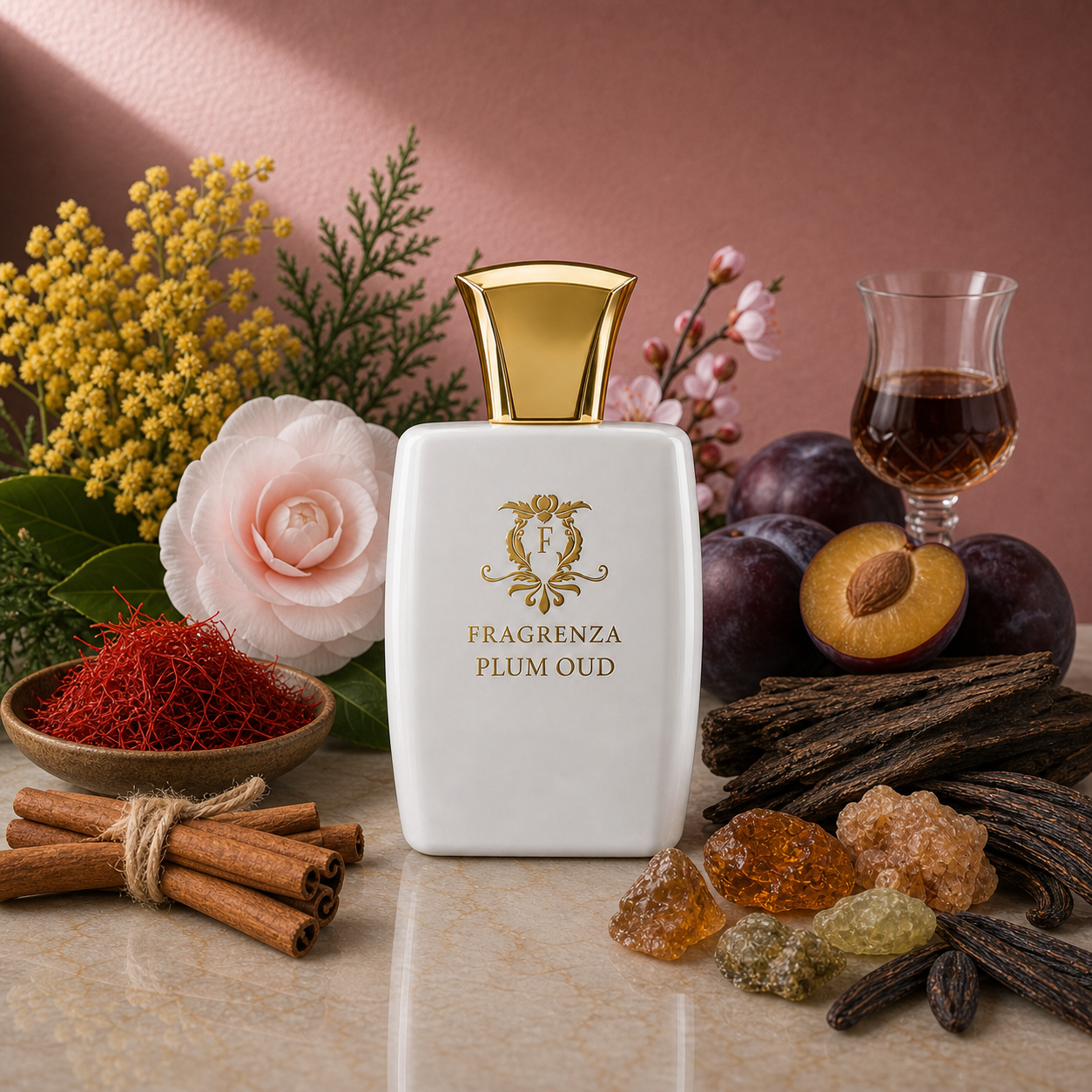
(Plum Oud) — a Tom Ford Plum Japonais-inspired composition with saffron and cinnamon opening, sun-ripened plum and plum blossom at the heart with immortelle, cypress, dark liquor, and camellia, settling into a base of smoky oud, molten amber, benzoin, fir balsam, and vanilla. Among the most architecturally complex plum compositions in contemporary fragrance.
2. Plum chypre (the niche-luxury register)
The structurally restrained archetype. Plum paired with bigarade, cardamom, and a white-floral chypre architecture — the niche-luxury direction that traces back to Lutens Féminité du Bois and Amouage Opus I. Reads as refined, evening-leaning, classically constructed. Best for evening wear, special occasions, and anyone drawn to chypre perfumery's contemporary niche revival. The closest Fragrenza match:
— an Amouage Opus I-inspired composition with bigarade and ripe plum opening, a white-floral heart of ylang-ylang, rose, jasmine, tuberose, and lily of the valley, settling into earthy papyrus, smoky guaiac wood, cedarwood, frankincense, tonka bean, sandalwood, and vetiver. The plum sits structurally rather than declaratively — it shapes the chypre architecture from within without becoming the foregrounded note.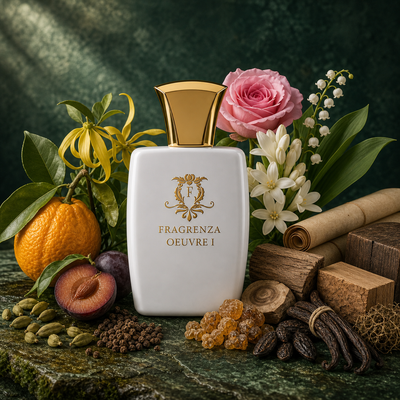
3. Plum oriental-floral (the Poison register)
The genre-defining archetype. Ripe plum paired with wild berries, aniseed, coriander, orange honey, a dense white-floral heart, and a resinous oriental base — the canonical Dior Poison architecture that established mass-market plum perfumery in 1985. Reads as dramatic, evening-only, intensely feminine. Best for evening wear, cool weather, and anyone drawn to the most architecturally maximal plum compositions. The closest Fragrenza match:
(Catania Crush) — a Dior Poison-inspired composition with intoxicating plum and wild berries opening alongside aniseed, coriander, orange honey, pimento, and rosewood; a heart of rose, jasmine, tuberose, carnation, neroli, cinnamon, frankincense, and opoponax; settling into amber, vanilla, heliotrope, sandalwood, cedar, vetiver, and musk. The most architecturally dense plum composition in the Fragrenza catalog.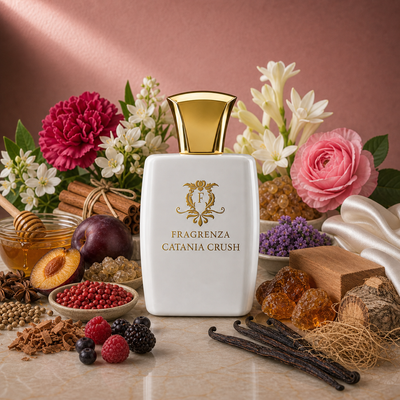
4. Plum modern-unisex (the osmanthus-tobacco register)
The contemporary-evolved archetype. Ripe plum paired with osmanthus, jasmine, honeyed tobacco, and a sandalwood-vanilla base — a modern direction that pulls plum into the unisex-elegant register that didn't exist before the 2010s. Reads as polished, cool-weather-evening, sophisticated. Best for autumn and winter evening wear, and anyone who wants plum in a genre-fluid composition. The closest Fragrenza match:

5. Plum-peony masculine elegance (the contemplative register)
The most unexpected of the five archetypes. Plum blossom (rather than the fruit) paired with bigarade, cardamom, incense, labdanum, ylang-ylang, orris, peony, vetiver, leather, amber, patchouli, and rosewood — the niche-masculine register that Amouage Dia Man defined. Reads as quietly powerful, evening-leaning, masculine-coded but unisex-flexible. Best for those drawn to architecturally complex masculine compositions where plum blossom serves as the soft floral counterpoint to the leather-incense base. The closest Fragrenza match:
— an Amouage Dia Man-inspired composition with bigarade, cardamom, incense, and labdanum opening; ylang-ylang, orris root, peony, and plum blossom at the heart; vetiver, leather, amber, patchouli, and rosewood at the base. The plum blossom is one element of a dense composition rather than the headline; for wearers drawn to the contemplative-masculine register, this is the plum pick.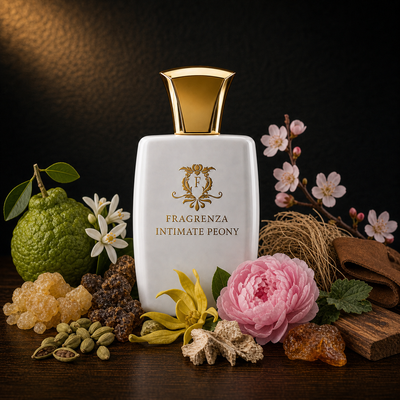
How plum fragrances wear on skin
Plum compositions wear specifically. Three patterns worth knowing.
The dry-down is the wear. Unlike peach (which declares itself in the opening) or citrus (which volatilizes within an hour), plum lives in the heart-to-base transition. The first thirty minutes typically read as floral or spiced; the plum character emerges around the 60-90 minute mark when the damascone chemistry integrates with the base materials. Give plum compositions at least 90 minutes on skin before judging — many wearers miss what makes plum perfumery distinctive by judging on the opening alone.
Skin chemistry shapes the wear meaningfully. The damascone-rose chemistry that defines plum interacts variably with skin. Warmer or oilier skin amplifies the cooked-fruit and dark-floral facets, making compositions read closer to jam-and-rose; cooler or drier skin amplifies the fresh-plum and chypre facets, making the same composition read closer to fresh-fruit-and-incense. The variation is more pronounced than for most fruity materials. See the skin chemistry deep-dive for the full mechanism.
Projection and longevity are typically high. The dense base materials (oud, patchouli, vanilla, amber, soft musks, leather) carry well; eight to twelve hours is typical for the full plum compositions, with the dark-floral character lasting longest. Apply with restraint; one to two sprays is sufficient for any plum composition in this category.
When and how to wear plum compositions
The plum register is fundamentally cool-weather and evening-coded. The dense base materials require cool air to develop properly; in high summer heat the compositions can read as cloying or overwhelming rather than seductive. The modern-unisex archetype (Pietra Blu register) is the partial seasonal exception — light enough to handle cool spring and autumn daytime contexts. The dark plum-oud, plum chypre, plum oriental-floral, and plum-peony masculine archetypes are emphatically autumn and winter evening territory.
For application, plum rewards restraint. The dense base materials project naturally without requiring volume; one or two sprays for the modern-unisex register, two for the chypre and oriental-floral registers, never more than three. Apply to pulse points and let the composition develop for at least 90 minutes — the plum reveals itself in the dry-down. For the broader wardrobe framework, our wardrobe pillar covers how plum fits alongside other fruity and oriental families.
How to layer plum fragrances
Three reliable layering patterns work within the plum register.
Pattern 1: plum over a clean musk base. Spray a clean musk on pulse points first, then apply the plum composition over it. The musk softens the projection of the denser plum compositions and lifts the dark-floral character without competing — particularly useful for the plum chypre and plum oriental-floral archetypes when daytime wear is required.
Pattern 2: plum + oud sequencing. For the dark plum-oud archetype, layering with a separate oud composition deepens the resinous character. Apply the oud composition lightly first, let it settle for ten minutes, then plum over. The reverse order tends to push the plum under the oud and lose the damascone character.
Pattern 3: plum + rose pulse points. The natural damascone chemistry connecting plum and rose makes a layered plum-rose wear among the most architecturally rewarding in contemporary perfumery. Apply the plum composition to chest and wrists, then a small amount of pure rose to inner elbows. The rose blooms into the plum heart and amplifies the dark-floral character of both compositions.
Anti-pattern: do not layer plum under bright citrus or aquatic compositions. The contrast between plum's dark-resinous wear and a sharp-cool top note tends to read as awkward rather than complementary. Save citrus pairings for fresh-floral or aromatic-fougere territory instead. For the broader layering framework, our layering pillar covers the principles.
Building a plum rotation
A two-bottle plum setup covers most use cases — one architecturally maximal pick for evening (the Plum Japonais register via Plum Oud, or the Poison register via Catania Crush) and one modern-unisex pick for cool-weather daytime (Pietra Blu). A three-bottle rotation adds the plum chypre register (Oeuvre I) for special-occasion evening wear. A five-bottle rotation covers all five archetypes including the plum-peony masculine register (Intimate Peony).
The plum register pairs naturally with the iter-23 Best Peach Fragrances pillar for the broader stone-fruit landscape, the Best Cherry Fragrances for the dark-fruit register, the Savory Gourmand pillar for the cultural context, and the Best Oud Fragrances guide for the oud-adjacent registers that plum perfumery often crosses into.
Who each pick is for
If you want the dark plum-oud register at niche-luxury depth: Plum Oud.
If you want the architecturally restrained plum chypre direction: Oeuvre I.
If you love the canonical 1985 Dior Poison plum oriental-floral: Catania Crush.
If you want modern unisex plum with osmanthus and honeyed tobacco: Pietra Blu.
If you want contemplative masculine plum-peony with leather and incense: Intimate Peony.
If you're not sure where you sit: The Fragrenza sample pack covers the full range — three-day testing on skin is the only way to discover which plum register your chemistry amplifies.
Frequently asked questions
What does plum smell like in perfume?
Dark, jewel-toned, and slightly cooked — closer to a sun-warmed ripe plum than to the fresh fruit. Quality plum compositions deliver the damascone-driven dark-floral character that distinguishes plum from peach (which leans bright-juicy) and from blackberry (which leans tart-green). The wear lives in the heart-to-base transition where the rose-chemistry of damascones integrates with the resinous base materials. Plum is fundamentally evening-coded; the character reads richest in cool air.
What is the difference between plum and peach in perfumery?
Chemistry: both share gamma-undecalactone (the stone-fruit lactone), but plum compositions also lean heavily on damascones (rose ketones), which give plum its dark-floral character. Wearing pattern: peach declares itself in the opening; plum reveals itself in the dry-down. Seasonal register: peach is broadly seasonal-flexible; plum is fundamentally cool-weather and evening. Cultural lineage: peach traces from 1919 Mitsouko through 2023 Bitter Peach; plum traces from 1944 Bandit through 1985 Poison through 2008 Plum Japonais. They share fruit-family chemistry but occupy very different commercial and wearing positions.
Are plum fragrances feminine?
Historically marketed as feminine because the canonical compositions (Poison, Féminité du Bois) had feminine launches, but the modern plum register is fully unisex. The dark plum-oud archetype is genre-fluid; the modern-unisex archetype is essentially unisex by design; the plum-peony masculine archetype is explicitly masculine-coded. Treat plum gender marketing as a starting point rather than a constraint.
How long do plum fragrances last on skin?
Eight to twelve hours is typical for full plum compositions on average skin. The dense base materials (oud, patchouli, amber, vanilla, leather, soft musks) carry the wear, and the damascone-driven dark-floral character is among the longest-lasting facets. The modern-unisex archetype wears slightly shorter (6-10 hours) because its base is less dense. Layering with a clean musk base extends most plum compositions by an additional 1-2 hours.
Can plum fragrances be worn in summer?
The modern-unisex archetype (Pietra Blu register) is the only one that handles warm weather well — the tobacco-osmanthus architecture stays balanced in heat. The dark plum-oud, plum chypre, plum oriental-floral, and plum-peony masculine archetypes are cool-weather compositions; the dense base materials project too aggressively in heat and the dark-floral character can read as cloying. Save those four for autumn, winter, and cool spring evenings.
What perfumes layer well with plum?
Three reliable directions: clean musk (softens projection of dense plum compositions), oud (deepens the resinous character for the dark plum-oud register), and rose (the damascone chemistry connecting plum and rose produces some of the most architecturally rewarding layered wears). Avoid layering plum with bright citrus or sharply aquatic fragrances — the contrast between dark-resinous wear and cool-sharp top tends to read awkwardly.
What is the best plum fragrance for beginners?
The modern-unisex archetype (Pietra Blu register) is the most universally-wearable entry point. The plum character is present and recognizable but never declarative; the tobacco-osmanthus architecture is sophisticated without being intimidating; the wear is genre-fluid and seasonally flexible across cool weather. Start there, learn how your skin amplifies the damascone materials over a season, and decide whether to explore the dark plum-oud direction (Plum Oud), the architectural plum chypre (Oeuvre I), the maximalist Poison register (Catania Crush), or the contemplative masculine register (Intimate Peony).
The bottom line
Plum is one of the most architecturally rewarding note families in fine perfumery and one of the most rewarding to learn deeply. The five archetypes give you the full commercial landscape — dark plum-oud, plum chypre, plum oriental-floral, modern-unisex plum, and plum-peony masculine — and the Fragrenza picks within each give you concrete starting points across the range.
Whether you want the niche-luxury depth of Plum Oud, the architectural restraint of Oeuvre I, the maximalist Poison-era opulence of Catania Crush, the modern-unisex polish of Pietra Blu, or the contemplative-masculine register of Intimate Peony, the contemporary plum family has the depth to reward years of exploration. Three-day skin testing on your own chemistry reveals which archetype your skin amplifies and which becomes a long-term part of your rotation.
For the broader fruity-cluster context, the Best Peach Fragrances 2026 pillar is the companion piece — peach and plum share lactone chemistry but diverge in wearing pattern and cultural register. Together they bracket the contemporary stone-fruit landscape.