

Blackberry in Perfumery: The Dark Berry That Anchors Modern Fruity Fragrance
Blackberry sits as a fruit-skin bright top: lifted, juiced, soft-sweet, with a quiet ripe echo lingering past the first hour.
By Julia Moretti 10 min read
The dark berry that quietly anchors modern fruity perfumery
Blackberry is one of perfumery’s quieter stars. It rarely takes the headline position the way peach, pear, or pineapple do, but it appears in the structural background of dozens of important contemporary compositions — lending dark, jammy, faintly tart fruit character to the heart of fragrances that would otherwise read as too sweet, too floral, or too one-dimensional. Where strawberry brings cheerful candied brightness and raspberry brings sharp tartness, blackberry contributes something darker and more grown-up: the smell of ripe fruit at the edge of fermentation, slightly winey, slightly green, with a faintly leafy undertone from the bramble that grew it.
This is the guide to blackberry as a perfumery material. What the note actually is, why it cannot be extracted directly from the fruit, how perfumers reconstruct the smell from aromatic molecules, the famous fragrances that put blackberry to work, the Fragrenza compositions that use the dark-berry register, and how to think about blackberry in your own wardrobe.
What blackberry is in perfumery
Blackberry — Rubus fruticosus in its wild European form, with countless cultivated hybrids — cannot be extracted as an aromatic material the way bergamot, rose, or vetiver can. Like nearly all soft fruits in perfumery (peach, pear, raspberry, strawberry), the smell of blackberry must be reconstructed from individual aromatic molecules and synthetic specialty bases. The fruit itself contains too little of its volatile aromatic profile, distributed across too many fragile compounds, to make extraction commercially or aromatically viable.
The work of reconstructing blackberry falls to the specialty material houses — Givaudan, Firmenich, IFF, Symrise, and others — who develop branded captive bases that perfumers blend into compositions to deliver the desired fruit character. The most well-known blackberry-direction captives include compounds in the gamma- and delta-lactone family for the creamy fruity facet, alongside specific aldehydes, esters, and ionone derivatives that contribute the tart-jammy and slightly floral-violet character that defines ripe blackberry.
This is not a defect of the material; it is how nearly all fruity notes in fine perfumery work. Bergamot oil, rose absolute, and oud wood are exceptions where the material itself is the molecule. Blackberry, peach, raspberry, pear, and most other soft fruits are aromatic constructions — the perfumer’s equivalent of painting from a palette rather than photographing the fruit directly.
What blackberry actually smells like
Blackberry as a perfumery accord has a distinct character that distinguishes it from other red and dark berries. The note is dark, jammy, slightly winey, with a faintly green or leafy edge from the bramble. The sweetness is restrained — less candied than strawberry, less sharp than raspberry, less herbaceous than blackcurrant (cassis). There is often a slight violet-leaf undertone in the modern reconstruction, which gives blackberry its characteristic adult-complexity that makes it work in compositions strawberry could not enter.
The aromatic profile typically combines several molecular families. Gamma-undecalactone (often known by the trade name “aldehyde C-14”) contributes the creamy peach-like fruity quality common to most stone and bramble fruits. Ionones (alpha- and beta-ionone) lend the slightly violet-floral character that distinguishes blackberry from purer peach or pear notes. Specific esters (ethyl maltol derivatives, fruity aldehydes) contribute the jammy, slightly cooked-fruit sweetness. Some modern blackberry reconstructions add cassis-leaning materials (sulfur-containing buchu derivatives) to push the character toward dark berries with a faintly green-tart edge.
The wear on skin reads as ripe fruit at the moment of peak ripeness — a few hours past the perfect strawberry stage, edging toward fermentation, with the slightly wine-like quality that comes from sugars beginning to break down. This is what gives blackberry its grown-up complexity. The note rarely reads as “fruit candy” the way some red-fruit accords can.
Cultural and compositional history
Blackberry as a perfumery note belongs almost entirely to the contemporary era. Traditional French perfumery before the mid-twentieth century rarely used identifiable berry notes — the materials and reconstruction techniques did not yet exist at the quality level needed for fine fragrance. Rose, jasmine, iris, and the green chypre materials dominated. Berries were the territory of soaps, body products, and inexpensive scented goods.
The modern niche-fragrance movement of the 1990s and 2000s changed this. As specialty material houses developed better fruity captives, perfumers began incorporating berry notes into serious compositions. The most influential early reference is probably Mugler Angel (1992), which used a constellation of dark fruity-floral materials including berry-direction notes inside its gourmand-patchouli structure. Later, the contemporary Tom Ford line, Maison Francis Kurkdjian, and various niche houses brought blackberry forward as a more identifiable structural element.
The contemporary use of blackberry leans into the fruit’s grown-up complexity. Compositions like Atelier Cologne’s various berry-direction works, several Tom Ford private blends, and a long list of niche cassis-and-berry compositions treat blackberry as a structural element of dark fruity-floral perfumery rather than a top-note novelty.
Famous blackberry-direction fragrances
Several compositions deserve study because they show what blackberry can do at the structural center of a fragrance. Tom Ford Black Orchid uses dark berry character (blackberry adjacent, more often described as “black truffle” but reading as dark fruity to most wearers) at the heart of its oriental structure. Several Mugler Angel flankers and Alien-line compositions use blackberry-direction materials in their berry-patchouli register. Maison Francis Kurkdjian Oud Cashmere Mood and several other dark-fruit niche compositions place blackberry-adjacent character in the heart.
In the cassis-leaning direction, Chanel Coco Mademoiselle uses blackcurrant-and-bramble materials at the top, and a long tradition of cassis-led florals (Mugler Aura, various Bvlgari pour Femme flankers) extends the dark-berry vocabulary into floral compositions. Berry character also shows up structurally in many berry-and-vanilla, berry-and-amber, and berry-and-patchouli modern compositions where the perfumer needs adult-complexity fruit rather than candy-bright fruit.
Blackberry direction in the Fragrenza line
Several Fragrenza compositions place blackberry-direction or cassis-adjacent character at the structural center of the wear.
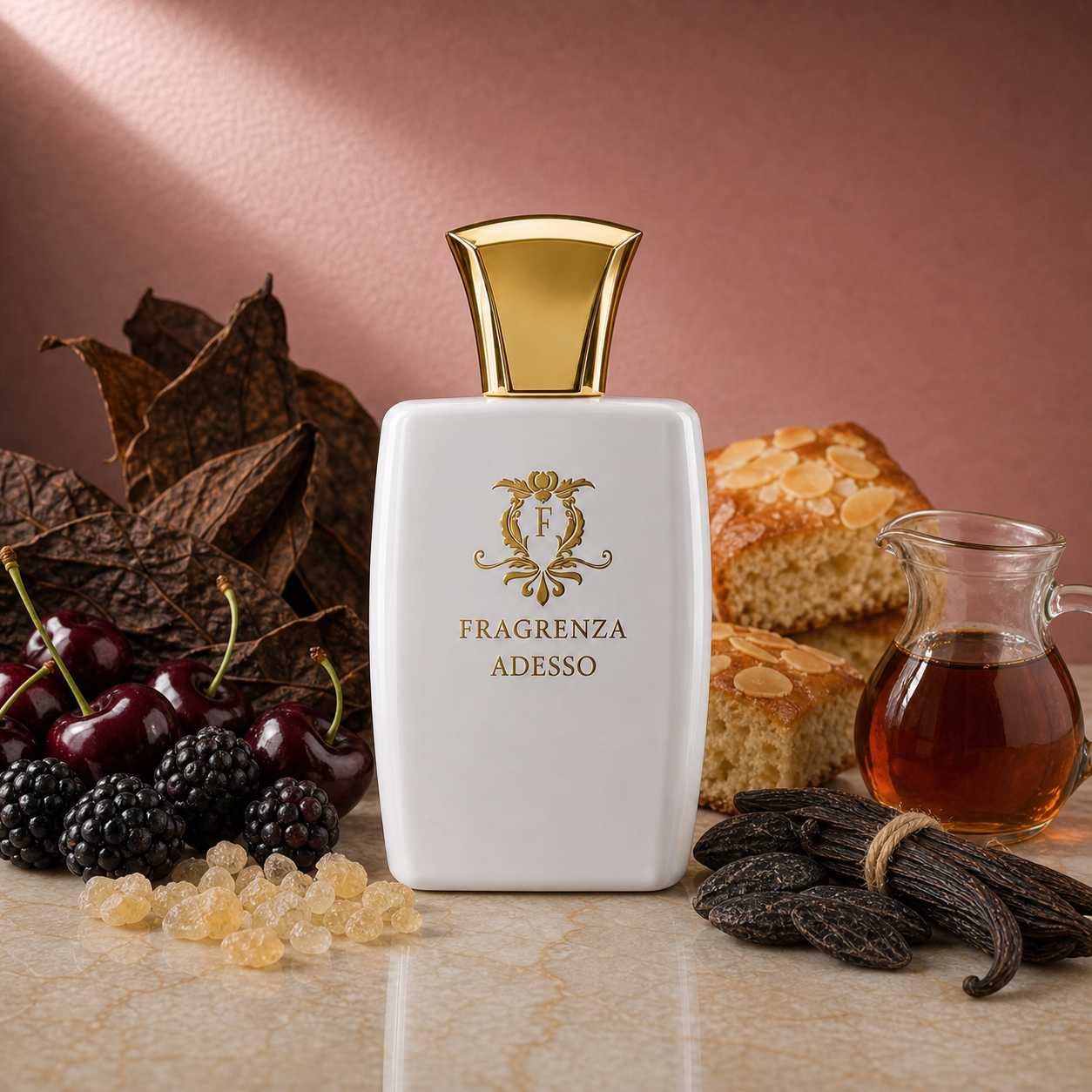
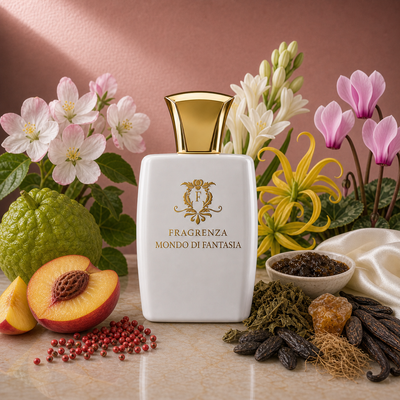
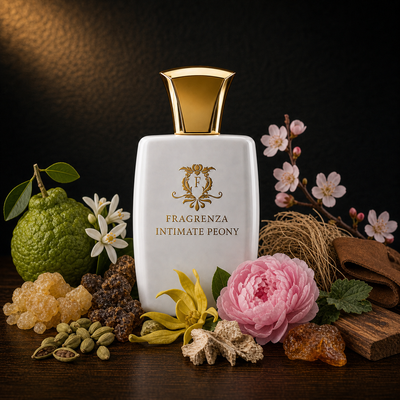
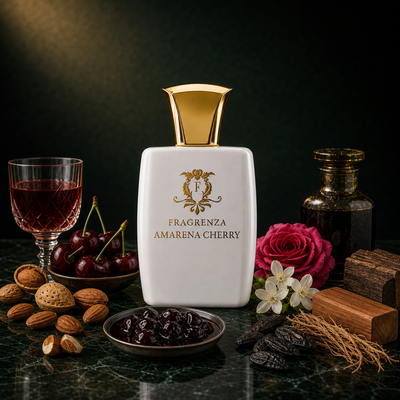
is the most directly relevant — an evening floral where blackcurrant tartness sits in the heart alongside aldehydes and licorice, before settling into incense, sandalwood, and patchouli. The dark-berry-and-patchouli register that anchors so many great contemporary compositions is delivered here in clear form. takes the fruity-floral-patchouli structure into more luminous territory — nectarine and apple blossom open into a tuberose-and-ylang heart with a patchouli-tonka-vanilla-castoreum base, the modern fruity-floral-with-depth structure that blackberry-adjacent compositions inhabit. uses plum-blossom and bigarade in a darker register, sitting closer to the resinous-incense end of the dark fruity-floral spectrum. And in a more directly jammy direction, (Amarena Cherry) demonstrates what dark-fruit reconstructions can do at the structural heart of a composition — black cherry, griotte syrup, and bitter almond paired with rose, jasmine sambac, and Peru balsam.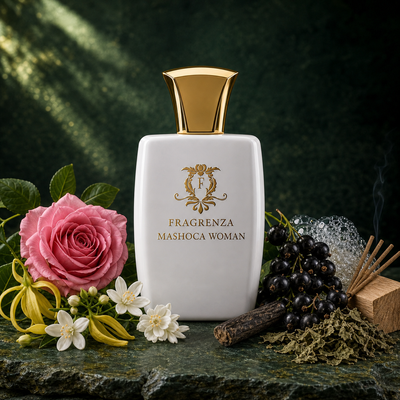
For more on related dark-fruit perfumery, see our entries on blackcurrant (cassis), raspberry, and blueberry — each part of the broader berry vocabulary modern perfumery draws on.
How blackberry interacts with other notes
Blackberry rarely sits at the top of a composition the way bergamot or grapefruit does — it is more often a heart-note element that bridges between top freshness and base depth. The compositional patterns that use blackberry well are several.
With patchouli, blackberry creates the dark fruity-oriental structure that has anchored Mugler Angel, several Thierry Mugler flankers, and a long line of contemporary fruity-oriental compositions. The earthy patchouli grounds the bright fruit; the blackberry humanizes the heavy patchouli. The combination is the structural backbone of an entire genre.
With rose, blackberry pushes a classical rose-soliflore into modern fruity-floral territory. Several contemporary rose compositions use blackberry-direction materials to lift the floral above its traditional powdery-classical reading.
With vanilla and gourmand sweetness, blackberry creates jam-and-cream structures. The fruit’s faintly winey edge prevents the gourmand from reading as too sugary, while the sweetness keeps the berry from feeling too tart.
With clean musks, blackberry produces the modern fruity-musk register that anchors a meaningful share of contemporary feminine and unisex perfumery. The dark fruit warms the clean musk; the musk extends the fruit’s wear well past its natural longevity.
With violet and violet-leaf, blackberry amplifies its own faint violet-floral undertone into a recognizable accord. Several niche cassis-and-violet compositions show how the two materials reinforce each other.
With amber and resinous bases, blackberry deepens into oriental territory. Niche cassis-and-amber or blackberry-and-incense compositions show what the dark berry can do when paired with serious base materials.
Blackberry in the modern wardrobe
Blackberry-direction compositions wear especially well in autumn and winter, where the dark-fruit character settles into the cooler air with depth. The category extends comfortably into spring through fruity-floral compositions. Pure summer wear is less natural — the dark, slightly heavy quality of blackberry can feel out of register against bright sunshine, which is why summer fruit perfumery leans more toward citrus, peach, and raspberry.
The note is most often coded as feminine in conventional perfumery marketing, but this is more habit than aromatic necessity. Several contemporary unisex compositions use blackberry-direction character without any feminine reading, particularly when paired with patchouli, leather, or oud. The grown-up complexity of the note — less candied than strawberry, less floral than raspberry — is what makes it sit so comfortably in unisex registers.
Application is conventional: pulse points, light spray, allow the heart and base to develop. Blackberry-direction notes tend to develop into the heart of a fragrance over the first thirty to sixty minutes of wear, then settle into the base register where the patchouli, musk, amber, or vanilla anchor carries the wear forward.
Frequently asked questions
What does blackberry smell like in perfume?
Dark, jammy, slightly winey, with a faintly green or leafy edge from the bramble. Less candied than strawberry, less sharp than raspberry, more grown-up than most red fruit accords. The character often has a faint violet-floral undertone that distinguishes it from purer peach or pear notes.
Is blackberry a natural perfumery material?
No — like most soft-fruit notes (peach, raspberry, pear, strawberry), blackberry cannot be extracted directly from the fruit at fine-fragrance quality. The note is reconstructed from a combination of aromatic molecules including gamma-undecalactone, ionones, fruity esters, and specialty captive bases developed by the major aroma-chemical houses. This is normal practice in modern perfumery and not a sign of lower quality.
What is the difference between blackberry and cassis (blackcurrant) in perfumery?
Different fruits, different aromatic profiles. Cassis (blackcurrant, Ribes nigrum) has a sharper, greener, more sulfurous character — faintly catty, faintly leafy, much more aromatic-tart. Blackberry is rounder, jammier, sweeter, with less of the sharp greenness. The two are sometimes used together to build complex dark-berry accords, but they are not interchangeable.
Is blackberry a feminine note?
Conventionally coded feminine in mainstream perfumery, but this is marketing convention rather than aromatic necessity. The grown-up complexity of blackberry — less candied than strawberry, with a slightly winey-leafy edge — sits comfortably in unisex compositions, particularly when paired with patchouli, leather, or amber. Modern niche perfumery increasingly treats blackberry as a structural element rather than a gender-coded one.
What season is blackberry best for?
Autumn and winter for blackberry-and-patchouli or blackberry-and-amber compositions, where the dark fruit reads at full depth in cooler air. Spring for fruity-floral expressions where blackberry lifts a rose or peony. Summer is the weakest season for the note — the dark, slightly heavy character does not always project well in full heat.
What perfumes use blackberry well?
Mugler Angel and several flankers use dark fruity-patchouli structure where blackberry-adjacent character lives. Tom Ford Black Orchid uses dark berry character at the structural heart. Several contemporary niche compositions place blackberry-direction materials in fruity-floral or fruity-amber compositions. The note also appears as a structural element in many modern feminine-coded fragrances even when not named on the front of the bottle.
Why does my blackberry perfume smell different from fresh blackberry?
Because perfumery blackberry is a stylized aromatic accord, not a literal extraction. Fine fragrance reconstruction picks the most aromatically interesting facets of ripe blackberry — jammy, slightly winey, slightly violet-leaf — and amplifies them while suppressing the green-watery character that dominates fresh fruit. The result smells like blackberry-the-idea more than blackberry-the-literal-fruit. This is intentional and shared with nearly every fruity note in fine perfumery.
The quiet importance of blackberry
Blackberry rarely gets top billing on a fragrance bottle, but it sits at the structural center of more contemporary compositions than most wearers realize. The note’s combination of grown-up dark-fruit character, slightly winey edge, and gentle violet-floral undertone makes it one of the most useful materials in modern fruity perfumery. Whether you are wearing a fruity-patchouli oriental, a contemporary fruity-floral, a dark-berry niche composition, or a clean fruity-musk, blackberry is probably contributing more to the wear than the front-of-bottle marketing language admits. The note rewards attention.