

Hawthorn in Perfumery: The Powdery, Wild-Flower Note You've Smelled Without Knowing
Crataegus monogyna marked Celtic threshold trees and Roman wedding torches, and its anisic-aldehydic May-blossom only entered fine perfumery once 20th-century chemistry could rebuild it.
By Julia Moretti 6 min read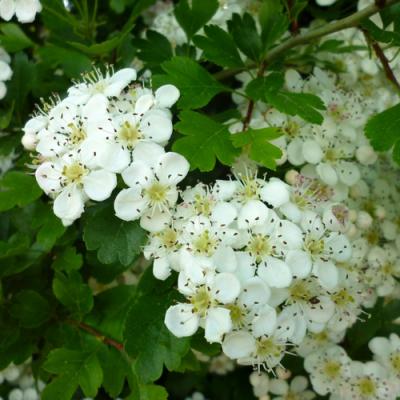
Hawthorn blossom smells powdery, sweet, and almond-like — a soft, creamy white floral with marzipan and anisic facets. But it has a famously divisive twist: a faint fishy-indolic, slightly “off” edge that lends a heady, animalic realism. In perfume it adds a nostalgic, powdery-floral softness, like a blossoming May hedgerow.
The Wild Rose of Ancient Hedgerows
Hawthorn (Crataegus monogyna and related species) is one of Europe's most ancient and storied plants. Its dense, thorny thickets have served as field boundaries since the Bronze Age. It blooms in late April and May, and the cloud of small white flowers that covers the hawthorn in spring — the "May blossom" of English folklore — has been a powerful symbol of seasonal change for millennia. Celtic traditions held hawthorn sacred as a threshold tree, marking the boundary between the human world and the fairy realm. Hanging a branch of hawthorn over a stable door was said to protect livestock from malevolent spirits.
Medicinally, hawthorn has been used since antiquity. Its berries, rich in flavonoids, are still used today in herbal preparations for cardiovascular support. The ancient Romans associated hawthorn with marriage and fertility, decorating wedding torches with its branches. Despite its ubiquity, hawthorn's delicate spring scent was not captured in perfumery until the early 20th century — not because the smell was unknown, but because the chemistry to recreate it took time to develop.
How Hawthorn Smells
Hawthorn's fragrance is one of the most quietly distinctive in the botanical world. The flowers carry a scent that is powdery, faintly sweet, green, and just slightly watery — like a flower garden just after rain, or the air on a warm May morning when the hedges are in full bloom. There is a mild anisic quality to it, a touch of something almost aldehydic, and underneath it all, a soft creaminess that makes it feel feminine and approachable without being cloying or overtly sweet.
Many people recognize hawthorn's scent without being able to name it — it belongs to that category of smells that feel deeply familiar and emotionally resonant, evoking childhood springtime and English country gardens. In a fragrance composition, it behaves like a quiet amplifier: it adds luminosity and freshness to floral hearts, softness to citrus constructions, and an intriguing powdery lightness to oriental bases.
The Chemistry of Hawthorn: Anisic Aldehyde and the Synthetic Breakthrough
Hawthorn cannot yield an essential oil through steam distillation — the flowers are too delicate and the yield too infinitesimal. Nor can the modern headspace technique extract the full complexity of the scent. Instead, hawthorn's fragrance is built in the laboratory from a key synthetic compound: anisic aldehyde (para-methoxybenzaldehyde), discovered in the latter half of the 19th century.
Anisic aldehyde has a scent that is simultaneously floral, sweet, powdery, and softly woody. It captures the anisic and slightly heady aspects of hawthorn blossom while contributing the powdery, almost face-powder quality that makes hawthorn-based fragrances feel so elegantly old-fashioned. Modern perfumers often blend anisic aldehyde with cyclamen aldehyde, florals like lily of the valley and violet, and honeyed notes to build a fuller hawthorn accord.
Guerlain is generally credited as the house that first harnessed anisic aldehyde to recreate hawthorn in perfume, most notably in Après l'Ondée (1906) — a fragrance of extraordinary delicacy that used hawthorn's powdery freshness to evoke the scent of a garden after summer rain. This was perfumery at its most poetic and precise.
How Perfumers Use Hawthorn
In contemporary perfumery, hawthorn typically appears as a top or heart note, where its fresh, powdery character helps open compositions with a quality of luminous softness. It is notably versatile — few notes blend as easily across fragrance families.
In feminine florals, hawthorn enhances the freshness of lily of the valley, rose, and violet, adding a slightly anisic brightness that lifts the composition. In fruity fragrances, it tempers sweetness with its fresh, green quality, preventing fruit notes from becoming jammy. In marine or citrus constructions, hawthorn introduces a powdery, almost nostalgic counterpoint that grounds fresh top notes.
Hawthorn also serves as an excellent fixative, helping to anchor more volatile notes and extend the overall development of a fragrance on skin. Its powdery, slightly waxy quality catches and holds other aromatic compounds, acting almost like a slow-release mechanism for the rest of the composition.
Famous Fragrances Featuring Hawthorn
Beyond Guerlain's seminal Après l'Ondée, hawthorn appears in a remarkable range of celebrated fragrances. Flower by Kenzo (2000) made hawthorn a central element of its deceptively simple poppy-floral construction, contributing the powdery, aldehydic quality that gives the fragrance its distinctive clean-yet-soft character. Chanel's Beige — one of the most refined designer fragrances — uses hawthorn as a top note, pairing it with ylang-ylang and a luxurious honeyed-white-floral heart.
Among the classic feminine florals, hawthorn adds its distinctive powder to Cacharel's Anaïs Anaïs and several Escada summer editions. In Armani's Emporio Night Her, hawthorn opens the fragrance with a suggestion of dewy spring air before deeper woody and amber notes take over. More recently, hawthorn has appeared as a supporting note in Chanel's aquatic florals and in a number of Jo Malone compositions where its English garden associations feel entirely appropriate.
Pairing Notes: What Hawthorn Loves
- Lily of the valley: The quintessential spring pairing — two freshly powdery notes that together evoke a May garden in full bloom.
- Violet and iris: Hawthorn's anisic quality harmonizes beautifully with violet's cool powderiness for an elegantly retro effect.
- Pink pepper and citrus: The peppery brightness cuts through hawthorn's softness and creates vivacious, modern openings.
- Rose: Hawthorn gives rose a greener, fresher dimension, shifting it away from classical richness toward something lighter and more contemporary.
- Vanilla and benzoin: In base-heavy orientals, hawthorn's freshness provides counterpoint to warm, sweet resins.
- Marine and aquatic notes: Hawthorn's slightly damp quality makes it a natural companion to aquatic compositions, where it adds floral warmth.
An Underrated Gem in the Perfumer's Palette
Hawthorn occupies a curious position in perfumery. It is among the most instantly recognizable and emotionally evocative scents in nature — that particular powdery-sweet cloud of May blossom is almost universally beloved — yet it rarely receives top billing on a perfume's note list. More often it performs a supporting role, quietly doing essential work: softening sharp citrus openings, adding luminosity to floral hearts, providing that ineffable quality of freshness-with-warmth that makes a fragrance feel alive.
Understanding hawthorn is a mark of genuine olfactory sophistication. When you next encounter its powdery spring lightness in a fragrance — and you will, because it is far more common than its name recognition suggests — you will know what that indefinable lift is. The chemistry is anisic aldehyde; the feeling is May morning.
Frequently asked questions
What does hawthorn blossom smell like?
Powdery and sweet, with a strong almond/marzipan and anisic character wrapped in soft, creamy white-floral facets — heady and nostalgic, like a hedgerow in full May bloom.
Does hawthorn smell bad or fishy?
To some people, yes. Alongside its almond sweetness, hawthorn blossom carries a faint fishy-indolic, slightly decaying edge (from trimethylamine, present in the real bloom) that some find heady and others find off-putting.
Is hawthorn used in modern perfume?
Yes — usually recreated with aroma molecules rather than extracted, valued for the powdery, almondy white-floral effect it brings to springtime and retro-floral compositions.