

Narcissus in Perfumery: The Hypnotic Green Floral
Narcissus is one of perfumery's most beloved floral notes, a note every fragrance lover should learn to recognise on skin.
By Julia Moretti 7 min read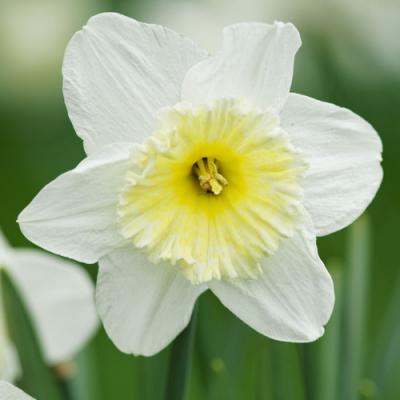
The Flower That Captivates and Unsettles
Of all the flowers used in fine fragrance, narcissus may be the most intellectually complex. Unlike rose, whose beauty is immediately accessible and universally understood, or jasmine, whose warmth and sweetness are seductive in an entirely approachable way, narcissus operates on a more demanding register. Its scent is simultaneously beautiful and unsettling — honeyed and green, floral and slightly animalic, luminous and shadowed. To encounter a true narcissus-forward fragrance is to experience one of perfumery's most sophisticated pleasures: a scent that seems to pull you towards it and hold you at a slight distance in the same moment.
The genus Narcissus encompasses hundreds of species, but the varieties most important to perfumery are Narcissus poeticus (the poet's narcissus), with its white petals and red-rimmed corona, and Narcissus tazetta, a multi-flowered species with smaller, more intensely fragrant blooms. Both grow wild across southern Europe, from the Iberian Peninsula to the Balkans and into Turkey, and both have been cultivated ornamentally for centuries. The perfumery-grade narcissus absolute, however, is now produced in only tiny quantities — principally in France's Grasse region and in the Netherlands — and ranks among the most expensive natural materials in contemporary fine fragrance.
The Scent Profile: Green, Honeyed, and Complex
Narcissus absolute is one of the more challenging materials in the perfumer's palette to describe, because its character shifts so dramatically depending on concentration, context, and the skin chemistry of the person wearing it. At high concentrations, it can verge on overwhelming — intensely green, slightly medicinal, with an almost harsh edge that some find intoxicating and others find difficult. Diluted, it reveals extraordinary beauty: a richly honeyed, green-floral character with narcotic depth and an almost dewy freshness.
The dominant olfactory impression of narcissus is green and floral simultaneously — a quality perfumers call "green floral" and which is fundamentally different from either a purely green material or a purely floral one. The greenness of narcissus is not the sharp, cut-grass green of violet leaf or galbanum, but something softer, wetter, more like the smell of flower stems and leaves in a spring garden. The floral quality is honeyed and rich, with a slight animalic underpinning — an indolic warmth that is much gentler than that of jasmine or tuberose but similarly suggestive of organic life and natural complexity.
There is also a distinctly cool, almost aquatic quality to narcissus — something that evokes the cold soil and damp air of an early spring morning, which is of course exactly when and where narcissus flowers in nature. This association with early spring, with the particular quality of light and air that accompanies the first warm days after winter, is one of the most powerful contextual associations that narcissus brings to a fragrance.
Extraction: The Challenge of Capturing the Note
Narcissus is notoriously difficult and expensive to process. The flowers are extremely delicate and must be harvested by hand in the early morning when their volatile aromatic compounds are at their peak concentration. The absolute is typically produced by solvent extraction of the freshly harvested flowers, followed by removal of the solvent to produce a concrete, which is then washed with alcohol to yield the absolute itself. This process is labour-intensive and the yield is extraordinarily low — it takes many kilograms of fresh flowers to produce even a small quantity of absolute.
The chemical profile of narcissus absolute includes benzyl benzoate and benzyl alcohol, which contribute a balsamic-floral sweetness; indole, responsible for the slightly animalic, organic depth it shares with jasmine; geraniol, a component it shares with rose and geranium; and various terpene alcohols that account for the green freshness. The presence of methyl anthranilate — the same compound found in neroli and orange blossom — adds a slightly fruity, grapey facet that gives narcissus its characteristic honeyed quality.
Because natural narcissus absolute is so costly, many perfumers work with reconstructions — synthetic approximations built from its key chemical components — or supplement small quantities of the natural material with carefully chosen synthetic molecules to extend and enhance the effect. The best reconstructions are remarkably faithful to the natural, though experienced perfume lovers can generally detect the additional dimensionality of a composition built around genuine narcissus absolute.
Narcissus and Myth: The Flower of Self-Enchantment
The cultural resonances of narcissus are inseparable from its presence in fragrance. In Greek mythology, Narcissus was a youth of extraordinary beauty who fell in love with his own reflection and, unable to leave it, withered and died at the water's edge, transforming into the flower that bears his name. The story encompasses themes of beauty, obsession, the danger of self-absorption, and the transformation of desire into something haunting and bittersweet. It is not entirely fanciful to suggest that these mythological associations inform the way perfumers reach for narcissus when they want a fragrance to have a quality of beautiful danger — something that draws you in with its beauty but hints at dark waters beneath.
The flower has been associated across European tradition with both beauty and death — worn at funerals in ancient Greece, used in bridal bouquets, and appearing throughout Romantic poetry as a symbol of fleeting beauty and the passage of time. In perfumery, as in mythology, narcissus occupies a position between the beautiful and the transgressive, the innocent and the knowing.
Note Interactions: Narcissus in Context
Narcissus's complex character means that it works best with materials that can either balance or intelligently amplify its facets. Its green quality pairs naturally with other green materials — violet leaf, galbanum, grass — but these combinations can push towards excess of the green dimension, working best when a counterbalancing floral or amber note is also present. With iris, narcissus creates one of perfumery's great pairings: both materials have a cool, powdery depth beneath their floral character, and their combination produces an accord of extraordinary refinement that is simultaneously earthy, floral, and luminously spring-like.
With rose, narcissus adds a green, dewy dimension that modernises what might otherwise be a conventional floral composition. The rose becomes more naturalistic, more like a living flower and less like a perfumery abstraction, when narcissus is present. With jasmine, narcissus creates a richer, more complex white floral accord — the honeyed warmth of jasmine deepening narcissus's cool green quality into something more fully dimensional.
With woody base notes, particularly vetiver and oakmoss, narcissus enters the territory of the classic green chypre — the construction that defined high-fashion feminine perfumery for much of the twentieth century. The combination of narcissus's green florality with the earthy, mossy character of vetiver and oakmoss creates a scent landscape that feels rooted and natural while remaining distinctly sophisticated.
Narcissus in Famous Fragrances
Narcissus has a strong historical presence in the chypre and floral categories of classic perfumery. Caron Narcisse Noir, first created in 1911 and reformulated many times since, placed narcissus at the centre of a deeply atmospheric, slightly dark floral composition that remains one of the most discussed fragrances in perfumery history. Penhaligon's Lily and Spice, various Guerlain compositions, and many of the great couture florals of the mid-twentieth century used narcissus as a pivotal ingredient.
In contemporary niche perfumery, narcissus has experienced something of a revival as perfumers seek natural botanical materials with genuine complexity and character. Houses like Hermès, Dior's Les Exclusifs line, and various niche independents have returned to narcissus as a way of creating green floral compositions with the naturalistic depth that synthetic reconstructions cannot fully replicate. For fragrance lovers interested in exploring these sophisticated floral compositions, the niche fragrance category is the most rewarding place to look.
Among more accessible compositions, Chanel Chance incorporates a subtle green floral character in which narcissus-adjacent materials play a supporting role, contributing to the fragrance's fresh, luminous spring quality without announcing themselves explicitly.
Narcissus and the Fragrance Wardrobe
Narcissus is a note for the fragrance enthusiast rather than the casual wearer — not because it is difficult to enjoy, but because its full complexity rewards informed attention and patient exploration. It is an ideal note for spring and early summer, when its seasonal associations feel most natural and its cool, green freshness is most welcome. It performs beautifully in cool, indoor environments and in the moderate temperatures of a European spring day, when its volatility is neither suppressed by cold nor overwhelmed by heat.
For those building a floral fragrance wardrobe that goes beyond the familiar rose and jasmine, narcissus represents one of the most intellectually satisfying and genuinely distinctive choices available. It is the floral note that does not simply please but genuinely intrigues — the scent equivalent of a poem that you continue to find new meanings in each time you return to it.