

Sustainable Farming in Modern Perfumery: From Field to Flacon in 2026
Sustainable farming in modern perfumery has become one of the most consequential dimensions of fragrance production, and it sits at the intersection of agricultural practice,…
By Julia MorettiFragrenza makes several of the alternatives featured in our guides — here’s how we test.
9 min read
Sustainable farming in modern perfumery has become one of the most consequential dimensions of fragrance production, and it sits at the intersection of agricultural practice, supply chain economics, and climate adaptation. The perfume industry depends on an extraordinary range of agricultural materials: rose, jasmine, lavender, vetiver, patchouli, sandalwood, vanilla, citrus, oakmoss, ylang-ylang, and dozens of less common materials all originate in farms, orchards, and managed forests around the world. The way these materials are grown, harvested, and processed affects not just the environmental footprint of the finished fragrance but the quality and consistency of the materials themselves.
For consumers, the sustainable farming question can feel abstract because the agricultural origins of fragrance materials are several supply chain steps removed from the finished bottle on the shelf. Understanding what sustainable farming actually involves, why it matters for fragrance quality as well as environmental impact, and which materials present the greatest sustainability challenges helps consumers make informed choices about which brands and which compositions deserve their support.
The Agricultural Foundation of Fine Perfumery
The materials used in fine perfumery have agricultural origins that span the globe. Rose centifolia and rose damascena are grown primarily in Bulgaria, Turkey, and Morocco, with smaller operations in France, India, and Iran. Jasmine sambac and jasmine grandiflorum come predominantly from India, Egypt, and France. Vetiver comes from Haiti, Indonesia, and Madagascar. Patchouli comes from Indonesia. Sandalwood comes from India and Australia. Vanilla comes from Madagascar, Indonesia, and Mexico. Lavender comes from Provence, Bulgaria, and increasingly Eastern Europe.
Each of these growing regions faces specific sustainability challenges. Climate change is shifting the viable growing zones for many materials, threatening traditional production regions. Water availability affects rose, jasmine, and citrus production in arid regions. Labour conditions vary enormously across regions, with some sourcing practices involving genuine ethical concerns about wages, child labour, and worker safety. Wild harvesting of materials like sandalwood and certain woods has put pressure on natural populations, sometimes pushing species toward extinction.
What Sustainable Farming Involves
Genuine sustainable farming practices address multiple dimensions simultaneously. Soil health management through cover cropping, reduced tillage, and organic matter restoration produces farms that maintain productivity across generations rather than depleting the soil. Water conservation through drip irrigation, rainwater harvesting, and drought-resistant cultivation reduces the pressure on local water resources. Biodiversity maintenance through hedgerows, intercropping, and habitat preservation supports pollinators and natural pest control. Labour practices that pay fair wages, ensure worker safety, and avoid child labour produce supply chains that are ethically defensible.
The most ambitious sustainable farming programmes go further, restoring degraded land through regenerative agriculture, sequestering carbon in soil and biomass, and contributing to local economic development through training and infrastructure investment. These practices require substantial commitment from brands willing to pay premium prices for materials and from farmers willing to invest in long-term practices that may take years to show full benefit.
Why Sustainable Farming Matters for Quality
Sustainable farming is not just an environmental and ethical concern; it directly affects the quality of the materials used in fine perfumery. Soil health affects the volatile oil content of aromatic plants. Water management affects the concentration of aromatic compounds in harvested materials. Harvesting timing and post-harvest handling affect the chemical profile of essential oils and absolutes. Carefully managed farms tend to produce materials with more complex chemical profiles, better consistency batch to batch, and higher concentrations of the molecules that perfumers value most.
The quality differential matters for compositions that depend on natural material complexity. Synthetic reconstructions can capture specific molecules from natural materials, but they often miss the subtle interplay of dozens of minor compounds that give natural materials their depth. Sustainably farmed materials, with their characteristic complexity, contribute architectural dimensions to compositions that purely synthetic alternatives cannot replicate.
Natural Material Examples in Modern Compositions
Several Fragrenza compositions illustrate how natural materials from carefully managed supply chains contribute to compositional quality. The careful sourcing decisions that go into selecting materials show up in the final wearing experience as depth and complexity that purely commercial calculation would not have supported.
Sensual Flame
uses natural floral materials as part of its creamy floral heart, with attention to sourcing decisions that affect the quality of the rose and jasmine elements in the composition. The structural warmth of the composition depends on the complexity that natural materials contribute, and the architectural choices around the natural-synthetic balance reflect a thoughtful approach to material provenance.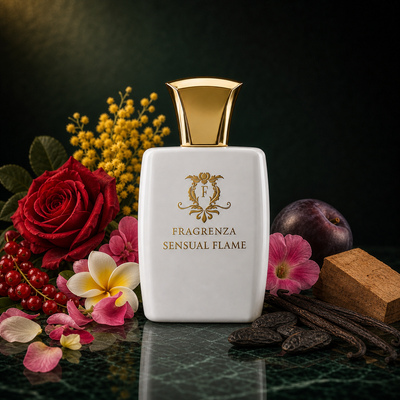
Adeline
illustrates the transparent floral architecture that has become an important variant in contemporary perfumery. The rose-lychee structure with subtle musky underpinnings demonstrates how natural floral materials can be incorporated into architecturally modern compositions, with the natural complexity providing the depth that makes the composition more than a commercial floral.
The Major Sustainability Challenges
Several materials present particularly significant sustainability challenges that deserve attention from anyone concerned about fragrance industry impact. Sandalwood from India faces severe pressure from overharvesting, with the genuine Mysore sandalwood that defined classical perfumery now extremely scarce. Australian sandalwood has emerged as a more sustainable alternative, with managed plantations producing reliable supply.
Oud (from Aquilaria trees infected with the fungus that produces the aromatic resin) has been threatened by overharvesting throughout Southeast Asia. CITES regulations now limit the trade in wild oud, and sustainable cultivation programmes are working to develop commercial production from managed plantations. The quality of cultivated oud is approaching that of wild oud, though differences remain.
Vanilla has faced significant supply disruption due to climate change and political instability in Madagascar, where the majority of the world's vanilla is grown. Price volatility has driven some brands toward synthetic vanillin, although the quality differential between natural vanilla and pure vanillin is significant. Sustainable vanilla programmes are working to stabilise supply through farmer support and diversified geographic sourcing.
Oakmoss has been affected by regulatory restrictions on the materials in classical oakmoss extracts due to allergen concerns. The natural lichen itself is also under pressure from air pollution and habitat loss in traditional growing regions. The chypre family of fragrances, which depended on oakmoss as a defining material, has been reshaped substantially by these constraints.
How Consumers Can Support Sustainable Farming
Consumer support for sustainable farming in perfumery happens primarily through brand selection. Brands that publish detailed disclosures about their material sourcing, that participate in certification programmes like Union for Ethical BioTrade, and that engage with industry-wide initiatives on supply chain sustainability are generally more reliable than brands that emphasise sustainability language without operational specifics.
The price premium for sustainably sourced materials is real, and brands that absorb these costs to maintain quality usually communicate this through their pricing and positioning. Consumers who prioritise sustainable farming should expect to pay somewhat more for fragrances that incorporate genuinely sustainable materials, although the differential is usually modest compared with the overall cost of luxury fragrance.
The Limits and Realistic Expectations
It is worth being honest about what sustainable farming can and cannot accomplish. Sustainable farming reduces but does not eliminate the environmental footprint of agricultural materials. It improves but does not perfect labour conditions. It supports but does not solve climate adaptation challenges in production regions. Brands that present sustainable farming as a comprehensive solution to industry sustainability concerns are overstating the case.
The honest position is that sustainable farming is a significant improvement over conventional farming practices and a necessary component of any credible sustainability programme, but it is one dimension of a larger conversation rather than a complete answer. Consumers who understand this can engage with the topic with appropriate nuance rather than treating sustainability as a binary question.
How to Apply These Principles
Three practical changes amplify the impact of consumer engagement with sustainable farming. First, prioritise brands that publish substantive disclosures about their sourcing rather than relying on vague sustainability marketing. Second, support compositions that incorporate natural materials thoughtfully rather than maximalist compositions that demand large quantities of pressured materials. Third, treat the longevity and use-completion of compositions as part of the sustainability calculation, since the environmental cost of agricultural production is amortised across the wearings each bottle delivers.
Related Reads
- Sustainability in the perfume industry: the broader picture
- Sustainable packaging: the packaging dimension of sustainability
- Rose in Perfumery: a major sustainable farming material
- Jasmine in Perfumery: another important natural material
- Vanilla in Perfumery: a material with significant supply challenges
- Oud in Perfumery: a material with major sustainability dimensions
- What is niche perfumery: the field most engaged with sustainable sourcing
Frequently Asked Questions
Why does sustainable farming matter for fragrance quality?
Sustainable farming practices affect the chemical profile of aromatic materials in ways that show up in finished fragrance. Soil health affects volatile oil content. Water management affects compound concentration. Careful harvesting and post-harvest handling preserve the subtle minor compounds that give natural materials their depth and complexity. Sustainably farmed materials tend to deliver more architectural dimension to compositions than commodity-grade materials from less carefully managed operations.
Which fragrance materials have the worst sustainability profiles?
Wild-harvested sandalwood, wild oud, and certain natural musks have historically presented severe sustainability challenges due to overharvesting pressure. Vanilla has supply chain challenges related to climate change and political instability in production regions. Oakmoss has been affected by regulatory restrictions and habitat loss. Each of these materials has alternative sourcing pathways or substitute materials that address the sustainability concerns, but the alternatives often involve quality trade-offs.
Are sustainable fragrance materials more expensive?
Generally yes. Sustainable farming practices require investment in soil health, water management, labour conditions, and biodiversity maintenance that conventional farming economises away. The cost differential is real but usually modest compared with the overall cost of luxury fragrance, and brands that absorb these costs to maintain material quality typically communicate this through their pricing and positioning.
What is the difference between organic and sustainable farming?
Organic farming has specific regulated criteria related to permitted inputs (chemical fertilisers, pesticides) but does not necessarily address other sustainability dimensions like labour practices, water use, or biodiversity maintenance. Sustainable farming is a broader concept that addresses multiple dimensions simultaneously. Some organic farms are highly sustainable across all dimensions; others meet organic certification while falling short on other sustainability criteria. Use both concepts as inputs to evaluation rather than treating either as a complete answer.
How can I tell if a brand actually supports sustainable farming?
Look for substantive disclosures about material sourcing, including specific certifications, participation in industry-wide initiatives, and detailed reporting on supply chain practices. Brands that publish lifecycle assessments and engage with credible third-party verification organisations are generally more reliable than brands that use sustainability language without operational specifics.
Is buying fewer fragrances better than buying sustainable ones?
For most consumers, yes. The environmental footprint of agricultural production is amortised across the wearings each bottle delivers, which means using fragrances to completion produces lower per-wearing impact than purchasing many sustainable bottles and using each only occasionally. Consumption pattern dominates product specification in determining total environmental impact, and the wearer who uses three bottles thoroughly produces less impact than the wearer who accumulates thirty bottles regardless of how either set was sourced.
The Bottom Line
Sustainable farming is a significant dimension of fragrance industry sustainability, with implications for both environmental impact and material quality. Substantive engagement with the topic involves looking past marketing language to actual sourcing practices, supporting brands that invest in farming partnerships, and treating consumption pattern as part of the sustainability calculation alongside product specification. The wearer who applies these principles consistently engages with the industry conversation in a way that produces real impact across decades of practice.