

Gentian in Perfumery: The Bitter, Alpine Note That Adds Rare Complexity
Gentiana lutea is harvested at 1,000 to 2,400 metres in the Alps, and the deep tap roots that supply Angostura bitters bring a bittersweet, cellar-damp depth into avant-garde perfumery.
By Julia Moretti 6 min read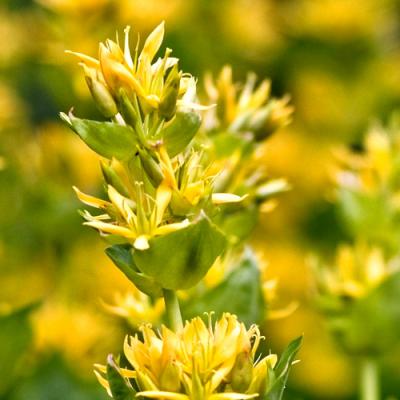
A Note from the High Mountains: Understanding Gentian
Gentian is one of the most unusual and specialised notes in contemporary perfumery. Its scent profile is not immediately appealing in the way that rose, vanilla, or jasmine seduce the uninitiated: it is bitter, earthy, herbaceous, slightly vegetal, with a deep, almost medicinal quality that announces itself quietly and then lingers with surprising tenacity. For those who find it fascinating — and a growing number of niche fragrance enthusiasts do — its rarity and complexity make it one of the most intellectually rewarding notes in the entire perfumery vocabulary.
Gentian is the rhizome (root) of Gentiana lutea, the great yellow gentian, a large herbaceous plant native to the Alps and other mountain ranges of Central and Southern Europe. The dried root has been used medicinally for at least 2,500 years as a bitter tonic and digestive stimulant — it is the basis of Angostura bitters and many other aromatic aperitifs — and its aromatic qualities have attracted perfumers seeking notes that lie outside the conventional vocabulary of sweetness and floralcy. The smell of dried gentian root is deep, bittersweet, earthy, with a hint of dark dried fruits and a quietly herbaceous, slightly cellar-like quality that is simultaneously challenging and beautiful.
Botanical Origins and the Alpine Tradition
Gentiana lutea grows at altitude — typically between 1,000 and 2,400 metres above sea level — on the limestone meadows and rocky slopes of the Alps, Apennines, Pyrenees, Balkans, and Carpathians. It is a long-lived perennial that takes years to reach flowering size, and its deep tap roots — the part used medicinally and aromatically — can grow to a metre or more in length and live for over fifty years. The deep roots, harvested in autumn when aromatic compound concentrations are highest, are dried and then extracted for use in both the pharmaceutical-liqueur industry and the fragrance trade.
The harvesting of wild gentian is regulated in most of its range due to population pressure from centuries of collection, and the plant is legally protected in several countries. Commercial production now relies partly on cultivation, but the cultivation of gentian is slow and demanding, contributing to the relative rarity and cost of genuine gentian materials in perfumery. Most perfumers working with gentian use either genuine gentian tincture or absolute, or synthetic materials designed to approximate the note's distinctive bitter-earthy character.
The cultural associations of gentian are deeply Alpine: the brilliant blue flowers (a different species, not Gentiana lutea) are the symbol of the Alpine tradition, used in Austrian, Swiss, and Bavarian heraldry and folk art. The root, with its bitter, complex scent, belongs to the tradition of Alpine herbal medicine that produced such familiar products as Underberg, Suze, and Campari. This heritage gives gentian a cultural specificity that few perfumery ingredients can match.
Key Molecules and the Chemistry of Bitterness
The aromatic character of gentian root is primarily shaped by a group of bitter compounds called iridoid glycosides, particularly gentiopicroside, which is responsible for the characteristic bitter taste but also contributes to the complex, slightly medicinal, bittersweet olfactory profile. Upon drying and degradation, these compounds produce various aromatic molecules including gentisein and several terpenoid compounds that contribute the deep, earthy facets of the dried root's scent.
The dried root also contains various aromatic esters and aldehydes that contribute sweeter, slightly dried-fruit facets, explaining the curious sweetness that emerges within the bitterness when the root is experienced closely. Xanthones — a class of polycyclic aromatic compounds — contribute to the deep, slightly resinous quality. Together, these compounds produce an aromatic profile that is genuinely unique: nothing else in the perfumer's palette smells quite like gentian.
Synthetic gentian materials and aroma chemicals designed to approximate the note have been developed, but capturing the full complexity of the natural material — its simultaneous bitterness, sweetness, earthiness, and depth — in a synthetic formulation remains challenging. This is one of the reasons that genuine gentian remains a valuable and irreplaceable ingredient for perfumers committed to working with the most complex natural materials.
Gentian in Perfumery: A Note for the Adventurous
Gentian's presence in fine fragrance is more recent and more specialised than most of the botanical materials in the perfumery canon. Its use in aromatic bitters and aperitifs — products valued precisely for their complex, bittersweet character — preceded its adoption by perfumery, and it is in some ways the fragrance equivalent of a cocktail bitter: an ingredient that adds depth and complexity in small quantities rather than a standalone pleasure.
The rise of niche perfumery and the growing appetite for fragrance that challenges conventional notions of beauty have created an audience for gentian-forward compositions. Perfumers working in the earthy-green, aromatic, or woody-bitter register have discovered that gentian provides something genuinely unusual: a note that makes compositions feel more complex, more mature, and more intellectually interesting without necessarily making them less wearable.
Gentian also carries the cultural associations of Alpine herbal tradition, of the apothecary and the mountain pharmacy, that resonate powerfully with contemporary interest in natural, artisanal, and plant-based products. A fragrance built around or enriched by gentian makes a quiet statement about the wearer's relationship to the natural world and to the deeper traditions of botanical perfumery.
Famous Fragrances Featuring Gentian
Gentian appears most explicitly in compositions from niche houses working in the herbal-aromatic tradition. Hermes' Equipage — one of the great classical masculine fragrances — uses bitter, herbal notes including gentian-adjacent materials in its complex, slightly smoky aromatic structure. Various Guerlain compositions from the archive incorporate gentian as a supporting note within their complex aromatic structures.
In the contemporary niche space, Atelier Cologne and Maison Margiela Replica have explored the bitter-aromatic register in which gentian feels most at home. Bleu de Chanel achieves a sophisticated aromatic freshness with woody-mineral depth, and compositions in this register often employ bitter herbal materials including gentian to achieve their characteristic intellectual precision. For those exploring the niche fragrance landscape with adventurous tastes, gentian-forward compositions represent some of the most rewarding discoveries available.
Note Interactions: Gentian in the Mix
Gentian's bitter, earthy character gives it an interesting relationship with sweet and floral notes. With iris, it creates a bitter-earthy, powdery combination that is both abstract and deeply beautiful — the two materials share an earthy quality that connects them, while their contrasting characters (iris's powdery elegance versus gentian's assertive bitterness) create productive tension. With vetiver, gentian achieves a dark, earthy, intensely complex accord that is among the most sophisticated in the woody-aromatic family.
With citrus materials, particularly grapefruit, gentian creates a compelling bitter-fresh accord that feels like a well-crafted aperitif in fragrance form — the bitterness of both ingredients amplifying and reinforcing each other in a combination that is refreshing rather than simply challenging. With woody materials including cedar and sandalwood, gentian's earthy depth finds a natural home, the woody warmth softening the bitter edge while preserving the note's distinctive complexity.
Wardrobe Context: Wearing Gentian
Gentian fragrances reward the mature, adventurous nose. They are not beginner fragrances, and they do not seek mass appeal. Their audience is the fragrance enthusiast who has moved through the conventional categories of fresh-clean, sweet-floral, and warm-oriental, and is now looking for something that offers genuine novelty and intellectual engagement. In that context, a well-constructed gentian composition is one of the most exciting discoveries available in contemporary perfumery.
In terms of occasion, gentian-forward fragrances tend toward autumn and cooler weather, where their dark, earthy bitterness feels contextually appropriate. They suit both professional and casual wear in the right composition — the complexity of the note gives them a gravity that works in formal contexts, while their naturalistic, botanical character connects them to the outdoors in a way that makes them comfortable in casual settings. For anyone building a collection of men's fragrances that aspires to genuine distinction, a gentian composition is an exciting and rewarding addition.