

Star Anise in Perfumery: Deep, Warm and Spicier Than You Think
Illicium verum from southwestern China supplies trans-anethole, foeniculin and limonene that together build the warm, resinous, woody character of phở broth and Chinese five-spice powder.
By Julia Moretti 5 min read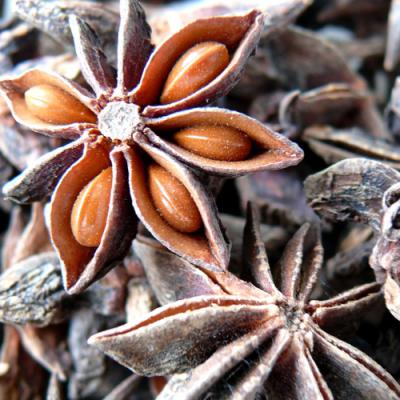
Star Anise: A Spice With Extraordinary Fragrance Potential
If anise is the gentle, confectionery-sweet member of the licorice family in perfumery, star anise is its more complex, more resinous and ultimately more interesting sibling. Derived from the star-shaped fruits of Illicium verum, a small evergreen tree native to southwestern China and northeastern Vietnam, star anise essential oil shares the dominant licorice character of its relatives but brings something additional: a warmth that borders on spice, a woody depth, and a slightly medicinal quality that makes it feel simultaneously exotic and familiar.
Star anise has been one of the most important spices in Chinese, Vietnamese and broader Southeast Asian cooking for centuries — it is a fundamental component of Chinese five-spice powder and Vietnamese phở broth. This culinary prominence means that most people encounter star anise long before they encounter it in fragrance, and the associations are powerful: warmth, conviviality, winter cooking, the smell of steam rising from a spiced broth. In fragrance, these culinary associations can be exploited for their emotional warmth, or transcended in compositions where star anise functions as pure aromatic material divorced from any specific culinary context.
Chemistry: Trans-Anethole with a Richer Supporting Cast
Like anise proper, star anise essential oil is dominated by trans-anethole, typically accounting for between 75 and 90 percent of the oil. It is the secondary compounds that distinguish star anise and give it its additional character. Foeniculin (para-allylanisole or estragole) contributes a slightly greener, more spicy-anisic dimension. Limonene provides freshness. Cis-anethole (the geometric isomer of trans-anethole, with a significantly different smell — more camphor-like, less sweet) appears in higher proportions in star anise than in sweet anise, contributing to its more complex, slightly medicinal quality. Various sesquiterpenes including beta-caryophyllene add a subtle woody-earthy depth to the base of the oil.
The overall effect is of a richer, more spatially complex version of the anisic character: the licorice sweetness is present but framed by additional warmth and a slight balsamic quality that makes it feel more appropriate for complex fragrance contexts than the simpler anise oil. Star anise also has excellent fixative qualities, meaning that its characteristic anethole note tends to persist on skin and in the drydown of compositions where it appears, creating a characteristic warm, spiced signature that can define a fragrance's lasting impression.
History: From the Silk Road to Modern Perfumery
Star anise entered the European pharmacopoeia and spice trade relatively late by spice standards: it was not widely known in Europe until the sixteenth century, when Portuguese traders began importing it from Southeast Asia. Its botanical similarity to European anise — and the similarity of its smell and flavour — led to its rapid adoption as a cheaper substitute for or alternative to anise seed in European food and medicine. By the seventeenth century it was a standard ingredient in liqueur production: star anise is a key botanical in pastis (particularly Ricard and Pernod), in certain gins and in a wide range of medicinal preparations.
In fine fragrance, star anise found a home most naturally in the oriental and spiced wood families that developed through the twentieth century. The warm, resinous quality of the oil complements the amber and wood bases of oriental compositions, while its distinctive identity — recognisable but not clichéd in a fragrance context — gives it creative specificity. Certain perfumers have used star anise as a bridge material in complex spice-wood accords, exploiting its ability to modulate between the clearly anisic and the more broadly warm-spicy depending on dosage and context.
Famous Fragrances Featuring Star Anise
Star anise appears in a range of commercially significant fragrances where it contributes its distinctive warm-anisic-spicy quality to compositions of considerable variety. Dior Sauvage, one of the best-selling fragrances in the world, features a spiced-woody structure that includes anisic and star anise facets in its complex heart, contributing to the characteristic warm-aromatic signature of the composition. In this context star anise operates as a supporting spice rather than a featured note, but its contribution to the overall warmth and complexity of the accord is meaningful.
Among darker, more oriental compositions, star anise appears in several fragrance structures where it works alongside oud, benzoin and labdanum to create rich, spiced-resinous bases of the kind associated with traditional Middle Eastern perfumery. The anisic warmth in these contexts reads as exotic and ancient rather than culinary — a deliberate transformation of the familiar into the ceremonial. For those exploring the oriental fragrance category, star anise-containing compositions offer a distinctive approach to warmth that differs from the more obviously sweet vanilla-amber route.
Note Interactions: How Star Anise Works Within a Composition
Star anise's primary compositional virtue is its ability to add warmth and a distinctive anisic-spice character without the cloying sweetness that can make vanilla-heavy bases feel heavy or one-dimensional. Used alongside cedar and other dry woods, it creates a warm-spiced wood accord with clear gender-neutral potential. With bergamot and citrus at the top, it creates a classic opening-to-drydown arc: fresh citrus giving way to anisic warmth, finally deepening into a woody-resinous base. With incense, star anise creates a meditation on ceremony and ritual that feels genuinely distinctive.
One of star anise's most interesting interactions is with leather materials: the combination of anisic sweetness and leather's smoky darkness creates a sophisticated, slightly unusual accord that appears in certain chypre-leather and oriental-leather compositions. With rose, star anise creates a spiced-floral accord that feels Middle Eastern in register, reminiscent of rose water-based preparations with added spice warmth. For those building a wardrobe of men's fragrances, a star anise-accented composition offers a warm, spiced alternative to more conventional woody or aromatic structures.
Wearing Star Anise: Context and Seasonality
Star anise in fragrance is definitively a cooler-weather material. Its warm, spiced character is ideally suited to autumn and winter, when the note's depth and complexity feel seasonally appropriate and when its generous projection complements rather than oppresses. In a summer context, star anise-dominated compositions can feel too heavy and too warm, though very light, well-diluted treatments can work in a spring context where the spice warmth provides welcome contrast to the season's typical freshness. Evening wear is star anise's natural territory: it has the richness and presence appropriate to occasions where making a considered impression is the goal.