

Lily in Perfumery: The Noble White Flower and Its Subtle, Enduring Complexity
Lilium candidum has been grown for over three thousand years, and the Madonna lily from the Balkans and Middle East still anchors the white-floral register in fine perfumery today.
By Julia Moretti 9 min read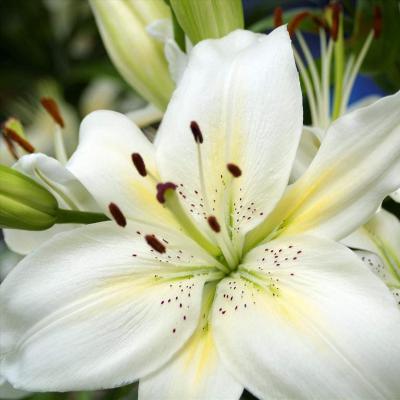
The Royal Flower of Civilizations
Few flowers have accumulated as much symbolic weight across human history as the lily. From ancient Egypt — where lilies appear in tomb paintings dating back to 1570 BC — to the royal courts of medieval Europe, where the fleur-de-lis became the emblem of French royalty, to the Christian tradition, where the white lily represents the purity of the Virgin Mary, this flower has accompanied humanity's greatest moments of ceremony, spirituality, and beauty. It is a flower that has been present at coronations and funerals, in sacred art and secular gardens, for more than three thousand years of documented human culture.
The lily genus (Lilium) contains over 100 species distributed across the temperate regions of the Northern Hemisphere — Europe, Asia, and North America. These are true lilies, distinct from the many plants colloquially called "lily" (lily of the valley, water lily, daylily) that belong to entirely different botanical families. True lilies grow from bulbs, produce erect stems ranging from 15 cm to 2.5 meters in height, and bear large, often trumpet-shaped flowers with six petals that may be white, yellow, orange, red, pink, or purple, often with distinctive markings and prominent stamens heavy with pollen.
The species most associated with fragrance in the Western tradition is Lilium candidum, the Madonna lily, which has been cultivated for over 3,000 years and is native to the Balkans and the Middle East. Its pure white, upward-facing flowers exhale a scent that has been described as one of the most beautiful in the natural world — at once fresh and deep, innocent and intoxicating, the embodiment of everything white florals aspire to be.
Other important species for fragrance include Lilium longiflorum (the Easter lily), Lilium auratum (the golden-rayed lily of Japan), and various Oriental hybrid lilies, each with its own distinctive scent character ranging from the sweetly fresh to the powerfully narcotic. The Oriental hybrids, in particular — those large, multi-petaled blooms common in florists — can fill an entire room with fragrance, their scent becoming more insistent as the evening temperature rises and more volatile molecules are released from the petals.
The Scent of Lily: Soft, Spicy, White, and Quietly Profound
Lily's fragrance defies easy categorization. It is a white floral — sharing the family with jasmine, tuberose, and gardenia — but its character is distinctly its own. The scent of a fresh lily bloom is simultaneously:
- Floral and sweet: A genuine floral sweetness, though less heavy and tropical than tuberose, less animalic than jasmine
- Slightly spicy: A clean, dry spiciness reminiscent of white pepper or very faint clove that adds complexity and prevents the sweetness from becoming one-dimensional
- Fresh and almost watery: Particularly in the Madonna lily, there is a quality of freshness — almost like water on petals — that gives the note a cool, airy dimension unusual among the heavier white florals
- Faintly green: The stem and leaf contribute a subtle greenness that adds naturalistic texture and prevents the floral note from feeling abstracted from the plant
- Quietly indolic: Like all white florals, lily contains traces of indole that add depth and a faintly animalic quality, though this is more restrained in lily than in jasmine or tuberose
Different lily species vary considerably in scent intensity and character. Oriental hybrid lilies can be powerfully fragrant — filling a room with a rich, slightly heady sweetness that becomes almost overwhelming in an enclosed space. The Madonna lily is more restrained and ethereal: softer, cooler, more transparent. The Easter lily falls somewhere between: sweet and fresh, with a transparency that makes it one of the most approachable white florals in perfumery.
What lily brings to any fragrance composition is a quality of refined clarity — a white-floral presence that illuminates rather than overwhelms, that adds elegance rather than drama. It is a note that knows its own worth without needing to assert it at every moment. For a deep dive into the closely related world of white-floral softness, explore our article on gardenia in perfumery, whose creamy richness sits at the opulent end of the same floral family.
Extraction: The Challenges and the Chemistry
Lily presents mixed possibilities for extraction. Lily absolute and concrete can be produced through solvent extraction, and natural lily materials are used in high-end niche perfumery where authenticity and naturalistic quality are prioritized. The concrete produces a waxy, richly floral material that captures much of the flower's complexity, though at significant cost — both in financial terms and in the sheer quantity of flowers required to produce a meaningful volume of material.
However, the majority of lily notes in commercial perfumery are constructed synthetically, for reasons of both cost and consistency. The key molecules in lily construction include:
- Hydroxycitronellal: The primary molecule associated with the clean, slightly sweet lily-like quality in many white floral constructions — a versatile and elegant material
- Linalool and linalyl acetate: Contributing fresh, slightly floral-citrus brightness to the opening stages of the accord
- Benzyl acetate: A key molecule in jasmine that also contributes to lily's white-floral character, providing depth and richness
- Methyl benzoate: Adding the slightly anise-like sweetness characteristic of many white florals and creating a smooth bridge between the fresher and richer elements
- Eugenol: In small quantities, for that clean, faintly spicy depth that distinguishes lily from purely sweet white florals
- Indole: Carefully dosed — enough to add depth and naturalness, not enough to overwhelm the composition's essential freshness and elegance
Building a convincing lily accord requires balancing these materials with great sensitivity. The goal is something that reads as both genuinely floral and unmistakably lily — not generic "white flower," but specifically the clean-spicy, slightly cool sweetness of the real bloom at its height.
How Perfumers Work with Lily
In fragrance construction, lily most commonly appears as a heart note, where its moderate weight allows it to anchor a composition without the heaviness of tuberose or the insistent dominance of ylang-ylang. It is an accommodating, versatile floral that works across a remarkable range of fragrance families and contexts — equally at home in a light daytime fragrance and in a complex evening composition.
In classic feminine floral constructions, lily provides a white-floral foundation of great refinement. Its spicy edge makes it more interesting than purely sweet white florals, and its freshness makes it more wearable in warm weather than some of its richer relatives. The classic "lily" perfume is a composition of quiet elegance — appropriate for formal occasions without being stiff or austere, beautiful without demanding attention.
In fresh or light compositions, lily contributes a white-floral presence that adds depth without weight — the signature of a skilled perfumer who can make a fragrance feel simultaneously airy and rich. This quality of "weightless depth" is among the hardest effects to achieve in perfumery, and lily is one of the most reliable tools for getting there.
Lily's affinity for green notes — iris, violet leaf, stem accords — reflects its naturalistic quality. A lily fragrance built with attention to the whole plant (not just the flower) can achieve a remarkable sense of three-dimensional, garden-realistic beauty. This approach — treating the lily not as an abstract "floral" quality but as a specific, three-dimensional plant — represents some of the most interesting contemporary work being done with the material.
Lily also plays surprisingly well in masculine and unisex contexts. Its combination of freshness, spice, and white-floral elegance gives it a quality that transcends conventional gender associations, and several contemporary "clean" masculines have used lily-adjacent materials to create something both sophisticated and broadly appealing.
Iconic Fragrances That Feature Lily
Dior's Diorissimo (1956, by Edmond Roudnitska) is technically built around lily of the valley rather than true lily, but its success demonstrated the white-floral family's enormous commercial and artistic potential and created a template for delicate, naturalistic floral perfumery that has influenced generations of perfumers. Cacharel's Anais Anais uses lily within a white-floral bouquet of lasting elegance that remains one of the most beloved soft florals in perfumery history.
More explicitly lily-forward compositions include Rochas' Absolu, which places lily alongside orange blossom and pepper to create a sophisticated, slightly spicy floral of considerable character. Cartier's Declaration d'un Soir uses lily as part of an unexpectedly sensual masculine composition, demonstrating the note's versatility beyond feminine contexts and suggesting that its future may lie partly in the growing unisex fragrance market. For a modern feminine interpretation of this luminous white-floral register, Fragrenza's J'Adore-inspired fragrance captures the same golden, radiant quality — a bouquet of white florals that feels simultaneously classic and contemporary.
In niche perfumery, Amouage's Lyric builds a remarkable multi-floral bouquet in which lily provides a cool white counterpoint to warmer rose and patchouli elements. The combination of lily's restraint with the opulence of the surrounding notes creates something of great depth and sophistication. Papillon's Salome uses lily in a context of considerable daring — the flower placed within a composition of considerable darkness and complexity, where its purity creates a fascinating tension with the shadows around it.
Notes That Pair Beautifully with Lily
- Rose: The classical pairing — lily's cool, slightly spicy freshness balances rose's warmth and depth perfectly, creating a white-floral bouquet of timeless appeal.
- Jasmine: The combination of lily's restrained elegance with jasmine's tropical richness creates a white-floral composition of great complexity and sensuality.
- Bergamot and citrus: Citrus openings lift lily's freshness beautifully, creating a bright, transparent effect that broadens the composition's appeal.
- White musks: Clean musks beneath lily amplify its skin-close, intimate quality and create a seamless, long-lasting drydown.
- Sandalwood: The warm creaminess of sandalwood pairs exquisitely with lily's floral elegance, the two notes amplifying each other's softness.
- Pepper and spice: Enhancing lily's own spicy facet creates a fragrance of unexpected vigor and presence that pushes the note toward more contemporary territory.
- Vetiver: An earthy, slightly smoky base beneath lily's white-floral brightness creates an interesting contrast of earth and heaven that feels deeply sophisticated.
Lily: Elegance Without Effort
The lily's enduring appeal in perfumery rests on a quality that is easy to recognize and difficult to manufacture: effortless elegance. It is a flower that has graced the altars of cathedrals and the lapels of kings, and its fragrance carries within it that long history of refined association. In a bottle, a lily note is an invitation to a certain kind of beauty — measured, graceful, quietly profound.
For the fragrance enthusiast, lily is a note that rewards attention. It lacks the drama of rose, the intensity of tuberose, the famous character of jasmine. But in its restraint and clarity, it offers something equally valuable: a reminder that true elegance is always understated, always earned, and always, in the end, unforgettable. The great lily fragrances are not the ones that make you stop in your tracks — they are the ones that you find yourself still wearing, still thinking about, still reaching for months and years after you first encountered them. That staying power is its own kind of magnificence. Explore our women's fragrance collection to discover white-floral compositions where lily and its kindred spirits create something truly lasting.