
Tomato Leaf in Perfumery: The Green, Herbaceous Note You Never Expected
Tomato Leaf is a crushed-leaf cool green note: sharp on opening, lit through the heart, with a quiet vegetal echo running through the base.
By Julia Moretti 6 min read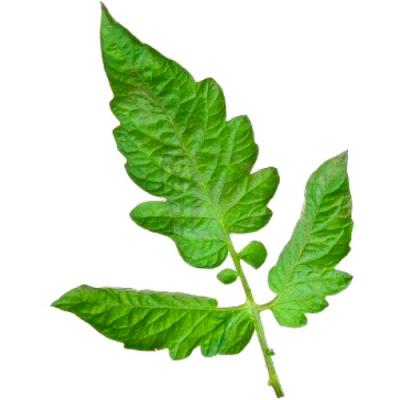
The Garden Note That Surprised Everyone
There are fragrance ingredients that surprise you with their beauty — notes you encounter and immediately understand why perfumers fell in love with them. And then there are ingredients that surprise you with their sheer unexpectedness: their willingness to be difficult, angular, challenging. Tomato leaf falls firmly into the second category.
The first time you smell a concentrated tomato leaf accord, the experience can be genuinely startling. It is intensely green — not the soft, reassuring green of cut grass or fresh mint, but something sharper and more complex. There is a metallic edge, a slight bitterness, and underneath it all, a quality that can only be described as vegetal and alive: the smell of a real plant, the specific chlorophyll-and-chemistry signature of a tomato plant bruised by touch. It is one of the most recognisably natural-smelling of all fragrance materials, and yet it is almost always encountered in synthetic form in perfumery.
Its story in fine fragrance is an object lesson in how the most unlikely ingredients, deployed with confidence and intelligence, can become canonical.
The Tomato: A Brief Natural History
The tomato, Solanum lycopersicum, is a member of the nightshade family, Solanaceae, and is native to western South America, with wild ancestors still found in the Andes. Domesticated by Mesoamerican civilisations thousands of years ago, it arrived in Europe in the sixteenth century following the Spanish conquest of the Americas — initially regarded with deep suspicion as a potentially toxic member of a notorious plant family, and cultivated as an ornamental curiosity before its culinary potential was eventually recognised.
The tomato's relationship with cosmetics and perfumery is rooted partly in its chemistry. The fruit contains lycopene — the carotenoid pigment responsible for its brilliant red colour — which has potent antioxidant properties and has become a valued ingredient in skincare formulations. But it is the leaves that interest perfumers, and for very different reasons.
Tomato leaves contain a range of volatile aromatic compounds, particularly 2-isobutylthiazole, which is primarily responsible for the distinctive green, slightly metallic, intensely fresh scent of the living plant. Anyone who has brushed against a tomato plant in a warm greenhouse and caught that characteristic smell on their hands will know exactly what molecule this is, even if they have never heard its name. It is one of the most instantly recognisable natural scents in the world.
How Tomato Leaf Smells in Perfumery
In a fragrance context, tomato leaf delivers a very specific set of olfactory qualities:
- Intensely green — perhaps the greenest of all common fragrance notes, more piercing than violet leaf and less sweet than freshly cut grass
- Metallic and slightly sharp — a distinctive character that gives it edges and personality but requires careful management in compositions
- Vegetal and natural — with a powerful sense of the living plant, of sap and chlorophyll, of the warm greenhouse
- Slightly bitter and herbaceous — echoes of the herb garden, of wild Mediterranean scrubland
- Fresh and diffusive — highly volatile, meaning it tends to appear in top and middle notes where its brightness is felt most keenly
Used in isolation, tomato leaf can be overwhelming. But in the hands of a confident perfumer, that very intensity becomes its greatest asset — a way of delivering an immediate, unmistakable declaration of greenness and freshness that no other ingredient can quite replicate.
Extraction and Synthesis
Tomato leaf absolute is technically obtainable — the aromatic compounds of the leaves can be extracted by solvent — but the resulting material is expensive, difficult to work with in large quantities, and subject to considerable natural variation. In practice, most tomato leaf notes in modern perfumery are achieved synthetically.
The key molecule, 2-isobutylthiazole, is produced industrially and used in very small quantities — it has enormous tenacity and odour impact at low concentrations. Perfumers often blend it with other green-metallic materials, violet leaf compounds, and various natural essences (including the occasional drop of actual tomato absolute) to build a convincing, nuanced tomato leaf accord that reads as natural without the inconsistency of the pure natural material.
Tomato Leaf's History in Perfumery
The story of tomato leaf in fine fragrance begins in 1977 with Sisley's groundbreaking Eau de Campagne, created by Geneviève Doré. This fragrance was genuinely radical for its time — in an era still dominated by heavy orientals and powdery florals, Doze introduced a green, herbaceous, almost vegetable freshness that felt like nothing that had come before. Tomato leaf, paired with jasmine and lily of the valley, gave Eau de Campagne the earthy immediacy of a French country garden. It remains a masterwork of the green genre, well represented across niche perfumery.
Annick Goutal returned to tomato leaf twice: first in Passion (1983), where it appeared as a green, slightly chypre top note in a fruity, complex composition, and later in Ninfeo Mio, a green, woody fragrance built around lemon and Mediterranean botanicals, where tomato leaf contributes to an extraordinary sense of an Italian garden in high summer.
Hermès' Un Jardin sur le Nil (2005), created by Jean-Claude Ellena, uses tomato leaf as part of a complex green accord that evokes the lush, watery vegetation of the banks of the Nile. Ellena's particular genius is in using green materials like tomato leaf not as obvious top notes but as structural elements that persist through a composition and give it a sense of living, breathing nature.
How Perfumers Use Tomato Leaf
Tomato leaf's most common placement in a fragrance is as a top note or heart note, where its brightness and intensity are experienced most directly. Its volatility means it rarely persists into the dry-down, but this is not a weakness — it functions as an immediate statement, a burst of green freshness that frames the opening of a composition before giving way to softer, more complex middle notes.
The most successful perfumers use tomato leaf not as a literal note ("this smells like a tomato plant") but as a mood — a way of evoking the particular freshness of green nature without resorting to the more generic freshness of aquatic or citrus materials. It is a more sophisticated choice, and it rewards the wearer who takes the time to appreciate it.
Pairing Notes for Tomato Leaf
- Citrus notes — lemon and bergamot amplify tomato leaf's freshness while softening its metallic edge
- Jasmine — the rich indolic quality of jasmine creates a fascinating counterpoint to tomato leaf's austere greenness
- Violet leaf — a natural partnership of green notes that creates layered, complex natural freshness
- Geranium — the clean, rosy-green character of geranium integrates beautifully with tomato leaf
- Cedarwood and vetiver — warm, dry woody materials provide an excellent foundation for tomato leaf's brightness to shine against
- Basil and aromatic herbs — the culinary associations are obvious but the olfactory synergy is real and very satisfying
An Underused Note With Great Potential
Despite its canonical status in certain key fragrances, tomato leaf remains relatively underused in perfumery — particularly compared to its potential. Most perfumers default to safer green notes: violet leaf, galbanum, freshly cut grass. Tomato leaf requires more confidence to deploy, because its character is so specific and so powerful that it cannot be hidden behind other ingredients. When you use it, you commit to it.
That specificity, however, is also its greatest appeal. In a market saturated with generically fresh, broadly pleasant fragrances, tomato leaf offers something genuinely different — a green note with personality, with edges, with a sense of real place and real nature, prized especially in men's fragrances. The perfumers bold enough to use it well have consistently produced some of the most interesting and memorable fragrances in the contemporary canon — explore our best-selling fragrances for those that use green notes masterfully. It deserves wider recognition — and wider use.