

Best Cherry Fragrances 2026: The Three Archetypes from Sparkling to Dark
There is no commercial cherry extract, so every cherry accord is rebuilt from synthetic aldehydes calibrated for marzipan, jam or boozy maraschino character.
By Julia MorettiFragrenza makes several of the alternatives featured in our guides — here’s how we test.
12 min read
Cherry has become one of the defining fragrance notes of the contemporary moment. Through the late 2010s and into the 2020s, cherry compositions have moved from niche curiosity to mainstream commercial dominance, appearing across every fragrance tier and inspiring some of the most distinctive releases of the past decade. What makes the note so compelling is the range of effects it can achieve: at one end of the spectrum, cherry reads as dark, boozy, slightly dangerous, the smell of fermented fruit in candlelit rooms; at the other, it is bright and almost edible, the sharp luminous quality of fresh cherries in early summer.
This is the complete commercial guide to the best cherry fragrances in the Fragrenza line, organized by the three cherry archetypes that define the contemporary commercial landscape. For the broader register that cherry now occupies, see the bright gourmand 2026 pillar. For the savory-leaning end of the spectrum where cherry sometimes meets darker materials, the savory gourmand pillar covers the adjacent territory.
What cherry actually is in fine perfumery
Cherry in fragrance is almost always a constructed accord rather than a natural extraction. There is no widely available natural cherry extract used in fine perfumery; the materials that smell most like cherry in any composition are blends of synthetic aldehydes, esters, and benzaldehyde derivatives calibrated to evoke specific cherry varieties. The perfumer's skill in building the accord from scratch entirely determines the quality of the result.
The chemistry that defines cherry character relies primarily on benzaldehyde (responsible for the almond-cherry-marzipan facet that all cherry accords share), furaneol (which contributes the caramelized-fruity sweetness), and various esters that simulate specific cherry varieties: ethyl acetate and ethyl butyrate for fresh-cherry character, methyl benzoate and benzyl benzoate for the deeper preserved-cherry direction. Most contemporary cherry compositions also include bitter almond accords (sharing chemistry with cherry through benzaldehyde) and cherry blossom accords (which lean lighter and more floral than the fruit itself).
The result is a material family that can be calibrated across a remarkable range of effects. Light cherry esters produce the bright sparkling-cherry register; heavier cherry-liqueur and cherry-syrup accords produce the dark indulgent register; almond-forward cherry compositions sit in the middle and lean sophisticated. The three Fragrenza picks below demonstrate each direction.
Cherry in modern perfumery
Cherry has appeared sporadically in fine fragrance for over a century (Guerlain Mouchoir de Monsieur 1904 included cherry-almond facets through benzaldehyde) but its modern breakthrough came with Tom Ford Lost Cherry (2018), which paired dark cherry liqueur with bitter almond and a velvety floral-balsamic base. Lost Cherry became one of the most influential niche releases of the 2010s and inspired a wave of cherry-forward compositions across niche, designer, and accessible tiers through 2020 to 2026.
The contemporary moment has seen cherry split into three distinct directions. The dark-indulgent register (descended from Lost Cherry) sits at the prestige and niche tiers. The bright-sparkling register (descended from earlier celebrity-feminine releases and refreshed through the contemporary clean-beauty wave) sits across mainstream and accessible tiers. The almond-cherry sophisticated middle ground bridges the two and has become one of the most commercially successful contemporary directions. The Fragrenza line covers all three.
The three cherry archetypes
1. Dark cherry (the indulgent register)
The archetype that brought cherry into prestige niche territory. Cherry liqueur or fermented cherry accords paired with saffron, osmanthus, leather, smoke, or animalic-balsamic anchors. The wear is unmistakably indulgent (cherry is sweet, immediately legible) but carries a structural complexity that prevents the composition from reading as candy. The natural choice for wearers who want a cherry fragrance that declares a clear point of view rather than apologizes for its sweetness.
The Fragrenza pick:
opens with tart sour cherry and golden saffron in an entrance that is vivid, deliberate, and slightly dangerous; the heart unfolds osmanthus's apricot-and-leather strangeness alongside actual apricot and a whisper of olive; the base settles on nagarmotha rising with dark woody intensity that wraps around the cherry and pulls everything into a smoldering trail. The composition demonstrates how the dark-cherry register can hold its indulgent center while still delivering structural ambition; the wear is among the most distinctive cherry compositions in the line.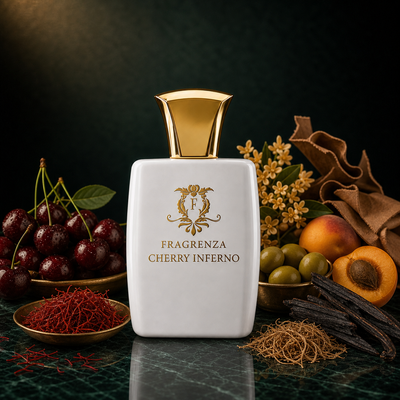
2. Sparkling cherry (the bright register)
The opposite end of cherry perfumery. Bright cherry esters paired with ginger, pink pepper, light florals, and a clean musky base. The wear is luminous, festive, and emotionally welcoming; the natural choice for wearers who find the dark-indulgent register too statement-driven and want cherry's appeal without the projection commitment. Among the most universally appropriate cherry compositions across daytime and warm-weather contexts.
The Fragrenza pick:

3. Amarena cherry (the sophisticated middle ground)
Between the darkness of the indulgent register and the brightness of the sparkling register lies the sophisticated middle ground. Named after the dark Italian maraschino cherry variety preserved in syrup, this archetype delivers cherry perfumery at its most refined: rich and sweet but never cloying, complex and layered in a way that rewards sustained attention. The composition style sits between gourmand and floral oriental; the wear reads as deeply considered rather than declarative.
The Fragrenza pick:
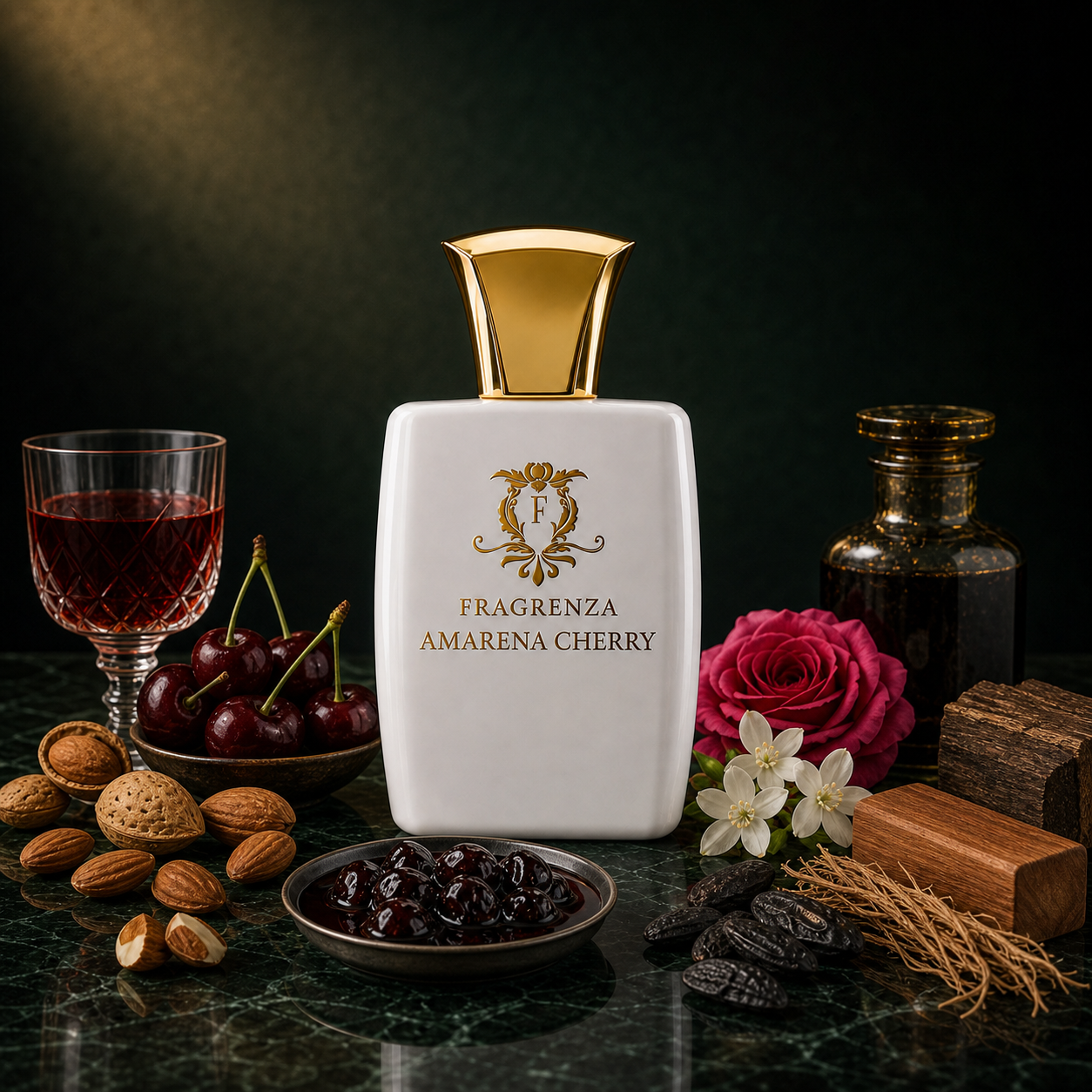
opens with black cherry, cherry liqueur, and bitter almond; the heart unfolds griotte syrup, Turkish rose, and jasmine sambac in a lush velvety chord; the base resolves on Peru balsam, tonka bean, sandalwood, vetiver, and cedar. The wear is the canonical amarena-cherry register handled with prestige-tier polish. Among the most culturally recognized contemporary cherry compositions, and the cultural reference point that established the modern cherry-fragrance wave.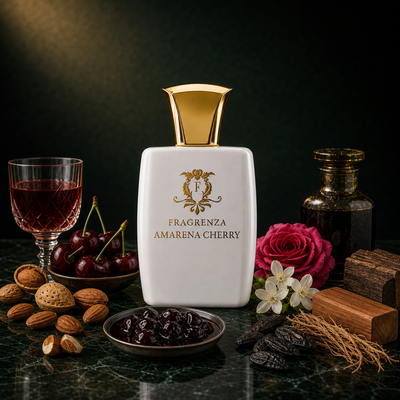
How cherry fragrances wear on skin
The wear pattern of the cherry family is specific and worth understanding before committing to a bottle.
Cherry declares itself in the opening. Unlike many other gourmand materials that emerge in the heart, cherry is most chemically present in the first thirty to ninety minutes of the wear. The bright top esters fade quickly; the heart-and-base cherry character integrates with supporting materials and produces a more textured, less immediately-fruity wear from hour two onward. If you are buying for the cherry character specifically, the opening is where you will hear it most clearly. If you are buying for the wear that lasts the rest of the day, the dry-down's cherry is softer and integrates with the supporting materials.
Cherry varies dramatically with skin chemistry. The benzaldehyde and ester-based cherry materials interact strongly with body warmth. Warmer or oilier skin amplifies the sweet-honeyed cherry facets; cooler or drier skin amplifies the bitter-almond facets. The same cherry composition can read as warm-jammy on one wearer and crisp-almond-sour on another. See the skin chemistry deep-dive for the full account.
Projection varies by archetype. Sparkling cherry tends to project moderately for the first one to two hours and then settle into a close-skin wear pattern. Dark cherry and amarena cherry project more strongly for longer (two to four hours of moderate projection) and produce wears that last eight to twelve hours total. Apply less than you would for a transparent fragrance; one to two sprays is typically enough for any cherry composition.
When to wear cherry fragrances
Cherry's three archetypes have distinct occasion ranges.
Sparkling cherry works in nearly any context where bright fragrance is appropriate. Daytime social occasions, warm-weather wear, casual evenings, professional environments where lighter fragrance is welcome - the register is universally appropriate and reads as friendly rather than declarative.
Amarena cherry is a day-to-evening transitional fragrance. Appropriate for daytime social events with a sophisticated edge (lunches, gallery visits, weekend afternoons) and also for evening contexts where the wear should register as polished. The middle-ground positioning makes it the most versatile of the three cherry archetypes.
Dark cherry is emphatically an evening fragrance. The wear's slightly dangerous edge, the smoke and animalic facets, and the projection profile read as out of place in daytime contexts and read as deliberate in evening ones. Cool weather is the natural seasonal home; the dense base materials project less aggressively in cold air. Save dark cherry for dinners, theater, and any context where the wear should declare a clear point of view.
How to layer cherry fragrances
Cherry layers well with a small number of partners. Three patterns work consistently.
Sparkling cherry over a clean musk skin scent. The combination extends a daytime-friendly cherry into a layered wear that holds the sparkling top while adding skin-close intimate range. Apply the musk broadly; add a single spray of sparkling cherry to one pulse point. Particularly useful for warm-weather evening wear when the cherry character should be present but not declarative.
Dark cherry under a single bright citrus top. Apply the dark cherry broadly and add a single spray of bergamot or grapefruit cologne to one pulse point. The bright top reads in the opening (lifting the dark-cherry register into something more daytime-appropriate), and the cherry carries the wear through the rest of the day. The technique extends dark cherry's wearability into contexts where the register alone would feel out of place.
Amarena cherry paired with a single floral top. A jasmine or rose-forward composition applied to a single pulse point alongside a broadly-applied amarena cherry produces a layered effect that emphasizes the floral chord in the cherry's heart. The combination works particularly well for evening events where the wear should register as floral-gourmand rather than purely cherry.
For the full layering technique theory, see the layering pillar.
Cherry in a fragrance wardrobe
A minimum viable cherry presence in a broader fragrance wardrobe is one well-chosen pick from the archetype most aligned with your wearing patterns. For wearers who prioritize daytime wear and warm-weather contexts, sparkling cherry is the natural choice. For wearers building toward evening or cool-weather occasions, dark cherry or amarena cherry are stronger picks.
Two cherry picks (one bright for daytime and one dark for evening) cover essentially the full range of contexts where cherry is welcome. Most wearers stop at two pieces from the family; the cherry character is distinctive enough that the wearer's signature becomes recognizable past that point.
Related reads
- Bright Gourmand: The 2026 Pillar
- Savory Gourmand and Burnt Sweet: The 2026 Pillar
- Best Tom Ford Lost Cherry Dupes
- Cherry in Perfumery (Educational Pillar)
- Why Skin Scents Smell Different on Everyone
- The Layering Pillar
- How to Build a Fragrance Wardrobe
FAQ
Does cherry fragrance actually smell like cherries?
Yes, recognizably, though the perfumery version emphasizes specific facets of the source material. Bright cherry esters produce the fresh-cherry character; cherry-liqueur accords produce the preserved-fruit character; bitter-almond materials (sharing benzaldehyde chemistry with cherry) anchor the deeper end. The best cherry fragrances do not smell like cherry candy or cherry cough syrup; they smell like the idea of cherry rendered as fine fragrance, with depth and complexity that the fruit itself does not deliver.
Why are cherry fragrances so popular right now?
Two reasons converged through the late 2010s. Tom Ford Lost Cherry (2018) established cherry at the prestige niche tier and proved the note could anchor a serious composition; the broader clean-beauty and savory-gourmand waves created cultural conditions where dark, slightly indulgent, slightly subversive fragrances became fashionable. Cherry sits at the intersection of those moments - sweet enough to feel approachable, dark enough to feel grown-up. The 2024-2026 wave is the commercial follow-on from the 2018-2020 prestige breakthrough.
Are cherry fragrances unisex?
Most contemporary cherry compositions function as unisex even when marketed by gender. The dark-cherry register skews slightly feminine in cultural associations but works on any wearer; sparkling cherry is essentially unisex; amarena cherry leans slightly feminine but is widely worn by men. Treat gender marketing on cherry as a starting point rather than a constraint.
How long do cherry fragrances last on skin?
Six to ten hours is typical for sparkling cherry; eight to twelve hours for dark cherry and amarena cherry. The supporting base materials (sandalwood, cedar, balsams, tonka, certain musks) are tenacious and extend the wear far beyond the cherry character's chemical lifespan. The cherry character itself is most present in the first one to two hours and progressively integrates with the base from hour three onward.
Can cherry fragrances be worn in summer?
Sparkling cherry works exceptionally well in warm weather and is often at its best in summer evening contexts. Amarena cherry can work in moderate warm weather, particularly evening or air-conditioned indoor settings. Dark cherry is the harder seasonal pairing; the dense base materials project too aggressively in heat. Save dark cherry for fall, winter, and cool spring weeks.
What is the easiest cherry fragrance to start with?
For most wearers, sparkling cherry is the most accessible entry point. The wear is bright and emotionally welcoming, the projection is moderate, and the composition is universally appropriate across daytime and casual evening contexts. Wear it for a season, learn how your skin amplifies the cherry materials, and decide whether to explore deeper into amarena cherry or dark cherry territory from there.
Why does my cherry fragrance smell almond-like on me?
Because the chemistry of cherry and bitter almond share the benzaldehyde compound. Wearers with cooler or drier skin tend to amplify the bitter-almond facet of any cherry accord, while warmer or oilier skin amplifies the sweet-cherry facet. Neither reading is wrong; the composition is doing exactly what its chemistry permits, and your skin is simply emphasizing the almond direction. If you prefer the sweet-cherry character, try a richer composition with explicit cherry-liqueur accords (like Amarena Cherry) rather than the lighter ester-based cherry compositions where the bitter-almond facet is more exposed.
The bottom line
Cherry is one of the defining commercial directions in contemporary perfumery and one of the most rewarding archetypes within the bright gourmand register. The three archetypes give you the full landscape; the Fragrenza picks within each give you concrete starting points; the wearing patterns and layering techniques give you the technical vocabulary to wear the register well.
Whether you want a dark-indulgent cherry statement (Cherry Inferno), a bright-luminous cherry for daytime (Sparkling Cherry), or the sophisticated middle ground of the cultural-benchmark amarena register (Amarena Cherry), the contemporary cherry family has the depth to reward years of exploration. Cherry done well is one of the most distinctive directions in fine fragrance; the four-hour wear test on your own skin tells you which archetype your chemistry amplifies and which to make a long-term part of your rotation.