Why Skin Scents Smell Different on Everyone: The Science of Fragrance and Body Chemistry
Skin pH, surface bacteria, sebum levels, temperature and diet all interact with the volatile aromatic molecules in ways that determine why the same bottle reads differently on two wearers.
By Julia MorettiFragrenza makes several of the alternatives featured in our guides — here’s how we test.
12 min read
Why your perfume never smells exactly like anyone else's
You spray the same fragrance your friend wears. You can smell the difference within thirty seconds. Hers reads as a clean-skin musk, soft and intimate. Yours reads as something faintly sweeter, warmer, with a hint of something almost gourmand. You bought the same bottle, sprayed at the same time, applied to the same pulse points. The fragrance smells distinctly different on each of you.
This is the most universally observed phenomenon in fine fragrance, and the most poorly explained. Most online perfume content reduces it to vague gestures about “skin chemistry” without explaining what that actually means. The truth is that there are five specific, scientifically understood forces that determine how a perfume develops on any individual’s skin — and skin scents in particular are the category most affected by all five.
This is the guide to why fragrances smell different on different people, with a focus on the skin scent category specifically. Read in order to understand the chemistry, or skip to the practical “how to find what works on your skin” section if you want the actionable takeaway.
The five forces that shape how fragrance develops on skin
Skin is not a neutral surface. It is a biologically active membrane with its own pH, its own temperature, its own oils, its own bacteria, and its own surface chemistry — all of which interact with the volatile aromatic molecules in fine fragrance. Five specific factors do the most work.
1. Skin pH. Healthy human skin sits between pH 4.5 and 6.0 (slightly acidic), but individual variation within that range is significant. More acidic skin tends to amplify sweet and powdery notes; more alkaline skin tends to amplify sharper, greener, more aromatic facets. The same fragrance can read as sweeter on one wearer and crisper on another simply because of where each wearer’s skin pH sits in the normal range.
2. Skin temperature. Body warmth is the engine that drives perfume evaporation. Warmer skin volatilizes top notes faster (so the bright opening burns off more quickly) but also projects the heart and base notes more prominently. Cooler skin holds the top notes longer and projects the base notes less. Wrist temperature in particular can vary by 3-5°F between individuals, which significantly affects how a fragrance develops over the first hour of wear.
3. Sebum (skin oil) levels. Sebum is the oily lipid film the skin produces continuously. It acts as a natural fixative for fragrance — the oily molecules in perfume bind to skin sebum and slow their evaporation. Drier skin has less sebum, so volatile materials evaporate faster (perfume reads as lighter and shorter-lasting). Oilier skin has more sebum, so the same fragrance reads richer and lasts longer. This is why the conventional advice to moisturize before applying fragrance actually works — the moisturizer mimics sebum and creates a longer-wearing surface.
4. Diet and lifestyle. What you eat, how much you sweat, what soaps you use, what laundry detergent your clothes carry, even how much water you drink — all of these change the surface chemistry of your skin enough to shift how fragrance develops. Heavy-spice diets, alcohol, smoking, and certain medications all leave aromatic molecules in your sebum and sweat that can interact with perfume materials. The effect is usually subtle but cumulatively significant.
5. Skin microbiome. Each person carries a distinctive community of bacteria, fungi, and other microorganisms on their skin. These microorganisms produce their own volatile aromatic compounds (which is what creates each person’s underlying body odor signature), and they interact with perfume materials in different ways. Recent research suggests the skin microbiome is one of the most important and least-understood factors in how fragrance develops — and may explain a meaningful share of the difference in how the same perfume smells on different people.
Why skin scents are the category most affected
Skin scents — the contemporary register of clean-musk, ambroxan-and-iso-e-super, second-skin compositions — are unusually sensitive to all five of the forces above. The reason is structural. See our complete guide to what skin scents are for the full account, but in short: skin scents work by being so close to the natural aromatic profile of clean skin that they essentially blend into your existing scent rather than overlay a distinctive perfume on top of it.
Because skin scents amplify and complement your underlying skin character rather than masking it, they reveal more of your individual chemistry than richer, heavier perfumery does. A heavy oriental composition has so many aromatic materials projecting at full strength that individual skin chemistry gets drowned out. A skin scent has a deliberately quiet, transparent structure — which means everything underneath it (your pH, your sebum, your microbiome, your diet) reads through into the wear.
The result is that the same skin scent can read as warm and sweet on one person and clean and aldehydic on another. Same bottle, same molecules, very different wear. This is the category’s great strength and the source of its most common confusion among new wearers.
The aromatic materials that change most on skin
Some perfume materials are notably more skin-chemistry-sensitive than others. The materials at the heart of contemporary skin-scent perfumery are particularly prone to varying with the wearer.
Musk — especially the macrocyclic and white-musk synthetics that anchor most contemporary skin scents — reads dramatically different on different wearers. On some skin musk reads as clean-laundry-soft; on other skin the same material reads as faintly powdery, sometimes verging on sweet, sometimes on slightly sour. Musks bind tightly to sebum and develop slowly over hours, which gives skin chemistry maximum opportunity to shape the wear. See our musk in perfumery entry for the full account.
Iso E Super is so receptor-dependent that some wearers cannot smell it at all (specific anosmia), while others find it dominates everything else they wear. The molecule’s unique receptor binding profile means individual genetic variation in olfactory receptors translates directly into wildly different wear experiences. See our Iso E Super deep dive.
Ambroxan reads as warm-skin-amber on most wearers but shifts dramatically with sebum levels. On drier skin Ambroxan can feel slightly synthetic; on oilier or moisturized skin the same material develops a distinctly warm, almost golden character. Our Ambroxan explainer covers the molecule in depth.
Cashmeran reads as warm-velvet on most wearers but can shift toward a slightly powdery character on more acidic skin or toward a more woody-sandalwood facet on more alkaline skin. The synthetic captive’s broad aromatic palette gives individual skin chemistry significant influence over which facet dominates.
Iris — particularly the orris-butter side — varies dramatically with skin temperature. Warmer skin pulls more of the carrot-iris chemistry forward; cooler skin keeps the powdery-floral facet dominant. The same iris fragrance can read as carroty-vegetal on one wearer and powdery-classical on another.
How to find what actually works on your skin
The practical implication of all this is that you cannot trust a friend’s recommendation, a magazine review, or a TikTok endorsement to predict how a fragrance will smell on you. The same bottle they love may read as something completely different on your skin. The only reliable way to know what works on your skin is to test on your skin.
The most useful protocol: spray on the inside of your wrist, walk away, and check at thirty minutes, two hours, and four hours. The first thirty seconds is dominated by the alcohol carrier and the most volatile top notes, neither of which represents how the fragrance will actually wear. By thirty minutes the heart is developing; by two hours the base materials are starting to come through; by four hours you have a clear picture of the dry-down. If you love the fragrance at four hours, you will love it as a personal scent. If you do not, no amount of patience will make the wear better — that fragrance simply does not match your skin chemistry.
The other useful trick is to test more than one spot. Wrist chemistry differs from neck chemistry differs from collarbone chemistry. The skin behind your ears is significantly oilier than the inside of your forearm, which changes how a fragrance develops. Most professional perfumers recommend testing on the inside of the elbow as the most representative spot, because the skin there is moderately oily, moderately warm, and not as easily contaminated by hand washing or lotion application as the wrist.
Skin scent picks from the Fragrenza line
Several Fragrenza compositions sit clearly in the skin-scent register and demonstrate how the category interacts with individual skin chemistry.
is the cleanest skin-musk composition in the line — cool, transparent, clean-skin character that reads as freshly clean-skin on most wearers but shifts subtly with sebum levels. The composition is the natural starting point for anyone exploring the contemporary skin-scent register.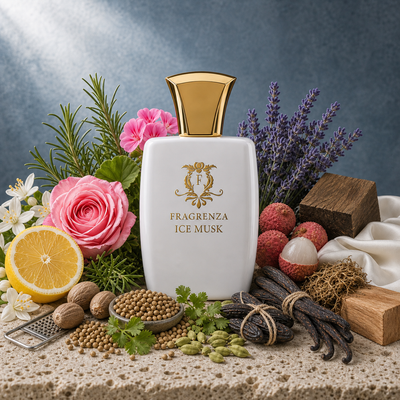
takes the citrus-floral-clean-musk register into a slightly warmer territory, with the kind of soft second-skin character that develops differently on dry versus oily skin.

For more on the skin-scent register and the molecular families that anchor it, see our complete guide to skin scents, the Skin Scents 2.0 trend hub, and the Iso E Super and Ambroxan deep dives.
What to do if a fragrance smells wrong on you
The conventional advice when a fragrance does not work on your skin is to give up on the fragrance. The better advice is to give up on that application of the fragrance and try another approach. Several modifications often shift how a perfume reads.
Layer with a fragrance-free moisturizer first. The added emollient creates a more sebum-like surface and slows top-note evaporation. Many wearers find that fragrances that read as too sharp on dry skin develop beautifully when applied over a thin layer of unscented body moisturizer.
Apply to clothing instead of skin. The fabric provides an inert surface that holds the aromatic molecules without skin-chemistry interference. The wear reads more uniformly across wearers when the fragrance is on clothing rather than skin — useful for compositions that are too skin-chemistry-sensitive at full skin contact.
Spray earlier and let it develop. Many fragrances that read poorly in the first thirty minutes settle into something better in the heart. If you can give a fragrance one to two hours before deciding whether you like it on you, you may discover that the dry-down is much more flattering than the opening suggested.
Adjust the dose. Some skin chemistries amplify materials at higher concentrations and suppress them at lower. A single light spray that reads cleanly may turn into a heavier, more synthetic-feeling wear at three sprays. The reverse can also happen — some compositions need a generous application to develop properly.
Frequently asked questions
Why does my friend’s perfume smell amazing but the same bottle smells different on me?
Because the volatile aromatic molecules in fine fragrance interact with your skin’s pH, temperature, sebum levels, microbiome, and underlying body-odor chemistry. The same molecules read differently on each person’s individual skin chemistry. This is universal, not a sign that something is wrong with you or the fragrance.
Is it true that perfume smells better on oily skin?
Generally yes. Oilier skin holds aromatic molecules longer because sebum acts as a natural fixative, slowing the evaporation of volatile materials. Fragrance projects more strongly and lasts longer on oilier skin. Drier skin tends to burn through fragrance faster. The fix for drier skin is layering with a fragrance-free moisturizer before applying perfume.
Does diet really change how perfume smells on me?
Modestly, yes. Heavy-spice diets, alcohol, certain medications, and some foods leave aromatic molecules in your sebum and sweat that can interact with perfume materials. The effect is usually subtle and gradual but cumulatively significant. Major diet changes can shift how a familiar fragrance reads on your skin over weeks or months.
Why are skin scents particularly sensitive to body chemistry?
Because skin scents work by amplifying and complementing your existing skin character rather than masking it with a stronger projection. The deliberate transparency and quietness of the category lets your underlying skin chemistry read through more clearly, so the wear varies more between individuals than richer, heavier perfumery does.
How long should I wait before deciding if a perfume works on me?
At least two hours, ideally four. The first thirty seconds is dominated by alcohol and the most volatile top notes, neither of which represents the actual wear. By thirty minutes the heart is developing; by two hours the base is starting to come through. Four hours gives you a complete picture of the dry-down, which is what you will actually wear most of the day.
Can I change how a perfume smells on me?
Modestly. Layering with fragrance-free moisturizer, applying to clothing rather than skin, adjusting the dose, and waiting longer for the dry-down all shift how a fragrance reads. None of these will make a fundamentally incompatible composition smell good, but they can rescue compositions that are close to working.
Is there any way to predict how a perfume will smell on me before buying?
The reliable answer is no. Online reviews, magazine writeups, and friends’ recommendations all describe the wear on someone else’s skin chemistry, not yours. Sample sets and decants exist precisely because individual testing is the only way to know what works on you. A four-hour wear test on your own skin is worth more than every review online combined.
The good news about skin chemistry
Individual skin chemistry can feel like a frustration when a fragrance you wanted does not work on you, but it is also the source of one of perfumery’s deepest pleasures: every wearer’s perfume becomes uniquely theirs. The same composition that reads as soft-clean-musk on your friend reads as something specifically yours when you wear it. This is part of why fine fragrance has anchored personal identity for centuries — not because of the bottle, but because of the way your skin transforms what is in the bottle into something only you can wear.
Find what works on your skin. The four-hour wear test is the single most useful diagnostic in fine fragrance. Once you know what your skin chemistry amplifies and what it suppresses, you can navigate the entire perfumery landscape with confidence — including the contemporary skin-scent register, where individual chemistry matters most and the rewards are most personal.