


What Are Skin Scents? The Complete Guide for 2026
Skin scents lean on white musks, ambroxan and lactonic accords that bind to skin oils and release in slow pulses, producing soft sillage in the immediate vicinity rather than across a room.
By Julia MorettiFragrenza makes several of the alternatives featured in our guides — here’s how we test.
9 min read
Skin scent is one of the most-used and most-misunderstood terms in modern perfumery. It gets used to describe everything from a faint clean musk to a barely-perceptible body lotion smell to a niche fragrance that happens to wear close. The actual definition is more specific, and the category has changed substantially in the last few years.
This is the educational guide. What a skin scent actually is, what notes go into one, why some perfumes wear closer to the skin than others, and which Fragrenza scents fit the category if you want to start exploring it.
What is a skin scent?
A skin scent is a perfume designed to read as an extension of your own skin rather than a separate fragrance applied on top of it. The composition uses notes — typically clean musks, soft woods, faint vanilla, lactonic accords — that smell warm and human rather than perfumed. Done well, the result is the impression of "yourself, but slightly enhanced": something a person notices when they get close, not when they walk past.
The technical definition centres on two things. First, the molecular structure: skin scents lean heavily on musk molecules and other materials that have natural affinity for skin. Second, the projection profile: they sit close to the body, producing soft sillage in the immediate vicinity rather than projecting outward.
What a skin scent is not: it's not unscented. It's not weak. It's not a perfume that "doesn't work" on you. A skin scent is a deliberate compositional choice — usually a more sophisticated one than a high-projection floral or oriental, because it requires the perfumer to build a fragrance that reads as natural rather than constructed.
What notes go into a skin scent
Musk (the foundational ingredient)
Modern skin scents are built around musk. Synthetic musks — particularly ambroxan, ethylene brassylate, and the polycyclic musks — produce a soft, warm, slightly sweet effect that reads as skin-adjacent rather than perfumed. Musk is the single most important ingredient in the category.
Ambroxan
A synthetic musk-amber molecule that smells warm, slightly salty, faintly woody. Ambroxan is to modern skin scents what musk is to traditional perfumery — the engine of the effect. Many of the most-loved "second skin" perfumes use it as their dominant note.
Iso E Super
A synthetic woody molecule that smells faint, warm, and slightly velvety. Iso E Super is unusual because it has a phenomenon called anosmia — about a quarter of people genuinely can't smell it — but it produces dramatic effects on those who can. Often used as a transparent base in skin scent compositions.
Soft sandalwood
The lactonic, creamy facet of sandalwood (rather than the dry, smoky facet) reads as skin-adjacent. Sandalwood gives skin scents warmth and persistence without making them feel "perfumed".
Faint vanilla
A trace of vanilla — well below the level you'd notice in a gourmand perfume — produces a faint sweetness that mimics the natural sweetness of warm skin. This is part of why skin scents often read as comforting; we associate that sweetness with being close to another person.
Lactonic notes (the modern addition)
Coconut milk, rice milk, soft peach skin. Lactonic molecules give modern skin scents their creamier, more textured quality. (For more on this family, see our lactonic fragrances guide.)
Why skin scents smell different on different people
This is the most-asked question about the category. The answer is genuinely about your skin chemistry — more so than for any other fragrance category.
Sebum (skin oil) levels. Musk and ambroxan bind to skin lipids. People with naturally oilier skin amplify these notes; people with drier skin can lose them entirely. This is why a skin scent can smell warm and present on one person and almost invisible on another.
Body heat. Skin scents need warmth to project. Cold skin barely diffuses them; warm skin produces a soft halo. Pulse points are particularly important.
pH and skin acidity. Slight differences in skin pH affect how musk molecules unfold over hours. The same fragrance can read as more sweet, more salty, or more woody depending on the individual.
The practical implication: skin scents reward longer skin testing more than any other category. A 30-second store test tells you almost nothing. Three days of wear tells you the truth.
The difference between clean perfumes and skin scents
The two categories overlap but aren't the same.
A clean perfume is one designed to smell freshly-showered — citrus, white tea, light florals, soap-like musks. The aesthetic is about cleanliness; the projection can be moderate to strong. Many "clean" perfumes are not skin scents at all because they project outward rather than sitting close.
A skin scent is defined by projection and composition, not by aesthetic. Some skin scents are clean (the soft musk register), but others are warm, gourmand-leaning, or even slightly oriental. What unites them is sitting close to the body, not the type of notes they contain.
The simplest test: a clean perfume can be loud-and-clean. A skin scent is, by definition, quiet.
How skin scents have changed in 2026
The first wave of skin scents (2020–2023) was about minimalism — sparkling-water musks, bare ambroxan compositions, "expensive water" perfumes built on as few ingredients as possible. The aesthetic produced some genuinely beautiful work and a much larger number of forgettable fragrances that smelled, frankly, like nothing.
The 2026 version is different. Modern skin scents add lactonic notes, soft sandalwood, faint vanilla, light florals, and warmer musks to the formula. The result still reads as personal and intimate, but with substance — it lasts on the skin, projects gently, and feels like a fragrance rather than a vague impression of one. (For the broader trend context, see our 2026 trends guide.)
Who should wear skin scents
Anyone who wants their fragrance to feel personal rather than projected. Anyone who works in shared spaces where loud perfume is inappropriate. Anyone who finds traditional perfumes overwhelming on their own skin. Anyone drawn to the idea of "yourself, slightly heightened" rather than "wearing a costume".
The category lends itself particularly well to office wear, daily wear, intimate evening wear, and any environment where you want fragrance to be discovered up close rather than announced from across a room. It's less suited to high-projection statement moments — formal evenings, dramatic seductions, situations where you want to be smelled across the table.
How to wear a skin scent well
Three rules.
Apply more than you would a projection perfume. Skin scents are designed to sit close, not to spread. Three to four sprays — wrists, behind the ears, base of the throat, inner elbows — is normal. Don't worry about overdoing it; the formula won't allow that.
Moisturise first. The single biggest variable in how a skin scent performs is whether your skin holds it. Dry skin loses 30–50% of the longevity of any musk-based composition. Apply unscented body lotion or oil to your pulse points before spraying. (See our longevity guide for the full set of techniques.)
Layer to add presence without losing intimacy. A skin scent layered over a matching scented body lotion produces a fuller, longer-lasting version of itself without making it project louder. (See our layering guide.)
Fragrenza picks: scents that wear in the skin scent register
Several Fragrenza scents wear in the skin scent register — close to the body, warm, personal. These are the closest matches in the line.
— clean, soft, second-skin musk. The most obvious skin scent in the line. Reads as "yourself, slightly elevated". Best for daily wear, office, anyone who wants the category at its purest.

— soft iris, pear, pink pepper. A more textured skin scent — the iris adds powdery softness, the pear adds a faint lactonic facet. Best for anyone who wants slightly more dimension than pure musk.
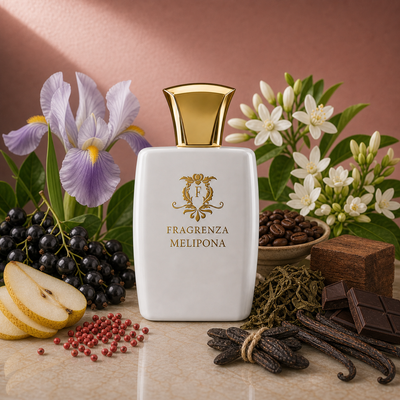

The Fragrenza sample pack lets you wear each on your own skin — which is essential for any skin scent decision because skin chemistry varies more in this category than any other.
Frequently asked questions
What does "skin scent" mean in perfume?
A skin scent is a perfume designed to wear close to the body — projecting gently in the immediate vicinity rather than radiating outward. The composition typically uses musks, ambroxan, soft woods, and warm subtle notes that read as natural skin rather than a layered perfume on top. The point is intimacy and personal presence, not projection.
Why do skin scents smell different on different people?
Skin scents are particularly sensitive to skin chemistry. Sebum (skin oil) levels affect how musks bind, body heat affects how the molecules diffuse, and pH affects how the notes unfold over hours. This is why a skin scent that smells warm and beautiful on one person can smell faint or absent on another.
Are skin scents long-lasting?
Moderately. Pure musk-based skin scents typically wear 4 to 7 hours. Skin scents built on heavier bases (lactonic, sandalwood, vanilla) can wear 7 to 10 hours. Compositions built mostly on ambroxan or Iso E Super can vary dramatically by skin type — some people get all-day wear, others get three hours.
What is the difference between a clean perfume and a skin scent?
A clean perfume is defined by aesthetic — fresh, soapy, just-showered. A skin scent is defined by projection — close to the body, intimate. There's overlap (many skin scents are clean), but a clean perfume can project loudly and a skin scent can be warm and gourmand-leaning. The categories are about different things.
Can men wear skin scents?
Yes — and increasingly do. The skin scent category is genuinely unisex. Men's skin scent options include clean musks, soft woody compositions, ambroxan-led fragrances, and warmer skin-vanilla scents. The smellmaxxing trend has expanded men's interest in the category significantly.
What is the best skin scent for everyday wear?
A well-built clean musk in EdP concentration. The combination produces enough longevity for a full workday plus evening, without overwhelming anyone in close range. Look for compositions that name musk and ambroxan in the top of their note list, with soft sandalwood or vanilla in the base.
Are skin scents worth the price?
For the right wearer, yes — skin scents are often the bottles people wear most consistently because they're the easiest to wear in any setting. The premium category (niche, extrait) gets expensive, but mid-range skin scents typically deliver more wear value than equivalently priced projection perfumes because you reach for them more often.
A final note
Skin scent is one of the most rewarding categories to explore because it teaches you to notice fragrance differently — close-up, slow, in textures rather than statements. A great skin scent doesn't announce itself. It rewards getting close. The first time someone leans in and says "you smell amazing", a skin scent has done what it was designed to do.