Exotic Fruits in Perfumery: How Tropical Notes Are Shaping Modern Fragrance
Exotic Fruits is a modern, clean, low-lit signature: dry-bright on opening, evenly tuned through the heart, slow and quiet in the base.
By Julia Moretti 8 min read
The World Opened Up — and So Did the Perfumer's Palette
There is a moment in the history of modern perfumery that might be called the "tropical turn" — roughly beginning in the late 1980s and accelerating through the 1990s — when the ingredients palette suddenly expanded beyond Europe's classical materials to encompass the fruits of Southeast Asia, the Caribbean, South America, and the Pacific. Mango, lychee, passionfruit, guava, papaya, tamarind: notes that would have seemed utterly alien to the Parisian parfumeurs of the early 20th century became, within a generation, some of the most sought-after accords in commercial fragrance.
This shift was driven by several converging forces: globalization and the increased availability of exotic ingredients, advances in synthetic chemistry that made it possible to recreate the volatile aromatic compounds of tropical fruits, a changing consumer base hungry for novelty and escapism, and a broader cultural fascination with the exotic and the sensorial. If the classic French perfume tradition was rooted in the European garden — roses, violets, jasmine, lavender — the post-1990s fragrance world embraced the entire planet as its garden.
The timing was not coincidental. International travel was becoming accessible to middle-class consumers for the first time. Television, film, and advertising were saturating Western culture with images of tropical paradises. The fragrance industry, always keenly attuned to cultural desire, responded by putting those paradises in a bottle. Today, exotic fruit notes are found in virtually every segment of the fragrance market, from luxury niche houses to mass-market body sprays, and their continued popularity shows no signs of waning.
The Major Exotic Fruits and Their Olfactory Profiles
Mango
Native to South Asia and cultivated for over 4,000 years, mango (Mangifera indica) produces a scent that is at once intensely sweet, tropical, and slightly resinous. The ripe fruit has a characteristic "peachy-tropical" quality — rich, lush, and unmistakably warm. In perfumery, mango accords are built using a combination of lactones (for creaminess), terpenes (for freshness), and certain fruity esters that convey the sticky sweetness of the ripe flesh. Mango notes tend to read as feminine and sunny, ideal for summer fragrances and warm-weather body sprays. They are particularly effective in skin care-adjacent fragrance products, where their warm, slightly creamy character feels appropriate.
Lychee
The lychee (Litchi chinensis), native to southern China, has become one of the most beloved exotic fruits in high-end perfumery. Its scent is floral as much as it is fruity — a quality that makes it exceptionally useful as a bridge between fruit notes and floral hearts. The characteristic lychee smell is rosy, slightly geranium-like, with a crisp freshness and a gentle sweetness. This affinity with rose made it the cornerstone of several landmark fragrances, most notably Cacharel's Amor Amor and Issey Miyake's L'Eau d'Issey variants. The key molecule, cis-rose oxide, explains the elegant floral-fruity bridge that lychee creates.
Passionfruit
Passionfruit (Passiflora edulis) from South America offers one of the most complex tropical scent profiles: simultaneously sweet, tart, tropical, and slightly musky. Its fragrance has a fermented edge — like ripe tropical fruit in full, gorgeous decay — that gives it a depth unusual for fruit notes. Perfumers use passionfruit accords to add tropical exuberance with an edge of sophistication; the tartness prevents it from becoming sugary, and the musky undertone gives it a body that extends well into the drydown, making it more enduring than lighter tropical fruit notes.
Guava
Guava (Psidium guajava), native to Central America and the Caribbean, has a distinctive smell: green, tropical, slightly musky, and faintly floral. The ripe pink guava, in particular, has an almost rose-adjacent quality that makes it useful in floral-tropical compositions. Guava's green edge keeps it from reading as purely sweet, giving it a freshness that works especially well in summer fragrances and aquatic compositions. Its slight astringency adds complexity and prevents the note from becoming merely pleasant.
Papaya
Papaya (Carica papaya) offers a softer, creamier tropical note than mango or passionfruit — slightly musky, warm, and lactonic, with a tropical sweetness that feels more skin-like than fruity. This makes it an excellent choice for "gourmand-tropical" compositions or fragrances aimed at capturing the warmth of sun-heated skin. Its mildness makes it a versatile supporting note that amplifies other tropical materials without competing with them.
The Chemistry: How Exotic Fruits Are Captured and Synthesized
With few exceptions, the aromatic compounds that define exotic fruit scents are present in quantities too small for commercial extraction to be viable. Most tropical fruits yield very little material through distillation or solvent extraction, and what little they do yield is often unstable or difficult to work with in a formulation context. The solution, as with most modern fragrance materials, lies in synthetic chemistry.
The key classes of molecules used to construct exotic fruit accords include:
- Lactones: Cyclic esters that provide creaminess and juicy sweetness. Gamma-decalactone (peach-like) and gamma-undecalactone (coconut-adjacent) are workhorses of tropical fruit construction.
- Fruity esters: Short-chain esters like ethyl acetate and isoamyl acetate provide the bright, fresh top of many tropical fruit accords — the "just-cut" quality that registers immediately.
- Rose oxides and related molecules: Essential for lychee and certain guava accords where a floral-fruity bridge is needed.
- Thiols and sulfur compounds: Used in tiny quantities (and with considerable care), certain sulfur-containing molecules add a distinctive tropical note — blackcurrant bud absolute, for instance, relies on mercaptomethyl pentanone for its characteristic fruitiness.
- Ionones: Adding depth, a slight floral quality, and longevity to fruit accords that might otherwise feel flat or one-dimensional.
The artistry lies in the balance. Too many lactones and a tropical accord becomes cloying and synthetic-smelling. Too much citrus and it loses its tropical identity. The best exotic fruit constructions have a sense of dimension — a top-note brightness, a mid-note body, and a base that lingers on the skin with warmth and sensuality. Achieving this requires not just chemical knowledge but genuine olfactory artistry.
Headspace technology has also transformed this field. By capturing the molecules floating in the air around an intact tropical fruit — without ever cutting or processing the fruit — perfumers can now access aromatic information that conventional extraction never reveals. The result is a new generation of tropical accords that are more realistic and more nuanced than anything achievable through traditional means.
How Perfumers Use Exotic Fruits
Exotic fruits can function in several different ways within a fragrance composition. As top notes, they create an immediate sense of energy and escapism — the opening seconds of a tropical fragrance should, ideally, transport the wearer to somewhere sunnier and more vivid. As heart notes, they provide a sensory bridge between airy top notes and deeper, woody or resinous bases. And in certain gourmand or oriental compositions, they appear in the base itself, contributing warmth and a lingering sweetness that develops over hours on the skin.
Pairing exotic fruits against floral hearts — jasmine, tuberose, orchid, tiare — creates the "tropical floral" category that has powered enormous commercial success in warm-weather fragrance markets. These fragrances evoke holiday, summer, freedom, and sensuality in a way that resonates powerfully with consumers worldwide. There is a reason why every summer fragrance launch season sees a proliferation of mango, lychee, and passionfruit notes: they deliver a very specific and universally appealing emotional experience.
Equally interesting is the use of exotic fruits against woody or oud bases. The contrast of bright, juicy tropical sweetness against the dark, resinous depth of oud or agarwood creates a tension that feels simultaneously ancient and contemporary — a collision of the Middle Eastern perfume tradition with the modern global palate. This pairing has become particularly popular in Middle Eastern and Asian markets, where both oud and tropical fruit are culturally familiar.
Famous Fragrances Built on Exotic Fruits
The list of landmark fragrances featuring exotic fruit notes is long and impressive. Kenzo's Flower by Kenzo uses red berry and rose in a way that borders on the tropical. Cacharel's Amor Amor opened the mainstream market to lychee. Thierry Mugler's Angel — with its berry-patchouli tension — demonstrated that fruit notes could carry serious artistic weight in complex compositions, and helped establish the fruit-oriental genre that remains commercially dominant today.
In the niche world, Amouage's Jubilation XXV uses dried fruit accords of extraordinary complexity alongside resins and oud. Serge Lutens' Datura Noir deploys coconut and apricot in service of something dark and hypnotic, proving that tropical materials can inhabit registers far from their "sunny" associations. Byredo's Mojave Ghost uses ambrette and violet in a way that creates a tropical-adjacent desert atmosphere of remarkable originality.
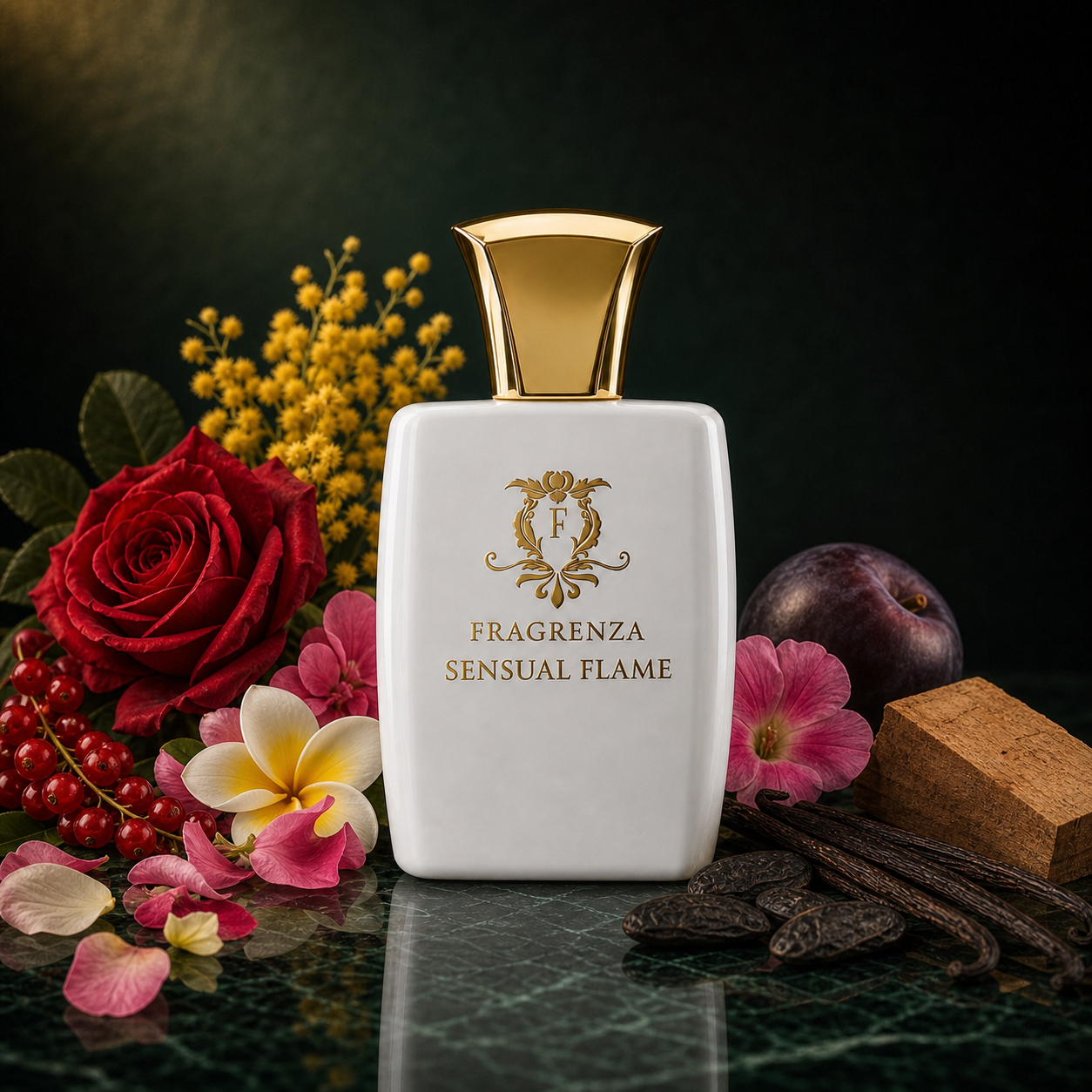
For a contemporary take on tropical fruit energy, Fragrenza's La Vie Est Belle-inspired fragrance captures that spirit perfectly — its warm, radiant accord of flowers and sweetness carries the effervescence of sun-drenched fruit in an endlessly wearable composition that transitions seamlessly from day to evening. The mangosteen note, emerging as one of the most refined tropical additions to modern perfumery, bridges fruit and flower in ways that feel genuinely new.
Pairing Notes for Exotic Fruits
- Coconut and tiare flower: The classic tropical combination — warm, creamy, and irresistibly escapist.
- Jasmine and tuberose: Rich white florals give depth and sensuality to tropical fruit constructions.
- Oud and sandalwood: A sophisticated contrast that transforms fruity brightness into something darker and more complex.
- Vanilla: Adds warmth and sweetness to tropical fruits without obscuring their character or making the composition too heavy.
- Aquatic and ozonic notes: The combination of tropical fruit and sea air creates the archetypal "holiday" fragrance that speaks to warm-weather pleasure.
- Bergamot: A citrus top note that enhances tropical fruits' brightness and creates a more complex, Italian-Mediterranean opening.
- Musk and ambergris: These base materials extend tropical fruit notes beautifully, adding a warm, skin-close quality that makes the fragrance feel intimate and sensual.
The Future of Tropical Fragrance
As biotechnology advances and new extraction techniques emerge, the palette of exotic fruit materials available to perfumers continues to expand. Synthetic biology is creating novel aromatic molecules inspired by exotic species that have never been used in perfumery before. Fermentation-derived fragrance materials — a rapidly growing field — are opening access to tropical aromatic compounds that would be impossible to capture through any other means.
What remains constant is the emotional power of these materials. Exotic fruit notes tap into something primal: the pleasure of abundance, the joy of summer, the promise of distant places. In a world where fragrance is one of our most direct connections to memory and emotion, the tropical note continues to deliver exactly what it has always promised — a moment of pure, sensory escape. Explore our floral fruity fragrances to discover how tropical fruit notes are woven into our most vibrant, sun-kissed compositions.