Honeysuckle in Perfumery: The Climbing Flower Whose Scent Defines Summer
Honeysuckle sits as a soft-bloomed heart, lit from inside, slow on skin, never loud, always close, always quietly present.
By Julia Moretti 6 min read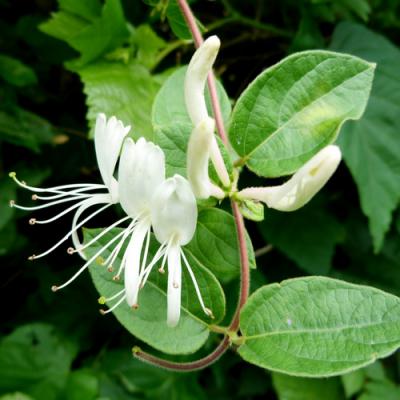
The Flower That Greets You on a Summer Evening
If you have ever walked past a garden wall in June with honeysuckle climbing over it, you already know its scent better than any written description can convey. It is one of those fragrances — like fresh bread or rain on warm earth — that bypasses description and goes directly to memory. Sweet but not cloying, floral but with a green, slightly honeyed edge, honeysuckle is the smell of summer evenings, of childhood gardens, of warmth and ease and the particular pleasure of being outdoors on a beautiful night.
For perfumers, honeysuckle presents an interesting challenge: a flower of extraordinary fragrance beauty that cannot be extracted directly. This has made it, paradoxically, a note that demands creativity — a reminder that some of the most evocative ingredients in fine fragrance are not materials at all, but constructions, carefully assembled approximations that reach toward an ideal they can never quite touch.
The Plant and Its History
Honeysuckle, Lonicera, is a diverse genus of climbing and shrubby plants belonging to the Caprifoliaceae family. With over 200 species and countless hybrids, honeysuckle grows across the Northern Hemisphere — in temperate climates from Europe and North America to China and Japan, where it thrives in hedgerows, woodland edges, and, increasingly, in cultivated gardens where its vigorous growth and extraordinary scent make it a favorite with gardeners.
As a climbing plant, honeysuckle wraps itself around supports with characteristic energy, forming dense twining lianas that can reach 4 to 5 meters in height and spread across 8 to 10 square meters of wall or fence. Some shrubby species are used as ground cover; all are valued for their visual and olfactory appeal. The tubular flowers, which range in color from creamy white to yellow, pink, and orange, have an airy elegance that suggests a delicacy at odds with the plant's vigorous constitution.
Honeysuckle blooms from June to October, depending on species and climate, and its cold tolerance — down to -20°C for hardy varieties — has made it a garden staple across northern Europe. After flowering, the plant produces dark round berries that are, despite their appealing appearance, poisonous.
In traditional Chinese medicine, Lonicera japonica — Japanese honeysuckle — has been used for centuries to treat digestive disorders, skin infections, and inflammation. The flowers are still used in Chinese herbal medicine, where the plant is known as jin yin hua (gold and silver flower), a reference to the way the blooms fade from white to yellow as they mature.
Why Honeysuckle Cannot Be Extracted
The fragrant molecules that make honeysuckle so beautiful on the vine are simply too delicate and volatile to survive conventional extraction methods. Steam distillation — the process used to produce essential oils from more robust materials like lavender or rosemary — would destroy the fragile aromatic compounds. Solvent extraction, which works for some flowers like jasmine and rose, yields too little material from honeysuckle blossoms to be commercially viable. The result: no honeysuckle essential oil exists on the market, and no natural honeysuckle absolute of meaningful quantity is available to perfumers.
This is where one of perfumery's most significant technical innovations comes in. The headspace technique, developed in the 1970s, allows scientists to capture and analyze the volatile compounds emitted by a living flower without cutting or damaging it. A small chamber is placed over the flower, and the air inside — rich with fragrant molecules — is slowly passed over a capture material that absorbs the aromatics. The resulting material is then analyzed by gas chromatography, revealing the chemical identity and relative proportion of every aromatic compound in the flower's emission.
Armed with this chemical map, a perfumer can then assemble a honeysuckle accord from available natural and synthetic materials — choosing molecules that correspond to the most important components of the real thing and combining them in proportions that mirror the original profile. The result is not a copy of nature; it is an interpretation, a perfumer's reading of what makes honeysuckle smell the way it does, translated into an entirely new set of materials.
How Honeysuckle Smells in Perfumery
The character of honeysuckle in fragrance is sweet, white-floral, and luminous, with a jasmine-like quality that reflects the genuine structural similarities between the two flowers' aroma profiles. Honeysuckle is somewhat lighter and less indolic than jasmine — less overtly heady, more fresh and airy, with a gentle honeyed quality and a faint vegetal greenness that keeps it rooted rather than purely abstract.
Depending on the accord used, honeysuckle can lean toward orange blossom (sweeter, slightly citrusy) or toward a more purely floral, almost lactonic quality — warm, creamy, and enveloping. Some accords bring out a citrus brightness that makes honeysuckle feel brisk and energizing; others emphasize its honeyed depth, creating something more intimate and sensual. This makes it a natural star in any floral fragrance collection.
As a primarily top-to-heart note, honeysuckle tends to express itself most fully in the first hours of a fragrance's development, gradually softening into the base as the more volatile molecules evaporate. Its seasonal association with spring and early summer makes it a natural choice for warm-weather fragrances — it simply smells like the right time of year.
Famous Fragrances Featuring Honeysuckle
Honeysuckle's presence in fine fragrance spans decades and categories. Cacharel's Anaïs Anaïs, one of the defining feminine fragrances of the late 1970s, uses honeysuckle as part of its luminous white floral heart — a composition that captures the exact quality of spring light translated into scent. Christian Dior's Diorella incorporates honeysuckle as part of a fresh, chypre-adjacent composition that was ahead of its time.
Estée Lauder's Beyond Paradise and Marc Jacobs' Dot both use honeysuckle to add a sweet floral freshness to modern, accessible compositions. Jo Malone's Honeysuckle and Davana makes the note a protagonist, combining it with the unusual fruity-herbal character of davana and grounding it with rose. Guerlain's Aqua Allegoria collection has used honeysuckle to beautiful effect in its seasonal releases — the note is perfectly suited to that collection's celebration of nature's lighter, more effervescent moments. Our inspired-by Flora Gorgeous Gardenia shares that same luminous, garden-fresh floral spirit.
Yves Rocher went so far as to dedicate an entire fragrance simply to honeysuckle — Chèvrefeuille (the French word for honeysuckle, literally "goat-leaf") — a charming piece of botanical focus in a brand known for its relationship with plants.
What Pairs Well with Honeysuckle
Honeysuckle's jasmine-like quality makes it a natural companion for other white florals: orange blossom, white rose, gardenia, tuberose. Its lighter, fresher character allows it to play the brightening role in compositions where heavier florals might overwhelm. For more on gardenia's role in this white-floral family, see our article on gardenia in perfumery.
Citrus notes — bergamot, grapefruit, neroli — amplify honeysuckle's freshness and create vivacious, summery openings full of energy and light. With green notes — grass, violet leaf, galbanum — honeysuckle contributes an outdoors quality that is naturalistic and appealing. With musky, woody bases — sandalwood, cedarwood, light musks — it settles into something warm and romantic that wears beautifully into the evening, much like our range of women's fragrances designed for exactly this kind of effortless, all-day wear.
The Meaning of the Unreachable
There is something poetic about the fact that honeysuckle, one of the most beloved flower scents in nature, remains beyond direct reach. The plant gives its fragrance freely to the warm evening air; to anyone passing by. But bottle it? That is another matter. The perfumer's solution — the headspace technique, the painstaking reconstruction — is its own kind of art, a tribute to the beauty of a flower that cannot be owned, only approximated.
That approximation, when it succeeds, is one of the most genuinely evocative experiences fine fragrance can offer: the scent of a summer evening, the sense of something fleeting and beautiful, made just permanent enough to carry with you.