

Leather in Perfumery: The Art of Civilised Wildness in 2026
No extract of hide exists, so cuir de Russie is built from birch tar, isobutyl quinoline and Suederal, and 17th-century glove-makers in Grasse first scented leather goods to mask the tanning stench.
By Julia Moretti 8 min read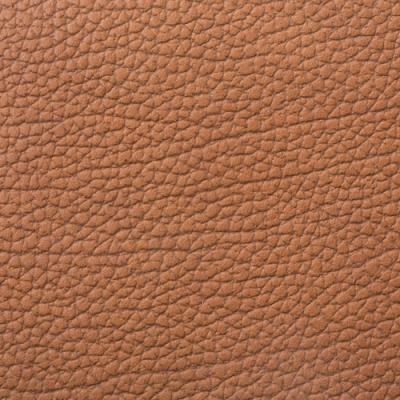
Leather occupies a peculiar position in perfumery. It is one of the most familiar materials in human experience, yet it is also one of the most difficult to capture in fragrance. Walk into a luxury boot shop or a high-end car interior and the scent of leather is immediately and unambiguously identifiable. But the leather note in perfumery is not produced by leather. It is produced by a combination of synthetic and natural materials that together recreate the impression of leather without containing any actual hide. Understanding this distinction is the key to understanding how leather fragrances work, and why some smell convincingly like real leather while others smell like an abstraction that bears only passing resemblance to the source material.
Leather as a fragrance category has been part of European perfumery since at least the seventeenth century. The original use was utilitarian rather than aesthetic: gloves and other leather goods were scented to mask the harsh smell of the tanning process, which used materials like fish oil and animal fat that produced extremely unpleasant odours. The scenting of gloves became a craft in itself, and the perfumers who specialised in this work eventually expanded into producing alcohol-based perfumes that captured the elegance of well-scented leather without requiring the leather to be present.
What Leather Actually Smells Like
Real leather varies enormously by tanning process, treatment, and age, but the most recognisable leather impressions share common elements. There is a slightly smoky, almost tar-like base note that comes from the tanning agents used in traditional leather production. There is a warm, slightly sweet middle that emerges from the natural oils and waxes in the hide. There is a faint animalic top that registers as faintly skin-like, the residual presence of the animal the leather came from.
Different leather types emphasise different elements. Vegetable-tanned leather (from oak bark or chestnut) has a drier, more herbaceous character. Chrome-tanned leather (the modern industrial standard) has a less complex profile and reads more uniformly across products. Aniline-finished leather retains more of the natural hide character. Suede emphasises the soft napped surface effect rather than the structural leather character.
The Chemistry of Leather Accords
The perfumer building a leather accord typically combines several materials in carefully calibrated proportions. Birch tar (Betula pendula) provides the smoky tar-like base that recalls traditional leather tanning. Quinoline and isoquinoline derivatives contribute the slightly bitter, medicinal edge that distinguishes leather from pure smoke. Suederal and related captives produce the soft suede-like effects that more refined leather compositions emphasise. Isobutyl quinoline produces a specific dry, slightly tobacco-like character that appears in many classical leather fragrances.
Castoreum (or its synthetic recreations) provides the animalic warmth that gives leather accords their sense of depth and presence. Labdanum contributes a balsamic-resinous element that bridges the gap between the smoky-tar base and the warm-animalic middle. Various aromatic ketones provide the slightly sweet, almost honeyed quality that emerges in well-aged leather.
Synthetic captives have expanded the leather palette considerably. Materials like Suederal LS, Iso E Super at certain dilutions, and various phenolic compounds allow modern perfumers to construct leather accords with precision that earlier generations could not achieve. The contemporary leather composition typically uses a mixture of natural and synthetic materials, with the natural materials providing complexity and the synthetic materials providing structural reliability.
A Brief History
The history of leather in perfumery begins with the Spanish glove industry of the seventeenth century. Cordovan leather gloves, produced primarily in Spanish cities, were scented with combinations of ambergris, civet, jasmine, and various resins to produce the elegant leather impression that became fashionable across European courts. The French perfumery industry developed its own glove-scenting traditions, particularly in the city of Grasse, which would later become the centre of European fine perfumery.
By the nineteenth century, alcohol-based leather perfumes had become independent products rather than treatments for leather goods. The classical leather perfumes of this period emphasised the smoky-tar base with significant castoreum and ambergris contributions, producing compositions that read as unambiguously masculine in the gendered conventions of the time. Tabac Blond (Caron, 1919) became one of the first leather compositions to be aggressively marketed as a feminine fragrance, challenging the gender conventions and opening the leather category to broader expression.
The twentieth century saw extensive development of leather as a perfumery accord. Cuir de Russie (Chanel, 1924), Knize Ten (Knize, 1924), and Bandit (Piguet, 1944) all explored different facets of the leather territory and established the variations that still define the modern leather category. Contemporary niche perfumery has extended this tradition considerably, with leather compositions exploring increasingly specific and unconventional facets of the broader accord.
Leather in Modern Compositions
The contemporary palette includes many distinct approaches to leather, and the Fragrenza catalogue demonstrates several of the most thoughtful interpretations.
Manhattan Leather
takes the classical leather composition and updates it for contemporary wear. The structure emphasises the warm, slightly smoky character of well-conditioned leather without descending into the heavy tar-and-birch territory that defined some earlier compositions. The result is a leather fragrance that reads as urban and refined rather than rugged or outdoors, suited to professional contexts and modern wardrobes.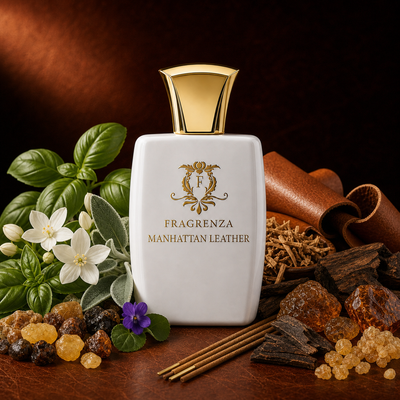
Hunters Smoke
takes the opposite approach, emphasising the smoke and tar elements that connect leather to the broader category of campfire and outdoor materials. The composition foregrounds these facets and uses leather as part of a larger narrative about wilderness and adventure rather than urban refinement. This is leather as character rather than as decoration, and it demonstrates how the same accord can occupy radically different emotional positions depending on architectural emphasis.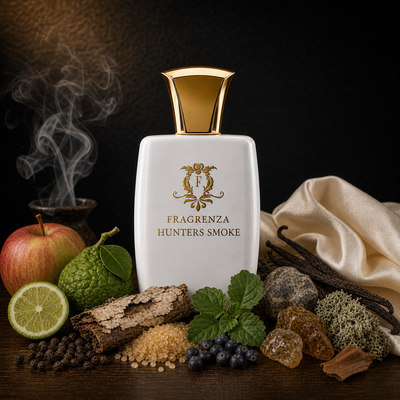
Oud Velluto
uses leather in a different way, as part of an oud-centric composition where the leather facet emerges from the natural overlap between oud and leather materials. The result is a velvety, plush composition where the leather reads as suede rather than as full hide, integrated into the architectural texture rather than appearing as a separate accord. This is leather as integrative material, showing how the broader leather palette can serve compositions that are not primarily about leather at all.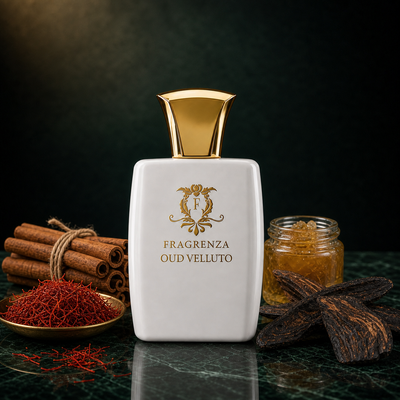
Adjacent Materials and Distinctions
Leather, smoke, tobacco, and oud share significant olfactory territory but emphasise different facets of the broader category. Smoke compositions tend to emphasise the carbon and char of burned materials without the warmer animalic depth of leather. Tobacco compositions emphasise the slightly sweet, slightly fermented character of cured tobacco leaves without the structural hide character of leather. Oud compositions emphasise the resinous, slightly fermented character of agarwood without the animalic warmth that defines leather.
Suede compositions form a sub-category within leather that emphasises the soft, slightly nubby textural character of suede rather than the more structured impression of full-grain leather. Suede materials often produce more wearable compositions because they avoid the heavier tar and animalic elements that can read as challenging in full leather treatments.
How to Wear Leather Compositions
Leather fragrances reward intentional wearing in contexts that suit their inherent character. Professional settings often suit leather compositions because the materials read as confident and sophisticated rather than playful. Cool weather generally suits leather better than warm weather because the slow evaporation allows the deeper materials to develop fully. Evening contexts often work better than daytime contexts for the more intense leather compositions, because the depth of the materials matches the slower pace of evening wear.
Skin chemistry matters significantly with leather compositions. Wearers with warmer skin chemistry will often find leather fragrances developing more intensely than expected, while wearers with cooler chemistry may need to apply more generously to achieve the desired projection. Test leather compositions over several days and varied contexts before forming firm opinions, as the materials behave differently than most other fragrance families.
Related Reads
- Oud in Perfumery: the resinous neighbour to leather
- Tobacco in Perfumery: the cured-leaf cousin to leather
- Incense in Perfumery: smoke and resin alongside leather
- Castoreum in Perfumery: the animalic foundation of leather accords
- How to choose a winter fragrance: where leather fits
- What is niche perfumery: the field that preserved leather seriousness
- Manhattan Leather: urban leather architecture in detail
Frequently Asked Questions
Is leather in perfumery actually made from leather?
No. Leather as a fragrance accord is produced by combining synthetic and natural materials that together recreate the impression of leather without containing any actual hide. The materials typically include birch tar, quinoline derivatives, castoreum or its synthetic recreations, and various aromatic captives. The art of leather perfumery is in producing convincing leather impressions through these proxy materials.
Why does leather in fragrance sometimes smell smoky?
Because traditional leather tanning produces smoky byproducts that get incorporated into the finished hide, and faithful leather accords recreate this smoky character through birch tar and related materials. Compositions that emphasise the smoky element tend to be more traditional in their leather treatment, while compositions that minimise smoke and emphasise the warm-animalic facets produce a more refined modern impression.
What is the difference between leather and suede in a fragrance?
Leather typically emphasises the structural, slightly smoky, slightly animalic character of full hide. Suede emphasises the soft, slightly nubby, more textural quality of napped leather without the heavier facets. Suede compositions tend to be more universally wearable, while full leather compositions deliver more architectural drama at the cost of being more contextually demanding.
Can leather fragrances be worn in summer?
Yes, but with care. Lighter leather compositions emphasising suede or modern leather treatments can work in warm weather, while heavier classical leather compositions usually feel oppressive in heat. The decision depends on which facets the specific composition emphasises and how the wearer responds to leather character in summer contexts.
Are leather fragrances unisex?
Increasingly, yes. The traditional gendered marketing of leather as masculine has largely dissolved in contemporary niche perfumery, where leather compositions are routinely worn across gender lines. Modern leather compositions often deliberately avoid gender signals, and the broader cultural conversation has moved away from the assumption that leather fragrance belongs to any specific gender.
How do I choose between different leather fragrances?
Identify which facet of leather appeals to you most. The smoky-tar facet suits wearers who want narrative drama and outdoor associations. The warm-animalic facet suits wearers who want refined sophistication. The suede facet suits wearers who want softness and approachability. The integrative facet (leather as supporting material in oud or amber compositions) suits wearers who want depth without making leather the dominant statement.
The Bottom Line
Leather is one of the most architecturally rich categories in perfumery, with a tradition stretching from seventeenth-century glove scenting to contemporary niche development. Understanding the materials that build leather accords, the variations within the category, and the contexts where leather compositions perform at their best opens up the full range of what this complex accord can do. The next time you smell a leather fragrance, listen for which facets are emphasised and how the surrounding architecture frames the leather presence.