

Tiare in Perfumery: Tahiti's Sacred Flower and the Scent of Paradise
Gardenia taitensis is the national flower of French Polynesia and the soul of monoi oil, layering coconut warmth, jasmine and ylang into a transparency no other tropical floral achieves.
By Julia Moretti 6 min read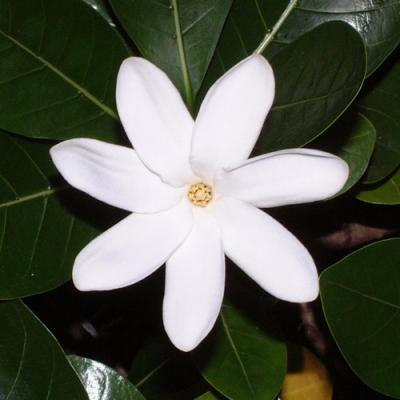
Tiare: The Flower That Smells Like the South Pacific
There is a moment, stepping off a plane at Fa'a'a International Airport in Papeete, Tahiti, when the humid Pacific air carries a scent so vivid and so specific that it immediately becomes associated with arrival, with arrival to somewhere extraordinary. That scent is tiare — Gardenia taitensis, the national flower of French Polynesia — and nothing in the world of fragrance quite replicates the experience of encountering it fresh on the island where it grows.
Tiare is not simply a tropical flower with a pleasant smell. It is a cultural symbol of profound importance, woven into the social fabric of Polynesian life in ways that make it impossible to discuss purely as a raw material. But in the context of perfumery, it is also one of the most prized and sought-after of all tropical florals: a note of extraordinary complexity that combines the sweetness of coconut, the creaminess of gardenia, the tropical lushness of ylang ylang, and a transparency that is entirely its own — a flower that manages simultaneously to be heavy and light, opulent and fresh.
The Scent Profile of Tiare
To smell tiare absolute is to be immediately transported. The first impression is intensely floral — sweet and tropical, with a rich, almost milky quality that distinguishes it from other white florals. Beneath this is a pronounced coconut facet: not the heavy, sunscreen coconut of mainstream resort fragrances, but a more delicate, creamy coconut that suggests the freshly grated flesh of the coconut rather than an oil. There is a jasmine-like quality, a tuberose-like quality, and something entirely its own that resists analogy.
What distinguishes tiare from its botanical relative gardenia is a combination of greater tropical richness and a quality of transparency that prevents the floral from becoming oppressive. Where gardenia can be intoxicating to the point of overwhelming, tiare has a clarity that keeps it wearable and appealing even at higher concentrations. This transparency is one of the reasons it has become so prized in fine fragrance — a tropical white floral that can be used with relative generosity without sacrificing elegance.
The relationship between tiare and gardenia is close enough that the two notes are sometimes conflated in marketing materials, but they are genuinely distinct. Tiare is lighter, more transparent, and has that characteristic coconut-cream quality; gardenia is denser, more waxy, and more intensely floral. Both are extraordinary, but they serve different compositional purposes.
Tiare in Polynesian Culture
The tiare flower has been at the centre of Polynesian cultural and spiritual life for centuries. It is the national flower of French Polynesia and the floral emblem of the Cook Islands. In Tahitian tradition, the tiare is worn as a hair ornament in a specific way that communicates social information: worn over the right ear, it signals that the wearer is available; over the left ear, that they are taken. This tradition reflects the flower's deep association with beauty, love, and human connection in Polynesian culture.
Monoi de Tahiti, the fragrant oil produced by macerating tiare flowers in refined coconut oil, is both a cosmetic preparation and a cultural product of profound significance. Its production is regulated by French law as an appellation d'origine, and the process — macerating the flowers in the oil for a minimum of ten days — results in a product that has been used in Polynesian cosmetics and fragrance for centuries. Monoi is the perfumery world's primary natural source for the tiare note, and its coconut-floral character is the reference point against which all tiare interpretations in commercial fragrance are measured.
Extraction and Aroma Chemistry
The extraction of tiare absolute is technically challenging and expensive. The flowers are delicate and must be processed quickly after harvest to preserve the most volatile and characteristic aromatic compounds. Solvent extraction produces an absolute of remarkable beauty, but the yield is low and the quality highly variable depending on harvesting conditions.
The aroma chemistry of Gardenia taitensis is complex and includes a number of compounds of particular interest to perfumers. Methyl benzoate provides the characteristic sweet, slightly balsamic-floral quality. Various linalool-derived compounds contribute a fresh, floral sweetness. And a range of lactone compounds — the same family responsible for coconut and peach notes in other contexts — are responsible for tiare's distinctive coconut-cream facet. Interestingly, the specific lactone profile of tiare absolute is quite different from that of coconut oil itself, which is why tiare's coconut quality reads as floral and fresh rather than cosmetic and heavy.
In commercial perfumery, the tiare note is typically constructed from a combination of natural monoi absolute, synthetic materials that approximate the flower's characteristic profile, and a careful balance of related white floral compounds (those also found in jasmine, tuberose, and ylang ylang). The result, in the best commercial interpretations, captures the essential quality of the flower with remarkable fidelity.
Tiare in Famous Fragrances
Several important fragrances have built their identity around tiare. Comptoir Sud Pacifique's Vanille Tiare is perhaps the most widely known tiare-based fragrance in the mainstream market, pairing the flower's coconut-cream quality with vanilla in a composition of uncomplicated but genuine tropical sensuality. It is the kind of fragrance that people wear on holiday and continue to wear at home to recapture that experience — a powerful example of fragrance as olfactory memory.
More ambitiously, Bruno Fazzolari's Lampblack uses tiare as part of a complex composition exploring tropical exoticism within a more sophisticated artistic framework. Various niche houses have produced tiare compositions that take the flower in unexpected directions: darker, more resinous interpretations that use tiare's richness as a foundation for more challenging olfactory architecture.
In terms of accessible contemporary fragrances, Flowerbomb by Viktor & Rolf, while not primarily a tiare fragrance, uses white floral materials including tiare-related accords as part of its opulent, sweet-floral composition. And various mass-market tropical fragrances use tiare notes as a key component of their holiday-sun aesthetic, demonstrating the note's extraordinary commercial appeal even in simplified form.
Note Interactions: Tiare's Natural Partnerships
Tiare's tropical richness makes it a natural companion for other warm, sensuous materials. Its most obvious partnership is with coconut — an enhancement of its already-present coconut facet that can range from subtle to full-on tropical depending on the desired effect. The tiare-coconut combination is the olfactory expression of a Polynesian beach, and it is enormously appealing in the context of summer and vacation fragrances.
With vanilla, tiare becomes creamy and warm, a gourmand-tropical combination that is deeply comforting without losing the flower's distinctive transparency. With sandalwood, tiare takes on a creamy, milky richness that is very appealing in skin-close, intimate compositions. And with musk, tiare produces a warm, sensuous skin scent that is among the most appealing and universally wearable in the tropical floral category.
More interesting combinations involve tiare with ylang ylang — a powerful tropical floral pairing that requires careful handling to avoid becoming overwhelming, but that at the right balance creates a composition of extraordinary tropical richness. And tiare with certain green or watery materials can produce a fresh, clean tropical accord that is ideal for hot weather and light, daytime wear.
Tiare in the Fragrance Wardrobe
Tiare fragrances are, quintessentially, warm-weather and tropical-context scents. They perform best in summer, on holidays, and in settings where their sunshine-soaked, sun-cream-adjacent character is contextually appropriate. Wearing a tiare fragrance in a cold-weather, indoor context can feel dissonant — the flower's tropicality is so specific that it carries strong associations of place and season that are difficult to overcome.
For the fragrance enthusiast, tiare offers an entry point into the broader world of tropical white florals — a category that also includes tuberose, frangipani, and gardenia, and that represents one of the most sensuous and emotionally charged registers in the entire fragrance spectrum. The floral fragrance collection offers a number of compositions in which tropical florals including tiare play a significant role, from the simplest and most accessible to the most complex and ambitious. For those yet to encounter tiare in a serious fragrance context, the experience is genuinely revelatory — a flower that captures something of the specific quality of paradise, and carries it wherever you wear it.