

Ylang-Ylang in Perfumery: The Tropical Floral That Seduces and Surprises
Cananga odorata from the Philippines and Indonesia supplies banana, custard, rubber and tropical green facets, and the early-morning extraction sits inside Chanel N 5, Joy and Arpege.
By Julia Moretti 7 min read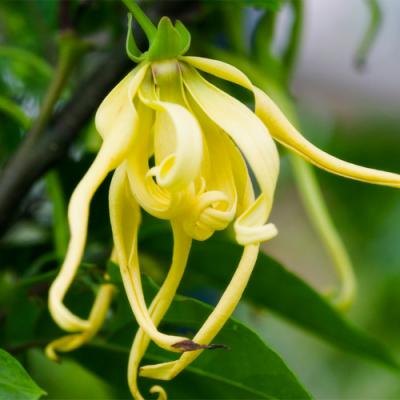
The Flower of Flowers
Its name translates from Tagalog as “flower of flowers,” and anyone who has encountered ylang-ylang in full bloom would find that description entirely apt. The scent of ylang-ylang (Cananga odorata) is one of the most intensely floral in nature — rich, creamy, and voluptuous, with facets that range from banana and custard to rubber, jasmine, and tropical greenness. It is also one of the most challenging notes in perfumery: too much and it becomes cloying, narcotic, even nauseatingly sweet; used with restraint and skill, it adds an incomparable tropical lushness that cannot be replicated by any other ingredient.
Ylang-ylang has been central to some of the greatest fragrances ever created. It is a key component of Chanel N°5 — arguably the most famous perfume in history — where it contributes to the floral heart alongside rose and jasmine in a way that adds depth and complexity without revealing itself obviously. It appears in Joy by Jean Patou, Arpege by Lanvin, and countless other twentieth-century classics. Understanding ylang-ylang means understanding why perfumers keep returning to this demanding, complicated flower despite the challenges it presents.
Origins and Cultural History
The ylang-ylang tree is native to the Philippines, Indonesia, Malaysia, and northern Australia, where it grows rapidly in tropical conditions and flowers year-round. The flowers are unusual: long, drooping, yellow-green petals arranged in a star shape, highly fragrant especially in the early morning hours when the essential oil content is highest. Traditionally, across the Philippines, Indonesia, and the Pacific Islands, ylang-ylang flowers were used in personal adornment, strewn on wedding beds as a symbol of sensuality and beauty, and incorporated into medicinal preparations.
Commercial cultivation for perfumery began in the nineteenth century, initially in the Philippines and later expanding to the Comoros Islands, where it found conditions that proved ideal for the highest-quality oil production. Today, the Comoros archipelago — a small island nation off the eastern coast of Africa — supplies approximately 80 percent of the world's ylang-ylang oil used in perfumery, making it one of the most important fragrance-producing regions in the world despite its small size. The relationship between the Comoros economy and the global perfume industry is intimate and significant: ylang-ylang is the islands' principal cash crop.
The distillation process for ylang-ylang is technically sophisticated and produces oils of distinctly different qualities. Flowers are distilled in stages, and the oil obtained at each stage is separated and graded. The first fraction, Extra or Extra Superior, is the finest and most expensive, with the most complex, transparent floral character. Subsequent fractions — Grade I, II, and III — become progressively heavier and less refined in character. A complete ylang-ylang oil is produced by blending all fractions. Most fine perfumery uses Extra grade or a blend of Extra and Grade I to achieve the desired floral richness without the harshness of the heavier fractions.
The Chemistry of Ylang-Ylang's Complex Scent
Ylang-ylang oil contains over 100 identified chemical compounds, making it one of the most chemically complex natural aromatic materials. The dominant molecules vary by grade and origin but typically include benzyl acetate (contributing the sweet, jasmine-like floral character), linalool (providing floral-herbal lift, also found in lavender and bergamot), geranyl acetate (adding a rosy-fruity facet), and p-cresyl methyl ether, which is responsible for the rubbery, slightly animalic facet that can tip ylang-ylang into challenging territory.
The banana and custard facets that many people associate with ylang-ylang come from isoamyl acetate and related esters, which create a creamy, slightly fermented fruitiness beneath the floral. Eugenol, also found in clove, contributes a subtle spicy-woody warmth. Farnesol adds a fresh, greenish quality that counterbalances the heavy floral and fruity elements. It is this combination of florality, creaminess, fruitiness, spice, and rubber that makes ylang-ylang both complex and difficult to manage at high doses — a single note that already contains the bones of an entire fragrance composition.
The relationship between ylang-ylang and jasmine is partly molecular: both contain benzyl acetate and linalool, which is why they are often described as sharing a tropical, white floral character despite being botanically unrelated. This shared molecular language also explains why ylang-ylang and jasmine blend so naturally, each amplifying the other's tropical floral intensity while also moderating some of each other's more challenging facets.
Ylang-Ylang in Iconic Fragrances
Chanel N°5 is the obvious starting point for any discussion of ylang-ylang in great perfumery. Ernest Beaux's creation for Gabrielle Chanel in 1921 combined May rose, jasmine absolute, and ylang-ylang with the newly developed aldehydes in a way that was completely unprecedented — the floral bouquet amplified and lifted into an abstract, shimmering radiance. Ylang-ylang's contribution to N°5 is the creamy, slightly exotic warmth that lies beneath the floral brightness, providing depth and a hint of the sensual that the cooler aldehydes and rose alone could not achieve.
Joy by Jean Patou (1930), long billed as the world's most expensive perfume, is built around an extravagant use of rose and jasmine with ylang-ylang providing tropical richness and depth. Lanvin's Arpege deploys ylang-ylang in a similarly central role. In the second half of the twentieth century, ylang-ylang appeared throughout the great oriental and floral oriental traditions, adding tropical dimension to compositions built on rose, jasmine, musk, and sandalwood.
In contemporary fragrance, Flowerbomb by Viktor & Rolf uses ylang-ylang as part of its floral explosion, where the tropical richness of ylang-ylang adds depth to the rose-jasmine-freesia accord and keeps the composition from feeling merely sweet. Black Opium by YSL incorporates ylang-ylang in its white floral coffee accord, where its creaminess melds beautifully with the coffee's roasted sweetness. In the niche world, ylang-ylang is frequently used to add tropical tension to floral compositions that might otherwise feel predictable.
Masculine and gender-neutral fragrances also exploit ylang-ylang, often as a subtle modifier rather than a featured note. The tropical floral warmth of ylang-ylang at low concentrations can add an intriguing depth to woody or aromatic compositions, a faint exoticism that is felt rather than consciously identified. Bleu de Chanel uses ylang-ylang as part of its complex floral-woody structure, where it contributes to the overall richness without being individually apparent.
How Ylang-Ylang Interacts with Other Notes
Ylang-ylang's most harmonious partnerships are with rose and jasmine, the two great white florals with which it forms the foundational accord of so many classic feminine fragrances. The three together create a tropical bouquet of extraordinary richness, each amplifying the others' florality while the combination becomes greater than the sum of its parts. Rose provides the refined, green-floral elegance; jasmine the indolic, white-floral warmth; ylang-ylang the creamy, exotic tropical dimension.
Ylang-ylang and sandalwood is one of the classic sensual pairings. The creamy, milky warmth of sandalwood embraces ylang-ylang's tropical florality, softening its more challenging aspects while amplifying its richness. The result is intensely feminine and warm — a pairing that has defined luxury Asian-inspired perfumery from classic Guerlain orientals to contemporary niche compositions. With patchouli, ylang-ylang creates a deep, earthy tropical accord — the combination most associated with the great floral oriental tradition of the 1970s and 1980s, simultaneously exotic and sensual.
Ylang-ylang interacts productively with musk, which grounds and extends its florality while adding an intimate, skin-like quality to the composition. The ylang-ylang-musk accord is a staple of modern feminine fragrance, appearing across commercial and niche productions as a way of creating warm, enveloping, approachable florals with genuine depth. With bergamot and citrus notes, ylang-ylang creates a tropical punch accord — the combination of fresh citrus brightness with creamy floral richness that suggests tropical fruit cocktails in the best possible sense.
Ylang-Ylang and Your Fragrance Wardrobe
Ylang-ylang is a warm-weather and evening fragrance note par excellence. Its tropical richness intensifies in heat and blooms most beautifully at body temperature, making it particularly compelling in spring and summer. The note's associations with sensuality, seduction, and lush tropical environments make it a natural choice for evening wear and intimate occasions — it carries a quiet but unmistakable voluptuousness that is hard to ignore.
For daytime wear, ylang-ylang works best in small doses as part of a complex composition, where its intensity is modulated by other notes. Fragrances where ylang-ylang appears as a supporting element rather than the lead are more versatile and generally more wearable across contexts. If you find ylang-ylang heavy or overwhelming at first encounter, it is worth seeking out fragrances where it appears in this supporting role before attempting the more full-throated ylang-ylang-forward compositions. The floral fragrance collection offers many opportunities to explore ylang-ylang across this spectrum, from transparent background notes to richly dominant tropical florals. Once you learn to recognize it, ylang-ylang becomes one of the most exciting and unmistakable signatures in the fragrance vocabulary.