

The Best Oud Fragrances: A Guide to Perfumery's Most Precious Ingredient
Indian oud leans dark and barnyard, Cambodian sits sweeter, Borneo refines toward green-woody, and Japanese kyara stays the most delicate of them all.
By Julia MorettiFragrenza makes several of the alternatives featured in our guides — here’s how we test.
12 min read
Oud doesn’t smell like one thing. That’s the first thing to understand. The material is a contradiction held in a single resin: animalic and refined, smoky and sweet, woody and medicinal, ancient and somehow always modern. Most fragrance materials announce themselves cleanly — vanilla is sweet, jasmine is heady, citrus is bright. Oud arrives in layers, and what you smell in the first ten minutes is rarely what’s still on your skin twelve hours later.
That layered character is also why oud has held its place at the top of perfumery for over a thousand years — longer than any of the categories cycling through Western fragrance trends. Understanding it isn’t optional for anyone serious about scent. It’s the deepest, most prestigious, and most rewarding category in the perfumer’s palette, and 2026 is the year it has finally moved from connoisseur territory into mainstream wear.
What oud actually smells like
The base of oud is woody, but it’s a wood unlike sandalwood, cedar, or vetiver. There’s a warmth that approaches body heat — a leather-adjacent quality some perfumers describe as “skin-like” because it reads as alive rather than inert. Underneath the warmth is smoke, the kind that comes from old incense rather than open flame. Around the smoke is a thread of sweetness, sometimes honeyed, sometimes resinous. And somewhere in the middle — the part that loses people on first wear — is a medicinal undercurrent that can feel barnyard before it learns to feel luxurious.
Origin shapes the oud you’re smelling. Indian oud, especially from Assam, leans dark and animalic, with that barnyard depth pushing forward. Cambodian oud is sweeter and more honeyed, easier to wear without context. Borneo and Malaysian oud sit between the two — woody, slightly green, refined. Japanese kyara is the most prized and the most delicate, a quiet wood reserved historically for incense rather than perfume. Modern Western perfumery uses cultivated rather than wild oud, which is cleaner, more consistent, and easier to compose with — but the soul of the material is the same.
The other thing worth knowing: oud is a base note. It sits low in the composition and develops slowly. The fragrance you smell at hour one and the fragrance you smell at hour eight are not the same wear — they’re two stops on a long arc. Judging an oud composition in the first ten minutes is like judging a novel by the back-cover blurb.
Why oud has lasted (and why it’s bigger than ever in 2026)
Oud is the only fragrance material that has been continuously prestigious for a thousand years. It was burned in mosques across Arabia and Persia centuries before European perfumery existed in any recognizable form. It appears in Sanskrit texts, in Chinese imperial archives, in the Quran’s account of paradise. It has been a symbol of luxury, hospitality, spirituality, and elevated taste across more cultures and more centuries than almost any other natural ingredient.
That history is part of what gives oud its present-day weight. When Western niche perfumery picked up oud in earnest in the early 2000s — Yves Saint Laurent’s M7 in 2002, the wave of niche oud houses that followed through the 2010s — it wasn’t introducing something new. It was finally interpreting something that had been sophisticated elsewhere for a thousand years. That depth of tradition is hard to manufacture and impossible to fake, which is part of why oud has held its place as Western gourmands, fruity-florals, and clean musks have cycled through their seasons.
What’s different in 2026 is the audience. Oud was once a niche-of-the-niche pursuit, the territory of fragrance obsessives chasing Indian agarwood oils on specialist forums. It is now mainstream — driven partly by men’s growing interest in richer, more characterful fragrances (the so-called smellmaxxing wave), partly by the broader luxury-fragrance moment that has pulled extrait concentrations and niche houses into ordinary consumer awareness. Oud is no longer the test-your-palate option. It’s what people reach for when they want to be taken seriously by their own nose.
The six facets of oud — what you’re actually smelling
If oud is a contradiction, the way to understand it is to take it apart. What follows are the six facets the best oud compositions emphasize, sometimes in combination, sometimes one at a time. Most people respond to two or three of them strongly and find the others harder to love. Knowing which is which is how you learn to choose oud well.
Animalic
The animalic facet is the warmth — that leather-and-skin quality that reads as alive. In poorly made oud compositions it can feel like a costume; in well-made ones it feels like the fragrance is sitting half a centimeter under the skin rather than on top of it. Modern oud-forward fragrances often soften this facet to make the material more wearable.

Smoky and incense-adjacent
Smoke is what links oud to its incense lineage. The smoke in good oud is dry, slightly bitter, more like a smoldering resin than a campfire. Pair it with frankincense, myrrh, or labdanum and you have what the trade calls “temple oud” — a meditative, almost sacral wear.
sits firmly in this territory: smoky woods, incense, oud, and patchouli built around a dark tropical core. It’s a fragrance that asks for a longer evening, an unhurried context, and rewards both.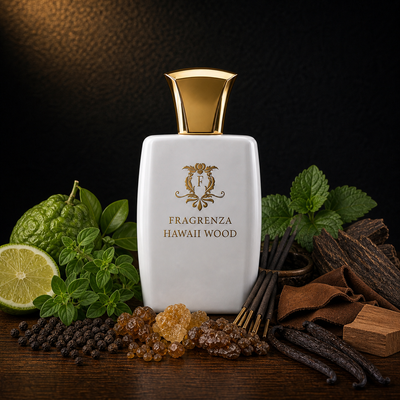
Sweet and saffron-adjacent
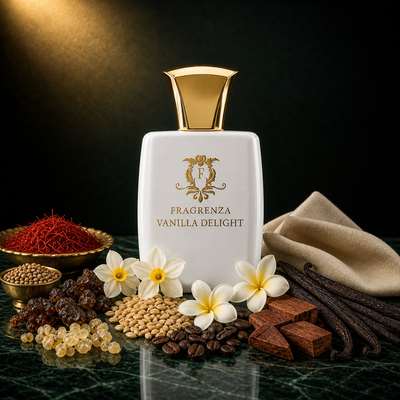
Sweetness in oud isn’t sugar — it’s the honeyed-resinous lift that comes from saffron, dates, amber, or warm spice. The saffron-oud accord is one of the genre’s defining structures: saffron’s leather-and-honey character mirrors oud’s, doubling and deepening it. Extrait concentrations in this style have driven much of the 2026 luxury-fragrance momentum.
Rose-oud (the classical luxury accord)
Rose is oud’s classical partner. Pair them and you get the most legible expression of luxury in modern perfumery — the rose-oud accord that defined the niche-luxury 2010s and remains a permanent fixture of the genre.
is the house’s rose-oud composition: dark glamour, rich evening, the kind of fragrance designed to be noticed when noticed and ignored when ignored. It’s not subtle, and it shouldn’t be — rose-oud isn’t a daytime mode.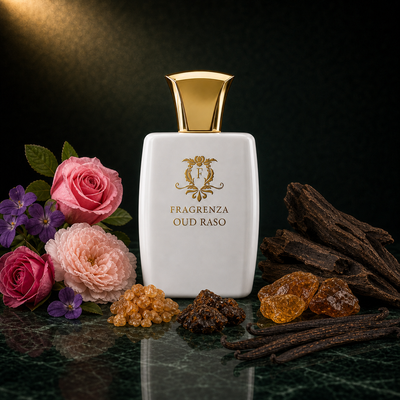
Dark fruit (the modern direction)
The newer angle, less classical and more 2020s, pairs oud with dark fruit — plum, fig, blackberry, sometimes raspberry. The fruit’s sweetness softens oud’s medicinal edge while preserving its depth.
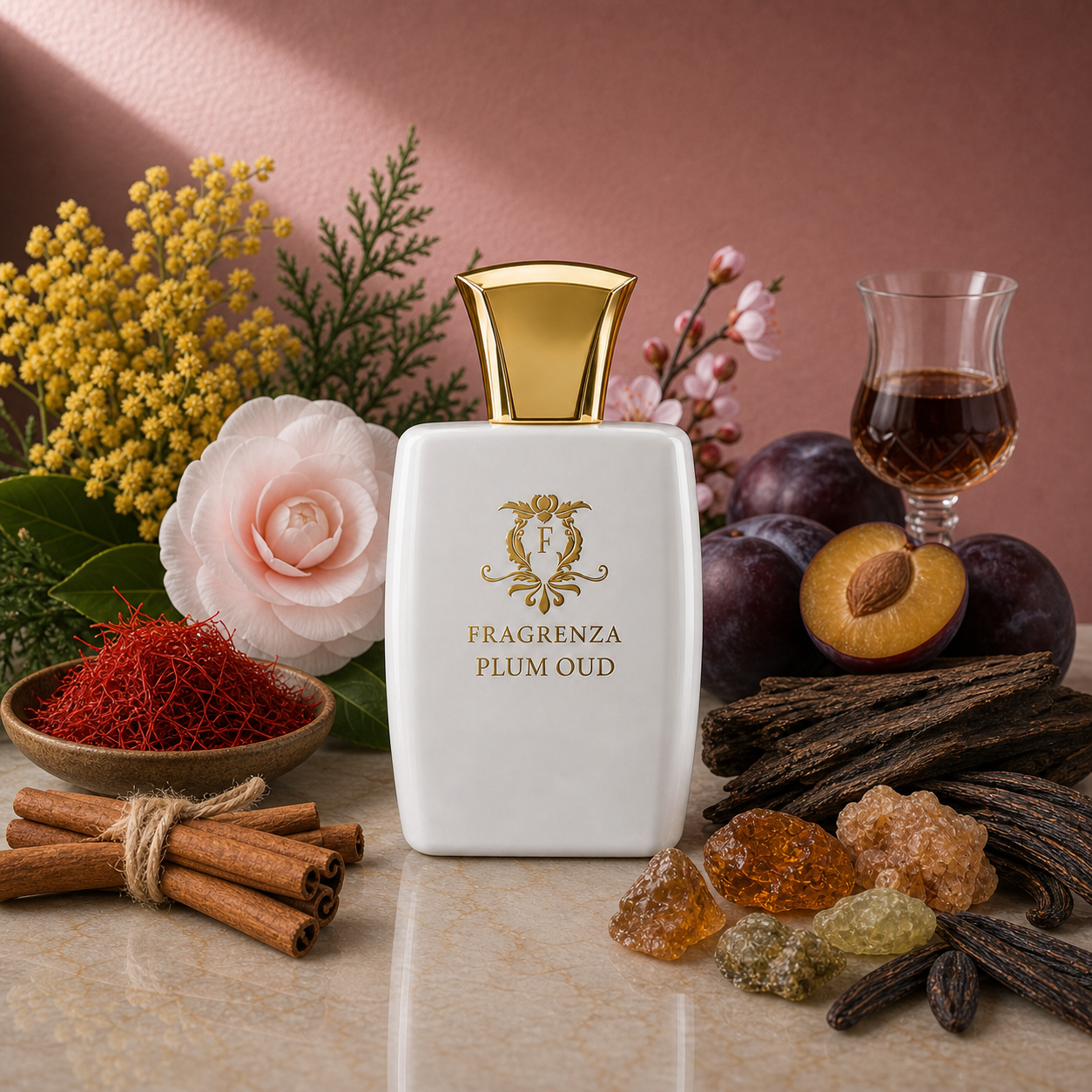
is the cleanest example of this idea: plum, oud, and a sensual woody-fruit base that reads as evening without reading as old-world. Fans of dark gourmands and fruity-orientals find this an easier route into oud than the more traditional rose-oud or temple-oud expressions.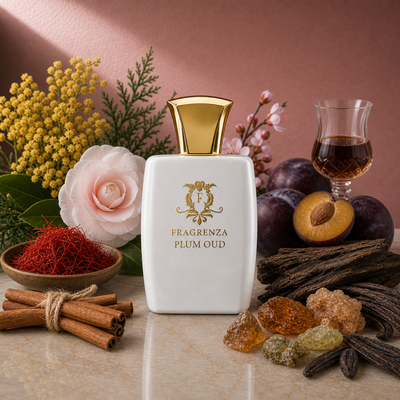
Medicinal
The medicinal facet — that camphor-and-eucalyptus thread that comes through in unbalanced oud compositions — is the one most beginners flinch at and most enthusiasts learn to love. It’s also the one that signals you’re smelling real or carefully-imitated oud rather than a generic woody base. Most modern Western compositions tame this facet substantially; the traditional Middle Eastern oud-attar tradition embraces it as the mark of authenticity. There’s no specific Fragrenza pick to recommend for this facet alone — the goal is to recognize it when you encounter it, and to understand that what reads as harshness on first sniff is, in trained noses, the signature of the real material.
Who wears oud, and when
The lazy answer is that oud is a winter, evening, special-occasion fragrance — and there is some truth to that. Oud’s warmth, density, and projection do best in cooler air and long-form contexts where the wear has room to develop. A summer afternoon at a barbecue is not where oud thrives.
But the real answer is more interesting. Oud is wearable any time you want a fragrance with weight — meaning you want to be taken seriously, want the wear to last, want the impression to outlive the conversation. It works for evenings out, but it also works for board meetings, for quiet dinners, for the kind of day where the fragrance is for you rather than for the room. Modern, refined oud compositions have softened the genre enough that the old “oud is for special occasions only” rule no longer holds. They wear comfortably in ordinary contexts and reveal themselves as the day moves into evening.
The honest constraint is volume. Oud projects, and a heavy hand is the most common mistake. Two sprays — one on the neck, one on the wrist — is enough for most compositions. Three is the maximum even on the deepest winter day. If you can smell yourself through your collar, the room can smell you through the door.
How to layer oud
Oud layers more readily than most heavy categories because its complexity gives layering partners room to add rather than fight. Three directions to know.
Sweet-dark. Oud + vanilla is the most universal layering pairing in the line. The vanilla softens oud’s medicinal edge while doubling its warmth; the oud keeps the vanilla from reading as gourmand-only.
Concentrated evening. When you want oud at its most evening-glamorous, layer dark fruit and rose-oud.
underneath creates a fragrance that reads as deeply niche — plum lifting the rose, both compositions pulling toward each other in the base. The full framework lives in our pillar on layering fragrances like a perfumer.Smoky counterbalance. The third move is the smoky-incense direction — for readers who find rose-oud too floral and dark-fruit-oud too gourmand.
holds this territory on its own, but it also layers beautifully under a thin spritz of any vanilla-forward composition; the vanilla rounds the smoke without softening the wood. This is a winter-evening combination, not a daytime choice.How oud fits a fragrance wardrobe
Most fragrance wardrobes need at least one oud, even if it’s not the everyday wear. The reason is structural rather than aesthetic: oud occupies a position no other category does, and a wardrobe without it is missing a register. For the broader picture of how to plan around this, see our complete guide to building a fragrance wardrobe in 2026.
If you’re choosing a single oud, pick the part of the genre you respond to most. Modern, soft, refined? The animalic-but-approachable end. Dark glamour? The rose-oud end. Smoky-temple? The incense-and-patchouli end. Dark-fruit-oud? The newer, more wearable end. Sweet-spice and saffron-adjacent? The gourmand-leaning end. There is no wrong answer, only the answer that matches what you wear oud to do. The five facets above each have a Fragrenza scent built around them; the right one is whichever facet you keep returning to in this article.
Related reads
If you’re going further into oud or its adjacent categories, these will help: our map of the most popular perfume notes of 2026 for the broader context, the 2026 trends hub for where oud sits in this year’s wave, the extrait trend explainer for why concentration matters in this genre, and the smellmaxxing piece for the men’s-audience angle that has driven much of oud’s recent mainstream momentum.
Frequently asked questions
What does oud actually smell like?
Oud is woody, animalic, smoky, slightly sweet, and sometimes medicinal — all at once. The base is a dark wood with a leather-and-skin warmth; over it sits dry smoke, honeyed sweetness, and a camphor-medicinal thread that reads as challenging on first wear and as the mark of authenticity to trained noses. Origin shapes the balance: Indian oud is darker and more animalic, Cambodian sweeter, Japanese lighter and more meditative.
Why is oud so expensive?
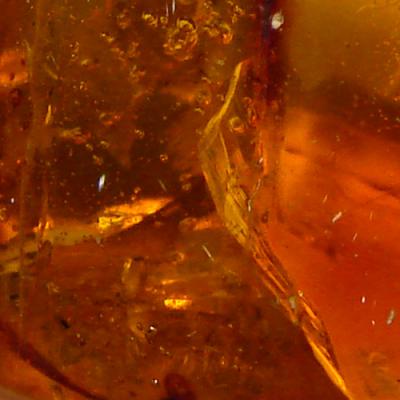
Oud forms only when an Aquilaria tree is infected by a specific mold, which triggers the tree to produce protective resin called agarwood. The process can take decades, only a small percentage of trees produce the resin, and harvesting it destroys the tree. Wild agarwood is now severely overharvested and CITES-protected, so the finest oud oils sell by the gram at prices that rival gold. Cultivated oud is more affordable but still expensive relative to almost any other natural fragrance material.
Is oud only for evening or special occasions?
It used to be. Modern, refined oud compositions like rose-oud and green-musk-oud have softened the genre enough that you can wear oud comfortably in ordinary contexts — work, dinners, daytime in cooler weather. The old “oud is winter-evening-only” rule applies more strictly to traditional Arabic-style attars; contemporary Western oud compositions are more flexible. Volume is the real constraint, not occasion.
What is the difference between oud and agarwood?
They’re the same thing. “Agarwood” is the English name for the resinous wood; “oud” (or “ud”) is the Arabic name. “Oud oil” specifically refers to the distilled essential oil; “oud” in fragrance descriptions can refer to the oil, an accord built to imitate it, or a synthetic equivalent. Most modern Western compositions use accords or cultivated oud rather than wild-harvested oils.
How long does oud last on the skin?
Longer than almost any other category. Oud’s molecular weight is high, which is why it’s a base note: it sits on the skin for ten to fourteen hours in most compositions, and traces of it can survive twenty-four hours, particularly on a fabric. This is one of the practical reasons oud is associated with luxury — the longevity is structural, not a marketing claim.
Is rose-oud or smoky-oud easier for a beginner?
Rose-oud, generally. Rose softens oud’s medicinal edge and provides a familiar floral anchor that gives new wearers something to recognize. Smoky-oud and traditional Arabic attars have steeper learning curves because they push the more challenging facets — animalic warmth, dry smoke, medicinal camphor — to the front. Start with rose-oud or modern green-oud, then move toward smokier territory once your nose has calibrated.
Can men and women both wear oud?
Oud is one of the most genuinely unisex categories in modern perfumery. The traditional Middle Eastern oud-attar culture is unisex by default; Western interpretations have often gendered oud-rose as feminine and oud-leather as masculine, but those associations are conventions, not rules. The contemporary fragrance audience is moving back toward the unisex framing, which is the more accurate one.
What perfumes layer well with oud?
Vanilla is the universal partner — it softens oud’s medicinal edge while doubling its warmth. Rose pairs with oud as a classical luxury accord. Saffron amplifies oud’s honeyed-resinous side. Dark fruit (plum, fig) modernizes it. Smoky woods like patchouli and incense extend its temple-incense lineage. Avoid layering oud with sharp citrus or aquatic notes — the contrast tends to feel inharmonious rather than complementary.
The long view
Oud has outlasted every fragrance trend of the last thousand years and will outlast the trends of the next thousand. That permanence is the most important thing to understand about it. You are not learning to wear a season’s note — you are learning a category that will be available, prestigious, and rewarding for the rest of your life. The investment of attention pays compounding interest, and there is no better time than now to start.