

Best Fig Fragrances 2026: Five Fig-Adjacent Registers from Philosykos to Skin Scent
Ficus carica is too watery for steam distillation, so the contemporary fig accord is constructed from Givaudan's stemone, leaf lactones and coconut-almond materials that read as one tree.
By Julia MorettiFragrenza makes several of the alternatives featured in our guides — here’s how we test.
13 min read
Fig is one of the most quietly distinctive notes in fine perfumery. The Mediterranean fig tree (Ficus carica) offers multiple olfactory registers at once — the milky-green sap of the leaves and branches, the sun-warmed sweetness of the ripe fruit, the cool-green character of the fig flower, and the creamy-woody quality of the bark. Quality fig perfumery captures the contradictions: simultaneously fresh and creamy, vegetal and edible, summer-bright and shadow-cool. The category opened with 1994's L'Artisan Premier Figuier and 1996's Diptyque Philosykos and continues as one of the most respected niche-floral registers in contemporary fine fragrance.
For the conceptual deep-dive on fig as a perfumery material, our Fig in Perfumery educational pillar covers the chemistry and the cultural history in depth. For the broader lactonic-floral context that fig anchors, our iter-22 Best Lactonic Fragrances 2026 pillar is the companion piece — fig's creamy-milky facet comes from the same lactone family that defines the lactonic register. This article is the dedicated fig buyer's edit.
What fig actually is in fine perfumery
Fig is one of the materials in fine perfumery where natural extraction effectively does not exist. The fruit is too watery for steam distillation; the leaves can be extracted but yield only a fraction of the aromatic complexity the perfumer needs. The note as we encounter it in fine fragrance is therefore almost entirely a constructed accord — built from synthetic and natural materials that capture different facets of the fig tree experience.
Three structural elements anchor the contemporary fig accord. Fig leaf materials — gamma-octalactone and gamma-decalactone applied at light concentration — contribute the green-milky character of the sap and leaf. These are the same lactone family that defines the broader lactonic register, which is why fig sits naturally alongside coconut, milk, and gardenia in the lactonic-floral cluster. Stemone (Givaudan's distinctive synthetic) carries the cool, slightly grassy character of the leafy fig branch. Coconut and almond materials — gamma-nonalactone and benzaldehyde — supplement the milky-creamy facet of the ripe fruit. Together these molecules build what perfumers and fragrance enthusiasts recognize as "fig" — a contradictory accord that reads as fresh and creamy simultaneously.
Two additional materials matter for the broader fig register. Cedarwood and sandalwood provide the bark-and-trunk dimension that distinguishes fig-tree compositions from fig-fruit compositions. Bergamot, grapefruit, and other Mediterranean citrus bridge the fig character into citrus-aromatic territory that captures the southern-European cultural register the note evokes.
The cultural arc — from Premier Figuier to contemporary niche staple
Fig perfumery is essentially a contemporary commercial category. Three moments matter most.
1994: L'Artisan Parfumeur Premier Figuier. Olivia Giacobetti's groundbreaking composition was the first commercial fig fragrance — a delicate, almost watercolor rendering of a sun-warmed fig tree. Premier Figuier introduced fig as a serious perfumery direction and remains influential more than thirty years later. Giacobetti returned to fig in 1998 with the related Premier Figuier Extreme.
1996: Diptyque Philosykos. Olivia Giacobetti again, this time for Diptyque. Philosykos became the genre-defining fig composition — a more complete fig-tree experience with the leaves, the bark, the fruit, and the green sap all captured. Philosykos remains the canonical fig reference and has anchored Diptyque's commercial success across three decades. Every subsequent fig composition is measured against it.
2005-2026: niche expansion. The contemporary niche fig category expanded substantially after the Diptyque moment. Marc-Antoine Barrois Tilia (2022) folded fig leaf into a Mediterranean-cologne register. Replica Beach Walk uses fig as a luminous beach-coded counterpoint to coconut. The lactonic wave of 2020-2026 (covered in our Best Lactonic Fragrances pillar) returned fig to commercial attention through its natural lactone chemistry, which sits inside the lactonic register the wave defines.
A note on Fragrenza and the fig register
Fragrenza does not currently market a literal fig composition — no product in the 180-item catalog uses fig as a structural material per its official product description. The picks recommended in the archetype sections below are therefore fig-adjacent compositions: scents that occupy the same green-creamy, milky-vegetal, Mediterranean-summer registers that draw people to fig perfumery, without making any compositional claim to contain fig itself.
This is the same §16.2-honest framing approach used in our Best Pistachio Perfumes guide (Fragrenza also does not market a literal pistachio composition). For wearers who specifically want a literal fig fragrance, the canonical commercial options remain Diptyque Philosykos and L'Artisan Premier Figuier; for those drawn to the underlying mood, the Fragrenza picks below capture register-adjacent experiences at accessible pricing.
For the focused brand-dupe edit on Diptyque Philosykos specifically, see our Best Diptyque Filosykos Dupes guide.
Five fig-adjacent registers and their closest Fragrenza picks
Each direction maps a facet of the fig-tree experience to a Fragrenza composition that occupies the same olfactory register through different materials.
1. Creamy-woody fig (the Philosykos lactonic register)
The most fig-canonical of the five archetypes. The creamy-milky character of fig leaf paired with sandalwood and a soft woody base — the register that Philosykos defined and that most contemporary lactonic-floral compositions inhabit. Reads as comforting, intimate, summer-warm. The closest Fragrenza match through different materials:
— sandalwood, tuberose, iris, violet, papyrus, amber, cedar, musk, and patchouli. The creamy sandalwood base produces the same lactonic-wood register that defines the Philosykos creamy-fig experience; the tuberose and violet add the floral-green facets that fig perfumery often emphasizes. While the composition contains no fig itself, the underlying lactonic-creamy-wood mood is closely related. The most universally-wearable entry point into the fig-adjacent register.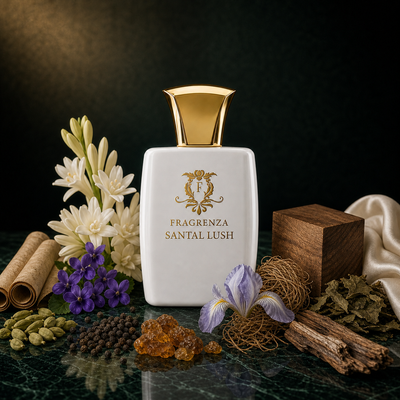
2. Fresh-green fig (the leaf-and-sap register)
The bright daytime archetype. The cool, slightly grassy character of fig leaves and stems paired with citrus and a clean musk base — the register that L'Artisan Premier Figuier and the lighter Diptyque compositions occupy. Reads as luminous, daytime-friendly, summer-coded. The closest Fragrenza match through different materials:
— bergamot, grapefruit, lemon, cranberry, lavender, jasmine, violet, lily of the valley, amber, vanilla, leather, and patchouli. The citrus opening and aromatic-fresh heart capture the bright-green register that fresh fig compositions occupy; the wear stays luminous without overwhelming. The right pick for fig-curious wearers who lean toward daytime aromatic compositions.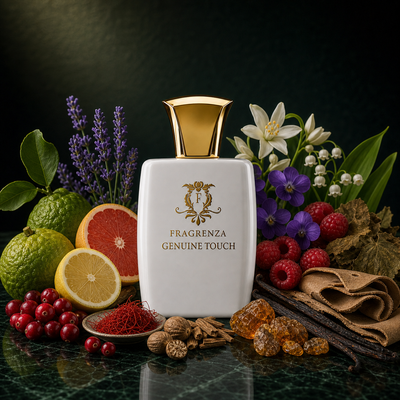
3. Warm-aromatic woody fig (the Mediterranean register)
The autumn-evening archetype. The warm wood-and-leaf character of late-season fig tree, paired with aromatic spice and a soft resinous base — the register that several niche compositions have explored in the 2010s and 2020s Mediterranean-evening tradition. The closest Fragrenza match:
— pink pepper, juniper, bergamot, black pepper, Atlas cedarwood, thuya, sandalwood, patchouli, and vetiver. The cedar-and-pepper opening over the resinous-woody base captures the warm Mediterranean fig-tree mood; the wear is meditative and slow-evolving. The fig-adjacent register for wearers drawn to cooler-weather aromatic-woody compositions.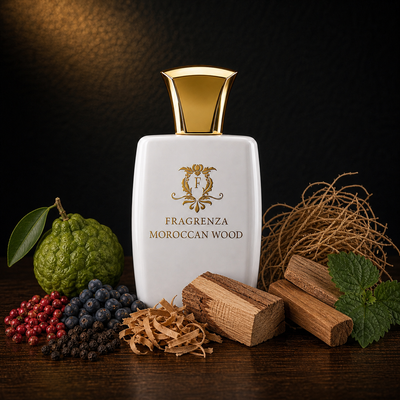
4. Clean-musk fig (the skin-scent crossover register)
The contemporary skin-scent archetype. The cool-green facets of fig paired with clean musks and soft white wood — the C9 Skin Scents 2.0 crossover register. Reads as personal, intimate, daily-wear flexible. The closest Fragrenza match:
— orange blossom, lemon, rose, geranium, rosemary, lavender, nutmeg, coriander, cardamom, lychee, tonka bean, teak wood, sandalwood, vetiver, and musk. The clean-musk base with bright-aromatic opening produces the lightest, most skin-close fig-adjacent register — the entry point for wearers who want fig's freshness without commitment to a full fig composition.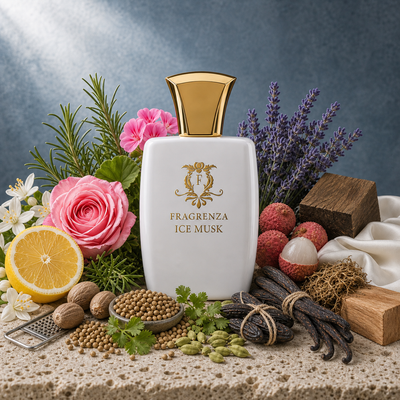
5. Fresh-rose fig (the spring-floral register)
The spring-floral archetype. The dewy-green character of fig leaves paired with rose petals and a soft musk base — a delicate spring register where fig's vegetal freshness lifts and supports a floral heart. The closest Fragrenza match:
— May rose, Turkish rose, Bulgarian rose, turmeric, Sichuan pepper, patchouli, and tonka bean. The triple-rose composition with its slight spicy-Sichuan pepper character produces a spring-floral register that fig-adjacent wearers often appreciate; the wear is daytime-friendly and luminous.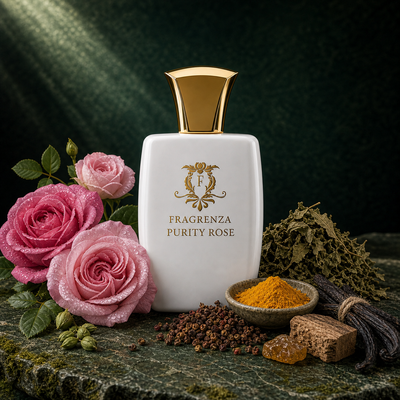
How fig fragrances wear on skin
Fig compositions — including the fig-adjacent register that the Fragrenza picks above occupy — wear specifically. Three patterns worth knowing.
Fig amplifies in warmth. The lactone chemistry that defines fig perfumery interacts strongly with body heat — fig compositions read brightest and most multi-dimensional in warm weather, where the leaf-sap and ripe-fruit facets concentrate. In high cold the same compositions can read flat. This is the opposite of how oud or amber behave.
The opening can mislead. Quality fig compositions transition between a green-sharp opening (the leaf and sap facets, plus the citrus that often supports them) and a creamy-lactonic dry-down (where the ripe-fruit and milky-wood facets emerge). Many wearers reject fig on the opening and miss the heart-to-base register where the magic lives. Give fig compositions at least 60 minutes on skin before judging.
Skin chemistry shapes the wear. The lactone facets interact with natural fatty acids in skin similarly to how they do in coconut and milk-cream lactonic compositions. See the skin chemistry deep-dive for the full mechanism.
When and how to wear fig
The fig register is fundamentally spring-and-summer territory with a partial autumn extension. The fresh-green and clean-musk archetypes (Genuine Touch and Ice Musk registers) are warm-weather daytime wears. The creamy-woody and warm-aromatic archetypes (Santal Lush and Moroccan Wood registers) handle autumn evening contexts. The fresh-rose archetype (Purity Rose register) is spring-flexible. Fig is one of the few notes that does not concentrate in winter — the cool-weather lactonic register belongs to coconut, vanilla, and the heavier lactonic compositions covered in our Best Lactonic Fragrances pillar.
For application, fig rewards moderate volume. Two sprays is appropriate for most fig-adjacent compositions; one for the heaviest creamy-woody compositions. For the broader wardrobe framework, our wardrobe pillar covers how fig fits alongside other green and lactonic families.
How to layer fig-adjacent compositions
Three reliable layering patterns work within the fig-adjacent register.
Pattern 1: fig-adjacent over a clean musk base. Spray a clean musk on pulse points first, then apply the fig-adjacent composition over it. The musk extends the dry-down and lifts the green-creamy character — particularly useful for the fresh-green and clean-musk archetypes during warm-weather daily wear.
Pattern 2: fig-adjacent + vanilla pulse points. Apply the fig-adjacent composition to chest and wrists, then a small amount of pure vanilla to inner elbows. The vanilla blooms into the lactonic dry-down without overwhelming the green-vegetal facets. Particularly effective for the creamy-woody and fresh-rose archetypes.
Pattern 3: fig-adjacent + coconut sequencing. For wearers who own a coconut-lactonic composition (see the iter-22 lactonic pillar's coconut tropical archetype), layering coconut first and fig-adjacent over produces a layered wear that captures something close to the Replica Beach Walk fig-and-coconut summer register at home.
Anti-pattern: do not layer fig-adjacent under heavy oriental or oud compositions. The dense base would bury the delicate green character. For the broader layering framework, our layering pillar covers the principles.
Building a fig-adjacent rotation
A two-bottle setup covers most use cases — one fresh-green pick for warm-weather daytime (Genuine Touch) and one creamy-woody pick for autumn-evening (Santal Lush). A three-bottle rotation adds the clean-musk crossover (Ice Musk) for daily skin-scent wear. A five-bottle rotation covers all five archetypes.
The fig register pairs naturally with the iter-22 Best Lactonic Fragrances pillar (fig is one of the canonical lactonic-floral materials through its leaf-lactone chemistry), the Mediterranean-cologne register (see the broader Best Neroli Fragrances for the neroli-cologne neighborhood), and the green-floral cluster (Best Jasmine and the White Florals hub).
Who each pick is for
If you want the creamy-woody Philosykos register through sandalwood: Santal Lush.
If you want the fresh-green leaf-sap register through aromatic citrus: Genuine Touch.
If you want the warm-aromatic Mediterranean register through cedar and pepper: Moroccan Wood.
If you want the clean-musk skin-scent crossover register: Ice Musk.
If you want the spring-floral fig-rose register: Purity Rose.
If you specifically need a literal fig fragrance: Look at Diptyque Philosykos or L'Artisan Premier Figuier — neither is a Fragrenza composition. For the focused Diptyque Filosykos brand-dupe edit, our dedicated guide is the next read.
If you're not sure where you sit: The Fragrenza sample pack covers the full range — three-day testing on skin is the only way to discover which fig-adjacent register your chemistry amplifies.
Frequently asked questions
What does fig smell like in perfume?
Simultaneously green, milky, slightly woody, and softly fruity. The fig accord is unusual in capturing multiple registers at once — fresh and creamy, vegetal and edible. Quality fig compositions deliver all these facets in balance; weak compositions reduce fig to a single dimension (usually the creamy-sweet) and lose what makes the material distinctive. The character reads brightest in warm weather and on body-warmed skin.
What is the difference between fig leaf and fig fruit in perfumery?
Fig leaf accords lean green, sharp, slightly milky — built from stemone and supporting green-leaf materials. Fig fruit accords lean creamy, sweet, lactonic — built from gamma-octalactone and gamma-decalactone with coconut-and-almond support. Most contemporary commercial fig compositions blend both registers, but the balance differs: Philosykos leans toward the full fig-tree experience including the bark, while Premier Figuier emphasizes the delicate leaf-and-sap character.
Does Fragrenza make a literal fig perfume?
No — the current 180-product catalog does not include a composition that uses fig as a structural material per its official product description. The picks recommended in this guide are fig-adjacent compositions that occupy the same green-creamy, lactonic-woody, or Mediterranean-summer registers that draw people to fig perfumery, through different aromatic materials. For wearers who specifically need a literal fig fragrance, Diptyque Philosykos and L'Artisan Premier Figuier remain the canonical commercial options.
Is fig a feminine or masculine note?
Fully unisex. The fig register is one of the most genre-fluid in fine perfumery — neither over-feminine sweet nor over-masculine smoky. Both Philosykos and Premier Figuier are marketed as unisex, and the fig-adjacent register the Fragrenza picks above occupy is similarly unisex-coded. Treat fig and fig-adjacent gender marketing as a starting point rather than a constraint.
How long do fig fragrances last on skin?
Moderate. Six to eight hours is typical for literal fig compositions and for most fig-adjacent picks. The fresh-green archetype wears slightly shorter (4-6 hours); the creamy-woody archetype wears longer (7-10 hours on cool-weather skin). Layering with a clean musk base extends most fig-adjacent compositions by an additional 1-2 hours.
Can fig fragrances be worn in winter?
The creamy-woody archetype (Santal Lush register) handles cool-weather contexts well. The fresh-green archetype reads thin in cold and is better saved for spring through autumn. The warm-aromatic Mediterranean archetype (Moroccan Wood register) is the most cool-weather-flexible fig-adjacent direction. Fig is fundamentally a warm-season note; the lactonic register the broader iter-22 Best Lactonic Fragrances pillar covers is the better cool-weather analog.
What is the best fig fragrance for beginners?
For literal fig: Diptyque Philosykos is the canonical entry point — accessible, genre-defining, and broadly wearable. For fig-adjacent within the Fragrenza catalog: the creamy-woody register (Santal Lush) is the most universally-wearable entry point because the sandalwood-driven lactonic character is closest to Philosykos's mood through different materials. Start with one of those two, learn how your skin amplifies the lactonic and green facets over a season, and decide whether to explore deeper into the fig register or pivot toward the broader lactonic family.
The bottom line
Fig is one of the most architecturally distinctive note families in fine perfumery — a contradictory accord that captures green and creamy, fresh and warm, vegetal and edible all at once. The five fig-adjacent archetypes give you a Fragrenza-catalog map across the registers that draw people to fig perfumery, even though the catalog itself does not market a literal fig composition. For a literal fig fragrance, Diptyque Philosykos or L'Artisan Premier Figuier remain the canonical references; for the underlying mood at accessible pricing, the Fragrenza picks above span the range.
For the broader lactonic-floral context that fig sits inside, the Best Lactonic Fragrances 2026 pillar is the companion piece. For the Diptyque Filosykos brand-dupe edit specifically, our dedicated guide covers that angle.