

What Is Clean Fragrance? The 2026 Guide to What It Means and Whether It Matters
Phlur and Henry Rose publish actual exclusion lists; everyone else uses the term as decoration above what IFRA already requires.
By Julia MorettiFragrenza makes several of the alternatives featured in our guides — here’s how we test.
16 min read
Walk into any beauty retailer in 2026 and you will see the word clean on bottles, shelves, signage, and brand decks. It promises something between transparency, safety, and gentle modernity. It rarely tells you anything specific. There is no governing definition of what makes a perfume clean, no regulatory body that certifies the claim, and no shared list of ingredients that brands have agreed to exclude. Clean fragrance is a marketing category that has tried, with mixed success, to become a meaningful product standard.
That does not mean the term is empty. There are real differences between brands that adhere to a published exclusion policy and brands that simply use the word as decoration. There are real consumer concerns the movement responds to. And there are also a fair number of safety claims dressed in scientific language that do not survive close scrutiny. This guide explains what clean fragrance actually means in 2026, what is true about the safety conversation, what is mostly marketing, and how to evaluate a clean claim before you buy.
For the related question of how clean fragrance differs from skin scents (a category often confused with it), see the companion guide on clean perfumes vs. skin scents.
Where the clean fragrance movement came from
Clean fragrance is the perfumery extension of clean beauty, the broader cosmetic-industry movement that emerged in the early 2010s. The original framing was straightforward. A first wave of skincare and makeup brands argued that mainstream cosmetics contained materials of questionable safety and that consumers deserved better-disclosed alternatives. They published exclusion lists, marketed transparency, and built a category that has since become a default expectation in cosmetics.
The fragrance industry was slower to follow. Fine fragrance had its own well-developed safety framework via the International Fragrance Association (IFRA), which issues binding restrictions on materials and concentrations across the global perfumery industry. Most fragrance materials of genuine concern had already been restricted or banned through the IFRA process. There was, by the standards of cosmetics generally, less obvious work for a clean movement to do.
The fragrance brands that emerged anyway built their positioning around a different combination of values: ingredient transparency, the elimination of materials the IFRA process permitted but consumers preferred to avoid, sustainable sourcing, ethical production, and a softer, more wearable aesthetic that distinguished them from the projection-forward designer mainstream. By Rosie Jane, ELLIS BROOKLYN, Phlur, Skylar, Sana Jardin, Henry Rose, Heretic, and the early Glossier You all sat in this register. Some leaned harder on the safety angle, some on the sustainability angle, some on the simplicity-and-wearability aesthetic.
By the early 2020s the clean perfume label had become a recognizable shelf category, particularly in North America, with strong traction in retailers like Sephora and Credo Beauty. By 2026 the label appears across niche, designer, and mainstream perfumery. What it specifically guarantees, however, depends entirely on the brand using it.
What clean fragrance brands typically exclude
The exclusion list varies brand to brand because there is no shared standard, but the most common categories are reasonably consistent across the movement.
Phthalates. Specifically diethyl phthalate (DEP), commonly used as a fragrance fixative and solubilizer. Most clean brands exclude it. Some research has raised endocrine-disruption concerns about phthalates broadly, although DEP at fragrance-relevant concentrations has been extensively studied and the European Commission's safety assessments have not flagged it as a meaningful exposure risk. Excluding it is a defensible precautionary choice; the science does not support a more dramatic claim.
Parabens. Used as preservatives. Most clean brands exclude parabens despite their long safety record because consumer preference has shifted decisively against them. The endocrine-disruption concerns frequently cited about parabens are real for some compounds in the family but have been overstated for the specific parabens used at cosmetic concentrations. Excluding them is again precautionary rather than scientifically required.
Synthetic musks (selectively). Older nitromusk compounds (musk xylene, musk ketone) have been phased out globally for decades because of bioaccumulation concerns. Some clean brands extend the exclusion to current polycyclic musks (Galaxolide, Tonalide), which have a different and considerably better safety profile but still face consumer skepticism. The current macrocyclic musks (Habanolide, Velvione, Cosmone) are not flagged by any current safety body and are used in nearly every modern fragrance, including most clean ones.
Certain UV filters. Materials like benzophenone derivatives appear in some perfumes for stability reasons. Clean brands generally exclude them.
Allergens at high concentrations. The EU has a list of 26 fragrance allergens that must be declared on cosmetic labels above a threshold concentration. Some clean brands go further and exclude or sharply limit these materials regardless of dose.
Animal-derived materials. Some clean brands also overlap with vegan positioning and exclude any animal-derived material (castoreum, ambergris, civet) as well as the synthetic musks that have historically replaced them.
What you cannot rely on, given the absence of a shared standard, is the specific contents of any individual brand's exclusion list. Two brands marketing themselves as clean may have substantially different formulation rules. Read the brand's own published policy if the specifics matter to you.
What is true about clean fragrance safety
The honest reading of the safety evidence is that mainstream fine fragrance, including conventional designer perfumes, is already among the most heavily regulated cosmetic categories in the world. The IFRA framework restricts hundreds of materials by maximum concentration across product types, EU cosmetic regulation requires declaration of 26 specific allergens above defined thresholds, and the major fragrance houses (Givaudan, Firmenich, IFF, Symrise, Mane, Robertet) maintain their own internal safety processes that go beyond regulatory minimums. The materials of genuine concern from earlier eras (lyral, oakmoss above certain concentrations, several lilial-family materials, the original nitromusks) have been progressively removed.
What clean brands typically add on top of this is precautionary exclusion of materials that meet IFRA standards but have generated consumer concern. This is a reasonable response to the demand for an extra margin of caution, particularly for wearers with sensitivities, but it is not a response to a documented safety problem in conventional perfumery.
Where clean fragrance does deliver real value: for wearers with specific allergies or sensitivities, the published exclusion list lets you verify in advance that a problematic material is not present. For wearers who simply prefer to know what is in their perfume, the transparency itself has value independent of any safety calculus. For wearers who care about sustainable sourcing or animal-derived material avoidance, the clean category often overlaps with brands that prioritize those things explicitly.
What clean fragrance does not reliably deliver: a measurably safer wear experience for the average user, or a meaningful reduction in any documented health risk relative to a well-formulated conventional perfume. Both are essentially safe under current regulation. The difference is precautionary, not protective.
Sustainability and the broader clean conversation
Several clean brands have moved beyond the original exclusion-list framing into broader sustainability positioning: refillable packaging, reduced-alcohol or alcohol-free formats, fair-trade botanical sourcing, carbon-neutral production claims, and so on. This is a meaningful expansion of what the label can mean, and for many wearers the sustainability angle is more concrete and verifiable than the safety angle.
The format question is interesting in its own right and increasingly tangled with clean positioning. Alcohol-free, oil-based, and bi-phase fragrances have built genuine momentum on the back of the clean fragrance moment, and a number of clean brands now produce both conventional EDP and oil-based or solid versions. The argument for these formats is partly about skin sensitivity and partly about projection profile (oil-based fragrances tend to wear closer to the body), and it is partly an aesthetic alignment with the broader clean visual identity.
Refillable packaging is the most defensible sustainability claim available within the clean fragrance category. It reduces glass and plastic waste meaningfully, requires no compromise on formulation, and is becoming standard among the more committed clean brands. If sustainability is the value driving your purchase, refillability is more concrete than ingredient-policy claims and worth weighting in the buying decision.
The clean fragrance aesthetic
Beyond the formulation question, clean fragrance has produced a recognizable aesthetic register. Soft florals (rose, jasmine, magnolia, peony) often handled in transparent rather than opulent treatments. Light citruses and herbs (bergamot, neroli, basil, mint). Soft musks of the modern macrocyclic kind, used to create a clean-skin character. Warm but restrained gourmand notes (vanilla, almond, coconut) handled lightly rather than as full gourmand pillars. Materials like ambrette seed, ambroxan, and Iso E Super used at concentrations that read as soft and transparent rather than dominant.
The wear pattern that results is often, though not always, skin-close — which is where the conflation with the skin scent category enters the picture. Many clean fragrances are skin scents in the perceptual sense (low projection, intimate halo, second-skin character). Many skin scents are not particularly clean. The two terms describe different axes, even though they often appear together in the same bottle.
For a Fragrenza fragrance that demonstrates the soft transparent register that clean perfumery has popularized,
sits in clean-musk territory with bergamot and orange-blossom freshness on top, a quiet aromatic and spiced heart, and a soft musk dry-down. The composition is built around the same kind of clean-skin clarity that defines much of the clean-fragrance aesthetic.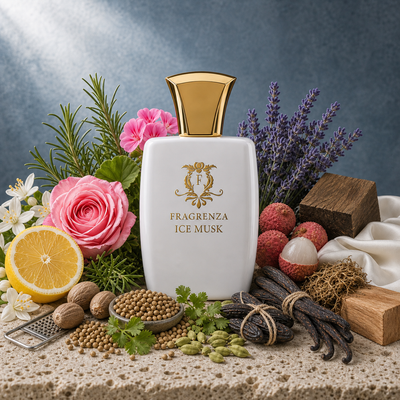
How to evaluate a clean fragrance claim
If you are weighing whether to buy into a brand's clean positioning, the questions worth asking are surprisingly concrete.
Does the brand publish a specific exclusion list? Brands that take the label seriously publish what they exclude and at what threshold. If the brand uses clean in marketing without specifying what that means, the claim is decorative. Brands like Phlur, Henry Rose, Sana Jardin, and By Rosie Jane publish detailed standards. Many mainstream brands using the language do not.
Does the brand list ingredients? Full ingredient transparency, including the fragrance constituents, is a stronger signal than a vague clean claim. Some brands publish the ingredient list openly; others provide it on request; others rely on the fragrance trade-secret exemption to disclose only "fragrance" or "parfum" on the label.
Are there third-party certifications? COSMOS, EcoCert, EWG Verified, Cradle to Cradle, and similar certifications are issued by independent bodies with defined standards. These provide more reliable assurance than self-applied marketing language. Not every clean brand pursues them; some legitimately have their own equivalent rigor without seeking certification. But where certifications are present, they meaningfully strengthen the claim.
What does the formulation actually contain? If a brand has published an exclusion list and the ingredient list, you can verify that the exclusions are honored. This is the only way to confirm a clean claim with certainty.
What is the wider sustainability story? Refillable packaging, sustainable sourcing programs, transparent supply chain, ethical labor practices in botanical farming. These are concrete and verifiable in ways that ingredient-policy claims sometimes are not.
For a fragrance that holds up well across both the clean aesthetic and the modern Skin Scents 2.0 register,
illustrates how the soft-transparent and depth-of-composition can coexist: black currant and pink pepper open the composition, iris and orange blossom in the heart, a base of patchouli and dark chocolate that adds weight without abandoning the wear-close character.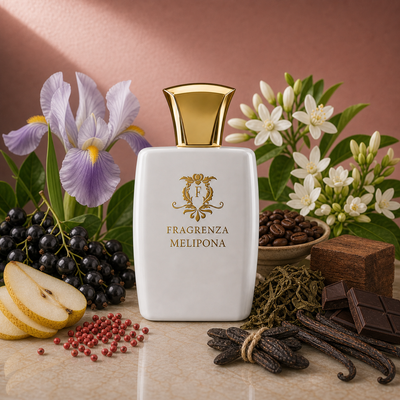
For wearers who want a transparent, masculine register that fits the clean aesthetic without the sometimes-unisex softness of contemporary skin scents,
uses bergamot, grapefruit, and lemon up top with cranberry and lavender, a heart of saffron, nutmeg, jasmine, and violet, and a base of amber, vanilla, and soft leather. The composition is precise, transparent, and built to wear close to the body without losing definition.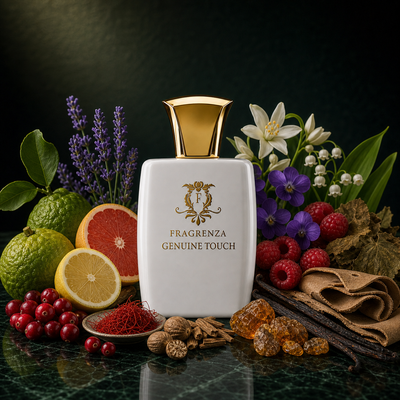
When clean fragrance genuinely matters
The clean fragrance label matters most for wearers with specific sensitivities, allergies, or skin conditions where the published exclusion list lets you verify in advance that a known trigger is not present. If you have a documented allergy to a specific allergen, a brand that publishes its full ingredient list and follows a strict exclusion policy is materially more useful than a conventional brand that does not disclose its full formulation.
It also matters for wearers who are pregnant or nursing and want to err on the precautionary side. Most fine fragrances are safe in these states under any current evaluation, but many wearers feel more comfortable using fragrances with simpler, more transparent formulations during pregnancy. The clean category fits this preference well even though the safety calculus is more nuanced than the marketing implies.
And it matters for wearers whose values align with the broader clean and sustainability movement. Buying from brands whose practices reflect your priorities (animal-derived material avoidance, refillability, supply-chain ethics, transparent ingredient policies) is itself a legitimate purchasing reason that does not require any safety claim to justify.
For a warm, gourmand-leaning Fragrenza pick that demonstrates how the modern register can be richly textured without the volume of conventional gourmand perfumery,
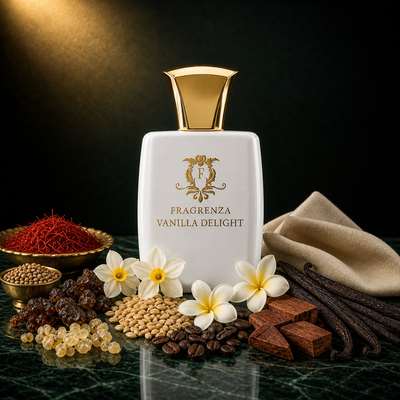
For wearers drawn to the more meditative, refined end of the clean aesthetic,
sits in soft sandalwood-amber territory with cardamom, violet, and iris through the opening and heart, and a base of creamy sandalwood, soft musk, patchouli, and warm cedar. The composition is restrained without being minimal, and it wears with the kind of quiet confidence that the clean register has made its signature.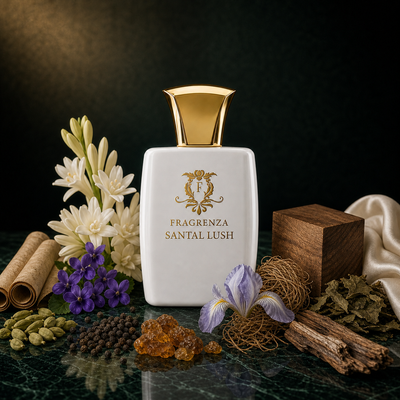
When the clean label is mostly marketing
The label is least meaningful when used by brands that have not published an exclusion list, do not disclose their ingredients, do not pursue certification, and do not have a wider sustainability story. In this case the word is doing aesthetic work — signaling a soft, transparent, modern aesthetic — without backing the claim with formulation specifics. There is nothing wrong with the aesthetic itself; many of these fragrances are well-made and worth wearing. The point is simply that the clean language in this context is not telling you anything specific about the formulation.
The label is also less meaningful when the brand defines clean narrowly enough that conventional designer perfumery would mostly meet the standard. If a brand's clean policy excludes only materials already restricted under IFRA, the policy is essentially equivalent to conventional formulation and the clean positioning is largely cosmetic.
The discriminating buyer asks: what specifically is this brand doing differently? If the answer is "we publish our exclusion list and it goes meaningfully beyond IFRA," the claim is doing real work. If the answer is "we say we are clean," the claim is decoration.
Related reads
- Clean Perfumes vs. Skin Scents: What's Actually the Difference
- What Are Skin Scents? The Complete Guide for 2026
- Skin Scents 2.0: Musk, Ambroxan, and Iso E Super
- Alcohol-Free Perfumes: Worth the Hype?
- The Best Fragrances for Sensitive Skin
- How to Build a Fragrance Wardrobe
FAQ
Is there a regulatory definition of clean fragrance?
No. There is no government or industry-wide standard that defines what makes a perfume clean. Each brand applies its own exclusion policy, and the policies vary substantially. The closest things to standards are third-party certifications like COSMOS, EcoCert, and EWG Verified, which do have defined criteria, but the word clean on a bottle does not by itself signal compliance with any external standard.
Are conventional designer perfumes unsafe?
No. Mainstream fine fragrance is regulated through IFRA, which restricts hundreds of materials by concentration across product types, and through EU cosmetic regulation, which mandates allergen disclosure above defined thresholds. Materials of genuine concern from earlier perfumery have been progressively removed. The choice between conventional and clean perfumery is largely a question of precautionary preference, transparency values, and aesthetic alignment, not a question of safety in any documented sense.
Does clean fragrance mean natural fragrance?
Not necessarily. Many clean fragrances are heavily synthetic, including the synthetic musks, ambroxans, and woody captives that anchor most contemporary skin-close compositions. Natural materials, including jasmine absolute, oakmoss, and certain citruses, are themselves potent allergens that appear on restriction lists for good reason. Clean does not equal natural; the categories overlap but are not the same.
Should I switch to clean fragrance if I have sensitive skin?
It depends on what specifically triggers your skin. If you have a documented allergy to a specific material, a brand with a published exclusion list and full ingredient disclosure lets you verify that the trigger is not present, which is more useful than a generic clean claim. If you have generalized fragrance sensitivity, the lighter formulations typical of clean perfumery may be easier to wear, but conventional fragrances at lower application levels can also work. The four-hour wear test on your own skin is more diagnostic than any label.
Are synthetic musks safe?
The synthetic musks used in contemporary fine fragrance (the macrocyclic family including Habanolide, Velvione, Cosmone, and Ambrettolide) are extensively studied and not flagged by any current safety body. The older nitromusks (musk xylene, musk ketone) were phased out decades ago. The intermediate polycyclic musks (Galaxolide, Tonalide) have a longer safety record than the recent macrocyclics, and there is some divergence between brands on whether they are excluded under clean standards. The honest answer is that current synthetic musks have a strong safety profile and are responsible for much of what most wearers love about modern perfumery.
Is clean fragrance better for the environment?
Sometimes. The most defensible environmental claims in the clean category come from refillable packaging, fair-trade botanical sourcing, and reduced-emission production. The ingredient-policy framing is less environmentally meaningful because the materials clean brands exclude are not generally a documented environmental concern at fragrance-use concentrations. If sustainability is your reason for considering clean fragrance, look at the packaging and supply-chain story rather than the exclusion list.
What is the best way to choose a clean fragrance?
Start with what specifically matters to you (a particular allergy, a sustainability priority, an aesthetic preference for soft transparent compositions) and then evaluate brands on whether they meet that specific need. A brand that publishes its exclusion list, discloses its ingredients, and pursues third-party certification is more credible than one that uses the language without backing it up. Sample before buying, give the fragrance four hours on your skin, and judge the result on actual wear rather than label claims.
The honest summary
Clean fragrance is a real category with real value, but the value is more concentrated in some uses than others. For wearers with specific sensitivities, for those who want full ingredient transparency, for those whose values align with sustainable production, the label can be doing meaningful work. For everyone else, the label is more aesthetic than protective; conventional fine fragrance under current regulation is already safe in any documented sense, and the clean choice is precautionary rather than necessary.
Read the brand's actual policy. Check the ingredient list. Look for third-party certification when it matters. And recognize that the wear pattern (whether the fragrance is a skin scent, projecting, soft, or full-bodied) is independent of the clean status — the two questions live on different axes, and treating them as the same will lead to disappointed purchases. For the comparison-focused breakdown of those two axes, the clean vs. skin scent guide covers the ground specifically.
Clean fragrance, used carefully, can be a useful filter on a perfume purchase. Used uncritically, it is mostly mood lighting. The difference is in whether you ask the brand what specifically the word means before you commit.