

Clean Perfumes vs. Skin Scents: What's Actually the Difference
Clean fragrance defines itself by what a brand chooses to exclude, while skin scent describes how a perfume actually behaves on the body, which is why the two labels collapse on the same shelf.
By Julia MorettiFragrenza makes several of the alternatives featured in our guides — here’s how we test.
14 min read
If you have spent any time browsing fragrance over the last few years, you have almost certainly seen the same two words used as if they meant the same thing: clean and skin scent. Both promise something modern, soft, and wearable. Both have moved from niche curiosities to mainstream marketing in less than a decade. And both are, quite frequently, used to describe the same bottle on the same shelf.
But they are not the same thing. They are not even on the same axis. One is a description of how a fragrance was made and what it claims to leave out. The other is a description of how a fragrance behaves on skin once it is worn. You can have a clean fragrance that announces itself across a room. You can have a skin scent built almost entirely from synthetics that no one would call clean. Telling the two apart is the first step to choosing what actually fits the way you want to smell.
This guide untangles the two ideas, explains where the overlap is real and where it is purely a marketing trick, and walks through how the modern Skin Scents 2.0 generation is rewriting both categories at once.
The two ideas, defined
Clean fragrance is a category defined by ingredient policy. It refers to perfumes formulated to exclude a specific list of materials a brand has decided are undesirable, often phthalates, certain UV filters, parabens, certain preservatives, sometimes synthetic musks, sometimes animal-derived materials. The list varies brand to brand because there is no regulatory definition of clean in fragrance. It is a marketing term. Whether a perfume is clean depends entirely on whose definition you accept.
Skin scent, by contrast, is a perceptual category. A skin scent is any fragrance that wears close to the body, smells like an enhanced version of clean skin, and creates a quiet halo of intimacy rather than a projecting cloud. The defining feature is how it behaves: it sits on you, not around you. People often have to lean in to catch it. The materials used to achieve this can be anything, natural or synthetic, regulated or not, simple or technically complex.
The difference matters because one of these terms is about ethics and ingredient transparency, and the other is about wearing experience. They can coexist in a single bottle, and they often do. They can also be entirely separate. A heavy oriental built from natural absolutes can be sold as clean if it meets a brand's exclusion list. A linear sandalwood-musk built from lab-developed captives can be a textbook skin scent without claiming any clean credentials at all.
Why the two terms got tangled
Clean fragrance, as a movement, emerged in the late 2010s alongside clean beauty more broadly. The first wave of brands leaned heavily into transparency, simple compositions, and a deliberate aesthetic of restraint. Soft florals, single-note focuses, transparent musks, and a kind of stripped-down cleanness in both the formula and the message. Glossier You, By Rosie Jane, ELLIS BROOKLYN, Phlur, Sana Jardin, the early Skylar releases. These fragrances looked clean, smelled gentle, and stayed close to the skin.
That last detail is what created the confusion. Because so many of the early clean perfumes happened to be soft, low-projection, second-skin compositions, the broader public started using clean and skin scent as synonyms. A fragrance was either clean or it was not, and clean was assumed to mean quiet, gentle, and skin-close. The two ideas merged in casual conversation even though they were never the same thing in technical reality.
What complicates it further is that some of the most iconic skin scents of the last twenty years are not remotely clean by any common definition. Narciso Rodriguez For Her, Frédéric Malle Musc Ravageur, MFK Gentle Fluidity in either edition, Le Labo Another 13. These are dense, expertly built, often heavily synthetic compositions that wear like a second skin. They are skin scents in the perceptual sense and have nothing in particular to do with the clean movement.
What clean perfume actually means in 2026
Clean fragrance is a category defined by ingredient policy, but the policies vary substantially because there is no shared standard. Some brands publish detailed exclusion lists; others use the word as decoration without specifying what it covers. The category genuinely matters for wearers with sensitivities, those who want full ingredient transparency, and those whose values align with sustainable production - but it is precautionary rather than protective; conventional fine fragrance under current regulation is already safe in any documented sense.
The point worth holding onto for the clean-vs-skin-scent question: the clean label tells you what a brand has excluded from a formulation. It tells you nothing about how that fragrance will wear, project, or behave on skin. For the deep-dive on what specifically clean fragrance means, what is real about the safety conversation, and how to evaluate a clean claim, see the dedicated guide on what clean fragrance means and whether it matters.
What a skin scent actually is
A skin scent is not a register or a family. It is a wearing pattern. It is the way a fragrance interacts with skin, body heat, and the sensory threshold of the people standing near you. The classic profile: low to moderate projection, medium to long wear time, a halo that extends maybe a few centimeters from the body rather than across a room, and a final character that smells like an idealized version of the wearer's own skin.
The materials that produce this effect are often, though not always, white musks (Cosmone, Habanolide, Helvetolide, Velvione), Ambroxan, Iso E Super, Cashmeran, and various creamy lactones. These materials share three useful properties: they sit close to the body rather than diffusing, they have a soft tactile quality, and they extend the perceived wear of a fragrance by activating in slow-burn pulses as skin warms.
An interesting consequence: skin scents are often more technically demanding to compose than projecting fragrances. Building a perfume that stays interesting for hours while never raising its voice requires precise control over molecular weight, evaporation rate, and the way a wearer's individual skin chemistry will activate the materials. A skin scent that simply disappears in twenty minutes is a failed composition. A good skin scent stays close, stays nuanced, and rewards the small distance.
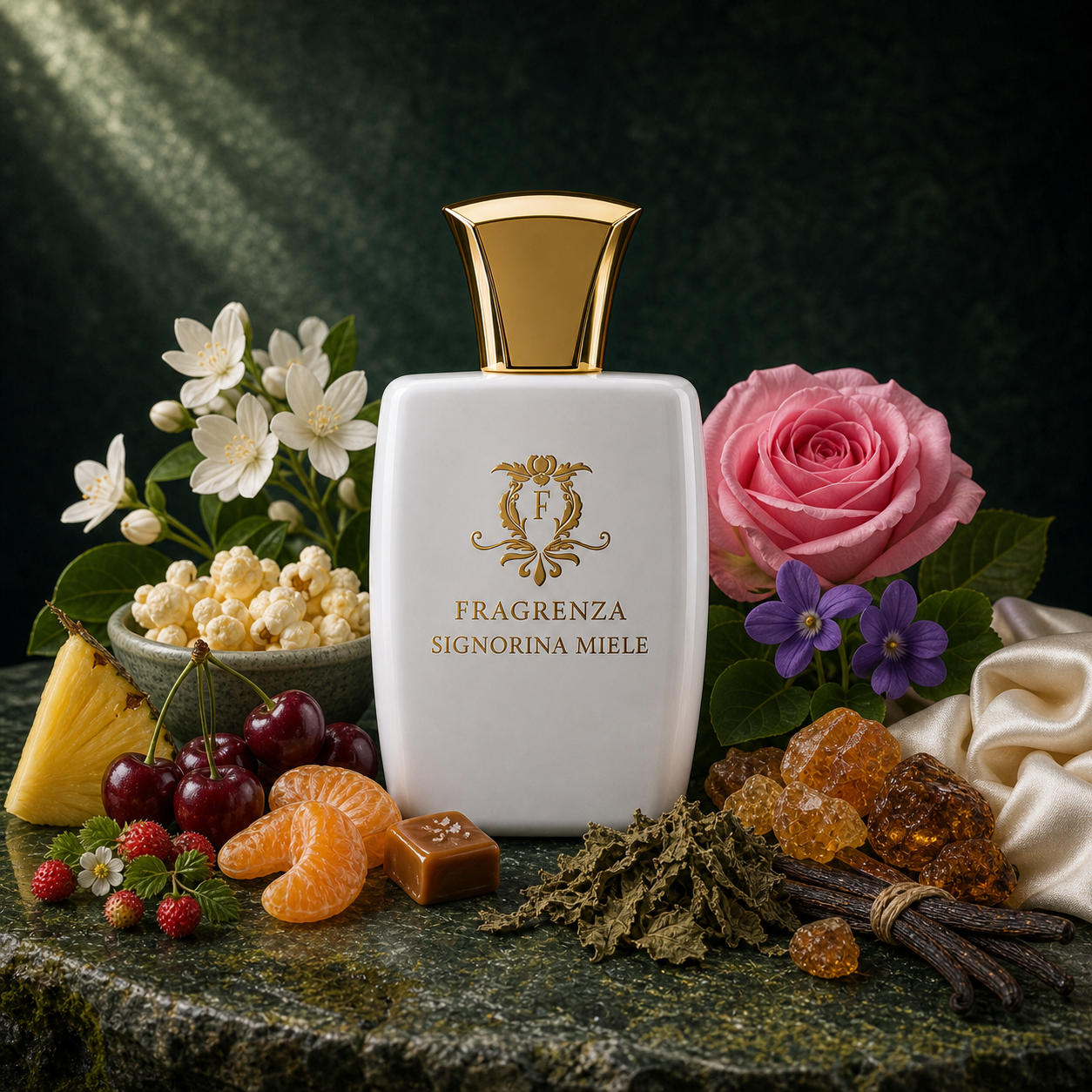
For a Fragrenza skin scent that demonstrates this technical balance,
is the simplest illustration: a clean musk pillar with bergamot and orange-blossom freshness on top, a quiet aromatic and spiced heart, and a final dry-down that wears as a soft glow rather than a cloud.
Where the two categories overlap
The honest overlap zone is real, and it is large. Many skin scents are built with simpler material lists, lower allergen loads, and softer projection profiles, all of which align with what most consumers think of as the clean aesthetic. So when a brand markets a perfume as both clean and skin-close, it often is. The overlap is not invented. It is simply not automatic.
You can think of it as a Venn diagram. Clean perfumes that happen to be skin scents are the largest visible category right now because that is where the clean movement started. Skin scents that are not particularly clean (densely synthetic musks, captive-driven compositions, niche-house releases that prioritize wear pattern over ingredient policy) make up a much larger group than the marketing makes obvious. And clean perfumes that are not skin scents (think bigger floral compositions, fresh sport-fragrance reformulations, or projection-forward summer perfumes that happen to meet a clean standard) round out the third quadrant.
Knowing which quadrant you are buying into is the difference between being satisfied and being mildly puzzled when the bottle does not behave the way the marketing implied.
How Skin Scents 2.0 changes the conversation
The current generation of skin scents, the so-called 2.0 wave, has decisively broken the assumption that skin-close means light, simple, or feminine. The 2.0 register builds the same intimate, second-skin wear pattern but layers it over deeper, more textured cores: oud touched with musk, vanilla rendered as suede, iris dressed with pink pepper and pear, even smoky woods that read as skin-close rather than as smoke.
This matters for the clean-versus-skin-scent question because it broadens what a skin scent can be without changing how it wears. A skin scent in 2026 can be soft, clean, and minimal, or it can be deep, layered, and complex. Both wear close. Both create that halo of intimacy. But the second category does it with material density and structural ambition that the first wave never tried for.
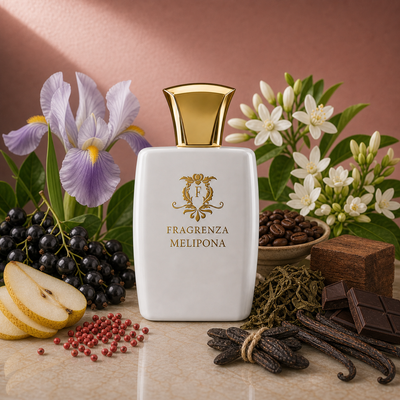
is a clear example of the 2.0 idea: iris and orange blossom in the heart, black currant and pink pepper up top, a base where coffee, dark chocolate, and tonka give the composition real weight. It still wears close. It is unmistakably a skin scent in the perceptual sense. But it is also unmistakably not the gentle floral musk of the early clean era.
What this means when you choose a fragrance
Decide which axis you actually care about, then shop accordingly.
If clean credentials matter to you (you are sensitive to certain ingredients, or you prefer brands with transparent formulation policies, or you simply align with the values), look for the brand's published exclusion list rather than the word clean on the bottle. Verify what is actually being excluded, and recognize that this tells you nothing about how the fragrance will wear. A clean perfume can be loud or quiet, projecting or skin-close, simple or complex.
If you want something that wears as a skin scent (close to the body, intimate, low projection), shop on wear pattern, not on ingredient policy. Read reviews specifically for projection and sillage. Test on skin for at least four hours before judging. The best skin scents reward the wearer with a private, slowly evolving scent narrative; the people standing nearby will catch the halo only when they get close enough.
For a warm, gourmand-leaning skin scent that proves the register can hold real density,

If you want both, look for brands that publish both their formulation policy and their wear-profile expectations. The Venn-diagram overlap is real and easy to live in if you know what to ask for.
Notes that signal each direction
Some materials predict skin-close wear regardless of how the rest of the composition is built. White musks are the strongest single signal, especially Cosmone, Habanolide, and Helvetolide. Ambroxan in low concentrations creates a salty, second-skin warmth. Iso E Super at the dosing levels common in modern niche fragrance produces a velvety, woody-ambrette character that wears close. Cashmeran adds a soft, cashmere-like texture that pairs naturally with skin. Creamy lactones (gamma-undecalactone, gamma-decalactone) bring milky, intimate depth.
By contrast, materials that predict projection regardless of clean status include high-impact aromachemicals like calone (oceanic), ethyl maltol (cotton candy), and high-dose linalool (lavender-citrus); intense florals like jasmine sambac absolute and tuberose; and any composition built around oud at concentration. None of these are inherently bad for skin scents, but they shift the wear pattern toward presence rather than intimacy.
For a fragrance that takes a traditionally projecting note (oud) and reshapes it into a skin-close register,

How to layer a skin scent
Skin scents reward layering more generously than projecting fragrances do because they leave room for a second voice without becoming a cacophony. The classic move is to build a skin scent as a base and add a more focused projecting note on top of it. Apply the skin scent to the body broadly (chest, neck, inner arms) and add a brighter or more characterful fragrance to a single pulse point: the inner wrists, behind the ears, or the base of the throat.
The pattern works in the other direction too. A skin scent worn over a richer, more characterful fragrance will quiet that fragrance into something more wearable. People who love a particular oud or amber but find it too heavy for daily wear often layer it under a clean-musk skin scent and discover the original they wanted at a volume they can use.
For more on this technique, see the full layering guide; for guidance on pairing skin scents with vanilla, oud, or florals specifically, see the upcoming layering deep-dive in this cluster.
Related reads
- What Is Clean Fragrance? The 2026 Guide
- What Are Skin Scents? The Complete Guide for 2026
- Skin Scents 2.0: Musk, Ambroxan, and Iso E Super
- Why Skin Scents Smell Different on Everyone
- Ambroxan Perfumes Explained
- Iso E Super in Perfumery
- How to Build a Fragrance Wardrobe
- How to Make Your Perfume Last All Day
FAQ
Is every clean perfume a skin scent?
No. Clean perfume describes ingredient policy, not wear pattern. Many of the early clean releases were soft and skin-close because that was the aesthetic of the moment, but plenty of clean perfumes today project strongly. There are clean fragrances built around big florals, fresh aquatics, or projecting fougeres that are emphatically not skin scents.
Is every skin scent a clean perfume?
Also no. Skin scent describes how a fragrance behaves on the body. The materials most often used to achieve a skin-close wear pattern (white musks, Ambroxan, Iso E Super, Cashmeran, lactones) are largely synthetic, and many iconic skin scents come from niche or designer houses that have no formal clean positioning. The wear pattern is independent of the ingredient policy.
Are synthetic musks safe?
The synthetic musks used in modern fine fragrance are extensively studied and regulated. Older nitromusks were phased out decades ago. Current polycyclic and macrocyclic musks (the kind in nearly every contemporary skin scent) have been evaluated for skin sensitization and environmental impact and are used at levels far below any threshold of concern. They are also responsible for much of what most people enjoy about modern fragrance, including the second-skin character at the heart of the skin-scent register.
Why do some skin scents disappear on me?
Two reasons. First, anosmia: many people are partially or fully unable to smell certain musks or Iso E Super, which means the fragrance is still on the skin and still being perceived by people around the wearer, but the wearer cannot detect it. Second, low projection is part of the design. A well-built skin scent is meant to live within a small radius of the body. If you cannot smell it from your forearm a few hours in, that is the intended behavior, not a failure of the perfume.
Can I make a stronger fragrance wear like a skin scent?
To some extent. Apply less of it. Apply it lower on the body (lower chest, inner thighs, behind the knees) where heat distribution favors a quieter halo. And layer a soft musk-driven fragrance on top to absorb some of the projection. None of this turns a sillage monster into a true skin scent, but the combination of restrained application and a softer top layer can move a strong fragrance several steps in the skin-close direction.
Are skin scents more appropriate for some occasions than others?
Skin scents work in any context where intimacy matters more than statement. Office environments, indoor restaurants, theaters, public transport, hot weather, anywhere people will be close to you and a strong sillage would feel imposing. They are also the natural fit for sleep, post-shower wear, and anyone building a low-profile fragrance wardrobe.
What is the simplest way to start with skin scents?
Start with a single transparent musk-driven fragrance, wear it on bare skin (no other products on top), and live with it for a full day. Notice when you can smell it and when you cannot. Notice how other people react. After a week of this, try layering a slightly richer skin scent on top and pay attention to how the two interact. This is the entry point into both the perceptual register and the layering technique that the skin-scent category rewards.
The bottom line
Clean is about what is in the bottle. Skin scent is about how the bottle behaves on you. The two categories overlap often, and that overlap is genuinely useful, but they are not the same thing and treating them as synonyms will lead to disappointed purchases. Decide which axis you care about, shop accordingly, and recognize that the modern Skin Scents 2.0 register has expanded what a skin-close fragrance can carry without changing the wear pattern that defines the category.
Clean perfumes will keep evolving as the regulatory and aesthetic conversation continues. Skin scents will keep deepening as composers push more material into the same intimate radius. The bottles that do both are easy to find when you know what to look for. The ones that only do one are easier to use well when you stop expecting them to do both.