

Best Saffron Fragrances 2026: The Five Archetypes of the Most Fashionable Spice in Perfumery
It takes around 150,000 hand-harvested autumn flowers to produce a kilogram of dried saffron, and the metallic-honey-leathery character bridges spiced openings and resinous bases.
By Julia MorettiFragrenza makes several of the alternatives featured in our guides — here’s how we test.
18 min read
There is no ingredient in fine perfumery quite like saffron. The world's most expensive spice by weight (often more valuable than gold by gram, hand-harvested from the autumn-flowering Crocus sativus) brings a remarkable complexity to fragrance: metallic and warm, leathery and honeyed, simultaneously ancient and unmistakably contemporary. In the hands of a skilled perfumer, saffron transforms a composition from merely pleasant to genuinely memorable, lending a golden, jewel-like quality that no synthetic substitute fully replicates.
Through 2025 and into 2026, saffron has become one of the defining signature notes of the contemporary savory gourmand register, where its metallic-honey character bridges the bright-spiced opening and the dark-resinous base of the most ambitious modern compositions. This is the complete guide to the best saffron fragrances in the Fragrenza line, organized by the five archetypes that define the contemporary commercial landscape.
For deeper material context, see the saffron in perfumery educational pillar. For the broader savory gourmand register that saffron now anchors, the savory gourmand 2026 guide is the cluster's anchor pillar.
What saffron is in fine perfumery
Saffron in perfumery is derived from the three vivid red-orange stigmas of the Crocus sativus flower, hand-harvested in autumn across Iran, Kashmir, Spain, Greece, and Italy. It takes approximately 150,000 flowers to produce one kilogram of dried saffron, which is why the spice has been more valuable than gold by weight for most of recorded human history. The fragrance industry uses saffron absolute, saffron tincture, and increasingly, sophisticated synthetic saffron accords that capture the essential character while bypassing the supply unpredictability of the natural material.
What saffron actually smells like, in concentrated form, is deceptively complex. Three primary chemical compounds shape its character. Safranal, the dominant aroma molecule (around 70 percent of saffron's volatile profile), contributes the warm, hay-like, slightly bitter-medicinal character that gives saffron its distinctive edge. Picrocrocin contributes a softer honey-sweetness that balances the medicinal facet. Crocin and related carotenoids contribute the golden visual character and a faint metallic-leathery quality that pairs uniquely well with woods, resins, and animalic materials.
The combined effect reads as warm-honeyed at the surface, hay-dry underneath, slightly metallic at the edges, and faintly leathery at the base. It is one of the few natural materials in perfumery that simultaneously occupies the floral, spicy, gourmand, and animalic registers; few other ingredients have that range. The result is a material that can anchor a composition (as in saffron-tobacco), shape a mid-section (as in saffron-rose), or sit decoratively at the top (as in lighter aromatic-spiced fragrances).
Saffron in modern perfumery: the cultural arc
Saffron has been used in perfumery for thousands of years; Persian, Mughal, and Ottoman traditions all incorporated saffron tinctures into ceremonial and luxury fragrance long before modern European perfumery developed. The material entered modern Western fine fragrance through niche releases in the late 1990s and early 2000s, broke through commercially in 2007 with Tom Ford Tobacco Vanille (which paired saffron with tobacco at the prestige tier and made the savory gourmand register newly fashionable), and reached cultural saturation in 2014 with Maison Francis Kurkdjian Baccarat Rouge 540 (which established saffron-at-concentration as the defining note of the contemporary luxe-gourmand register).
Through 2018 to 2022, saffron migrated decisively into the accessible-niche tier through houses like Lattafa (whose 2022 Khamrah remains one of the most commercially successful saffron-amber compositions ever released) and Mancera (whose Cedrat Boise and Aoud Lemon Mint embedded saffron in the contemporary mainstream luxury idiom). Through 2024 to 2026, saffron has continued its march from niche specialist note to mainstream commercial anchor. The material now appears prominently in compositions across the prestige, accessible-niche, and even mass-market tiers; it is the single most fashionable spice in fine fragrance in 2026, and the savory gourmand wave has elevated its presence further by establishing it as one of the genre's defining bridge materials between gourmand sweetness and the darker oriental register.
Famous saffron fragrances in the cultural canon
Five compositions define the contemporary saffron canon and explain why the material has become unavoidable across every commercial tier. Maison Francis Kurkdjian Baccarat Rouge 540 (2014) is the defining cultural reference point; the saffron-jasmine-cedar architecture redefined what a single signature note could carry at the prestige luxe-gourmand tier and remains the most widely recognized saffron fragrance in the world. Tom Ford Tobacco Vanille (2007) codified the saffron-tobacco-vanilla architecture that anchors the contemporary savory gourmand register; almost every saffron-tobacco composition of the last fifteen years owes its template to this release. Tom Ford Tuscan Leather (2007) codified the saffron-leather-raspberry architecture for the contemporary modernist leather register. Memo Inle (2010) from the Cuirs Nomades line established saffron-cumin-leather as a distinct accessible-luxury register sitting between the spiced-oriental and modernist-leather families. Lattafa Khamrah (2022) brought saffron-amber-dates into the accessible-niche tier at sub-prestige pricing and remains the gateway saffron composition for most wearers entering the register in the 2020s.
The five saffron archetypes
Contemporary saffron perfumery organizes around five distinct archetypes, each delivering a different wearing experience. The Fragrenza line covers all five with one clean-handle Fragrenza pick per archetype.
1. Saffron-tobacco (the savory gourmand anchor)
Saffron and tobacco are natural perfumery companions; both contribute warmth, both carry a slightly metallic dry edge, both develop honeyed depth as the wear settles. Together they produce one of the most distinctive directions in the contemporary savory gourmand register: a composition rich enough to read as luxurious, dry enough to avoid the dessert register, and ceremonial enough to feel occasion-specific without being inaccessible. The archetype is one of the major commercial successes of the third-wave gourmand wave, anchored architecturally by Tom Ford Tobacco Vanille (2007) and extended through dozens of subsequent prestige and accessible-niche releases.
The Fragrenza pick:
opens with saffron, cinnamon, incense, nutmeg, pear, apple, and oud; the heart works patchouli and jasmine into the spiced foundation; the base resolves on tobacco leaf, amber, woody notes, vetiver, vanilla, and white musk. The wear demonstrates how saffron transforms tobacco from a casual evening register into something genuinely ceremonial. Among the most commercially recognizable savory gourmand compositions in the line.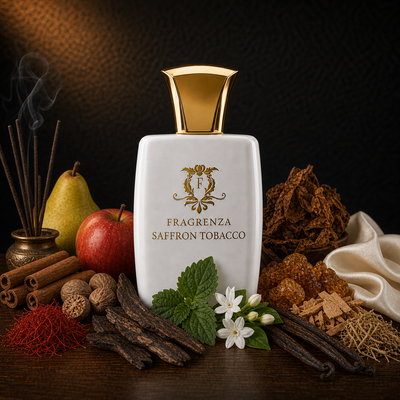
2. Saffron-rose (the classical Eastern luxury archetype)
Saffron and rose have appeared together in fine fragrance since the Mughal courts, where the pairing was reserved for the most ceremonial occasions. The combination works because rose and saffron occupy complementary registers; rose is floral-sweet and slightly powdery, saffron is warm-spiced and slightly metallic, and the meeting point produces a wear that reads as Eastern-luxurious in the most refined sense. The archetype is the natural choice for wearers who want a fragrance that conveys serious occasion without overt projection, and it has informed compositions from Armani Privé Rose d'Arabie (2004) through Mancera Roses Vanille (2010) and dozens of subsequent niche and accessible-niche releases.
The Fragrenza pick:
opens with the molten golden warmth of saffron and the sharp aromatic bite of black pepper; the heart unfolds Rose de Mai, Turkish rose, and Bulgarian rose in a deep sensual chorus; the base resolves on roasted coffee, smoky incense, warm amber, creamy sandalwood, and earthy patchouli. The wear is unambiguously saffron-rose at the heart and savory gourmand at the dry-down. Among the most distinctive picks in the Fragrenza saffron range.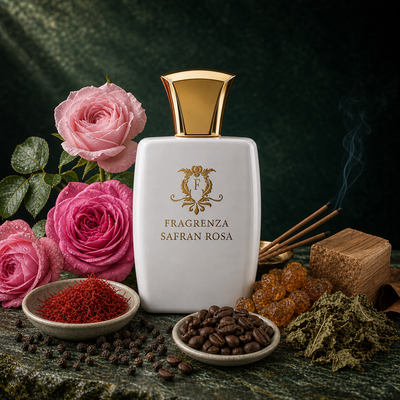
3. Saffron-leather (the modernist statement archetype)
Saffron and leather are an architectural pairing rather than a cultural one; the metallic-leathery facet of saffron's chemistry (largely driven by the crocin carotenoids) integrates almost seamlessly with modern leather accords, producing a wear that reads as architectural, urban, and unmistakably contemporary. The archetype was codified at the prestige tier in 2007 with Tom Ford Tuscan Leather (saffron-raspberry-leather) and at the accessible-luxury tier in 2010 with Memo Inle (saffron-cumin-leather from the Cuirs Nomades line). The register is the choice for wearers who want their saffron to read as confidently modern rather than romantically Eastern.
The Fragrenza pick:
opens with bergamot, cardamom, and cumin atop a structural saffron-leather opening; the heart works geranium absolute and patchouli into the spiced-leather foundation; the base resolves on oud, vetiver, and a creamy musk. The wear holds the modernist-leather architecture from opening through dry-down with saffron carrying the metallic-honey signature through the entire wear curve. Among the most distinctive and architectural compositions in the Fragrenza saffron range.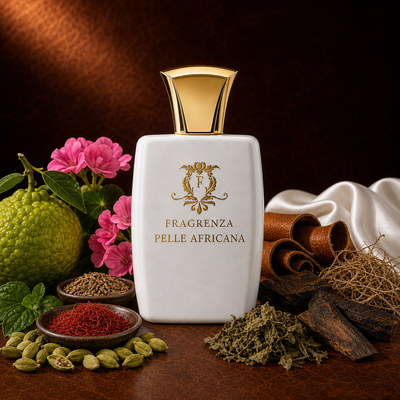
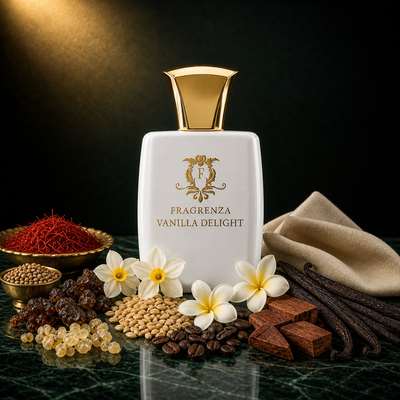
4. Saffron-suede-vanilla (the polished evening archetype)
Saffron used as a structural opener that integrates into a vanilla-and-suede base, producing a wear that reads as polished, intimate, and unmistakably evening-coded. The archetype sits between saffron-tobacco and the broader burnt-vanilla territory of the savory gourmand register; saffron contributes the metallic-honey opening, vanilla and suede carry the wear through the dry-down. Ideal for formal evening contexts where the register should declare itself with restraint. The architecture became commercially dominant through Tom Ford Tobacco Vanille adjacents and the wave of suede-vanilla accessible-luxury releases through the late 2010s.
The Fragrenza pick:
5. Burnt-saffron sugar (the cultural-benchmark statement archetype)
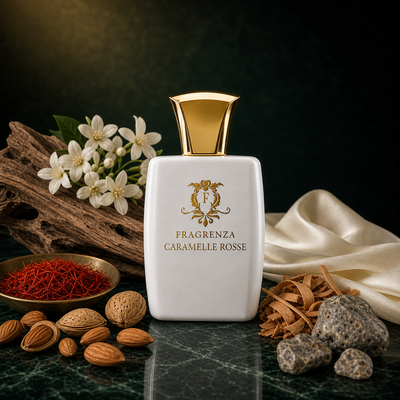
The most boldly statement-driven saffron archetype, anchored in saffron at concentration alongside burnt-sugar accords and a dense base of musks and woods. The wear is unmistakable and projection-forward, designed for wearers who want their saffron to declare rather than whisper. The archetype became culturally inescapable through Baccarat Rouge 540 (2014), which established saffron at the prestige luxe-gourmand tier and remains the most widely recognized cultural reference point for the register. The composition has since been the most-imitated single fragrance of the late 2010s and early 2020s.
The Fragrenza pick:
How saffron fragrances wear on skin
The wear pattern of the saffron family is specific and worth understanding before committing to a bottle.
The opening is the saffron moment. Saffron is most chemically present in the first thirty to sixty minutes of the wear. The metallic-honey character declares itself early and then progressively integrates into the heart and base materials. If you are buying a fragrance specifically for the saffron character, judge the opening; if you are buying for the dry-down, judge what saffron eventually becomes (often a warm, honeyed-spiced anchor underneath the heart materials).
Saffron interacts strongly with body warmth. The volatility curve of safranal and the related compounds is mid-range, which means body heat plays a significant role in how the material releases over the wear. Warmer or oilier skin amplifies the honey-sweet facets; cooler or drier skin amplifies the metallic-leathery facets. The same saffron composition can read substantially different across two wearers, and the variation is more pronounced than for most other materials. See the skin chemistry deep-dive for the full account.
Projection and longevity vary by archetype. Saffron-tobacco and burnt-saffron sugar tend to project moderately for the first two hours and then settle into a close-skin wear pattern for the remainder of the day. Saffron-rose tends to project more strongly for longer (the floral materials extend the projection profile). Saffron-leather sits in the middle of the projection spectrum and holds its architectural character for the longest portion of the wear curve. Saffron-suede-vanilla is the most close-skin of the five archetypes; it reads as intimate from the early heart onward. Apply less than you would for a pure floral or oriental; one to two sprays is typically enough for any of the archetypes.
When to wear saffron fragrances
The register is occasion-coded, and the specific occasion depends on the archetype.
Saffron-tobacco and burnt-saffron sugar are evening fragrances, ideal for dinners, theater performances, formal occasions in cooler weather, and any context where the wear should declare a clear point of view. Cool weather is the natural seasonal home for both; the dense materials project less aggressively in cold air and develop more slowly.
Saffron-rose is a day-to-evening transitional fragrance, appropriate for daytime social events (lunches, gallery visits, weekend afternoons) as well as evening occasions. The floral materials soften the saffron's metallic edge and make the wear universally appropriate across daytime contexts.
Saffron-leather is the modernist's professional-to-evening wear, suitable for office contexts where the wearer wants a saffron presence without the romantic-Eastern coding, as well as evening contexts where the architectural quality should anchor the wear. The register reads as urban and contemporary across both contexts.
Saffron-suede-vanilla is the most versatile of the five, suitable for evening wear, cooler-weather daytime contexts, and quieter formal occasions where the register should register as polished rather than declared. The wear is intimate enough that it works in close-quarters social settings without imposing on those nearby.
Hot weather is the harder context for the saffron family generally. The dense base materials project more aggressively in heat, and the metallic-honey character can read as cloying when warm air does not let the resin and wood anchors develop properly. Most wearers reserve saffron compositions for fall, winter, and the cooler shoulder weeks of spring.
How to layer saffron fragrances
Saffron layers well with a small number of partners and poorly with most others. Three patterns work consistently.
Saffron over a clean musk skin scent. Apply a transparent clean musk broadly; add a single spray of the saffron fragrance to one pulse point. The musk softens the projection of the saffron into the body's immediate radius while preserving the metallic-honey focal voice. Particularly useful for wearers who love saffron compositions but find their projection too statement-driven for daytime contexts. For the full technique, see how to layer skin scents with vanilla, oud, or florals.
Saffron-rose paired with an oud composition. Saffron-rose and oud have coexisted in Middle Eastern perfumery for centuries; the combination works because saffron-rose contributes the bright spiced-floral character while oud anchors the wear in something darker and more resinous. Layering a saffron-rose composition on the chest with a small amount of an oud on a single pulse point produces the classical Eastern luxury wear pattern in a contemporary-wearable form.
Saffron-tobacco under a single bright top. Apply the saffron-tobacco broadly and add a single spray of a bergamot, neroli, or orange-blossom cologne to one pulse point. The bright top reads in the opening and fades over the first hour; the saffron-tobacco carries the wear through the rest of the day. The technique extends an evening-coded composition into daytime appropriateness.
Saffron in a fragrance wardrobe
A minimum viable saffron presence in a broader fragrance wardrobe is one well-chosen pick from the archetypes most aligned with your wearing patterns. For wearers who prioritize evening occasions in cool weather, the saffron-tobacco or burnt-saffron sugar archetypes are the natural choices. For wearers who want a saffron presence that works across daytime and evening contexts, saffron-rose or saffron-suede-vanilla are more versatile selections. For wearers who want their saffron to read as architectural rather than romantic, saffron-leather is the modernist's pick.
Two well-chosen saffron picks are typically more useful than four; the register is distinctive enough that diminishing returns set in past two pieces, and the wear pattern becomes recognizable on the wearer in ways that make over-saturating the wardrobe counter-productive. Most serious saffron-wearers stop at two pieces from the family and supplement with related archetypes (tobacco, oud, rose, vanilla, leather) from elsewhere in the wardrobe.
Who each pick is for
Saffron Tobacco is for the wearer who wants the savory gourmand anchor at full statement strength: the wear is unmistakably saffron-tobacco from opening to dry-down, and the composition reads as ceremonial-evening from the first thirty seconds. Buy this if you want one piece that defines your evening register through fall and winter.
Safran Rosa is for the wearer who wants saffron in its classical Eastern-luxury context: rose-saffron-coffee-incense layered for serious occasion-coding without overt projection. The most distinctive pick in the line for wearers who recognize the cultural reference and want their saffron to carry it.
Pelle Africana is for the wearer who wants saffron without romance: architectural, urban, and confidently modern, with a leather-cumin-geranium spine that reads as contemporary across professional and evening contexts. The modernist's saffron pick.
Vanilla Delight is for the wearer who wants saffron at its most polished and approachable: saffron in the opening, suede and vanilla through the heart and dry-down, intimate projection throughout. The most universally appropriate saffron in the line and the natural starting point for new entrants to the register.
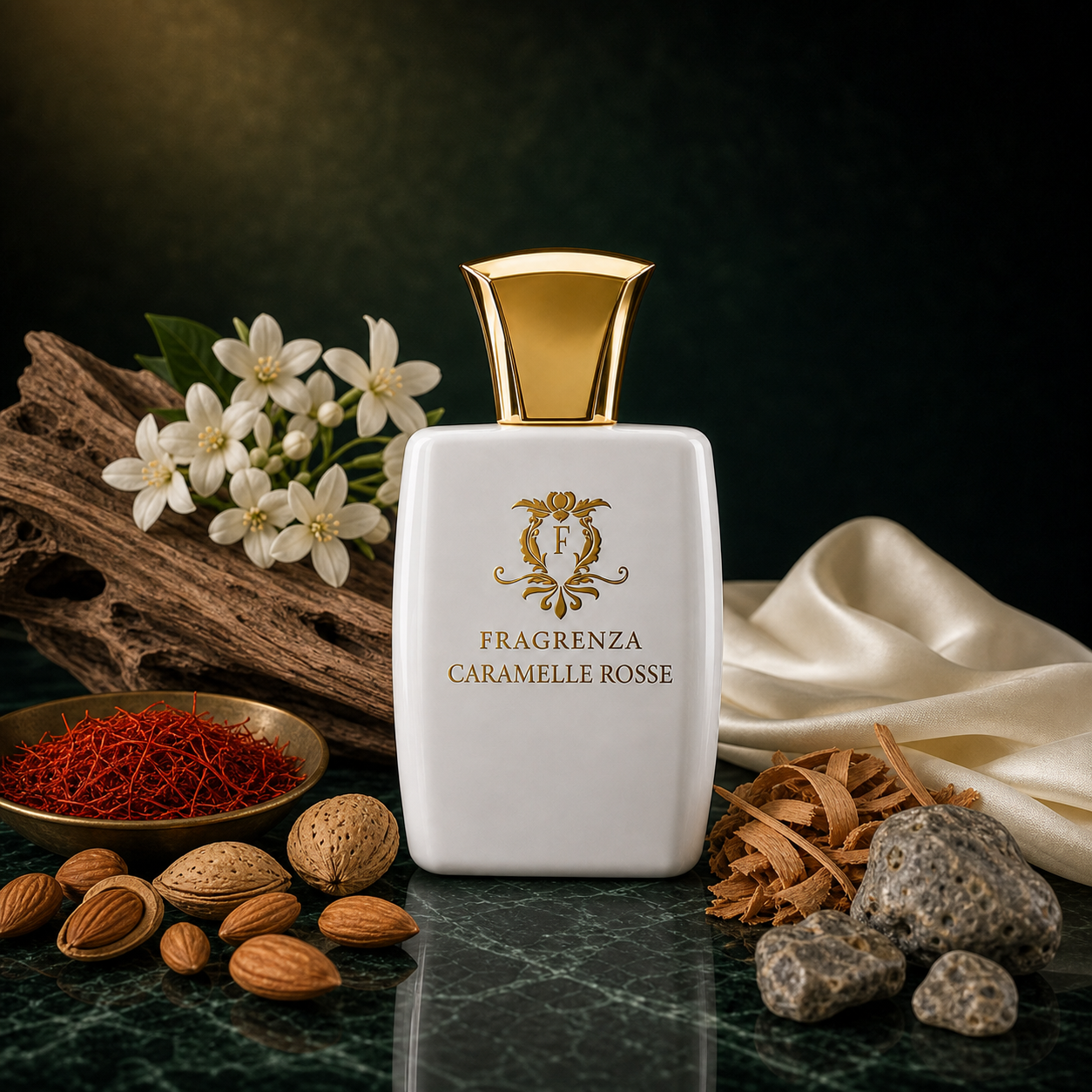
Caramelle Rosse is for the wearer who wants the cultural benchmark: the saffron-at-concentration architecture that defined the contemporary luxe-gourmand register. Buy this if you want to wear the most-imitated saffron composition of the last decade and understand why it became culturally inescapable.
Related reads
- Savory Gourmand and Burnt Sweet: The 2026 Pillar
- Best Tobacco Fragrances 2026: The Six Archetypes
- Saffron in Perfumery (Educational Pillar)
- How to Layer Skin Scents With Vanilla, Oud, or Florals
- Why Skin Scents Smell Different on Everyone
- How to Build a Fragrance Wardrobe
- How to Make Your Perfume Last All Day
FAQ
Why is saffron so expensive in perfumery?
Saffron is the most expensive spice by weight in the world because the harvest is extraordinarily labor-intensive. Each Crocus sativus flower produces only three red-orange stigmas, and those stigmas must be hand-picked at dawn during a narrow autumn harvest window. It takes approximately 150,000 flowers to produce one kilogram of dried saffron. The cost translates directly into perfumery pricing: even a small percentage of saffron absolute in a composition significantly raises the formulation cost, which is why saffron-forward fragrances tend to sit in the prestige and accessible-niche tiers rather than at mass-market price points.
What does saffron actually smell like?
Saffron is one of the most chemically complex single materials in fine perfumery. The dominant aroma molecule, safranal, contributes a warm hay-like dryness with a slightly bitter-medicinal edge. Picrocrocin contributes honey-sweetness that balances the medicinal facet. Crocin contributes the faint metallic-leathery quality that pairs uniquely well with woods and resins. The combined effect reads as warm-honeyed at the surface, hay-dry underneath, slightly metallic at the edges, and faintly leathery at the base.
Is saffron a feminine or masculine note?
Neither inherently. Saffron is one of the most gender-flexible spices in perfumery, and the five archetypes above span the full range. Saffron-tobacco and saffron-leather lean slightly masculine-coded in cultural associations but work on any wearer. Saffron-rose leans slightly feminine but is widely worn by men in Middle Eastern fragrance traditions. Saffron-suede-vanilla and burnt-saffron sugar are essentially unisex. Treat gender marketing on saffron compositions as a starting point rather than a constraint.
How long do saffron fragrances last on skin?
Eight to twelve hours is typical for well-built saffron compositions, with the saffron character most pronounced in the first two hours and progressively integrated into the dry-down materials thereafter. The dense base materials in most saffron compositions (oud, amber, sandalwood, certain musks) are tenacious, and the wear extends naturally as body heat develops over the course of the day. Saffron applied to fabric continues to release scent for many hours after application.
What is Baccarat Rouge 540 and why is it culturally important?
Baccarat Rouge 540 is a 2014 fragrance from Maison Francis Kurkdjian that anchored a luminous saffron-amber heart on a dense musk-cedar base. The composition became culturally inescapable through the late 2010s and early 2020s, particularly via social-media-driven luxury culture, and it remains the most widely recognized cultural reference point for the modern burnt-saffron sugar archetype. The fragrance demonstrated that a single distinctive note (saffron at concentration) could carry a composition into iconic prestige territory, and it inspired a generation of saffron-forward releases across the prestige and accessible-niche tiers.
Can I wear saffron fragrances in summer?
Generally not, or at least not comfortably. The dense materials project more aggressively in heat, and the warm honeyed character can read as cloying when warm air does not let the resin and wood anchors develop properly. The exception is the saffron-rose archetype, which can work in warm-weather evening contexts because the floral materials lighten the wear; even there, the composition is happier in cooler weather. Save saffron fragrances for fall, winter, and the cooler shoulder weeks of spring.
What is the easiest saffron fragrance to start with?
For most wearers, the saffron-suede-vanilla archetype is the most accessible entry point. The saffron character is present but balanced by the polished suede-and-vanilla architecture, the wear is intimate rather than projecting, and the composition is universally appropriate across cool-weather contexts. Wear a saffron-suede-vanilla through a season, learn how your skin amplifies the saffron material, and decide whether to explore deeper into saffron-tobacco, saffron-rose, saffron-leather, or burnt-saffron sugar territory from there.
The bottom line
Saffron is the most fashionable spice in fine fragrance in 2026 and one of the defining anchors of the contemporary savory gourmand register. The five archetypes give you the full commercial landscape; the Fragrenza picks within each give you concrete starting points; the wearing patterns and layering techniques give you the technical vocabulary to wear the register well.
Whether you want the savory gourmand statement of Saffron Tobacco, the Eastern-luxury chorus of Safran Rosa, the modernist architecture of Pelle Africana, the polished evening intimacy of Vanilla Delight, or the cultural benchmark of Caramelle Rosse, the contemporary saffron family has the depth to reward years of exploration. The most valuable spice in the world is also one of the most rewarding to wear; the four-hour wear test on your own skin is the diagnostic that tells you which archetype your chemistry amplifies and which to make a long-term part of your rotation.