Iso E Super in Perfumery: The Molecule That Became a Movement
A 1973 IFF synthetic that John B. Hall built for cedar effects ended up powering Geza Schoen Molecule 01 and the whole skin-integrated wave.
By Julia MorettiFragrenza makes several of the alternatives featured in our guides — here’s how we test.
11 min read
If ambroxan is the molecule that taught modern perfumery how to do quiet, Iso E Super is the molecule that taught it how to do strange. Of all the synthetic materials that reshaped fragrance over the last fifty years, Iso E Super is the one with the deepest mythology — a molecule some people cannot smell at all, that others find unforgettable, that develops differently on every wearer, and that became the sole ingredient of one of the most successful niche fragrances of the twenty-first century. Understanding what it is, what it smells like, and what it does is most of what you need to read modern perfumery accurately.
This is the explainer. Where Iso E Super came from, why it behaves the way it does on skin, the famous fragrances built around it, and the broader family of synthetic woody molecules it sits inside. By the end you will recognize Iso E Super on yourself and on other people, which is the start of understanding why so many modern fragrances feel skin-integrated and slightly uncanny in the same way.
What Iso E Super actually is
Iso E Super is, formally, 1-(1,2,3,4,5,6,7,8-octahydro-2,3,8,8-tetramethyl-2-naphthalenyl)ethan-1-one — a name nobody outside the fragrance chemistry world has reason to remember. It is a synthetic molecule developed in 1973 by chemist John B. Hall at International Flavors and Fragrances (IFF), originally created as a cost-effective way to deliver woody, cedar-like effects without relying on expensive natural cedar materials.
For roughly thirty years, Iso E Super lived a quietly utilitarian life as one of perfumery’s standard tools. Perfumers used it widely in commercial and niche compositions for its dry-woody character and its remarkable ability to amplify the materials around it. The molecule was hiding in plain sight in hundreds of fragrances long before any consumer had heard the name. What changed in the 2000s was less the molecule than the conversation around it — specifically, the moment a perfumer named Geza Schoen decided to put Iso E Super in the spotlight rather than the support cast.
What Iso E Super actually smells like
Describing Iso E Super is one of the harder exercises in the fragrance vocabulary. The most consistent descriptions: dry, woody, cedar-adjacent, slightly smoky, with a velvety or suede-like smoothness underneath. There is a faint spicy quality at the edges and, at high concentrations, a slightly sharp almost chemical note that some people read as woody hairspray and others read as one of the most distinctive smells in modern perfumery.
The defining experience, though, is what Iso E Super does on skin rather than what it smells like in a vial. The molecule responds to body heat and skin chemistry in a way that most synthetics do not — the wear develops differently on different people, often producing the impression that the fragrance is genuinely personalizing itself to the wearer. Where most fragrance materials project from the body outward, Iso E Super sits with the body and modulates around it. The wear feels less like a perfume applied and more like the skin’s own warmer, slightly woody amplification.
It is also the most genuinely close-skin material in the perfumer’s palette. Compositions built around Iso E Super tend to be discovered rather than announced — the wearer often cannot smell the fragrance on themselves after the first hour, while people standing nearby can. This is partly perceptual chemistry and partly the reason Iso E Super powered the entire skin scent category that emerged in the 2010s.
The perception puzzle
Iso E Super has one of the strangest perceptual profiles of any fragrance material in commercial use. A significant portion of the population has specific anosmia to the molecule — meaning they cannot smell it at all, or they smell it briefly and then lose perception entirely. Even among people who can smell it, repeated exposure leads to receptor saturation: the conscious perception fades within minutes of putting on a high-Iso-E composition, even as the molecule continues sitting on the skin and continuing to project to people nearby.
This perceptual variability is itself part of the molecule’s legend. Wearers of high-Iso-E fragrances frequently report that they receive compliments on a scent they themselves cannot smell, which has produced a small body of fragrance-folklore around “the perfume your nose denies but everyone else notices.” Research by perfume scientists including Andreas Keller has suggested that Iso E Super may interact with olfactory receptors typically associated with pheromone-like signaling, which would partially explain both its perceptual oddities and the consistent reports that high-Iso-E compositions generate positive attention from others.
The practical takeaway: do not over-spray Iso E Super-heavy fragrances. The fact that you cannot smell yourself after twenty minutes does not mean the fragrance has faded. It almost certainly hasn’t.
Molecule 01 and the cult phenomenon
Iso E Super’s transformation from utility ingredient to cultural artifact is largely the work of one perfumer. Geza Schoen, a German perfumer with a deep interest in materials, became fascinated by Iso E Super’s perceptual properties and decided to create a fragrance that would foreground the molecule rather than hide it. The result, launched by his Escentric Molecules brand in 2006, was Molecule 01 — a composition built from approximately 65% Iso E Super alongside small quantities of supporting materials.
Molecule 01 was a deliberate provocation. It was a fragrance about a single synthetic ingredient. It was a perfume that admitted, in its very name, that the era of pretending fine fragrance was about flowers and fruits had passed. It read as quiet, modern, distinctive, and it played beautifully on skin in the personalized way Iso E Super always does. It became a cult phenomenon, and the success of Molecule 01 triggered a cascade of niche releases through the late 2000s and 2010s that put Iso E Super in the conceptual foreground rather than the structural background. The skin scent category as it exists today owes much of its conceptual frame to that 2006 release.
Iso E Super in famous fragrances
Beyond Molecule 01, Iso E Super appears at high concentrations in some of the most successful fragrances of the last two decades. Two of the most prominent examples are mainstream blockbusters that have used the molecule as a load-bearing structural element.
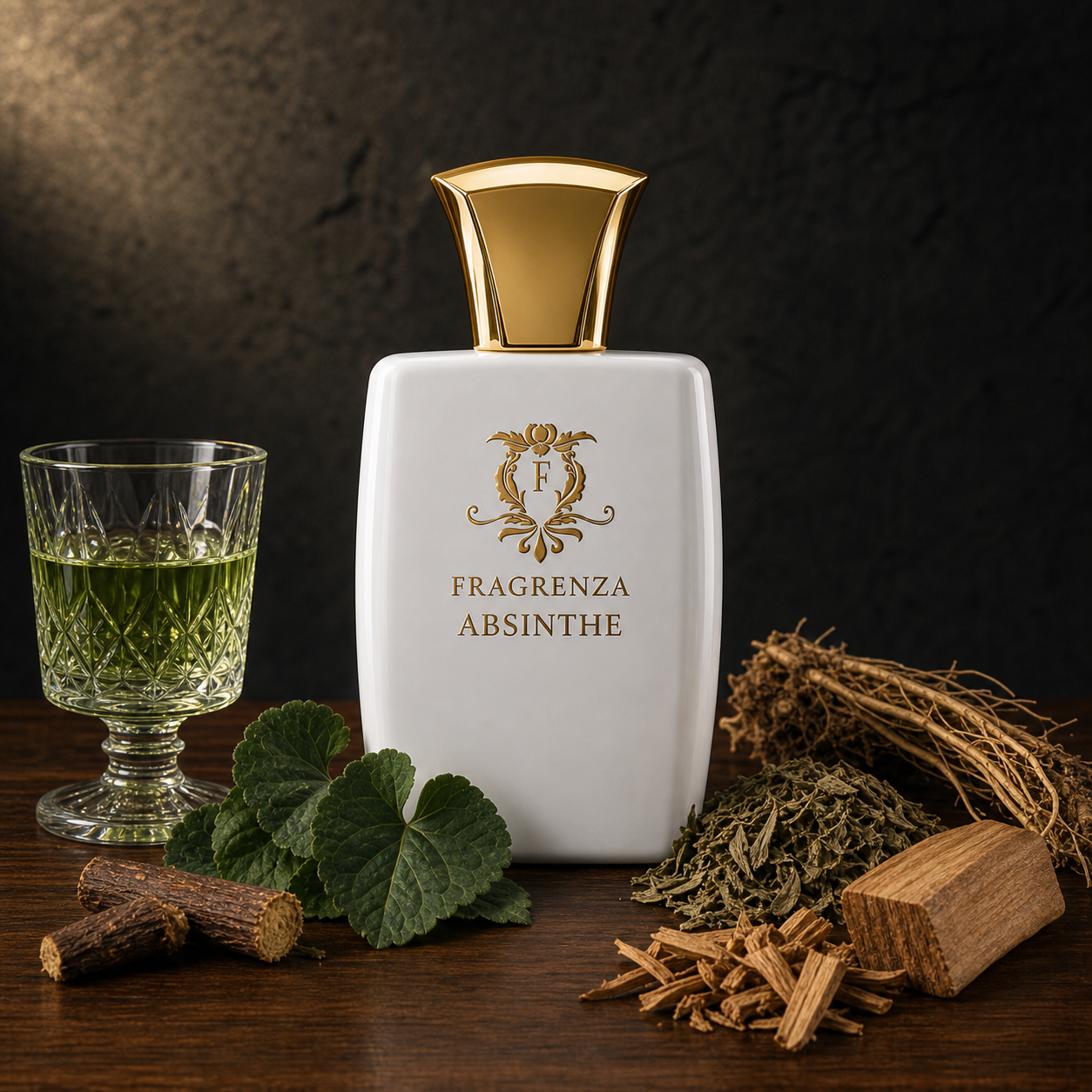
The most commercially visible Iso E Super composition in modern perfumery is Dior Sauvage. The fragrance’s dry, peppery-woody architecture sits on Iso E Super as foundation, and much of the wear’s remarkable longevity and skin-integrated quality comes directly from the molecule. The Fragrenza interpretation in the same register is
, the value-luxury counterpart that captures the same dry-woody-Iso-E architecture without the designer markup.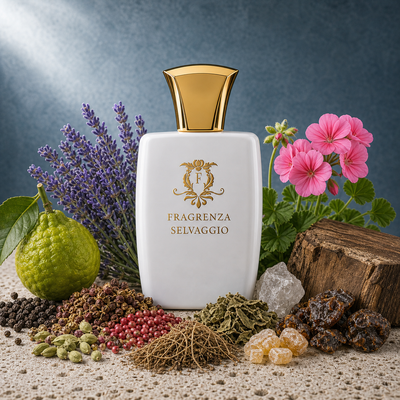
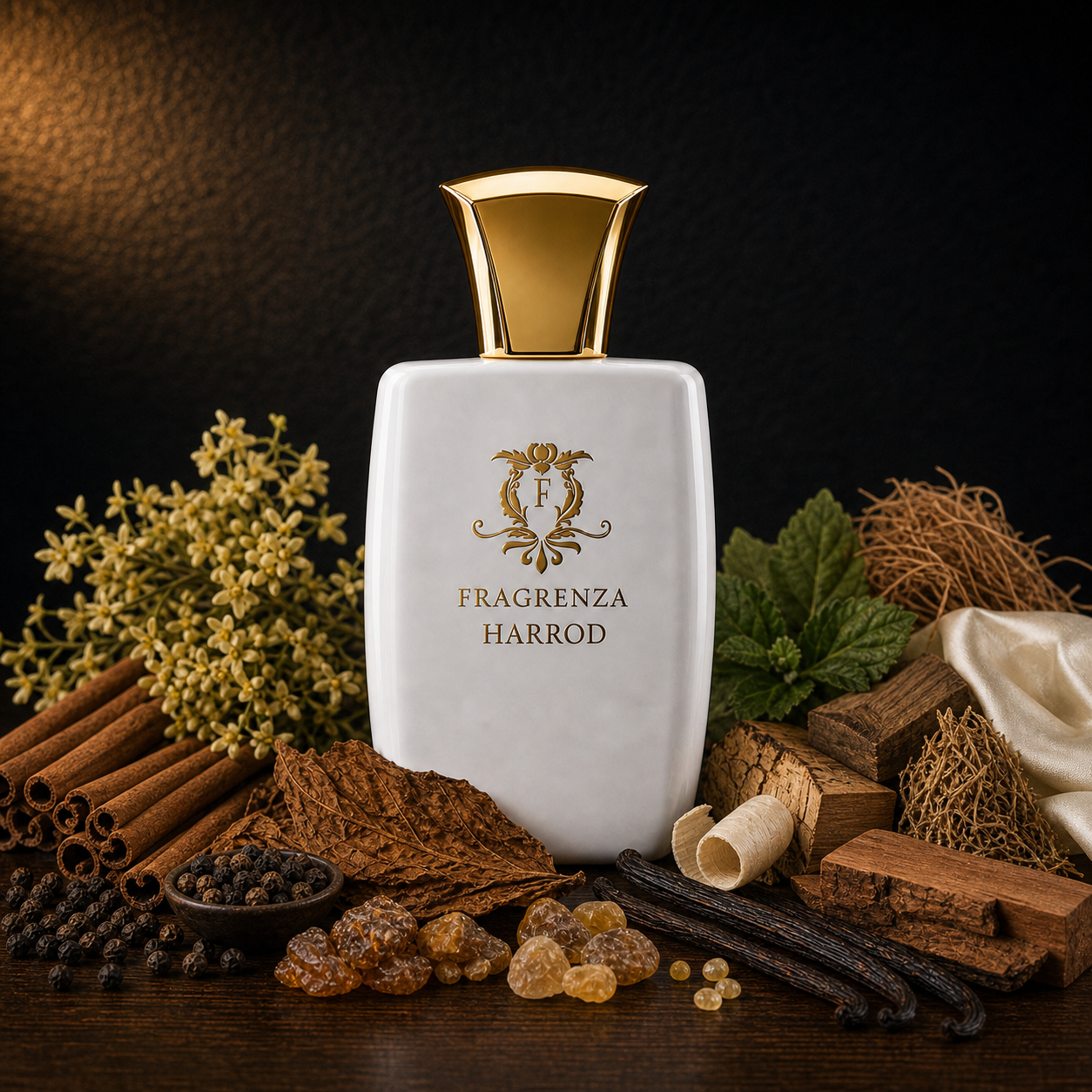
The second mainstream example is Bleu de Chanel. The fragrance uses Iso E Super to give its clean woody-aromatic structure a smooth, velvety depth that integrates with skin and reads as restrained luxury rather than as a fragrance announcing itself. The Fragrenza version,
, holds the same structural territory at the value-luxury price point.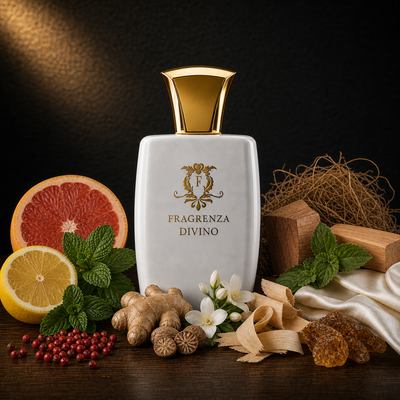
Beyond these mainstream uses, Iso E Super powers many of the niche compositions that defined the 2010s and 2020s — modern fougeres, dry woody compositions, the dimensional skin scents that sit at the center of the current fragrance moment. The molecule is woven through almost every major release of the last fifteen years.
The broader family of modern woody molecules
Iso E Super does not work alone. It sits at the center of a family of synthetic woody molecules that have collectively reshaped what contemporary perfumery sounds like. Knowing the family makes it easier to read what you’re smelling when a fragrance feels modern in the specific way it usually feels modern.
Ambroxan — the dry, salty-amber synthetic that replaced natural ambergris and structurally powers most modern skin scents. The most common partner for Iso E Super in modern compositions. Our Ambroxan explainer covers the closest co-traveler in detail.
Cashmeran — soft, woody, faintly powdery, cashmere-like. Used widely in “clean and cozy” compositions to add warmth without crossing into gourmand territory.
Javanol — a synthetic sandalwood molecule with a creamy, woody character that mimics the lactonic side of natural sandalwood. Carries some of the same skin-integration quality Iso E Super has, in a different register.
Clearwood — a transparent, highly realistic synthetic patchouli used in modern compositions where the natural would feel too earthy or heavy.
Norlimbanol — a powerful, almost animalic woody molecule used sparingly in oud-adjacent compositions for depth.
These are the structural backbone of contemporary fragrance. Most modern compositions use multiple molecules from this family, blended at low percentages, to create the close-skin and dimensional wear that the modern audience has come to expect.
How Iso E Super interacts with other notes
The most important practical property of Iso E Super is its amplifying effect. A small percentage of Iso E Super in a composition does not just add a woody note — it deepens and projects whatever else is in the formula. The cedar in a fragrance gets cedar-er; the rose gets more rose-projecting; the vetiver gets earthier. This is why perfumers reach for Iso E Super as a structural choice rather than a flavor choice.
With deep woods (cedar, sandalwood, vetiver) it produces a seamless, amplified woody accord that reads as a single rich material rather than several separate notes. With florals it can give an otherwise delicate jasmine or rose composition meaningful projection without making the wear feel synthetic. With ouds it amplifies the dry-woody facet of the oud accord and pushes the composition toward refined modernity. With clean musks it creates the layered, dimensional skin scent that the current fragrance moment is built around.
Compositions that use Iso E Super well tend to be the ones that read as expensive, dimensional, and skin-integrated. Modern oud compositions like


Iso E Super and the modern wardrobe
For anyone building a wardrobe with current perfumery in mind, Iso E Super is one of the materials worth seeking out and learning to recognize. Compositions where the molecule plays a prominent role tend to share a recognizable signature: skin-integrated wear, strong longevity, the personalization-on-skin effect that other categories don’t produce as cleanly. They wear comfortably in office settings, daytime professional contexts, and the broader polished register that the smellmaxxing wave has put back in the conversation.
For the cluster context, our Skin Scents 2.0 pillar places Iso E Super alongside its co-travelers in the broader 2026 trend. The guide to what skin scents actually are covers the foundational definition. The oud pillar covers the wood that frequently anchors Iso E Super-led woody compositions. And the 2026 trends hub places the entire molecule-forward conversation in the broader landscape.
Frequently asked questions
What does Iso E Super smell like?
Dry, woody, cedar-adjacent, slightly smoky, with a velvety or suede-like smoothness. At high concentrations it has a faint spicy quality and a slightly sharp character that some people read as woody hairspray. The most distinctive thing about it, though, is what it does on skin: the molecule responds to body chemistry in a way that produces the perception of personalization, where the wear develops differently on different people.
Why can’t I smell Iso E Super on myself?
A meaningful portion of the population has specific anosmia to Iso E Super, and even among those who can smell it, repeated exposure leads to receptor saturation — the conscious perception fades within minutes while the molecule keeps projecting to people nearby. This is why wearers of Molecule 01 frequently report receiving compliments on a fragrance they cannot smell themselves. Do not over-spray to compensate; the molecule is working even when you can’t detect it.
What is the most famous Iso E Super fragrance?
Escentric Molecules Molecule 01, launched in 2006, is built around approximately 65% Iso E Super and is the most direct expression of the molecule in commercial fragrance. Beyond Molecule 01, the most commercially visible Iso E Super-driven compositions are Dior Sauvage and Bleu de Chanel, both of which use the molecule as a structural element. The Fragrenza catalog has value-luxury interpretations of both.
Is Iso E Super natural or synthetic?
Synthetic. Iso E Super was developed at IFF in 1973 by chemist John B. Hall as a cost-effective way to produce woody, cedar-like effects without natural cedarwood. The molecule is now one of the most widely used synthetics in commercial fragrance, appearing in a meaningful percentage of releases at any given concentration.
How is Iso E Super different from Ambroxan?
Both are synthetic boosters with skin-integrated character, but they have different signatures. Iso E Super is woody, dry, and slightly smoky-cedar; Ambroxan is amber, salty-mineral, and faintly musky. Iso E Super amplifies woody and aromatic notes; Ambroxan amplifies amber and skin-warmth notes. Most modern compositions use both at low percentages because they complement each other rather than overlap.
Are Iso E Super-heavy fragrances long-lasting?
Yes — remarkably so. Iso E Super has strong substantivity on skin and tends to outlast most of the composition it sits in. Combined with the molecule’s amplifying effect on other materials, this is part of why Iso E Super-driven compositions read as long-lasting and dimensional in a way many fragrances without it do not.
The bigger picture
Iso E Super is the molecule that proved a synthetic material could be the subject of a fragrance, not just the support. Before Molecule 01, the assumption in fine perfumery was that synthetics were the ingredients you used to make naturals smell better; after it, an entire generation of niche releases foregrounded synthetics as worth wearing on their own. The shift is one of the foundational moves in modern perfumery, and Iso E Super is the molecule that powered it. Knowing what it is and how to recognize it is most of what you need to read the last twenty years of fragrance accurately.